





























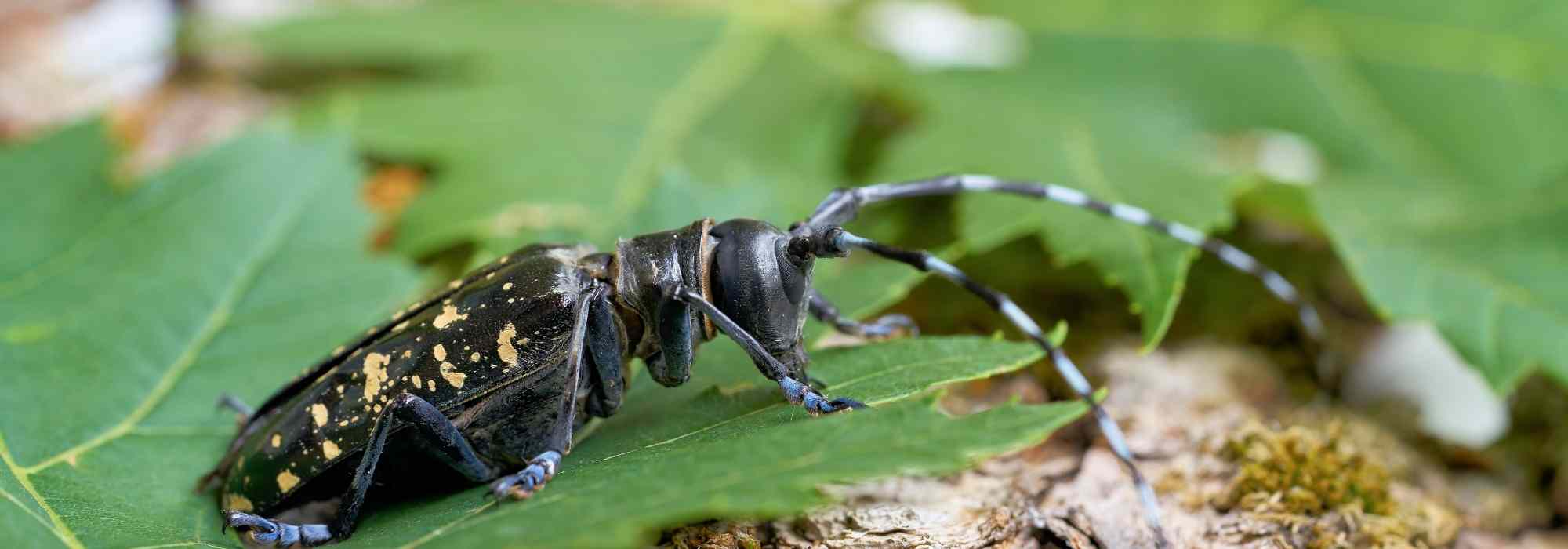
The Asian long-horned beetle: a threat to our trees?
How to identify and control this beetle that is very dangerous to leafy trees?
Contents
Anoplophora glabripennis and Anaplophora chinenis, these are the scientific names of wood-boring beetles, feared as the Asian long-horned beetle and the Asian citrus long-horned beetle. Feared to the point of being classified, on EU territory, as a “priority quarantine pest” under Regulation (EU) 2016/2031 of 26 October 2016 concerning measures to protect against pests to plants. In some regions, the Asian long-horned beetle is also regulated by a prefectural order. For these two insects in the family Cerambycidae that attack leafy trees, relatively common in the territory, such as maple, poplar, birch… some fruit trees and citrus trees such as lemon trees
If the majority of infestation hotspots have to date been virtually eradicated in France, surveillance remains constant and active in certain areas.
Find out who this Asian long-horned beetle really is, how to recognise it and what to do if there is a suspected detection

What exactly is the Asian hornet?
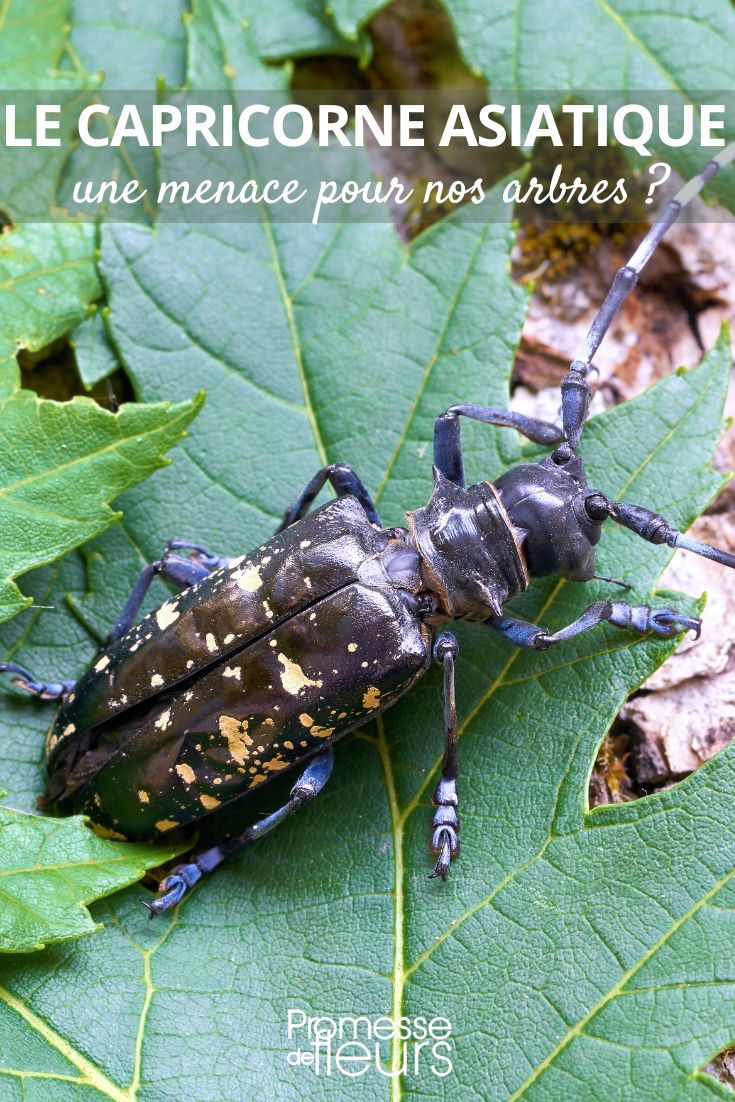
Asian long-horned beetles (Anoplophora glabripennis and Anoplophora chinensis) are beetles, recognisable by their black, shiny and smooth elytra (hard wings), maculated with whitish spots, and by their very long thread-like antennae which make up two-thirds of their body. These same antennae are blue-grey and striated. This living-wood-loving insect measures between 20 and 37 mm, the female being slightly larger than the male.
The legless larvae of this insect are 5 cm long and display one or two bands on the pronotum (the upper part of the first thoracic segment).
Native to East Asia, the Asian long-horned beetle first appeared on the American mainland in 1996, and in Europe from 2001 onwards. In France, in 2020, five infestation hotspots were identified, scattered across the country. To date, only the Loire Valley, and more specifically the town of Gien, has been the subject of a systematic monitoring programme.
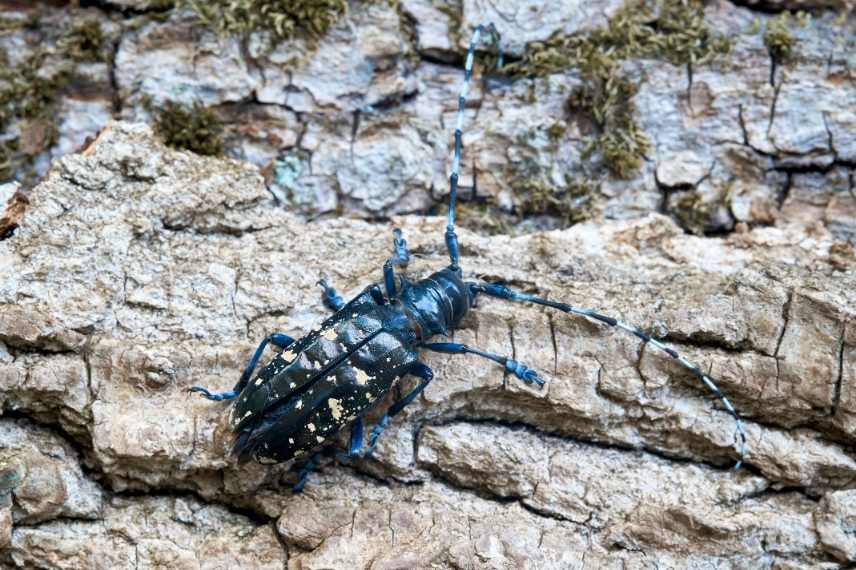
The Asian long-horned beetle has black elytra punctuated by black spots and very long antennae
As for the Asian citrus long-horned beetle, it was detected on the European continent in 2000, more precisely in Milan, then in France in 2003. Today, it appears to be eradicated in France.
Nevertheless, vigilance remains essential, as the Asian citrus long-horned beetle is regarded as a pest of deciduous trees, wild or cultivated, particularly dangerous. Moreover, European climatic conditions are highly favourable to it. And trade with China is an introduction pathway as favourable as the climate!
Life cycle of the Asian longhorn beetle
The life cycle of the Asian long-horned beetle lasts one to two years. It all depends on the timing of egg-laying! But it all begins with the flight of the adult beetles. Males and females gather near their host plants during the growing season. But it is especially the period from June to August that is most favourable for mating, as the beetles fly only on fine sunny days.
The female then seeks a tree whose trunk and branch bark she bores into. Between the phloem and the sapwood, she lays between 30 and 60 eggs and then dies. Once hatched, the larvae feed in the phloem to ensure their development. At the third larval instar, it is able to penetrate deeper into the tree, via galleries. When the larva reaches the nymphal stage, the adult beetle returns to the surface of the bark and bores a neat, round exit hole about 1 cm in diameter. It is ready to take flight. The cycle is complete.
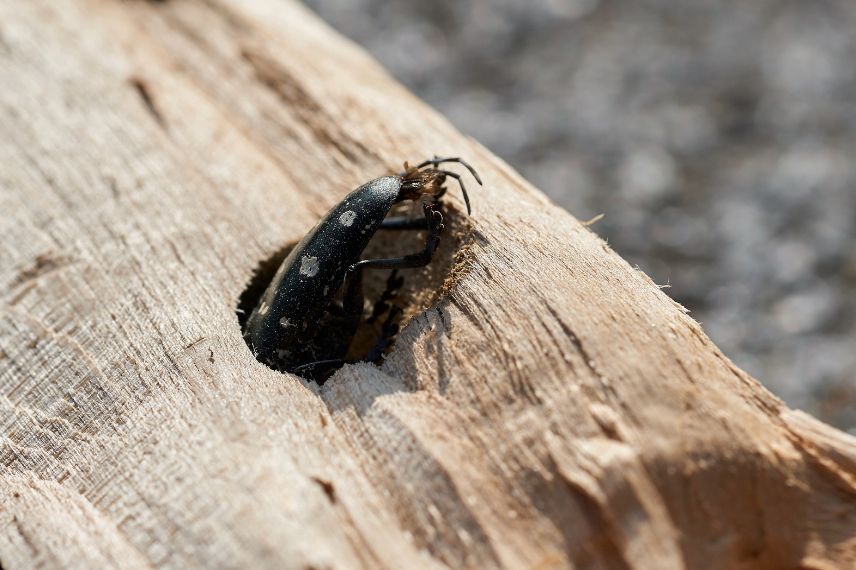
Adult Asian long-horned beetle emerging from the exit hole bored in the surface of the bark
Which trees are affected and what are the symptoms?
Asian longhorned beetles (Anoplophora glabripennis) s’attaquent essentiellement aux arbres feuillus à bois tendre, et en particulier certaines espèces telles que le maple (Acer), le birch (Betula), le willow (Salix), le hornbeam (Carpinus), le poplar (Populus), le lime tree (Tilia), le horse-chestnut (Aesculus) et le beech (Fagus). Dans son milieu d’origine, il jette son dévolu sur plus de 100 espèces.
Quant au capricorne asiatique des agrumes (Anoplophora chinensis), il se nourrit des arbres précédents, auxquels s’ajoute l’alder (Alnus), le hazelnut (Corylus), le plane tree (Platanus), le lemon tree (Citrus) ou encore les pommiers et les poiriers.
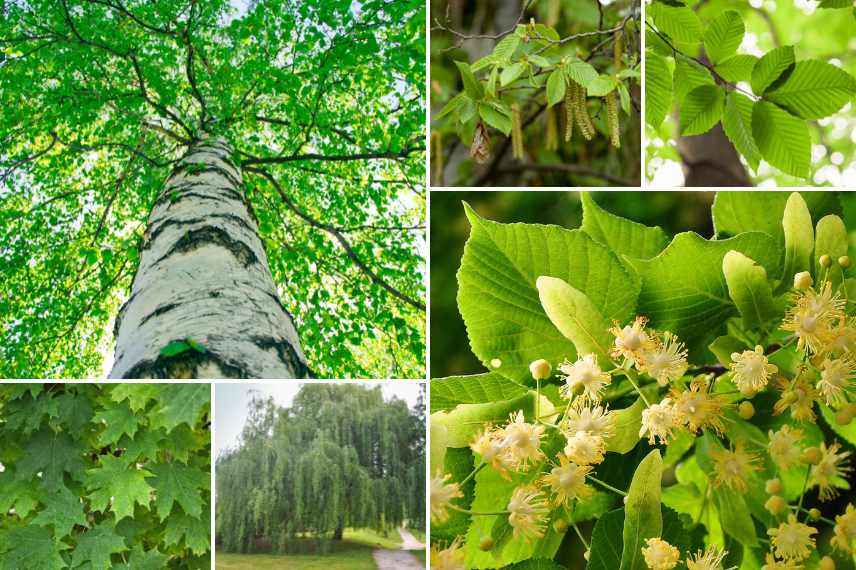
The Asian long-horned beetle has a predilection for leafy, soft-wooded broadleaf trees
Concrètement, ces arbres infestés par les larves de capricorne dépérissent lentement. Tout simplement parce qu’à cause des galeries, la sève ne circule plus normalement, l’arbre n’est plus alimenté par les nutriments et l’eau. Il s’affaiblit et peut mourir. Alors que les larves œuvrent en toute discrétion, bien dissimulées sous l’écorce. Pour autant, quelques signes permettent de détecter une infestation de capricornes asiatiques :
- Small piles of sawdust se déposent au pied des arbres ou sur les fourches des branches. Cette sciure résulte des trous percés par les larves dans l’écorce
- Incisions and circular emergence holes d’émergence des adultes sont visibles sur l’écorce du tronc ou des branches. Les incisions correspondent aux trous de ponte. En général, ils sont repérables aux suintements de sève qui en coule. Ces trous sont aussi des portes d’entrée aux champignons et bactéries
- Certaines branches sont écorcées par les femelles pour faciliter la ponte
- Certaines branches dessèchent et dépérissent.
Read also
Hazel diseases and parasitic pestsWhat should you do if you suspect Asian long-horned beetle is present?
If you notice any suspicious signs, it is obligatory and essential to notify authorities. Start by marking the trees where suspicious signs have been noticed. If you spot an insect, capture it and put it in the freezer. A photograph is also important. Next, contact the Regional Directorate for Food, Agriculture and Forestry (DRAAF) in your region, which will identify the insect via SRAL (Regional Service for Food) and/or the FREDON network dedicated to plant health. These two bodies are responsible for surveillance, but also for tackling these pests.
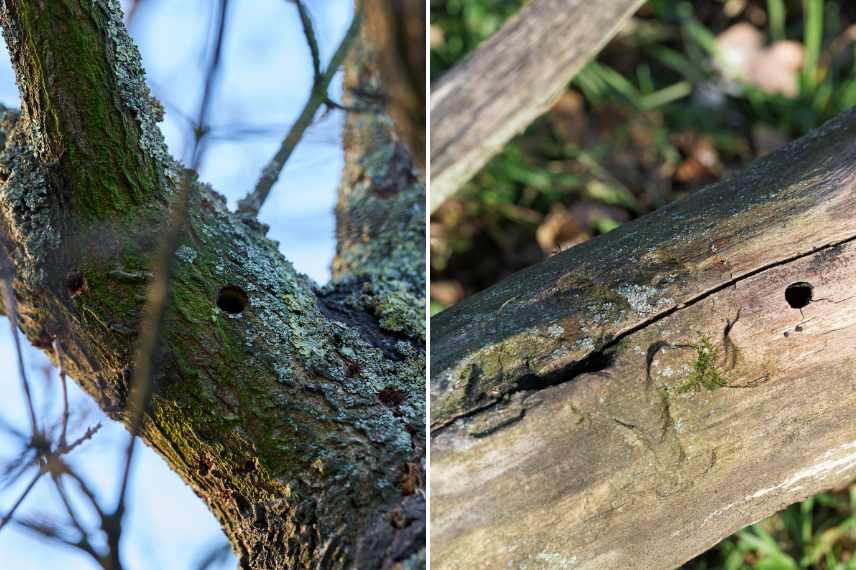
Small circular holes mark the presence of the Asian long-horned beetle
Control of this pest relies solely on felling the tree as soon as possible. The tree will be shredded and incinerated. Then, a surveillance campaign for surrounding trees is implemented. Likewise, wood products (crates, pallets…) that may be infested can also be incinerated.
For example, a surveillance campaign is currently underway in the Centre-Val de Loire region. In 2024, 300,000 host trees were inspected in the communes of Gien, Poilly-lez-Gien and Saint-Martin-sur-Ocre, among others thanks to a canine unit. 16 trees were felled in March and April 2024, and another campaign of felling took place between 17 and 28 June 2024. An outbreak is not declared eradicated until four years after the last infested tree is detected.
Areas such as Furiani (Corsica), Divonne-les-Bains and Royan are still under surveillance.
- Subscribe!
- Contents
Comments