





























The horse-chestnut leaf miner: a pest to be feared?
Found throughout the territory, this insect weakens horse-chestnut trees.
Contents
For around twenty years, climate disruption has greatly favoured the arrival of pest insects that had previously not been present in particular regions. In parallel, the growth in international trade is also contributing to the infestation of our plants by insects that were previously unknown or present only in small numbers in our territory. The horse chestnut leaf miner (Cameraria ohridella) belongs to this latter category of insects. Discovered in 1984 in the Balkans, it has rapidly spread across Europe, eventually crossing the French border in 2000 via Alsace. Today, its presence is established on virtually 100% of the territory, in both urban and rural settings.
Learn to identify this lepidopteran from the leaf-mining larvae on the leaves of horse chestnut trees, and discover how to fight effectively and naturally to limit its progression.
To go further : Horse chestnut: planting, growing and care

The Horse-Chestnut Leaf Miner: A Portrait of a Particularly Invasive Insect.
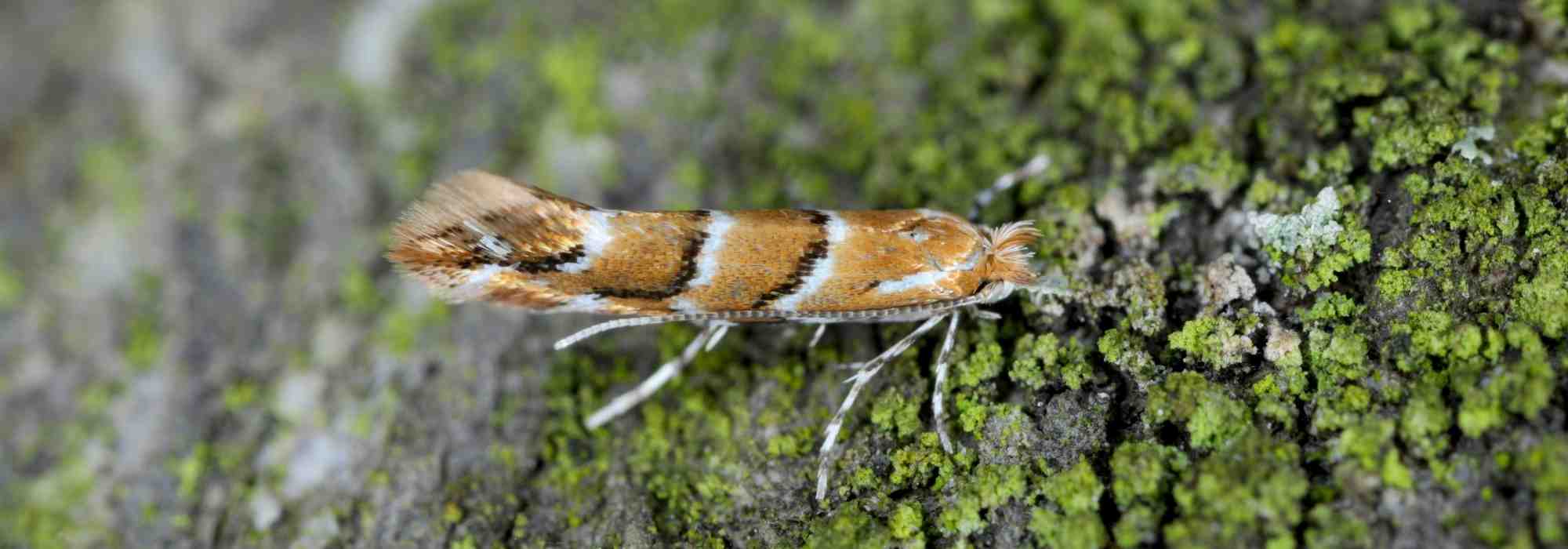
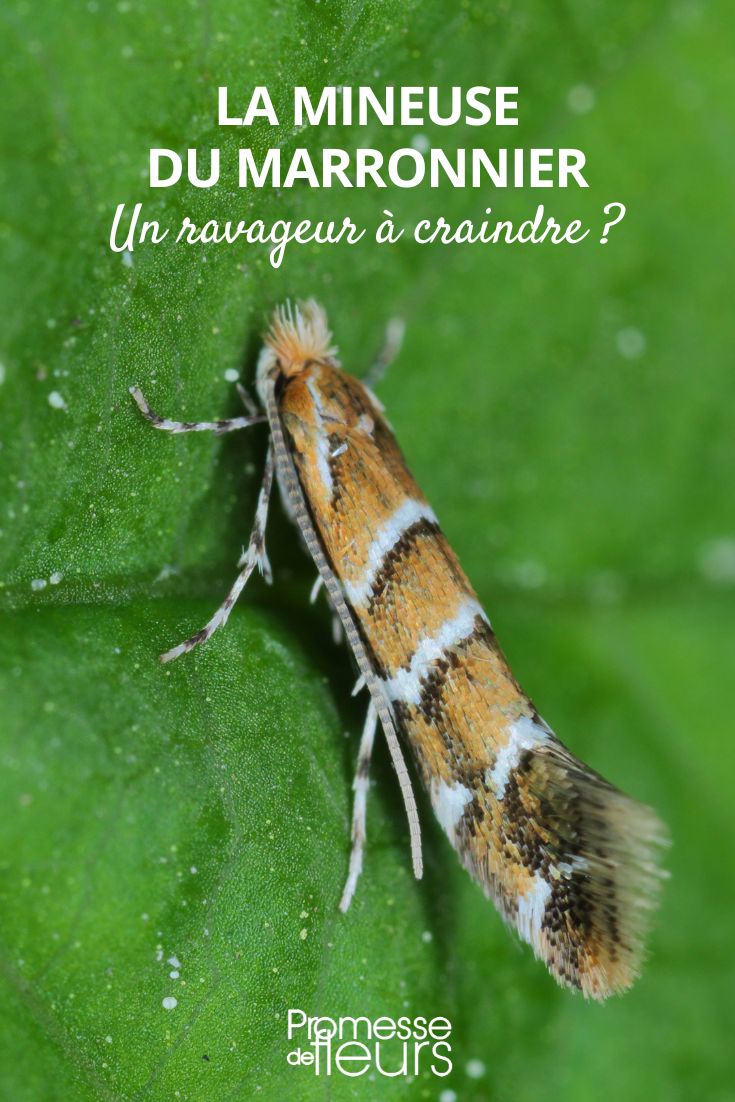
Cameraria ohridella. Behind this Latin name lies the horse chestnut leaf miner, sometimes referred to as the horse chestnut moth. It is a moth in the family Gracillariidae. Commençons par le papillon : long de 3 à 5 mm, il est doté d’un corps de couleur brun ocre. Ses ailes antérieures montrent des stries argentées alors que les ailes postérieures sont plus fines et frangées. De par sa taille, il passe inaperçu, d’où la difficulté à le repérer.
Pourtant, il est bien présent sur le territoire, se déplaçant rapidement d’un arbre à un autre, en milieu urbain comme à la campagne. D’après les études, la progression de la mineuse du marronnier serait de l’ordre de 50 à 58 km/an. Cette progression semble toutefois moins rapide dans les régions à la densité de population plus faible ou les zones montagneuses. En revanche, en ville, l’infestation est plus fulgurante.
D’après les observations faites partout en Europe, la mineuse du marronnier pourrait être vecteur de la maladie du chancre bactérien du marronnier (Pseudomonas syringae).
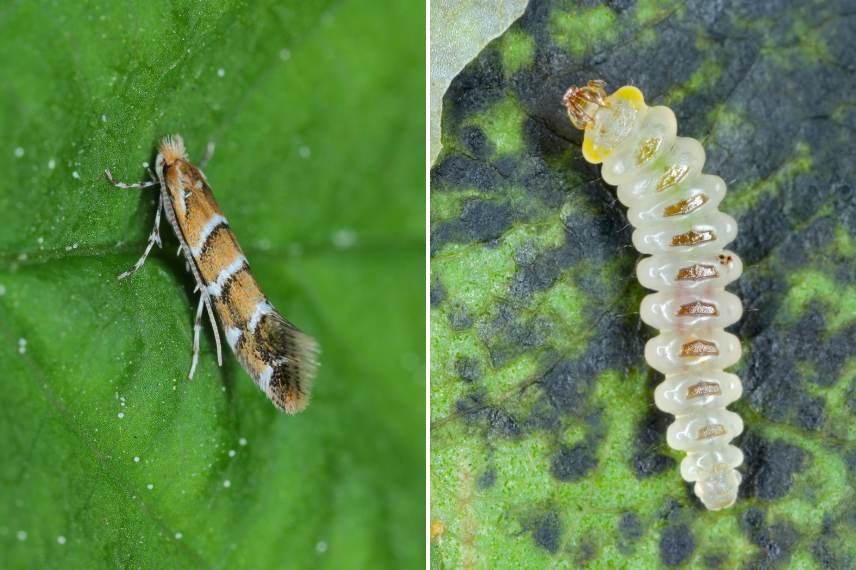
Adulte et larve de Cameraria ohridella
Read also
Diseases and Pests of the Horse ChestnutWhat is the life cycle of the horse-chestnut leaf miner?
With the climate conditions in our country, the horse-chestnut leaf miner typically has about 3 generations per year, with a life cycle of roughly 7 to 11 weeks, which explains its rapid spread. Depending on the region, once temperatures reach 12 °C for at least 48 hours, the first adults emerge in spring, during a period between the end of March and mid-April. Born to reproduce, the adults of the first generation live about thirty days, the other generations slightly less.
Mating takes place on the trunks of trees and recurs throughout the short lives of the moths. Once fertilised, the female lays between 20 and 100 tiny eggs directly on the leaves of their host plant, namely horse-chestnut trees. The eggs lie along the veins. The larvae hatch after about 3 weeks of incubation. From then on, the infestation is under way.
The caterpillars then bore into the cuticle, between the epidermises of the leaves, to drill galleries called mines, ranging from 1 to 2 mm long. They feed on the parenchyma. As they develop, the mines widen and may join to cover the entire leaf. The larvae grow in their mines for 20 to 45 days, depending on the generation, before pupating inside the mine. The second generation generally emerges in July, the third in August. And the cycle continues with each generation.
The last pupa remains in the leaf that falls to the ground. It will spend the winter there peacefully before emerging in spring.
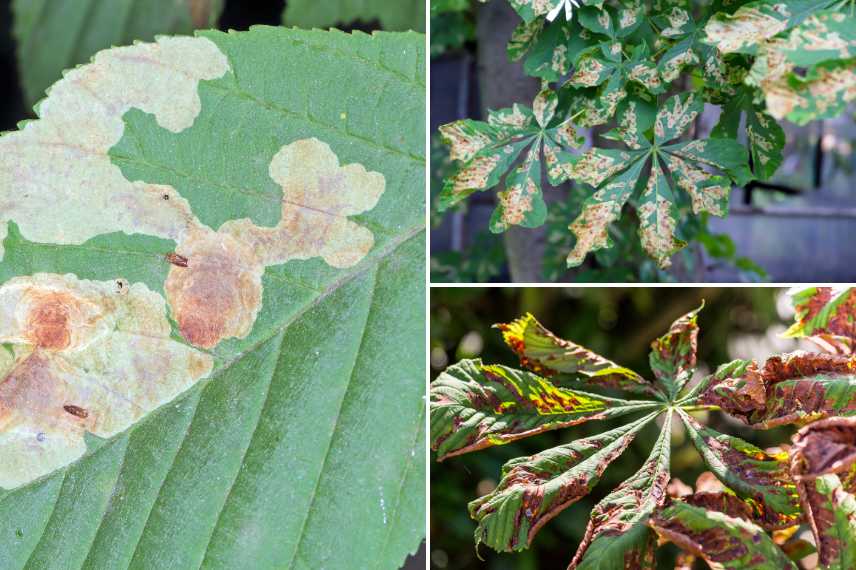
Different phases of infestation of horse-chestnut foliage by the leaf miner
What damage does it cause?
In practice, a leaf-miner attack is detected by the reddish mines that appear on the leaves. Initially fine, these mines lengthen and widen, sometimes joining if several larvae share a leaf. In the end, the leaves turn brown altogether and the crown takes on a reddish hue in midsummer: from then on, photosynthesis is no longer effective, and horse chestnuts tend to weaken and become more susceptible to pathogens. The yellowing leaves fall prematurely in midsummer. This drop in foliage may seem serious, but leaf-miner attacks appear to have only aesthetic consequences. The vigor of horse chestnuts does not appear to be affected, and no horse chestnut has died from a leaf-miner attack.
Nevertheless, there are still effects on flowering and fruiting. And in the longer term, scientists do not yet know the after-effects that infestations over several consecutive years may cause.
Regarding the trees affected, these are mainly Indian horse chestnut trees (Aesculus hippocastanum), the most common horse chestnuts in our region. All varieties can be affected, namely Aesculus hippocastanum ‘Hampton Court Gold’ with yellow new shoots that become green, Aesculus hippocastanum ‘Memmingeri’ with a very regular habit, or Aesculus hippocastanum ‘Umbraculifera’, smaller in size.
Chestnuts from species Aesculus pavia or flava can also be affected. Thus, the palmated foliage of the ornamental chestnut with red flowers (Aesculus pavia ‘Humilis’) can be impacted by leaf-miners, as can the variety ‘Koehnei’ with pink erect panicles, or the yellow chestnut (Aesculus flava).
By contrast, red-flowered horse chestnuts (Aesculus x carnea) are markedly less affected.
Two other tree species can also suffer horse-chestnut leaf-miner attacks. The sycamore maple (Acer pseudoplatanus) or the Norway maple (Acer platanoides) can occasionally be attacked if they grow near chestnuts.
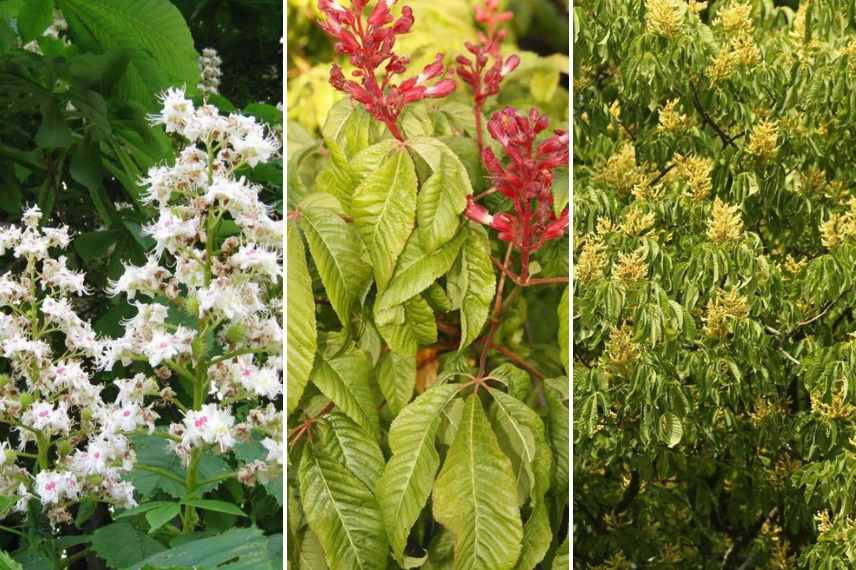
Three species of horse chestnuts are particularly targeted by leaf-miners: Indian horse chestnut, the red-flowered ornamental horse chestnut, and the yellow horse chestnut
Read also
Welcoming Blue Tits to the GardenHow can you naturally combat this pest?
The fight against the chestnut leaf miner is considered difficult. Primarily because the action of natural enemies, particularly parasitoid wasps, is insufficient to regulate populations. Moreover, this leaf miner spreads very quickly, especially in areas densely planted with chestnut trees or in urban settings.
There are, however, chemical insecticides that many local authorities refuse to use because of their environmental impact. So preventive control remains, which helps limit damage without eradicating the pest.
In your garden, if you have a chestnut tree, there is a measure that really helps reduce the populations: collecting autumn leaves. Indeed, the last generation that enters diapause overwinters in the leaves that have fallen to the ground. Leaf collection must be thorough, not only under the tree but also in surrounding areas. This will greatly reduce the infestation in the following spring.
Otherwise, at garden scale, the chestnut leaf miner pheromone trap is relatively effective at catching the males, and thus limiting their reproduction. These pheromone capsules dedicated to chestnut leaf miners are installed in a specific trap during the various periods of nuptial flight, from late March to August–September.
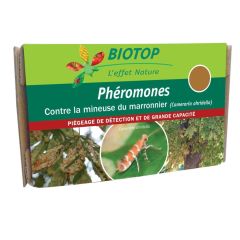
Phéromones spéciales Mineuse du marronnier Cameraria ohridella Biotop - 2 capsules
Finally, it is always essential to maintain good diversity within your garden. Indeed, chestnut miners count among their predators a number of birds, in particular, the great tits and blue tits. Earwigs (Forficula auricula) also occasionally feed on larvae. Another predator, the Meconeme fragile grasshopper (Meconemus meridionalis) proves quite active in the fight against the chestnut leaf miner. It is therefore essential to grow melliferous plants, plant countryside hedges composed of flowering and berry-bearing shrubs, and install bird feeders and nest boxes, or insect shelters.
- Subscribe!
- Contents
Comments