





























The main diseases of peonies
Identification, prevention and natural solutions to care for your flowers
Contents
Peonies (Paeonia) include several types of perennial plants, which all share a magnificent spring flowering, often fragrant. They are plants with undeniable ornamental qualities that do not go unnoticed in the garden.
If they benefit from good growing conditions, peonies can have a long lifespan. These plants are not known to be particularly susceptible to disease, but can nonetheless experience some health problems, notably caused by fungi. Let’s look at the most common ones, how to prevent the risks and treat your peonies naturally, without harmful chemical products.
For more information: Peonies: planting, pruning and care.

White rot
White rot develops in conditions of high moisture in the soil. As its name suggests, it is identified by the white, cottony-looking masses (mycelium) that it develops on peonies. It causes the roots and bulbs to rot and also causes the foliage to yellow.
Read also
Choosing the Right PeoniesGrey mould
Grey mould, or botrytis, is a fungus which thrives in humid, confined conditions associated with mild temperatures. It can be found in ornamental gardens as well as vegetable gardens and orchards. You will notice brown spots on the plant, covered with a grey fuzzy coating. All parts of the plant can be affected: foliage, flowers, shoots and even the roots. The flowers wilt; the plant eventually rots and dries out.
To learn more: Botrytis or grey mould
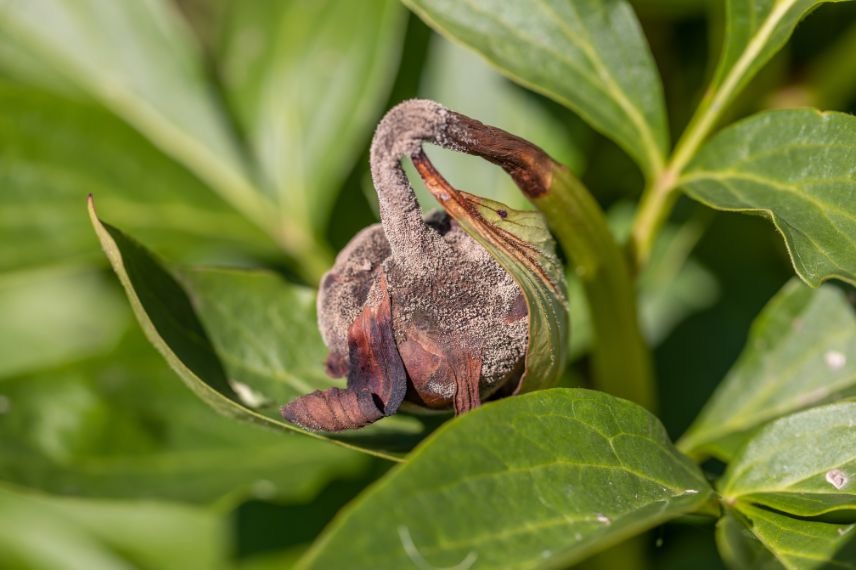
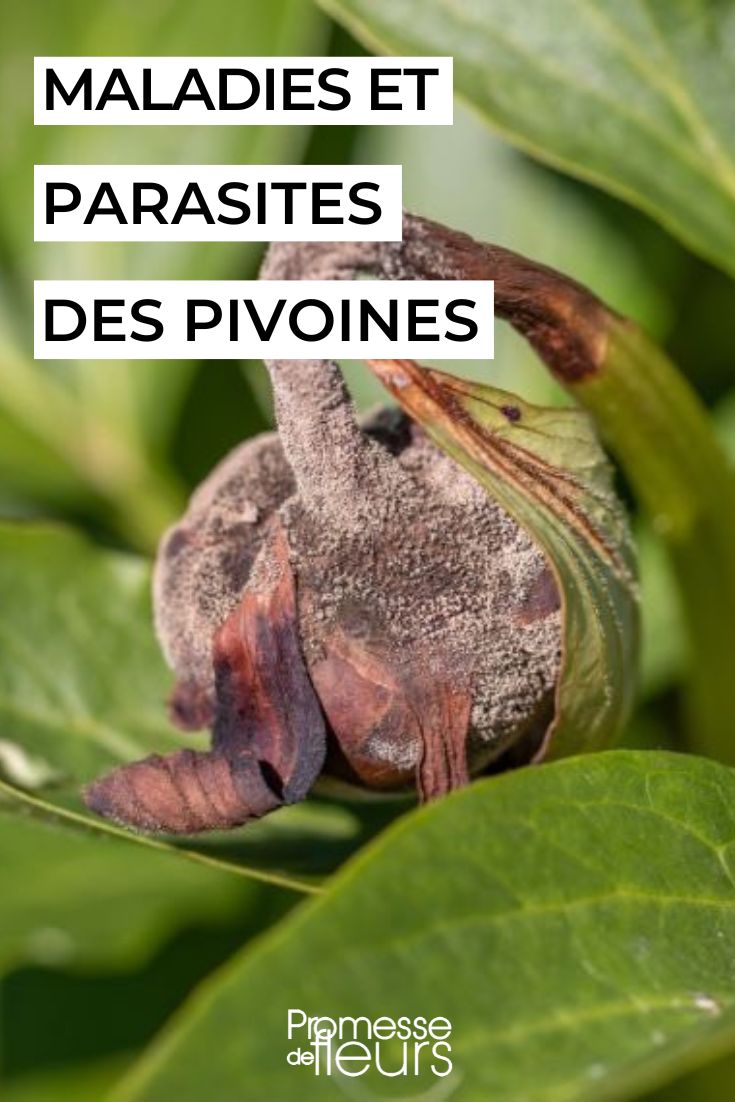
A peony bud affected by botrytis
Downy mildew
Once again, humid, poorly ventilated atmospheric conditions favour the development of downy mildew. If we are most familiar with tomato downy mildew, this fungus can also infect other plants, notably peonies. This disease first causes the appearance of small grey‑brown spots that turn black on the foliage. They develop rapidly. Then the disease causes rotting and the withering of the rest of the aerial parts (stems, flower buds), which gradually collapse. The plant eventually dies completely.
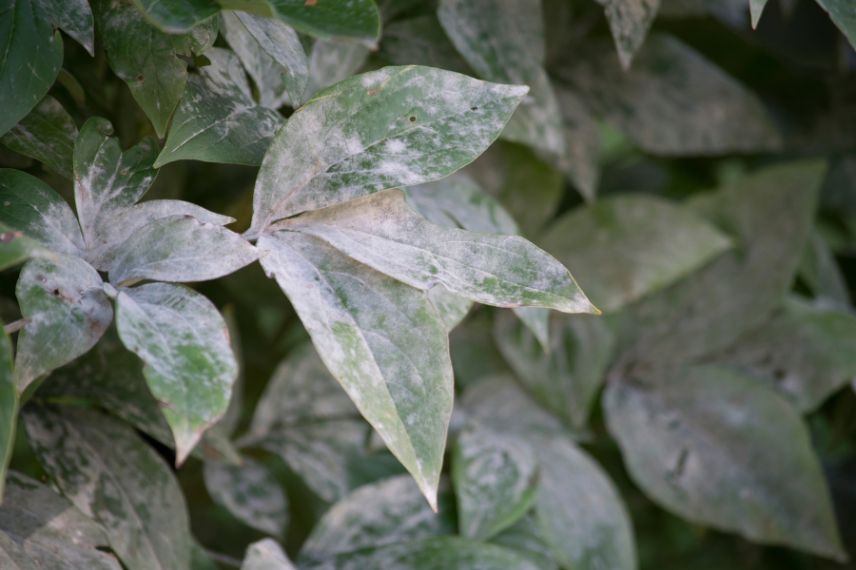
Peony leaves affected by downy mildew
Read also
How to pair peonies?Rust
Rust is another very common disease in the garden. It is easily recognisable by the powdery pustules of orange, yellow or brown colour that it leaves on peony foliage. When they burst, these pustules allow the fungus’s spores to spread to neighbouring plants. The leaves dry out and fall prematurely. Photosynthesis can no longer take place; growth and flowering are slowed. Symptoms are often cosmetic, but a fragile plant may eventually perish.
For more information: Rust
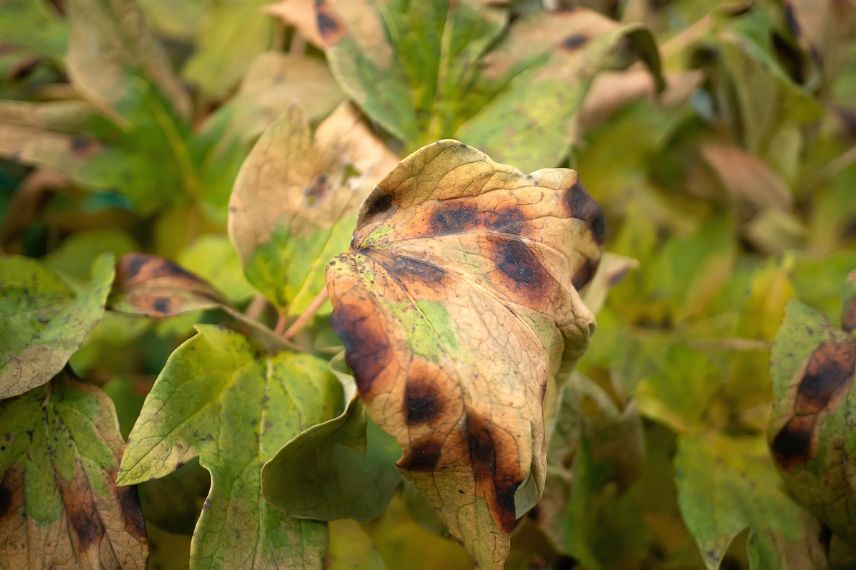
Peony leaves affected by rust
Cladosporium
This fungus mainly affects peonies grown in warm regions, whether they are shrubby, herbaceous or hybrid. The first symptoms appear in late spring and early summer. They are identified by the presence of small dark brown or red spots on the foliage. Little by little they spread to form large patches that completely cover the foliage. The foliage eventually turns completely black and dries out.
Verticillium wilt
Verticillium wilt of the peony, also called ‘verticillium wilting’, is another disease you may encounter. It causes wilting of the tips of the stems, which dry out. It affects the plant’s vascular system, preventing the proper circulation of the sap and causing the death of the plant.
Preventing peony diseases
Fungal diseases (cryptogamic diseases) are caused by fungi. They are among the most widespread in the garden. A humid, mild environment favours their development, which is why the periods most at risk are generally spring and autumn. They are highly contagious and can develop quickly if conditions are favourable.
Herbaceous peonies are particularly susceptible to these diseases, but other types of peonies can also be affected. Prevention is essential for fungal infections, as treatments unfortunately cannot always cure infected plants.
Here are some preventive measures you can easily apply to reduce the risk of disease in your peonies.
- Give your peonies good growing conditions. They will then be naturally more resistant to disease and healthier. Plant them in deep soil rich in organic matter, but essential that it is well drained. Water must not stagnate.
- Keep good planting distances between your plants to ensure air circulation and avoid confined, humid atmospheres.
- Do not plant peonies in a site previously contaminated by a cryptogamic disease. Spores can survive in the soil for several years.
- Quickly remove any plant debris at the base of your peonies (dead leaves, faded flowers, etc.).
- When applying fertiliser, avoid using fresh manure. Also ban excessive nitrogen applications, which can weaken peonies.
- When you need to carry out pruning work (for example removing faded peony flowers), always clean your cutting tools before and after use to avoid the risk of contamination.
- When watering, avoid wetting the foliage and splashing the plant. Water in the morning rather than in the evening.
- Spray a horsetail decoction or nettle manure on your peonies at the beginning of spring, to boost their natural defences. Find our tutorial to make your own nettle manure or our tutorial for making homemade horsetail manure.
- Check your plants regularly so you can act at the first symptoms of disease, before it spreads.
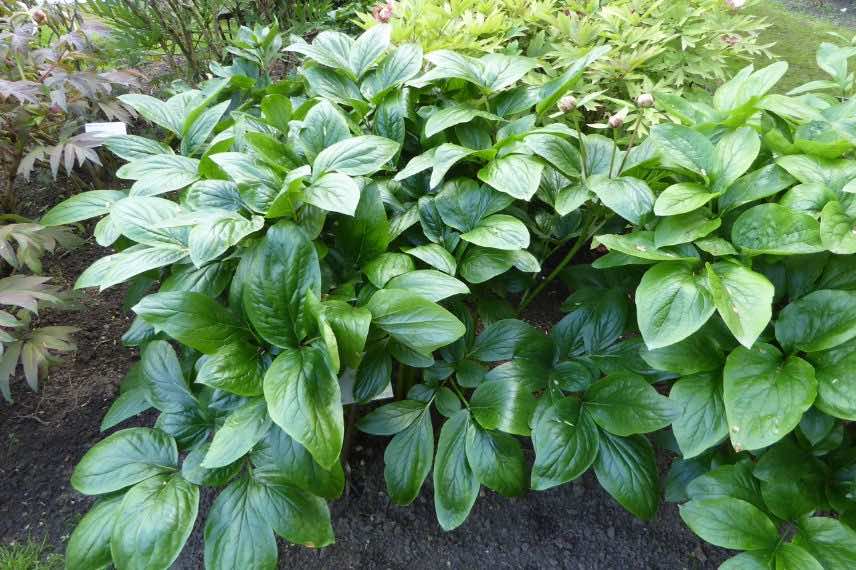
Give your plants plenty of space, always good advice
Natural antifungal treatments for your flowers
At the first signs of disease on your peonies, prune the affected parts back to a still-healthy zone. Do not put this plant waste in the compost; take it to a recycling centre to avoid further contamination.
Some natural fungicides can limit the spread of disease. This is the case, for example, with sulphur-based products and Bordeaux mixture (based on copper sulfate). These products are accepted in organic farming, but we recommend using them with caution and for short periods. Used in large quantities and regularly, they can contribute to soil imbalance, favouring the development of fungi.
If plant manures are often used preventively, they can also be used as natural curative treatments. This is particularly true of horsetail manure. Note that these solutions must never be used undiluted. They must be diluted in water before being sprayed on the contaminated areas. Apply every two weeks in dry weather. Preferably use rainwater rather than mains water.
As always, we advise against using phytosanitary products. These chemical solutions are not necessarily effective and prove to be particularly polluting.
In some cases, if the peony is too badly affected or the disease is incurable (as with verticillium wilt), the infected plant will unfortunately have to be destroyed, to prevent the transmission of disease to other plants.
For more information: “All you need to know about fungal diseases” and “Bordeaux mixture and other copper-based treatments in the garden“.
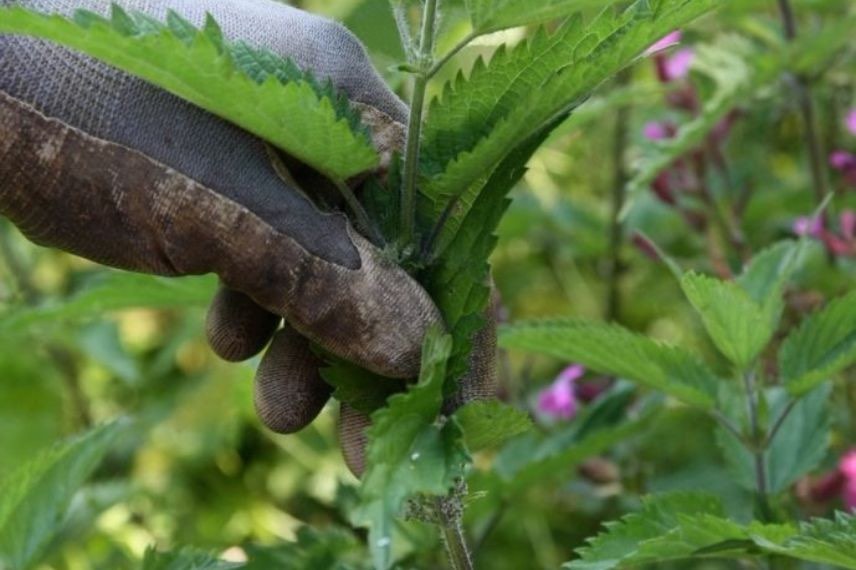
Harvest nettles, horsetail and comfrey to make your manure. Ready-to-dilute mixes are also available commercially
- Subscribe!
- Contents
Comments