





























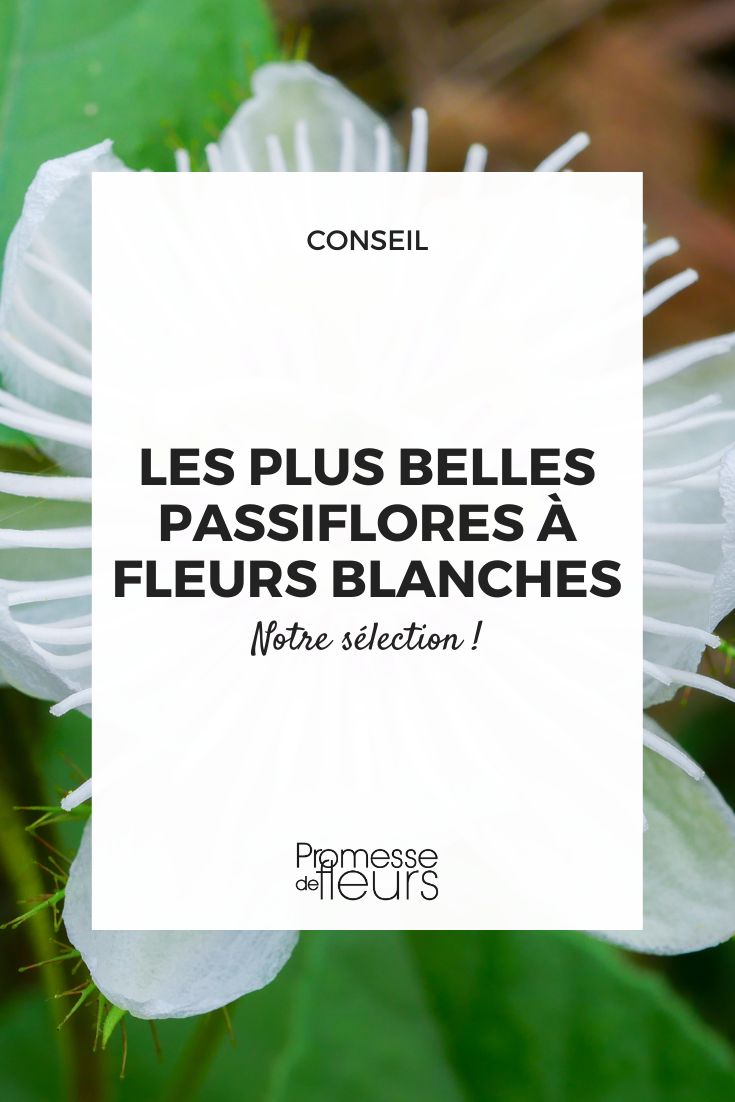
The most beautiful passionflowers with white flowers
A selection of seven passion flowers for the garden or balcony
Contents
The complex and exotic flowers of passion flowers captivate gardeners. Among them, white-flowered varieties stand out for their refined elegance and brightness. These vigorous and sometimes fragrant lianas attract a multitude of pollinators. In this article, we present seven white-flowered passionflowers, each with its own unique characteristic and cultivation tips, to help you choose the one that will harmonise perfectly with your small balcony or garden.

Passionflower 'Snow Queen' - Passionflower
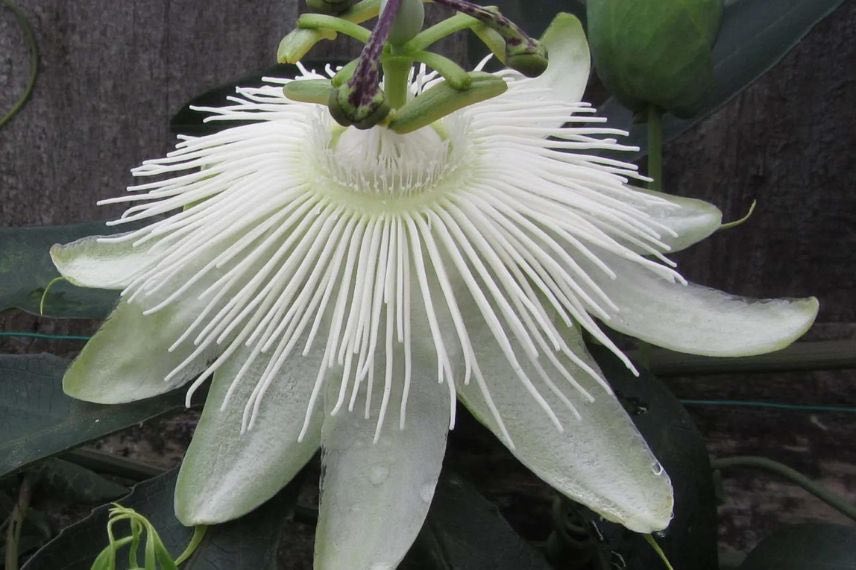
The Passiflora ‘Snow Queen’ is a variety of passionflower recently introduced and particularly noteworthy, capable of resisting disease and thriving in open ground in areas where winter temperatures do not fall below -8°C. With vigorous growth, it climbs with ease and produces during the entire summer season multiple large white flowers, adorned with long filaments which encircle a distinctive centre, formed of four green stamens and three black anthers. Although this passionflower may bear oval yellow-orange fruit, the fruits remain decorative and inedible.
‘Snow Queen’ is a notable improvement over the well-known variety ‘Constance Eliott’, offering larger flowers and better disease resistance. The plant grows to more than four metres tall thanks to its tendrils, and its quadrangular stems bear leaves divided into three to five oval lobes, a vibrant dark green. Its flowering extends from June to September, with large flowers that continually renew themselves and emit a light fragrance of exotic fruit.
Robust and easy to grow, Passiflora Snow Queen thrives in well-drained, light, deep soils that are not too dry, in direct sunlight and sheltered from strong winds. It is ideal for adorning walls, fences, trellises, and other vertical structures, and thrives wherever frost is not too severe.
Read also
6 passionflowers to grow in potsPassiflora mucronata - Passionflower
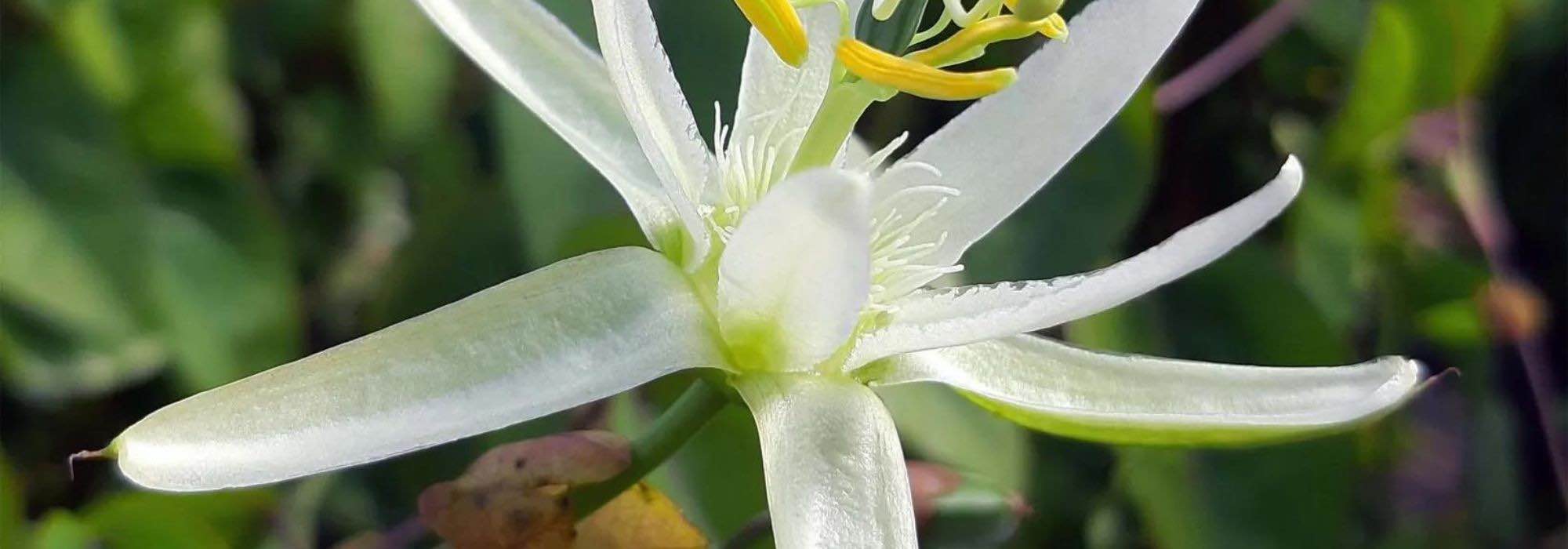
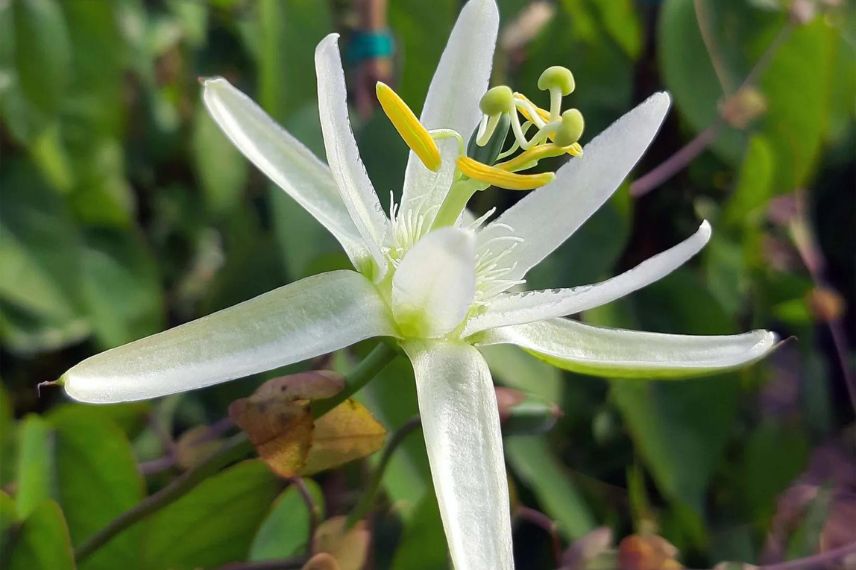
Passiflora mucronata, endemic to Brazil’s tropical forests, is a unique botanical species, known for its nocturnal flowering. This climbing vine produces from July to September white flowers of a fairly slender and pointed shape, with pale yellow stamens, which open at night and close by mid-morning. This species is pollinated in its natural habitat by bats, attracted by its sweet nectar.
In cultivation terms, the Passiflora mucronata is not particularly demanding. It thrives in well-drained, light soil that is sufficiently deep, and requires a sunny and sheltered location. This plant typically reaches a height of 3 to 4 metres, making it ideal for spaces such as terraces or conservatories. In winter, it should be protected or brought indoors if temperatures are likely to fall below -2°C.
The foliage of the Passiflora mucronata is also attractive, with glabrous oval leaves of mid-green that remain more or less evergreen depending on the climate. Its pruning at the end of flowering helps to maintain a dense and tidy structure, thus promoting abundant flowering the following year. This passionflower is suited to southern and Atlantic regions, where it can be grown either in the ground or in a container to facilitate movement during the coldest months.
Passionflower 'Panda' - Flower of the Passion
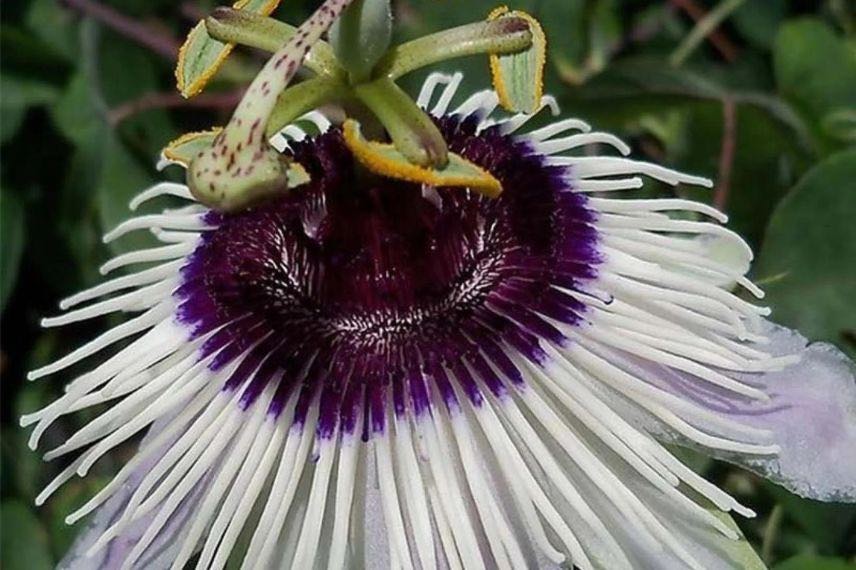
The Passiflora ‘Panda’ is a remarkable hybrid, the result of Dr. Roland Fischer’s research, combining the elegance of varieties ‘Monika Fischer’ and ‘White Wedding’. Floriferous, it develops large flowers 10–12 cm in diameter, characterized by sepals and tepals of a pearly white to very pale lavender, surmounted by a crown of bright filaments and greenish stamens. The heart of the flower is a deep purple, tending toward black, creating a striking contrast.
With a height of 3–4 metres, this Passiflora is ideal for growing in pots or in the ground in regions where winter temperatures do not drop below -2°C, although it can tolerate short periods of frost down to -5°C if well established. It thrives in sunny, warm situations, and its sturdy stems, bearing large leaves cut into 3 to 5 pointed, dentate lobes, cling to their support with tendrils, enabling voluble growth.
Passiflora Panda thrives in well-drained, light and fairly deep soil, and is not overly fussy about watering. It is an excellent option for dressing walls, fences, lattices, porches and trellises, and it is also highly valued for ornamenting conservatories, where it can be sheltered during cold winters.
Passion flower 'Snow Star' - Passiflora (x) incarnata
The ‘Snow Star®’ passion flower is a hybrid variety with numerous advantages: ornamental, fruiting and hardy down to -10/-12°C once established. Flowers about 10 cm across, pleasantly fragrant, are formed of white tepals slightly greyed, the centre occupied by greenish stamens. The pure white corona filaments, neatly crimped, extend well beyond the tepals in this variety. Pollinated by bees, they become tasty fruits, yellow when ripe.
This passion flower ‘Snow Star’ produces new twining shoots each spring, quite late, between late May and early June. The above-ground growth dies back completely in winter. The stems climb to 3 to 4 m in height in a single season, bearing glabrous leaves divided into three elliptical lanceolate lobes, with a medium green upper surface, veined with pale yellow veins.
The flowering of the Snow Star passion flower extends from June to October in a favourable climate. Once pollinated, the flowers give way to ovate fruits. The pulp, translucent, is sweet, delicious and fragrant. Fruits will form on the plant only in the presence of another passion flower, by cross-pollination.
It is very important to protect the crown from cold and damp during the first two winters. This variety thrives in all regions not too cold, in a well-sheltered position with well-drained soil, without standing damp in winter.
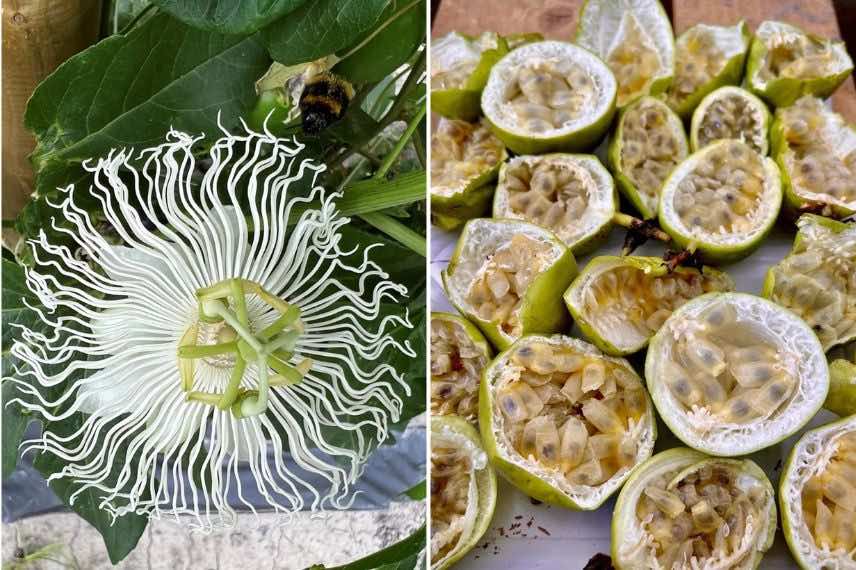
Passiflora subpeltata - Passion flower
Another botanical species endemic to the tropical forests of Brazil, the Passiflora subpeltata offers numerous flowers with rounded white petals, topped by a collar of pure white filaments and small stamens pale yellow to purple. It has naturalised in many parts of the world, including Australia where it is regarded as invasive. Its flowering period extends from July to September.
The Passiflora subpeltata develops long shoots bearing trilobed leaves, more or less evergreen, with a medium green colour on the upper surface and slightly blue-green on the underside. Its shoots reach 4 to 6 m in height, and it is grown in pots to shelter it in winter, wherever necessary, as it needs to be brought in when temperatures fall below -2°C. The Passiflora subpeltata is also highly regarded in conservatories or greenhouses year-round. Although not very hardy, it grows readily in any well-drained, light, fairly deep soil and not too dry in summer, and it flowers generously in the sun in a sheltered position.
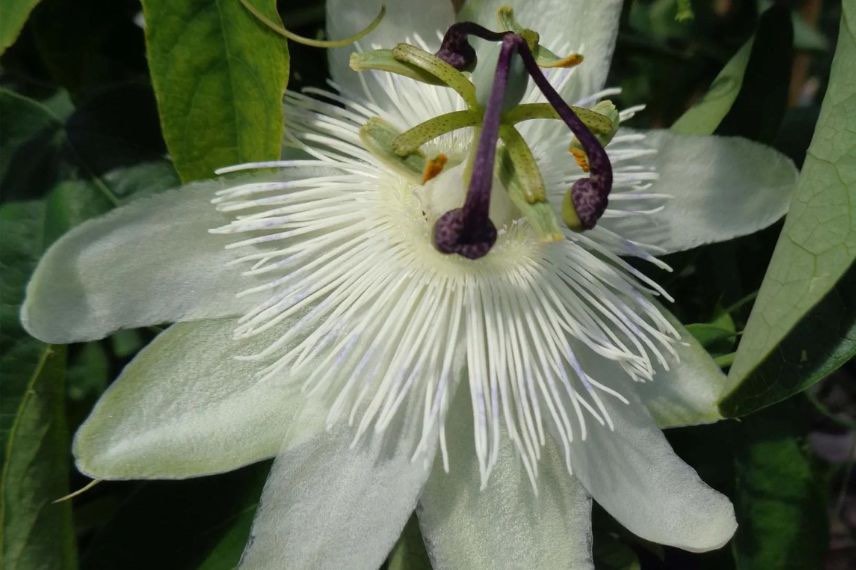
Passion flower 'White Lightening'
Passion flower ‘White Lightning’ forms beautiful white flowers 9 cm in diameter with a coloured centre. Of medium vigor and hardiness, it reaches about 3.5 to 4 m tall and about 2 m wide in good conditions, and tolerates frost down to about -8°C in well-drained soil.
‘White Lightning’ is derived from the species Passiflora caerulea and its variety ‘Constance Elliot’. It has inherited the white-grey petals and sepals of ‘Constance Elliot’, while the flower’s centre evokes the type species. The crown of fine filaments is dark purple at the base, then white in the middle section and finally bluish at the tips. The stamens are green-toned and the pistil purple-mottled, contrasting with the white petals and sepals. The leaves, semi-evergreen depending on winter conditions, are five-lobed with a dark, slightly glossy green.
The Passionflower ‘White Lightning’ grows in rich, cool, well-drained soil in a sunny position or possibly in partial shade. It thrives in fairly mild winter climates and not-too-dry summers. This climbing plant will be very decorative when trained on a trellis or fence. In very cold climates, it can be brought indoors for the winter into a sufficiently bright garage.
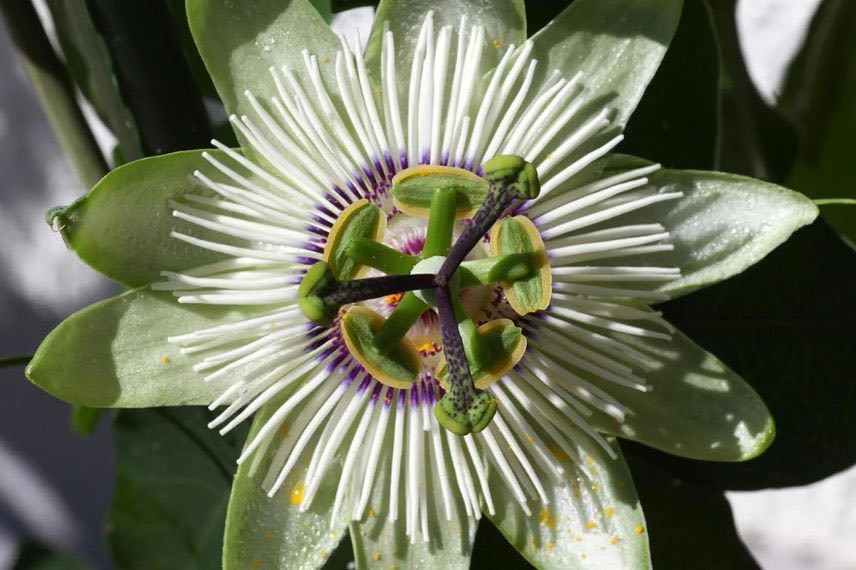
Passionflower Amethyst Blanche
Passiflora ‘Amethyst Blanche’ is a striking variant of the timeless ‘Amethyst Violacea’, renowned for its stamina and good frost resistance. It bears lightly fragrant flowers, of medium size, from June to October, where white petals tinged with lavender, crowned by intensely violet filaments, harmonise with lime-green stamens. This variety has earned an RHS Award of Garden Merit for its ornamental qualities and ease of cultivation.
This variety results from cross-breeding of P. caerulea and P. racemosa. The stems of Passiflora ‘Amethyst Blanche’ rise to a height of 4 metres and a width of 3 metres, and are adorned with quadrangular leaves, divided into 3 to 5 thick, oval lobes, a glossy dark green, sometimes with coppery reflections. This passionflower thrives in sun, in a sheltered position with loose, deep soil, and is frost-hardy to -8°C.
Suitable for the southern and Atlantic regions, ‘Amethyst Blanche’ is perfect for brightening walls, fences and trellises, and also fits well in conservatories where it is sheltered from harsh winters in cold regions.
- Subscribe!
- Contents
Comments