





























The most sought-after chicken breeds to have in your coop
Which breeds of chickens to choose based on your preferences?
Contents
Like cats and dogs, chickens are increasingly making their way into our homes, or at least our gardens. The fact that adopting a chicken has become widely popular is evident. However, raising chickens is not a trivial matter and requires a certain investment of time and money to ensure their well-being, comfort, and safety. Between purchasing the chickens and their feed, building or acquiring a coop, bedding, and any necessary treatments and supplements, owning chickens deserves careful consideration. On the other hand, if this choice has been thoroughly thought out, the next question is which breeds of chickens to acquire? We assist you in your decision by presenting the most sought-after chicken breeds based on your criteria, needs, or desires?
The best hens for beautiful and tasty eggs
Legitimately, when adopting hens, it is often done to have good fresh eggs (almost) every morning. Of course, a hen does not lay 365 eggs a year, as certain factors can diminish her laying capacity. Cold weather, heatwaves, illness, moulting, and age are all reasons that can block or reduce egg production. Additionally, the breed plays a role. Indeed, some hens are known to be good layers, while others are less so.
The Red Hen or Farm Hen
This is the most common hen in French henhouses, found in professional farms. It is safe to say that it is an excellent layer, producing 250 to 300 eggs per year. Recognisable by its orange plumage and its well-developed comb and wattles, the red hen is hardy, easy to care for, and gentle.
Many retired red hens are available for adoption, as farmers sell them at around 12 to 18 months old because they are less profitable!
The Marans
Known for laying very dark brown, even chocolate-coloured eggs, the true Marans hen sports a black and copper plumage around the neck and breast. It is often confused with another breed, the Harco, another quality laying hen. Nevertheless, the Marans lays up to 250 eggs per year.
This hen, originating from a village in Charente-Maritime, is robust and pleasant to keep, and is also a broody hen and a good mother.
The Sussex
This is a large and beautiful white hen with a collar sprinkled with black feathers. The Sussex lays up to 250 large eggs, even in winter, as it is not particularly afraid of the cold. Quiet by nature, it can be timid but remains a very easy-going hen.
The Leghorn
A small-sized hen, the Leghorn is most often white. It is an exceptional layer, capable of providing you with up to 300 eggs per year, which are characterised by their immaculate white shells.
This hen is particularly active and will need a sufficiently large space. It can be timid and difficult to tame. However, once this hurdle is overcome, it is very affectionate.
The Naked Neck of Forez
Here is a hen that does not go unnoticed with its naked neck. Admittedly, it is not very attractive with its bare neck revealing skin the same colour as its comb, but it has other characteristics. These traits make it a remarkable hen: it lays up to 180 eggs per year, is robust against both heat and cold, is very sociable, and particularly active. It spends its days foraging.
Be careful, the true Naked Neck of Forez is white.
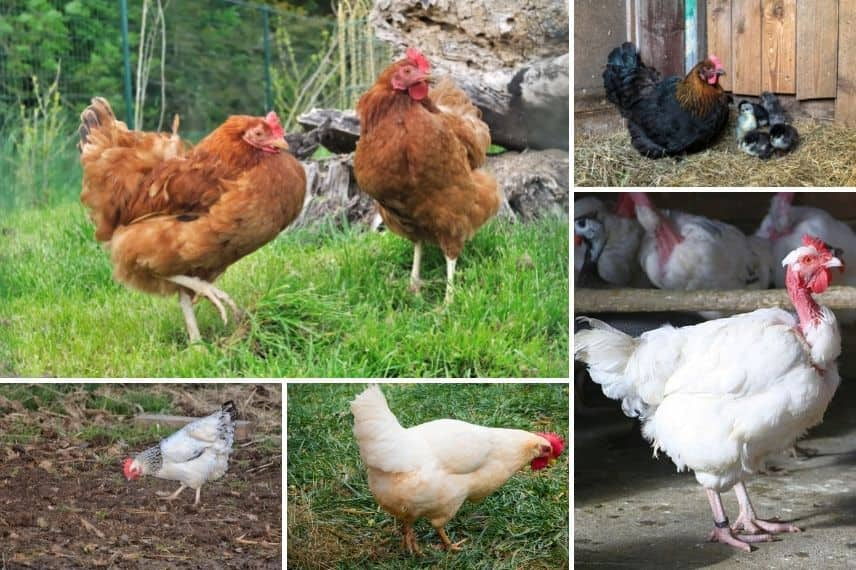
The red hen, the Marans, the Sussex, the Leghorn, and the Naked Neck of Forez (©DocMuséo)
The Gâtinaise
Another white hen that deserves to join your henhouse due to its many qualities. Firstly, as a layer with an average of 200 eggs per year, with a nice white shell. Additionally, it is a good broody hen. Very pleasant to keep, it behaves like a pet and is very close to children. Moreover, it has a slender and elegant silhouette.
The Gournay
What primarily attracts attention to the Gournay is its plumage variegated with black and white. However, with its 170 annual eggs, it is also classified among the best layers. It is also a hardy hen, easy to tame, but it loves open spaces.
The best broody hens that make good mothers
Certain hens are good sitters, patient and quick to raise their offspring. While others are completely disinterested. So, if you want to expand your flock and watch adorable little chicks grow, you will first need a rooster, but also hens that are willing to spend hours in their nest.
However, remember that not all chicks will become hens; some may grow into proud, noisy, and vigorous roosters!
The Coucou de Rennes
It is true that with its 200 eggs annually, this pretty hen with ash blue plumage is a good sitter, as well as a good layer. This Breton hen, sturdy at nearly 3 kg, is cold-resistant, calm, and enjoys large spaces. Therefore, it is a relatively versatile hen that will take great care of its babies.
The Faverolles
This is a hen with a powerful silhouette and a dense salmon-coloured plumage. Perched on short, feather-covered legs, the Faverolles sports sideburns that hide its ear lobes.
It has a good temperament, is easy to socialise, and adapts well to the coop.
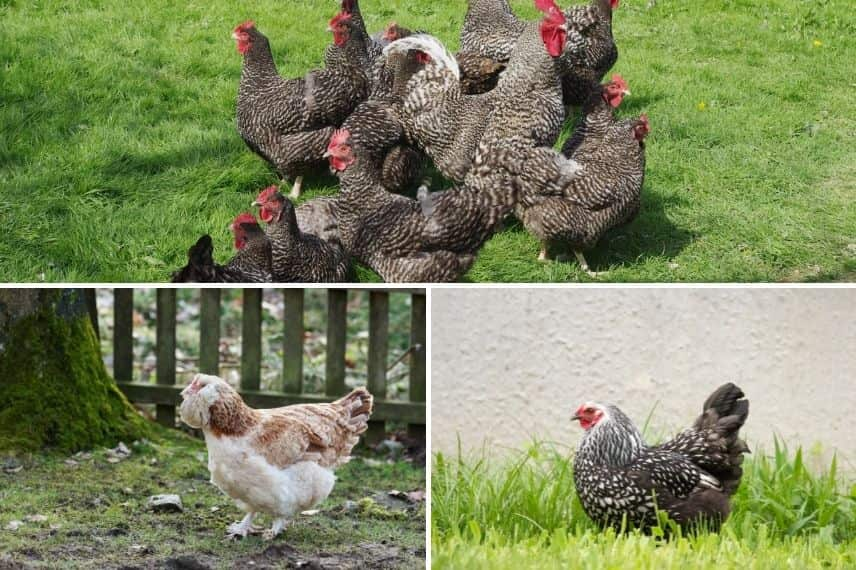
The Coucou de Rennes, the Faverolles, and the Wyandotte
The Wyandotte
Here is a potential good mother, who is also a good layer. Very cold-resistant, the Wyandotte has a changing plumage, most often speckled with black and white. It is a discreet layer that may come across as shy. However, it is very sociable and ideal for beginners.
Chickens known for their sociability and gentleness
Each hen is unique and displays its own character, its own personality. Some will be easy to approach and tame, while others may be timid and form few bonds with their owner.
So, if you want hens that follow you everywhere like little dogs or that enjoy cuddling, choose breeds known for their sociability.
The Brahma
The Brahma is a hen that stands out primarily for its morphology. Very large (it can weigh up to 4 kg!), it has thick, fluffy plumage that makes it resistant to cold, but not to heat. It also has feathers on its legs.
A good layer, it is especially known for its docile and friendly character. Due to its weight, it is not very active and enjoys lounging around and following its owners everywhere. It is also very fond of being petted.
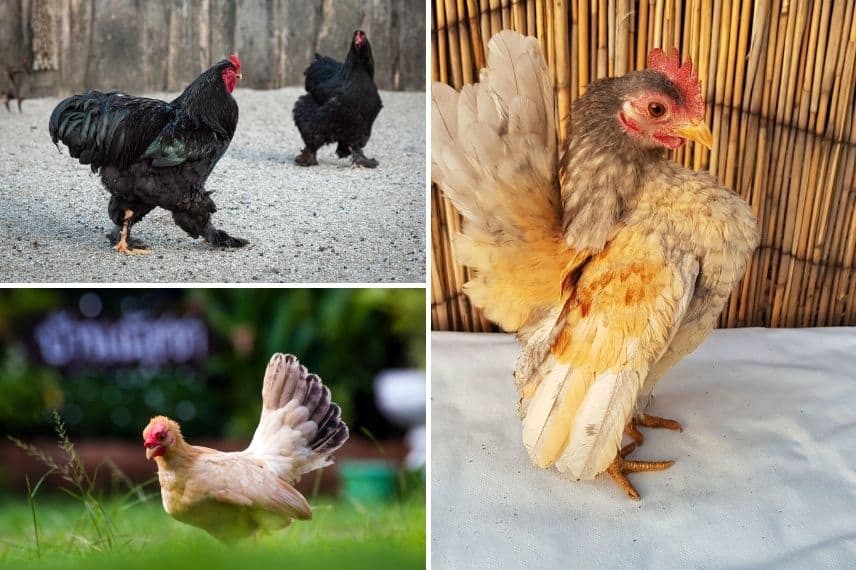
The Brahma, the Bantam of Burma, and the Serama
The Burma or Bantam of Burma
This is a very small ornamental hen (weighing between 600 and 700 g) with feathered legs. It is also known for having a tuft of feathers and a beard! Besides its astonishing appearance, the Burma also has a very endearing character.
It is very familiar with humans, and its remarkable gait is much appreciated. However, it needs a covered enclosure, as this lady does not like to get her feet dirty.
The Serama
Known as “the smallest domestic hen in the world,” the Serama weighs no more than 425 g! It is very friendly and curious about everything humans do. Originating from Malaysia, it is even considered a pet there.
With colours ranging from fawn to black and white, the Serama lays fewer than 100 eggs per year.
Chickens chosen for aesthetic criteria
You can choose to adopt chickens solely because you find them beautiful. These ornamental bantam chickens are therefore the most suitable. However, they are chickens that, while easy to care for, lay few eggs. They can also sometimes prove to be very delicate, a bit fragile, as they are a breed of chicken.
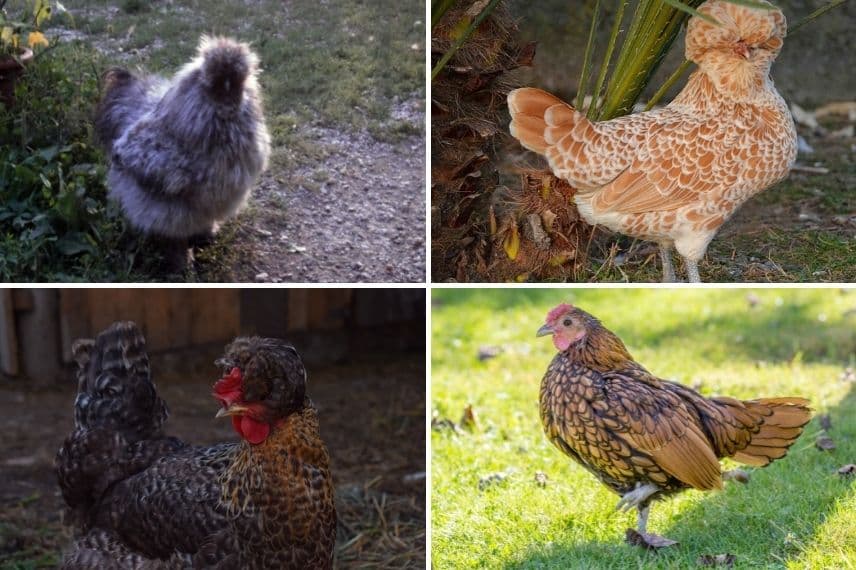
The Silkie, the Padua, the Crested Holland and the Sebright
The Silkie
As its name suggests, this chicken is covered in very silky plumage that could be mistaken for hair. Very abundant, this plumage completely covers it, making it resemble a pom-pom. It also has the unique feature of having 5 toes.
It is a very calm chicken, perfect for taming, known for its quality as a brooder. It lays about 3 eggs per week.
The Padua
The Padua is easily recognisable thanks to its impressive crest of feathers that replaces the comb and cascades down over its head. The perfect pet, this chicken is also very curious, and sometimes nervous. Due to its plumage obscuring its vision, the Padua is happier in a run where it is less likely to be targeted by predators.
The Crested Holland
As its name indicates, it originates from the Netherlands. This chicken also sports a white crest on its head, rich in feathers. Unfortunately, it is a breed prone to diseases, as it is sensitive to cold and pecking from its peers.
Very close to humans, it is easy to raise. However, do not choose it for egg-laying as it will only provide you with 50 eggs per year.
The Sebright
This bantam chicken has everything to please. Starting with its plumage, which is most often silver or gold with feathers edged in black.
This little chicken does not let itself be pushed around and has a strong character, but is not aggressive. As it is very active and curious, it requires a sufficiently large area. Very independent, it does not necessarily form bonds with humans.
- Subscribe!
- Contents
Comments