





























The planting density of pond plants
How many pond plants do you need?
Contents
When you have a water feature in your garden, whether it’s a basin, a pond, or a small pool, you should diversify the types of plants, not only for their different roles but also for aesthetic reasons and biodiversity. But beware of over-planting aquatic plants, or, conversely, of a lack of vegetation if you don’t want a cesspit in place of the pretty basin you covet… The golden rule for water features is always two-thirds of the surface kept free of any planting to maintain proper water balance.
Do we really know how many plants to install to ensure good water filtration? The planting density in a garden pond is in no way comparable to that of a flower bed on land.
We explain the right number of iconic aquatic plants to place in your basin so that it will thank you!

Some general guidelines on planting quantities in an aquatic medium
The planting density of pond plants is a key factor in ensuring the beauty of your water feature. But by respecting the space–water-volume requirements of each species, you will mainly contribute to the creation of a balanced ecosystem.
To limit the eutrophication of the water (an excess amount of organic matter), it is advisable to remove a large proportion of the plants every year or every two years. It is considered that a good proportion in a pond consists of a majority of emergent plants, a few oxygenating plants, and a small ratio of floating plants, the whole not exceeding a third of the pond’s surface.
It is also important to note that some plants have invasive growth habits, for which you will need to be vigilant from the outset. Don’t hesitate to consult professionals to assist you with your water garden project!
Riverbank plants
Riparian plants, also known as wetland plants, are essential for stabilising banks, adding plant diversity, and adorning the edges of the water feature. They also form a buffer zone between the water and the rest of the garden and provide habitat for small wildlife. They should be planted in moist soil, in the immediate vicinity of the water, but the roots should not be in the water. Here are a few examples:
- Carex (Carex spp.): decorative grass, plant 3 to 5 plants per m².
- Water mint (Mentha aquatica): aromatic plant, to be planted in moist soil, plant 3 to 5 plants per m².
- Loosestrife (Lythrum salicaria): plant with purple flowers from June to August, to be planted in moist soil, around 3 to 5 plants per m².
- The Acorus calamus, with handsome linear foliage, will be planted at 4 per m².
- Gunnera or the Colocasia will expand considerably: one plant per m² is more than sufficient.
- Pond perennials that are lighter, such as Eupatorium or Ligularias, will be planted at 1 to 3 per m².
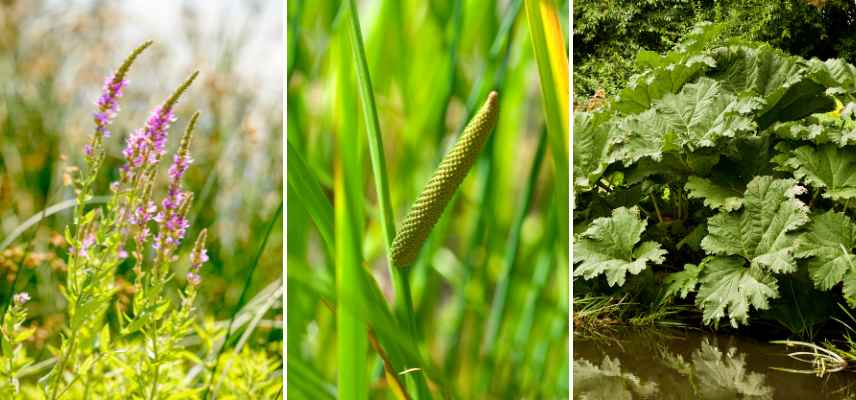
Lithrum salicaria, Acorus calamus and Gunnera manicata
Oxygenating aquatic plants
Oxygenating plants play a crucial role in filtering and oxygenating the water. They must be planted in sufficient numbers to fulfil this role, but they can be invasive at times. Among the most common species you will find:
- The Canadian elodea (Elodea canadensis), an submerged plant. Plant 1 to 3 stems per m². Be mindful; you will need to monitor its growth.
- The submerged hornwort (Ceratophyllum demersum): a floating plant to be placed in a basket containing 1 to 2 cut flower arrangements per m².
- Milfoil (Myriophyllum spicatum): a submerged plant between 10 and 60 cm tall; plant 3 stems per m², strictly in baskets to limit its invasiveness.
- Frogbit (Limnobium laevigatum), also fairly prolific, should be watched in its spread. Plant it in regions with a mild climate, limiting to 1 plant per m², in shallow water and in closed or artificial ponds.
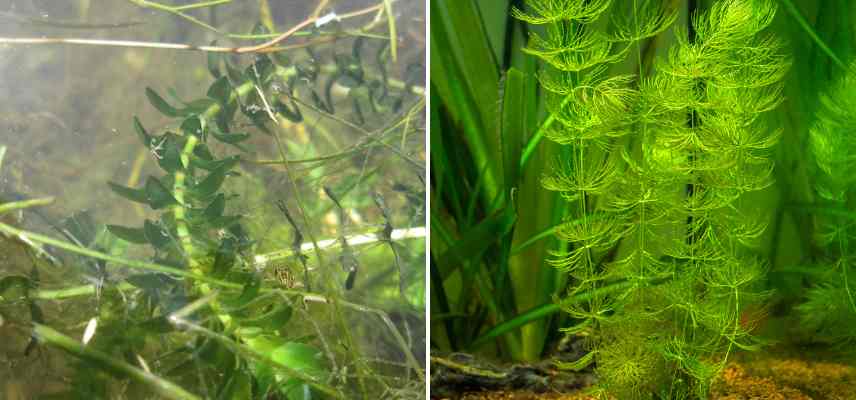
Elodea canadensis (© Andreas Rockstein – Flickr) and Ceratophllym demersum
Read also
The best time to plant pond plantsEmergent aquatic plants
Emergent aquatic plants, with their roots in the water and their heads above the water, are essential for stabilising banks and welcoming wildlife. They include flowering plants and foliage plants of interest. They should be planted in pots, at a water depth suitable for each species. Among the loveliest and most common, you will find:
- Marsh iris (Iris pseudacorus) with yellow flowers, to be grown in a pot at a depth of 5 to 20 cm; 4 plants per m².
- Pickerelweed (Pontederia cordata) with superb lavender-blue spike flowers, to be grown in a pot at a depth of 10 to 20 cm. Plant 3–4 specimens per m².
- Common reed (Phragmites australis): a tall, elegant plant, to be grown in a pot at a depth of 10 to 20 cm; 2 reeds per m².
- Arrowhead (Sagittaria sagittifolia or Sagittaria latifolia with remarkable leaves): a very handsome aquatic plant with arrow-shaped leaves, to be planted in a pot at a depth of 10 to 40 cm; 3–5 plants per m².
- Marsh marigold (Caltha palustris) produces a profusion of small yellow flowers from June to August. To be planted at a depth of up to 5 cm; 4–5 plants per m².
- Thalia (Thalia dealbata), valued for its broad foliage and exotic vertical presence, should be planted to a depth of 40 cm; one plant per m².
- Rushes (Juncus effusus, Juncus inflexus, Juncus gracilis…), should be planted at a depth of 5 to 10 cm, at a rate of 3–4 plants per m².
- Bulrushes (Typha sp.) or reeds are planted at a depth between 5 and 50 cm. Count only 2 plants per m².
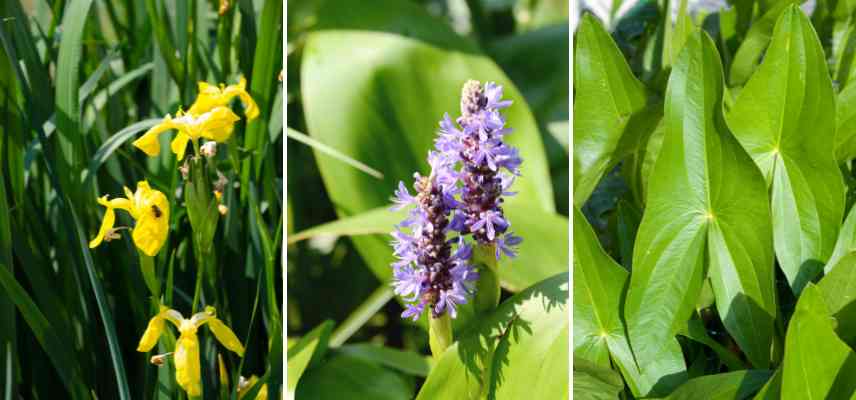
Iris pseudoacorus, Pontederia cordata and Saggitaria sagittifolia
Floating aquatic plants
Floating plants are not anchored to the bottom of the pond, but drift on the water. They contribute to shading, to water purification and to limiting algae growth. They should cover about 20% of the water surface. Here are some emblematic species and their planting densities:
- The common duckweed (Lemna minor): a small floating plant to be spread on the surface in moderation, as it tends to smother its neighbours. Space 1 to 2 plants per m².
- Azolla (Azolla filiculoides, Azolla caroliniana): a small floating water fern, to be spread over the water surface, about 4 plants per m² (beware of its very invasive nature, too).
- Salvinia natans: another floating fern, annual (frost-tender), very effective at filtering and oxygenating the water and much less expansive. Place 4 to 5 plants per m² on the water surface.
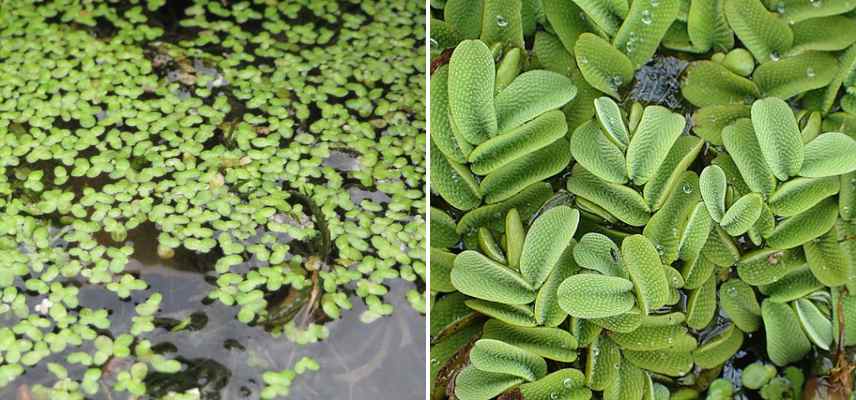
Lemna minor on the left (© Andreas Rockstein – Flickr) and Salvinia natans on the right (© K. Ziarnek – Wikimedia Commons)
Submerged aquatic plants
Submerged plants provide shelter for fish and aquatic wildlife and help purify and shade the water. They should be planted in pots, at a depth suitable for each species. In this category you’ll find floating‑leaved plants, some of which have spectacular flowering. Among the most popular:
- The water lily (Nymphaea spp.) : this is THE star plant for ponds, to be planted in pots, with a water depth of 30 to 100 cm depending on their spreading (dwarf or large water lilies). The ideal density is 1 plant per m² (but this should be adjusted according to varieties; some require more space and you should count 1 water lily for 2 m² of water). NB: water lilies should be contained as they grow, and about a third should be removed once they reach their adult size.
- The Lotus (Nelumbo nucifera and Nelumbo japonica spp.) : a spectacular plant for deep ponds and mild to temperate climates. Count 1 plant per m² of water, in 20–40 cm of water.
- The potamogeton (Potamogeton spp.) : this submerged and oxygenating plant should be planted in pots at a depth of 50–100 cm depending on species. We count 2 plants per m² (to be adjusted according to species P. natans, P. lucens, etc.)
- The Aponogeton distachyos or water vanilla with elegant white flowers scented in the evening: it is advised to plant 3–4 rhizomes maximum per square metre. The bulbs should be buried at a depth of 20–60 cm.
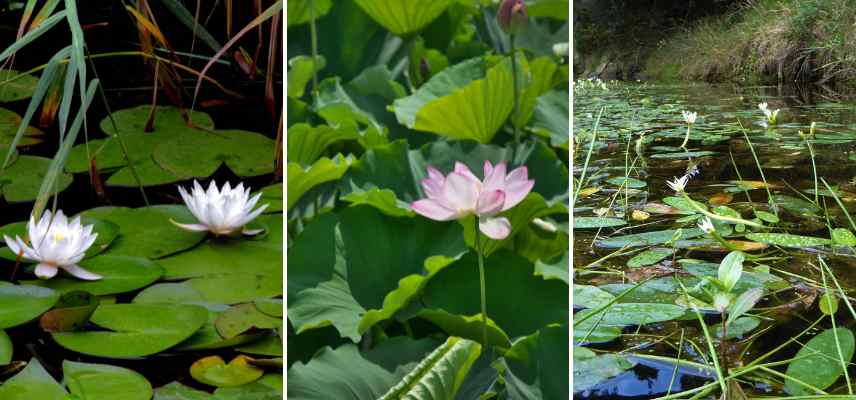
Water lilies, Lotus (Nelumbo nucifera) and water vanilla
- Subscribe!
- Contents
Comments