





























The Spotted Salamander
The most common in Europe
Contents
The Spotted or Common Salamander (Salamandra salamandra) is an amphibious creature that lives in leafy forests crossed by streams where it lays its larvae. Essentially nocturnal and very discreet, the Salamander is rarely encountered in the wild and even less often in our gardens. How and where does it live? How can you differentiate a salamander from a newt?
We tell you everything about this charming amphibian in our advice sheet.

The species of salamander found in France and Belgium
In mainland France, there are 4 species of salamander:
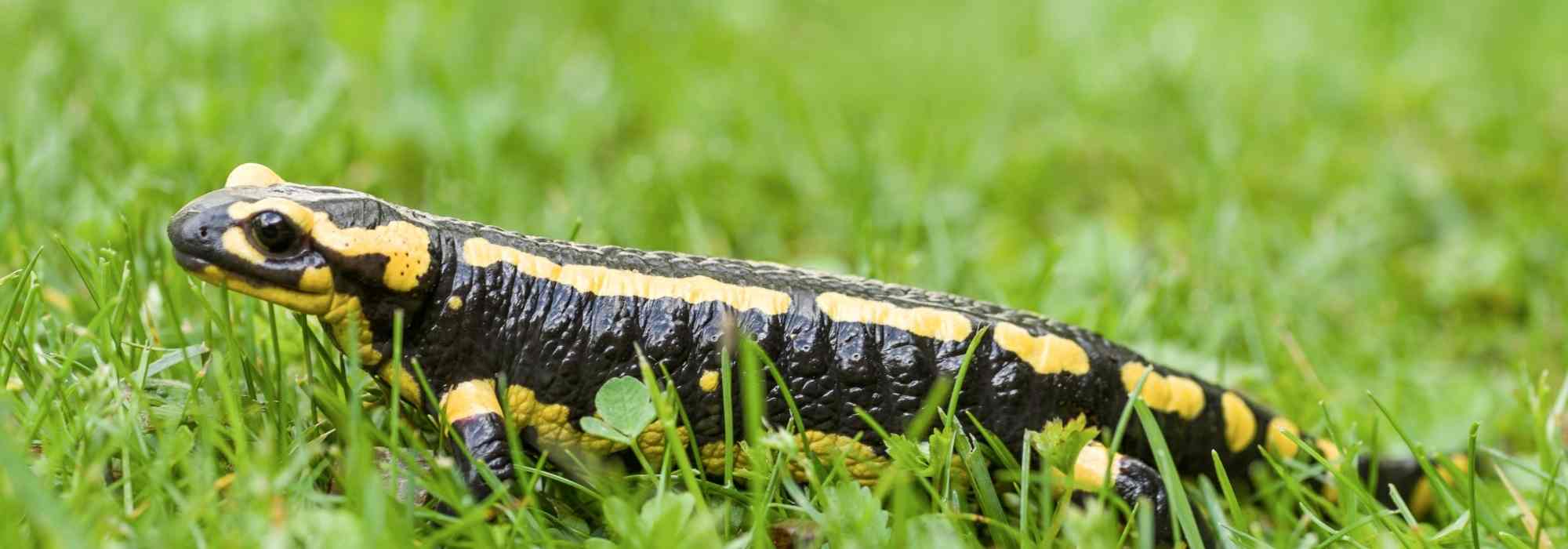
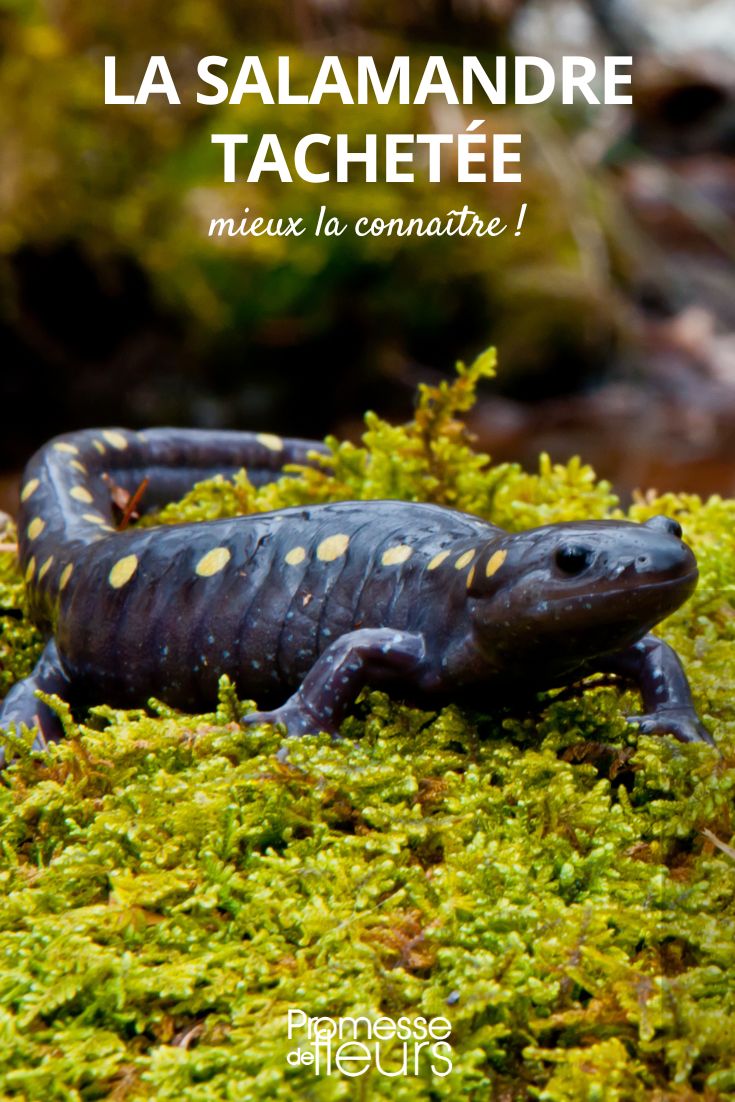
- The Spotted Salamander or Common Salamander (Salamandra salamandra): a salamander measuring 14 to 18 cm long, black, spotted with yellow. The position and extent of the yellow spots vary from one individual to another. These spots can even merge into almost continuous longitudinal bands. The eyes are large, black, and prominent. The skin is shiny but dry. The tail is round in cross-section. This salamander is found throughout France, except in Corsica;
- The Alpine Salamander (Salamandra atra): a small all-black salamander found at high altitudes;
- The Corsican Salamander (Salamandra corsica): a black salamander, spotted with yellow, endemic to the island of Corsica;
- The Lanza Salamander (Salamandra lanzai): a large black salamander, mainly found in Italy, but also in the French Alps.
In Belgium, only the Spotted Salamander is present in the forested areas.
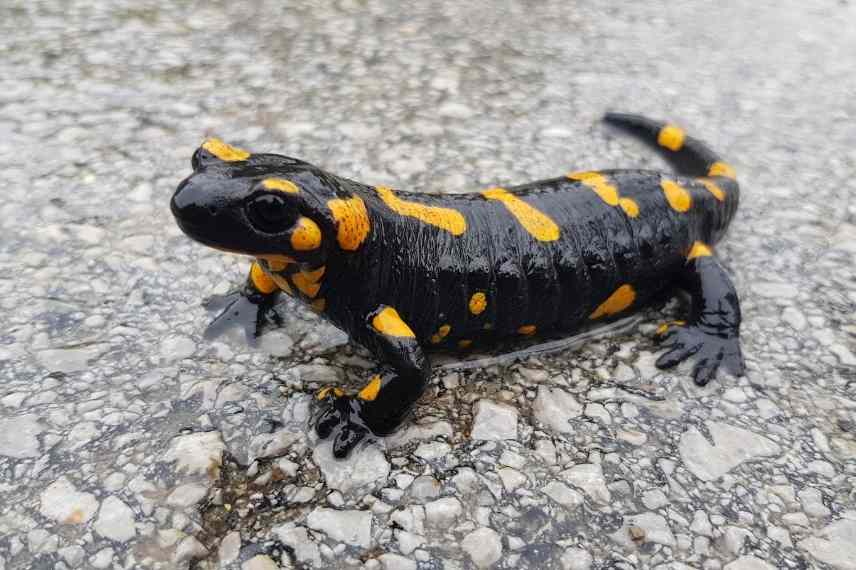
Salamandra salamandra
Read also
The Swiss Grass SnakeHow does the Common Salamander live?
The Spotted Salamander or Common Salamander (Salamandra salamandra) is the most common in our regions, although relatively rare in the wild. The other species are more anecdotal.
Habitat
The Spotted Salamander lives in forested areas, particularly in deciduous forests. In autumn, it hibernates in very humid caves or cellars.
Behaviour
The Salamander is a discreet animal, which moves little, and is primarily nocturnal. They are mostly seen at night during rain following a dry spell. Adults are strictly terrestrial and only return to water to lay their eggs. The larvae live in water. Unless faced with an unfortunate event, a Spotted Salamander typically lives for around twenty years.
The adult Salamander secretes a toxic substance (completely harmless to humans or pets), called samandarine, and its colours (black and yellow) are said to be aposematic, warning potential predators with the message “I am not good to eat.” Consequently, adult salamanders have no predators (the only threat comes from humans running them over with cars or destroying their habitat). However, salamander larvae are consumed by fish, the water shrew, dragonfly larvae, and ground beetles.
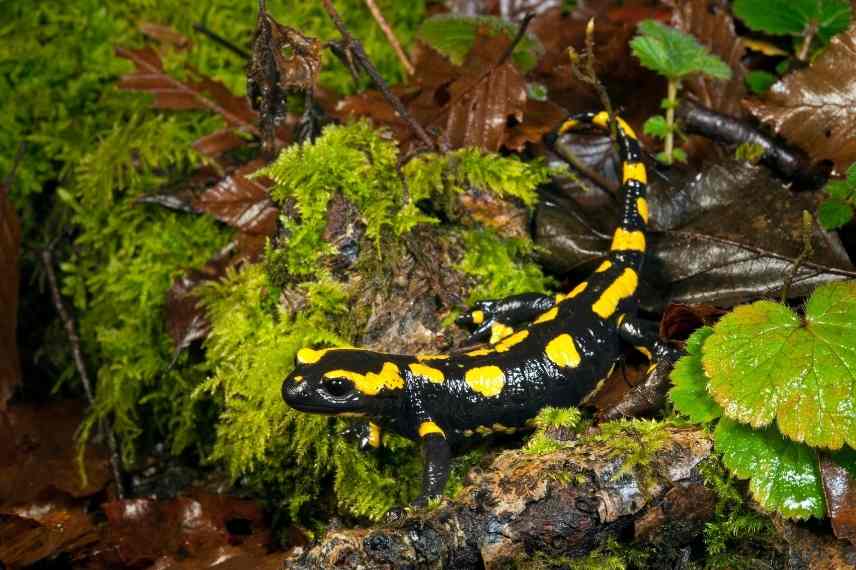
The salamander in its natural habitat
Reproduction
The salamander is ovoviviparous, meaning that the eggs hatch inside its body. The female then deposits her larvae in streams from January to June, and sometimes in autumn. The larvae grow in small, fast-flowing streams, more rarely in springs, ponds, or ruts.
Diet
Spotted Salamanders primarily eat woodlice, insects, spiders, and slugs, but they can also feed on young newts or frogs. Salamanders hunt by scent at night, and their prey tends to move during the day, the rare occasions when they are active in daylight.
Reminder: What is an amphibian? Amphibians (or batrachians) are amphibious animals, meaning they can live in and out of water. These animals undergo complete metamorphosis. For example: frog egg, then tadpole, then frog. Respiration occurs through the skin, which is covered in glands that secrete a viscous substance. These are the main characteristics of amphibians or batrachians (an older term). As their skin is naked (without hair, feathers, or scales), amphibians should be handled with damp hands to avoid injury. In any case, it is best to avoid disturbing them.
Why and how to protect the salamander?
Why protect the Spotted Salamander?
The Spotted Salamander is fully protected in a large part of Europe, under the Bern Convention. Although it is less rare than previously thought, the Common Salamander still faces threats to its survival. The replacement of leafy forests with resinous plantations restricts its habitat. The crushing of salamanders on roads that cross forests also significantly reduces populations. The channelisation of streams prevents breeding and the development of larvae. Recently, a pathogen from Asia (a microscopic fungus named Batrachochytrium salamandrivorans) has been wreaking havoc on salamander populations. In short, we should be a bit concerned for these charming little creatures.
What can be done to protect it?
It is difficult to take action in your own garden for the conservation of salamanders, unless you live on several wooded hectares crossed by a stream. However, you can reach out to a national or local nature protection organisation. Each year, they organise awareness days and actions concerning amphibians, including salamanders. Don’t hesitate to volunteer; nature protection organisations need people!
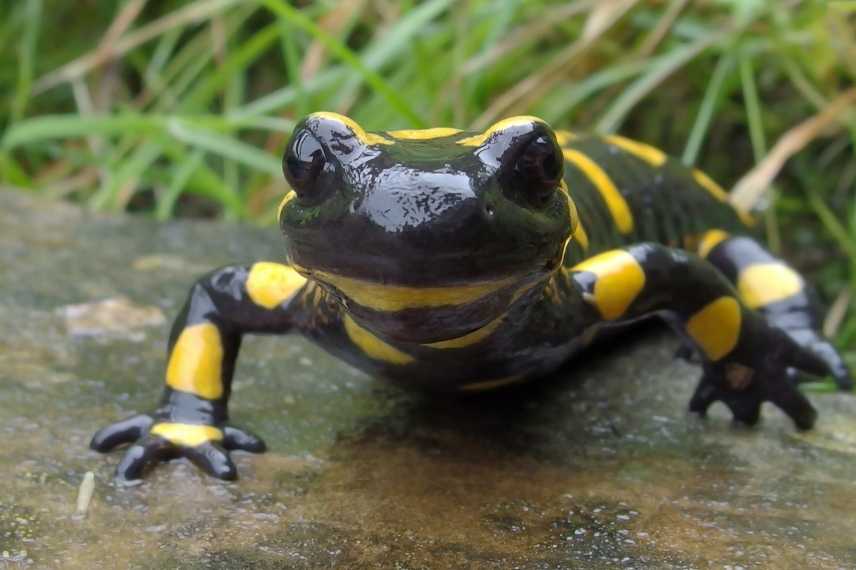
Salamandra salamandra
Read also
Creating a natural pond in your gardenTriton or Salamander: no more confusion
- The common Salamander is yellow and black, while the Newt often has orange on its belly (notably the Alpine Newt), sometimes with dark spots or webbed feet, and a crest develops on the male’s back during the breeding season;
- The adult Salamander is terrestrial and does not swim, while the newt moves on land and in water and swims very well;
- The head of the salamander is large, whereas that of the newt is small in relation to its body;
- The salamander’s tail is round in cross-section, while the newt’s is flattened for swimming;
- The newt is oviparous (lays eggs), while the salamander is viviparous;
- The salamander is nocturnal, while the newt is diurnal during its aquatic phase;
- The salamander lives in forests, while the newt can more easily be found in a garden when there is a pond nearby.
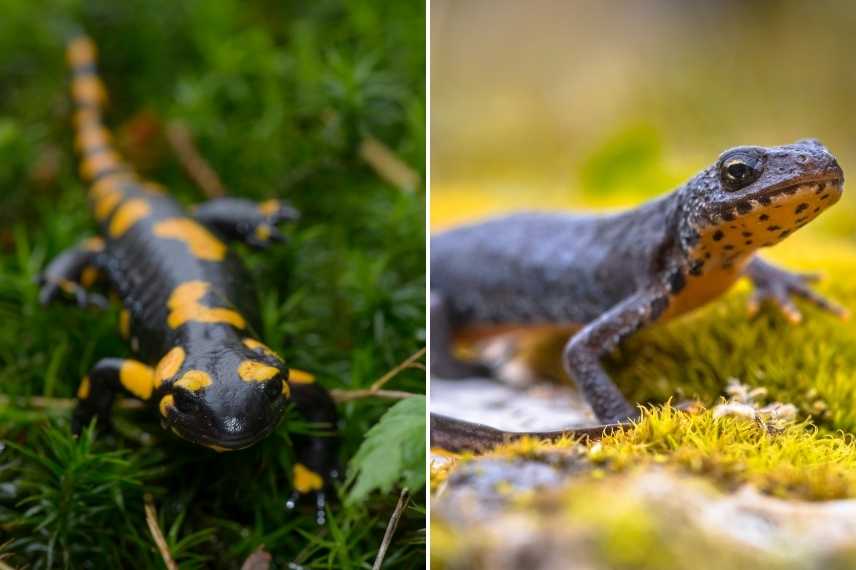
Salamander on the left, newt on the right
- Subscribe!
- Contents
Comments