





























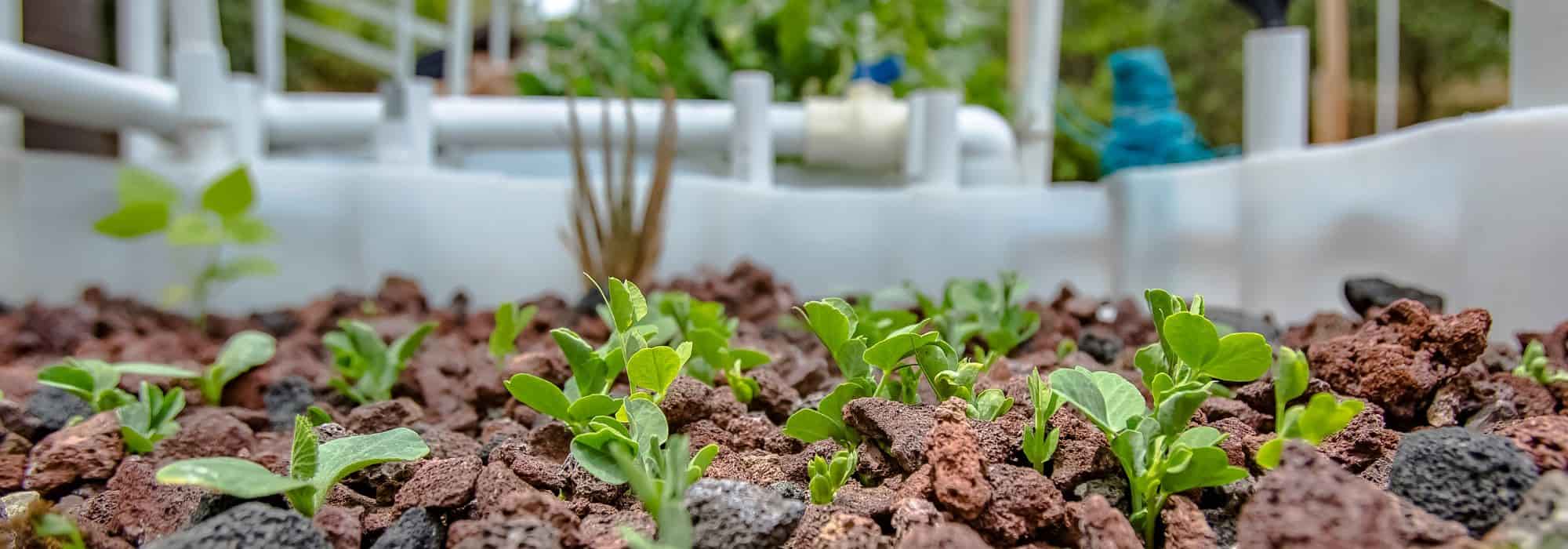
What exactly is aquaponics?
Understanding and installing an aquaponic system in your garden or even in your garage
Contents
Right from the outset, to understand what aquaponics is, we’ll take a detour into its etymology. In fact, The word “aquaponics” is a word derived from the contraction of the terms “aquaculture” and “hydroponics”. In short, aquaponics is a cultivation method that combines fish farming with the cultivation of vegetables in water, without soil. It’s a system based on mutual give-and-take, as the fish and the plants benefit from each other to produce healthy vegetables. It is, above all, a virtuous cultivation technique, a soilless ecosystem that allows both to grow vegetables, berries or organic aromatics while raising fish (which can also be eaten or simply used within the system).
Let’s try to understand how aquaponics works and how to set up an aquaponics system.

What exactly is aquaponics?
Aquaponics is a revolutionary technique that combines aquaculture, fish farming, and hydroponics, the cultivation of plants in water. This system creates an ecosystem in which plants and fish coexist to mutual benefit. Although seemingly innovative, Aquaponics has been practised for millennia by other civilisations than our own, in Asia and Latin America, for example. Thus, the Aztecs cultivated plants on chinampas, rafts of reeds and rushes, covered with mud, on the lakes. The roots of the plants stretched through the rafts to draw the nutrients from the water that they needed. In Asia, peasants practised rice-fish farming with fish and prawns.
The aquaponics as developed today originated in the United States in the 1970s to address the energy crisis. Today, aquaponics has spread worldwide and is already being tested on a commercial scale.
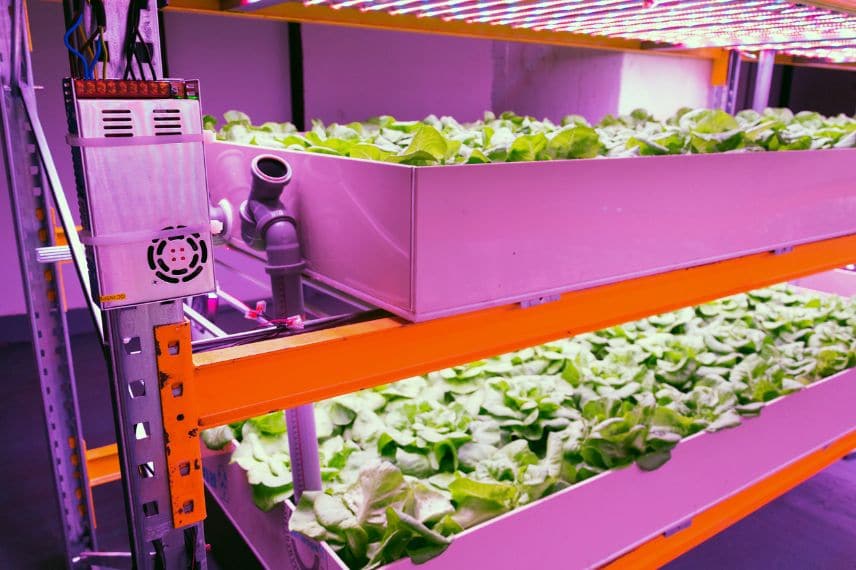
A large-scale aquaponic system
This cultivation method, based on the symbiosis between fish and plants, can readily be applied to a more domestic practice. It is a circular, virtuous system that enables food production. Aquaponics relies on three players: fish (which may eventually be raised for consumption), plants (mostly vegetables), and bacteria, which are the essential interface for the proper functioning of the system.
How does an aquaponic system work?
Aquaponics is a closed system that relies on the interaction between fish, bacteria and plants. Specifically, fish are raised and fed in a tank. Their droppings, rich in nutrients such as nitrogen, phosphorus, potassium, calcium and iron, end up in the basin water, which is directed to the plant grow bed. There, bacteria take over and transform the ammonia in the water, derived from the droppings, into nitrite, and then nitrates. This process is called nitrification. From then on, the plants, via their root system, can absorb these nitrates, but also all the nutrients and mineral elements contained in the water, to feed themselves, grow, and produce.
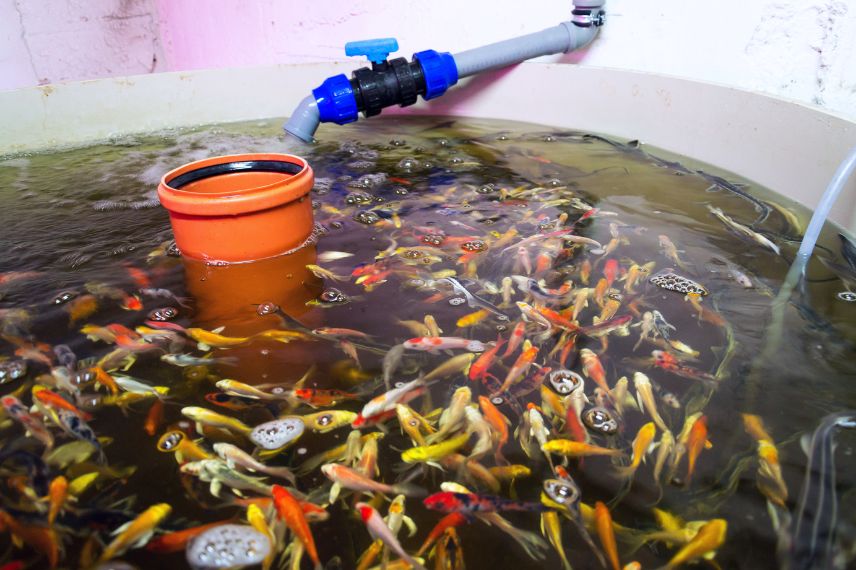
Aquaponics is a combination of aquaculture and hydroponics
The water is thus freed of nitrogen, which is very useful to plants but toxic to fish. It returns purified to the fish tank. We are thus in a closed loop where waste is used to produce food. The water is recycled and used indefinitely. All that is needed is to top up with a little water to compensate for evaporation.
Aquaponics essentially reproduces what happens in a pond, lake or reservoir; it uses the natural nitrogen cycle.
Aquaponics: Which fish? Which plants?
The simplest aquaponics systems use goldfish, hardy fish that adapt well to life in a tank or pond. Koi carp are also suitable if you wouldn’t dream of eating your fish!
However, for those who want to combine eating the fish with growing vegetables, you should choose edible fish such as tilapia, perch, rainbow trout, carp, grayling or catfish.
As for potentially cultivable vegetables, these are essentially leafy greens that are not particularly nutrient-hungry to grow. Thus, the salad leaves (lettuce, watercress, rocket…), the spinach, the Chinese cabbage, the leeks, the celery stalks, the peas and the beans, the chard, the cabbage (cauliflower, broccoli)… but also the aromatic herbs such as the parsley, the basil, the coriander, the chives, the mint, the dill… or even the edible flowers.
Conversely, fruit vegetables (tomatoes, peppers, aubergines…) require somewhat more elaborate systems with larger ponds and more fish. As for root vegetables, they are also more difficult to grow, as they require a deeper growing bed.
Read also
The best plants for phytoremediationThe advantages of aquaponics
The aquaponic ecosystem, built on a fine balance and a symbiosis between organic and biological, offers numerous advantages:
- Aquaponics allows you to grow and produce organic, perfectly healthy vegetable plants, since the use of nitrogen fertilisers and pesticidal products is completely unnecessary and, above all, harmful to the well-being and health of the fish. Moreover, this system has no impact on the environment; it is absolutely non-polluting for air or soil.
- It is a water-efficient system since the basins operate in a closed loop. Water is continually reused. Experts estimate water savings of around 90% compared with a traditional irrigation system. Additionally, watering sessions become unnecessary, and the vegetables are drought-tolerant.
- Aquaponics requires little space and can be set up indoors (for example in a garage) as well as outdoors, in rural environments as in a city. It is furthermore a means of enabling the cultivation of your own vegetables even if you have poor, infertile, or even polluted soil.
- Vegetable plants are free from soil-borne diseases transmitted through the soil.
- The growth of vegetables is faster than in conventional gardening as they have a plentiful and continuous supply of nutrients.
- Vegetable production extends over a long period and, with an appropriate lighting system, you can even extend the production seasons.
- Aquaponics eliminates the effort, physical labour and aches associated with digging, hoeing and weeding… Moreover, the basins are waist-height, so no more backache!
- The aquaponic system is engaging for children who watch the vegetables grow and the fish flourish. And, thanks to the ease of sowing, planting and harvesting, they can take part.
There are drawbacks and constraints as well!
However, even though the advantages are numerous, there are a few drawbacks to bear in mind before getting started with aquaponics. Maintaining the balance between the needs of the fish and those of the plants requires constant understanding and monitoring. An imbalance can lead to the death of the fish or the plants, compromising the entire system. Thus, you must maintain a constant and balanced water temperature for both the fish and the plants between 18 and 30°C. This balance can be difficult to achieve, especially with extreme weather. As for the pH, it should be between 6 and 7, water that is too alkaline or too acidic can quickly prove deadly for the fish.
In addition, the start-up of an aquaponic system can be costly, due to the necessary infrastructure, such as fish tanks, filtration systems and grow beds. The initial installation also requires a ripening phase, during which the bacteria needed to convert ammonia into nitrates must develop sufficiently. This phase can take several weeks, during which it is crucial to monitor ammonia, nitrite and nitrate levels.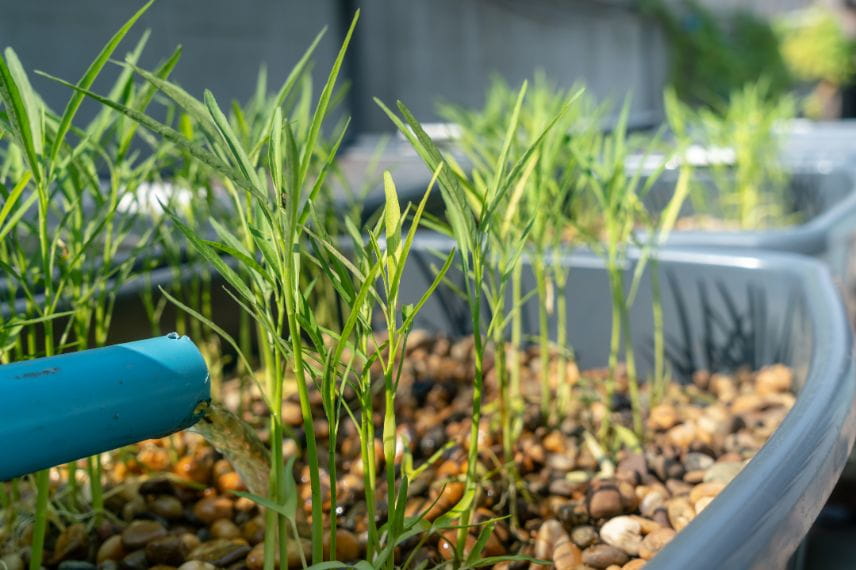
Aquaponics requires a balanced diet for the fish, as the quality of their excretions directly impacts the health of the plants. It is therefore essential to choose high-quality feeds suitable for the species of fish kept.
Finally, although aquaponics is a sustainable method of cultivation, it relies heavily on electricity to run the pumps and filtration systems. This can pose problems in the event of a prolonged power outage. And this consumption represents a non-negligible cost.
How to start an aquaponics project?
The simplest way to start aquaponics is to buy an aquaponics kit. If you’re a bit handy, you can also implement your own system in several steps.
The choice of the aquaponics system is an important step. First, you need to choose the fish tank which depends on the volume of plants and the number of fish. Next, you need to select the grow bed. The most common systems are the grow bed system, where plants grow in a gravel bed or expanded clay, and the NFT system (Nutrient Film Technique), where the plant roots are suspended in a channel through which a thin film of nutrient-rich water flows.
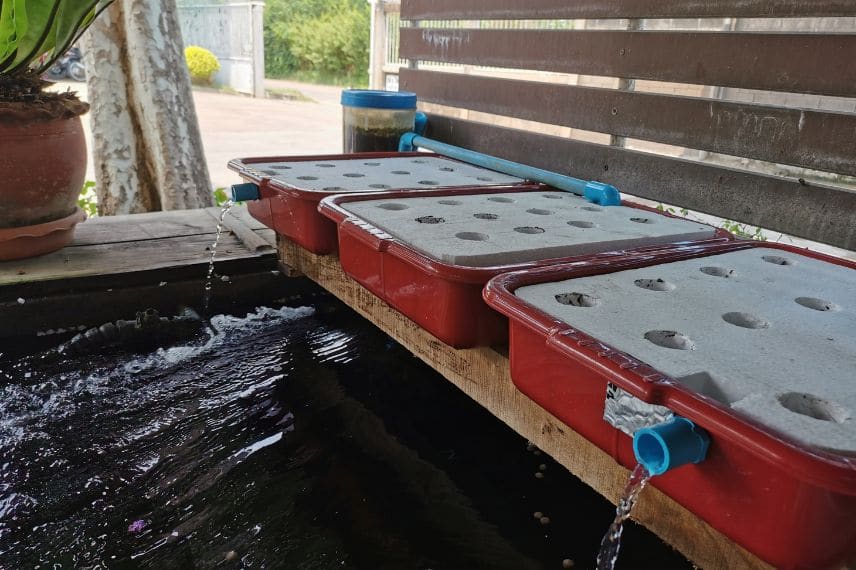
Aquaponic system being installed
Installing a pump and a filtration system is essential to maintain the balance of the ecosystem. The pump circulates water between the fish area and the plant-growing area, while the filter helps remove solid waste and keep the water clean.
The final step is to choose the ideal location, with a stable temperature, good light and shelter from the weather (greenhouse, under a balcony…). Finally, you will need to select the fish and the plants.
- Subscribe!
- Contents
Comments