





























Which Dasylirion should you choose to enhance your garden?
Buying guide to finding the ideal Dasylirion
Contents
Originating from semi-arid regions of the southwestern United States and Mexico, the Dasylirion is a woody plant with a striking, architectural habit, suitable for a Mediterranean or contemporary garden. It bears a radiant globe of slender, long evergreen leaves. With age, it forms a trunk that curves, and when it flowers in summer, it produces a spectacular flowering stalk three metres tall, adorned with numerous small cream-coloured or yellow flowers. Highly drought-tolerant and very hardy when grown in well-drained soil, it needs plenty of sun and warmth to thrive and is well suited to regions with a Mediterranean climate. It can be grown in pots in other regions if the substrate provides excellent drainage, as its roots fear moisture in cold climates. Discover our buying guide to help you choose a Dasylirion according to various criteria and pick the one that appeals to you most.

Choosing a Dasylirion for its foliage
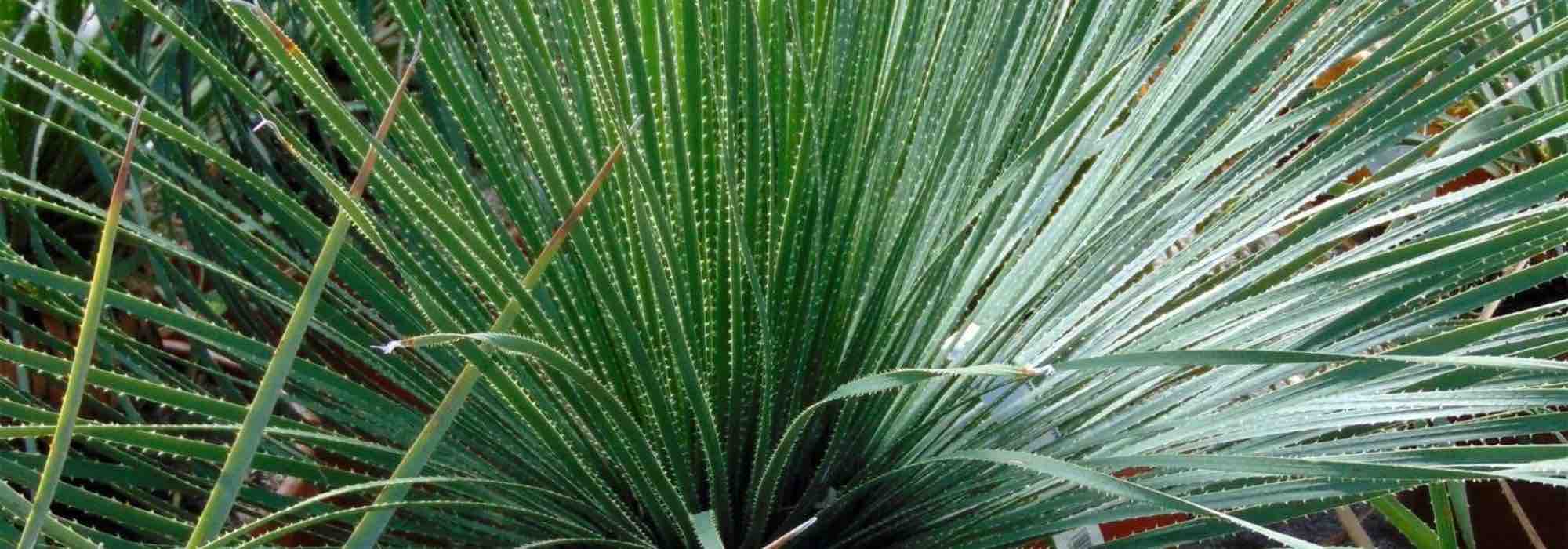
Dasylirion features a linear, highly graphic and decorative foliage as it is evergreen.
It offers several colour variations and different characteristics.
– The leaves of Dasylirion can be light green like Dasylirion leiophyllum – Sotol or Dasylire, a deep green like Dasylirion lucidum – shiny Sotol, bluish-green like Dasylirion wheeleri or the Dasylirion serratifolium – Dasylire, Sotol, and a vivid green like Dasylirion longissimum.
– They can be edged with spines like Dasylirion glaucophyllum, or less spiny like Dasylirion lucidum – shiny Sotol.
– Some resemble rush leaves like Dasylirion longissimum and others are spineless like Dasylirion quadrangulatum – Dasylire or Sotol quadrangulaire. Some leaves have a tuft of fibres at the tip like Dasylirion wheeleri, while others bear a small hook at the tip like Dasylirion acrotrichum – Dasylire acrotriche. The Dasylirion quadrangulatum – Dasylire or Sotol quadrangulaire forms a rosette of thread-like and radiating leaves that resemble a bouquet of optic fibres.
– Leaf widths vary by species. Thus, Dasylirion quadrangulatum – Dasylire or Sotol quadrangulaire forms thread-like leaves with a square cross-section while Dasylirion cedrosanum – Dasylire bears broad leaves about 2.5 cm wide.
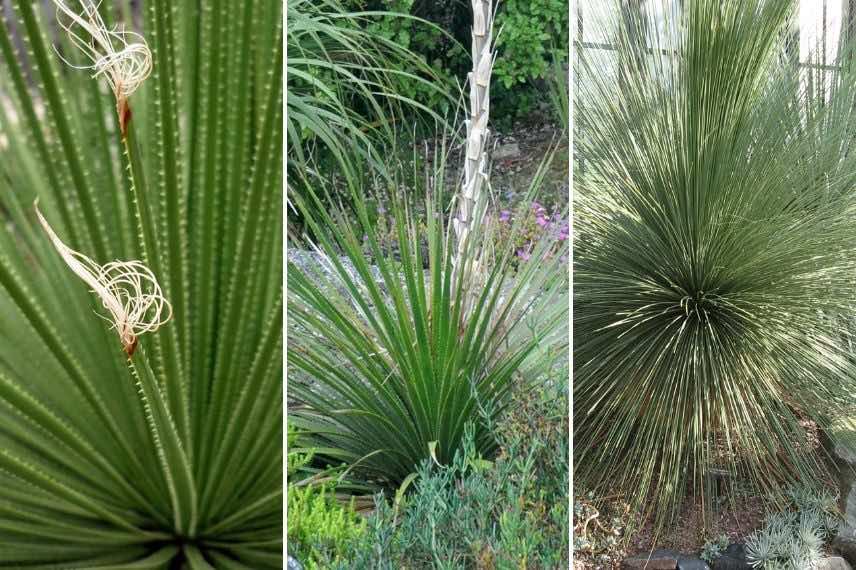
Dasylirion acrotrichum, lDasylirion cedrosanum and Dasylirion longissimum
Choose a Dasylirion for its flowering
The spectacular flowering of Dasylirion is well worth waiting for, since it flowers after 10 to 15 years. But that is worth it, because the flowering stalk measures over 3 metres long and is typically covered with creamy-white flowers.
The Dasylirion glaucophyllum stands out from other species for the yellow colour of its flowers. Flowering occurs between June and August.
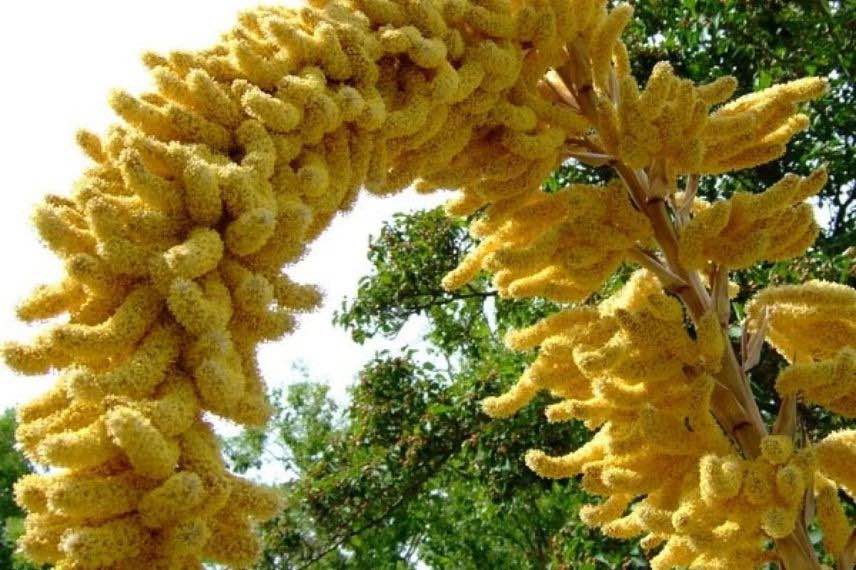
The flowering of Dasylirion
Choosing a Dasylirion for its size
Dasylirion grows slowly and its height at maturity can vary from 1.70 m to over 2 m.
Dasylirions from 1.0 m to 1.50 m
Most Dasylirions reach a height of about 1.50 m after many years, such as the Dasylirion wheeleri, the Dasylirion longissimum, the Dasylirion acrotrichum – Dasylire acrotriche and the Dasylirion serratifolium – Dasylire, Sotol.
Dasylirions 2 m and taller
The Dasylirion glaucophyllum, the Dasylirion lucidum – glossy sotol, the Dasylirion cedrosanum – Dasylire, the Dasylirion miquihuanensis and the Dasylirion texanum – Texan sotol can reach 2 metres tall, again after many years spent in the garden.
Choose a Dasylirion according to its habit
Old specimens are recognisable by the rosette of linear leaves borne on a trunk. This trunk curves and may even lie on the ground as the years pass, creating a distinctive silhouette.
The Dasylirion lucidum – Shiny Sotol has the feature of producing several trunks, at the ends of which rosettes of leaves will grow.
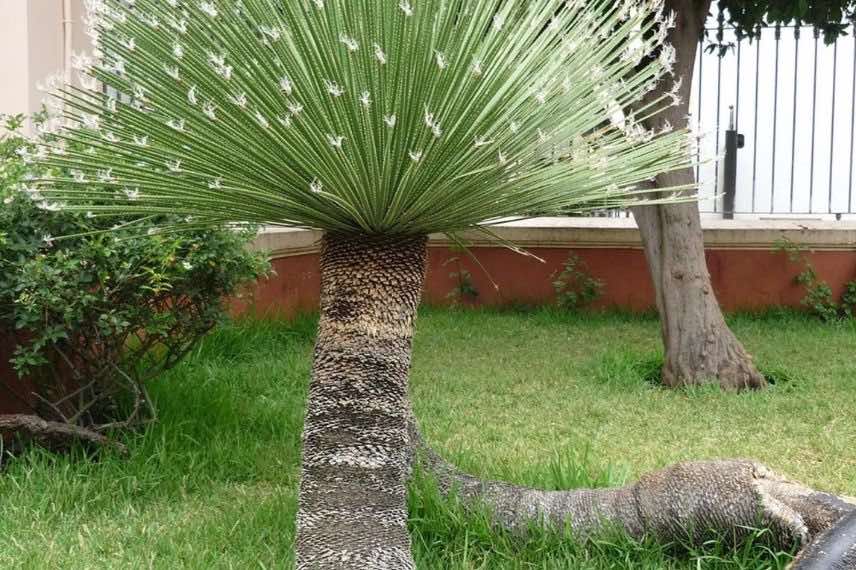
An aged specimen of Dasylirion acrotichum
Choosing a Dasylirion based on hardiness
- Dasylirion is fairly hardy to frost when planted in very well-drained soil.
- Some Dasylirions are hardy down to -9.5°C in the ground and in very well-drained soil, such as Dasylirion quadrangulatum – Dasylire or quadrangular Sotol or the Dasylirion cedrosanum – Dasylire.
- Others are even hardier still, as they can withstand temperatures down to -15°C such as the Dasylirion wheeleri or the Dasylirion miquihuanensis.
Choosing a Dasylirion based on its intended use
- You can plant a Dasylirion in an exotic or Mediterranean-style border in a garden, as is the case for the Dasylirion miquihuanensis or the Dasylirion serratifolium – Dasylire, Sotol.
- They can also be planted in a large rock garden, on a dry slope, or as a specimen to emphasise their architectural form.
- It is also possible to plant a Dasylirion in a large tub, which allows you to bring it indoors for the winter if the substrate does not drain well or if you live in a region with very cold winters, as with the Dasylirion wheeleri or the Dasylirion acrotrichum – Dasylire acrotriche.
To learn more, discover our full range of Dasylirion, as well as our care guide on the cultivation and planting of Dasylirion.
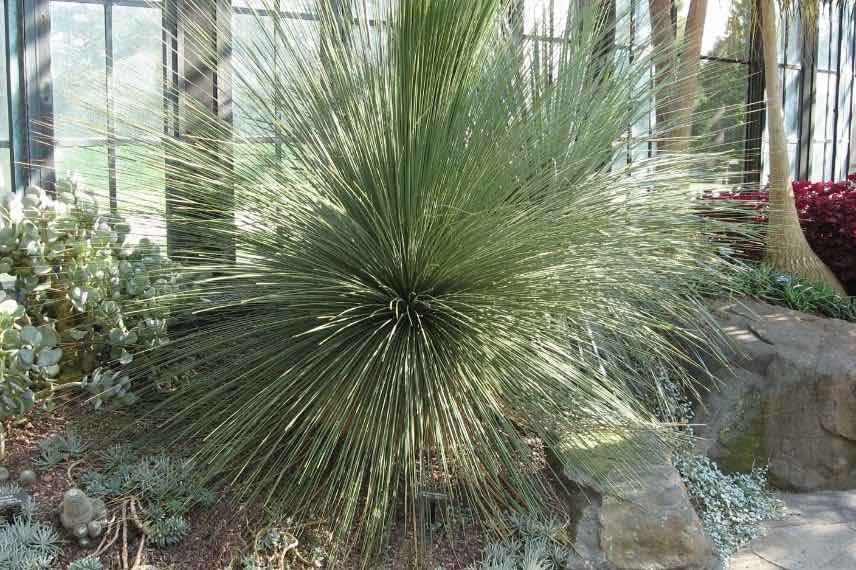
A Dasyrilion longissimum in a rockery, an ideal and obvious use
- Subscribe!
- Contents
Comments