





























My handkerchief tree is not blooming, why?
The various reasons that affect the flowering of Davidia
Contents
Anyone who has ever seen the flowering of the handkerchief or dove tree (Davidia involucrata) will surely remember it. But you may not know the handkerchief tree, sometimes called the pocket-handkerchief tree, the dove tree or ghost trees. This tree, native to China, where it was discovered and described by Father Armand David, the renowned missionary naturalist, in 1869, was introduced to Europe in 1897. Even though several specimens, mostly century-old, are planted in the botanical gardens of Tours, Montpellier, or at the Arboretum des Barres in the Loiret, this tree remains rare in private gardens.
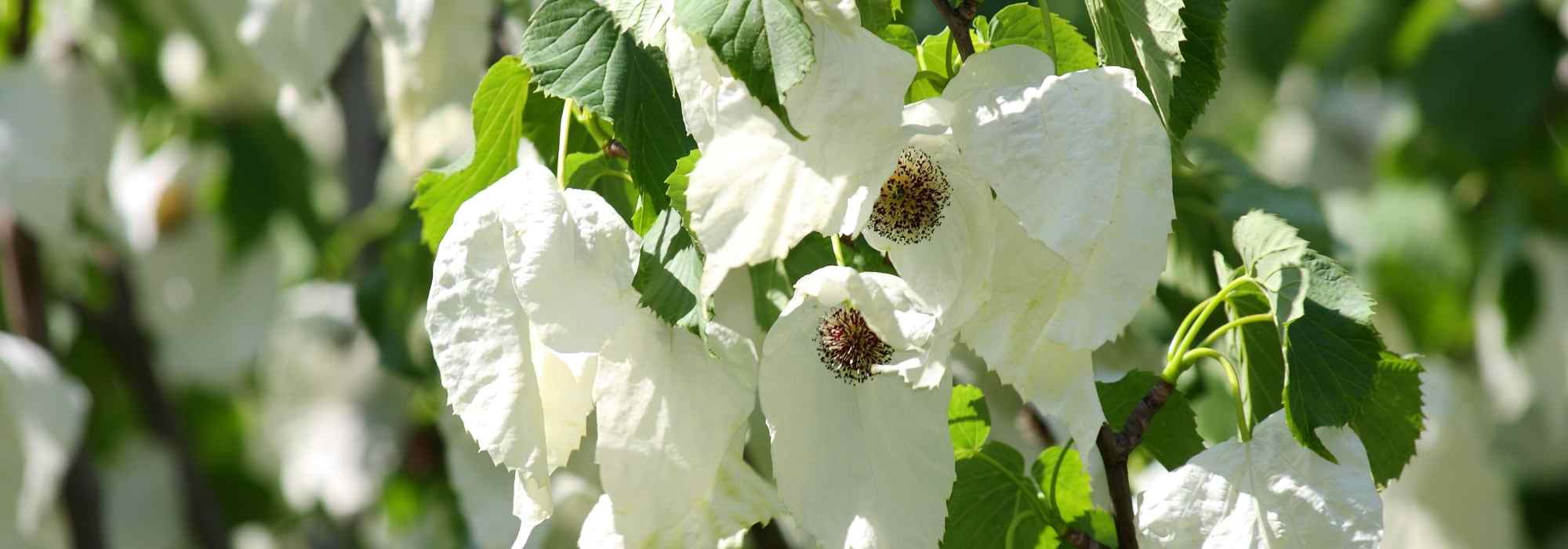
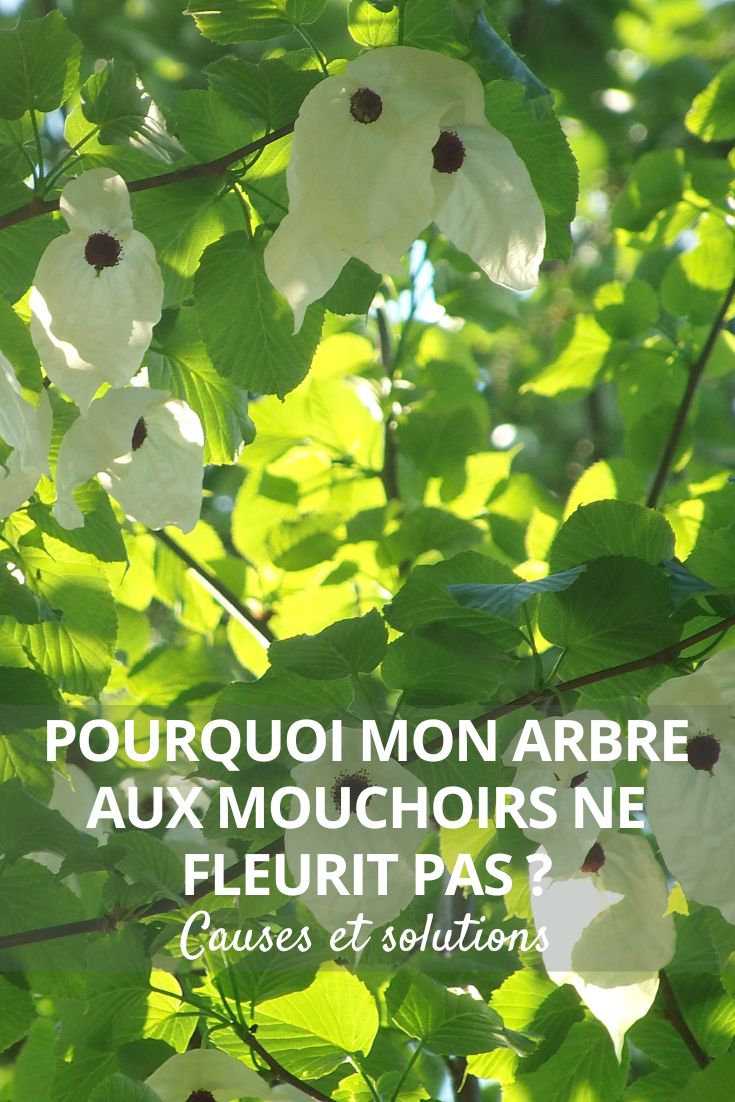
However, it offers a truly spectacular flowering: the two white bracts, of different sizes, surrounding the flower, formed by a globose ball of stamens, evoke handkerchiefs hanging from the current year’s shoots. These bracts turn green as they age and usually appear in May. They never fail to impress curious gardeners.
Sometimes this flowering doesn’t live up to expectations. Discover with us the reasons why Davidia involucrata does not flower. And, above all, the means to remedy this absence of flowers.
Further reading : Handkerchief tree, Davidia: planting, pruning, care

Because it is too young
If you planted your handkerchief tree a year or two ago, there’s no point waiting for flowering this year, or in the next few years. Indeed, the Davidia involucrata is a tree known for taking its time! It takes at least 10 years to produce its first flowers, and 15 to 20 years for the slowest specimens. That’s why patience is required to enjoy this flowering that is both aesthetically striking and original. In May, trees at least 10–12 years old come into bloom, but it is somewhat ephemeral, lasting only about three weeks. Still, the wait is worth it!
On the current-year shoots, small globose inflorescences appear, made up of numerous stamens at the base of an involucre formed of two opposite bracts resembling paper handkerchiefs, light as air, as if hanging from the branches after a strong gust of wind. The bracts, about 20 cm long, undulate and are heavily veined; they are obovate and pendulous. Initially pure white to ivory, these bracts turn green with time. As for the inflorescences, they combine the white of the stamens with the crimson-red of the anthers. A total delight for the eyes, heightened by the wait needed to enjoy it!
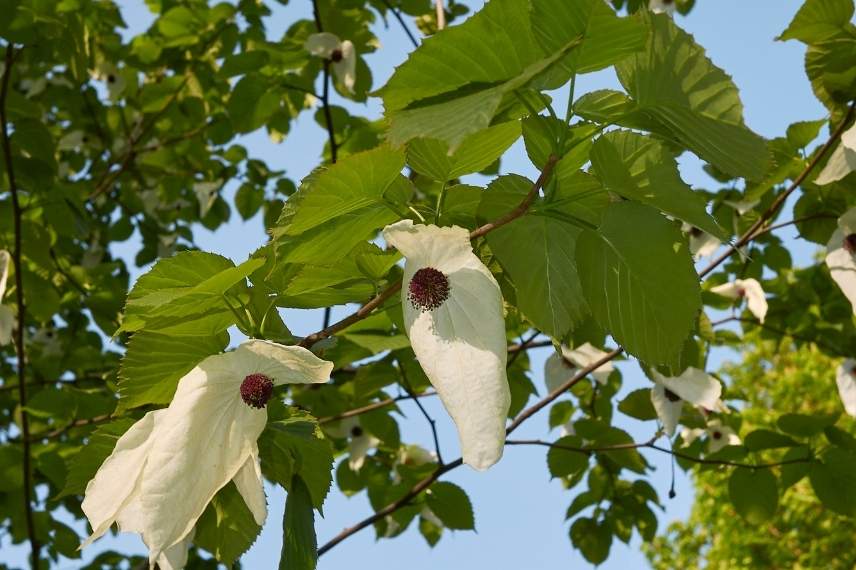
The handkerchief tree typically comes into flower after about 10 to 15 years
Less impatient gardeners can plant varieties of handkerchief tree, known to come into flower much earlier than the species. Starting with the variety ‘Sonoma’, which can produce its first flowers, as large and as beautiful as the others, as early as its second year — even in the planting year if it reaches at least 40 cm in height. Its small dark-green flowers are enclosed by long bracts of a creamy white. Admittedly, this first flowering is not abundant, but it has the merit of existing… and of keeping the gardener waiting.
Another handkerchief tree variety proves particularly precocious. It is the variety ‘Lady Sunshine’, which produces its first inflorescences in the second or third year after planting. Moreover, it features dentate, variegated foliage, with a dark-green lamina margined in cream.
Due to weather conditions
Your handkerchief tree is well past its flowering period, but May is approaching and no flower seems to want to bloom. Perhaps it’s worth looking at the weather conditions?
Indeed, the handkerchief tree can be sensitive to the caprices of the weather. And in particular to spring frosts and the intense heat of summer, even heatwaves.
With good robustness and a hardiness down to -15 to -20 °C, the typical species of the handkerchief tree (Davidia involucrata), but also the Davidia involucrata var. vilmoriniana, which is distinguished by the glabrous underside of its leaves, can be sensitive to late spring frosts. Indeed, the flowers, which form from April, are very fragile in the face of the slightest frost. This phenomenon is all the more pronounced by climate change in recent decades: winters are less cold, which leads to earlier growth of vegetation. And, at the same time, spring frosts are more numerous. As a result, flower buds damaged by frost in April will not bloom in May.
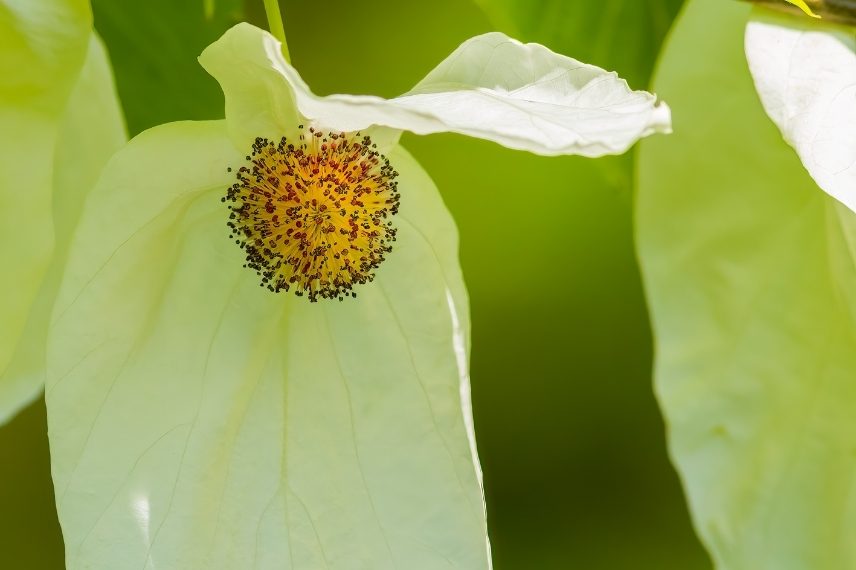
The handkerchief tree’s flowers are vulnerable to spring frosts
The other climatic phenomenon that can impact flowering is drought. Indeed, the handkerchief tree is sensitive to dry soils since, in its native habitat, it grows in moist soils (but not waterlogged). A dry soil will be fatal to it and, very quickly, it will suffer from water stress. Thus, a handkerchief tree that does not receive regular watering quickly suffers from water stress. Which can compromise its flowering.
Because it does not benefit from the best growing conditions
The handkerchief tree isn’t necessarily a difficult tree to grow or demanding, provided it has optimal growing conditions. Conditions that will allow it to reward you with splendid flowering. Of course, if your tree is already established, you won’t be able to do much in terms of exposure or soil type. But you can improve its care.
The ideal soil and location for an optimum flowering
Thus, the handkerchief tree must absolutely be planted in deep, fertile, humus-bearing and cool soil. It must above all be perfectly drained and fairly light. It will also have a preference for neutral soils or those tending toward acidity. By contrast, calcareous soils don’t suit it well. And, as noted above, it doesn’t tolerate dry soils that hinder its flowering. If you want to plant a handkerchief tree, remember to add sand or gravel if your soil is heavy or clayey. Likewise, a good supply of well-decomposed compost or manure is recommended.
Sun exposure is also essential for the flowering of handkerchief trees. Indeed, this tree detests scorching sun, extreme heat, but also cold winds and spring frosts. That is why it must be planted in a location well sheltered from strong winds and spring frosts, and preferably semi-shaded, but with plenty of light.
In the end, Davidia involucrata likes not-too-warm, slightly humid, and fairly sheltered atmospheres. An oceanic climate suits it quite well.
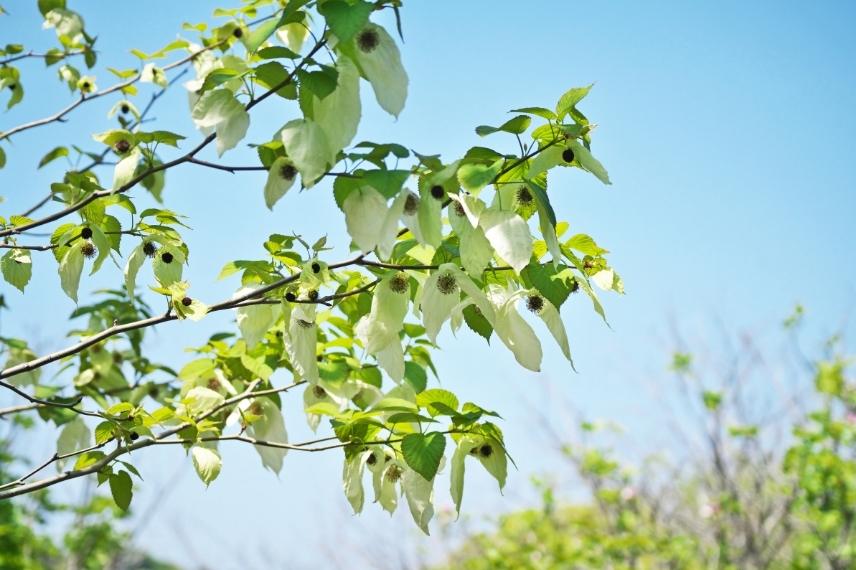
Handkerchief tree dislikes dry soils and scorching sun
What care is needed to obtain beautiful flowers?
If your handkerchief tree has been planted in optimal conditions, it will be vigorous and floriferous. If not, you will need to step up its care to hope for flowering.
Thus, watering should be substantial and regular for the two years after planting, especially in spring and summer. It is better to water once a week in large quantities than every day in small amounts. If your soil isn’t cool enough, watering should continue beyond these two years. In winter, stop watering.
Fertilisation is also very important for the health and thus the flowering of a handkerchief tree that thrives in rich soils. Twice a year, in autumn and late winter, a good application of compost can be made at the base of the tree. It is also possible to add a well-balanced organic fertiliser rich in nitrogen, phosphorus and potassium to promote foliage as well as root growth and flowering. A fertiliser higher in potassium is particularly recommended to support flowering.
Read also
7 trees with white flowersPerhaps too severe a pruning?
If you have eliminated all the previous causes and your handkerchief tree still doesn’t flower, perhaps it is due to pruning being too severe. Indeed, the handkerchief tree is grown in a free-growing habit. This tree has a particularly graceful and elegant natural habit. Thus pruning should be minimal, limited to removing dead, damaged or crossing shoots.
If your tree is still young (less than five years old), you can still shape it to highlight the framework branches and the secondary branches.
- Subscribe!
- Contents
Comments