





























Why isn't my persimmon bearing fruit?
All our tips to ensure your persimmon tree bears beautiful orange fruits
Contents
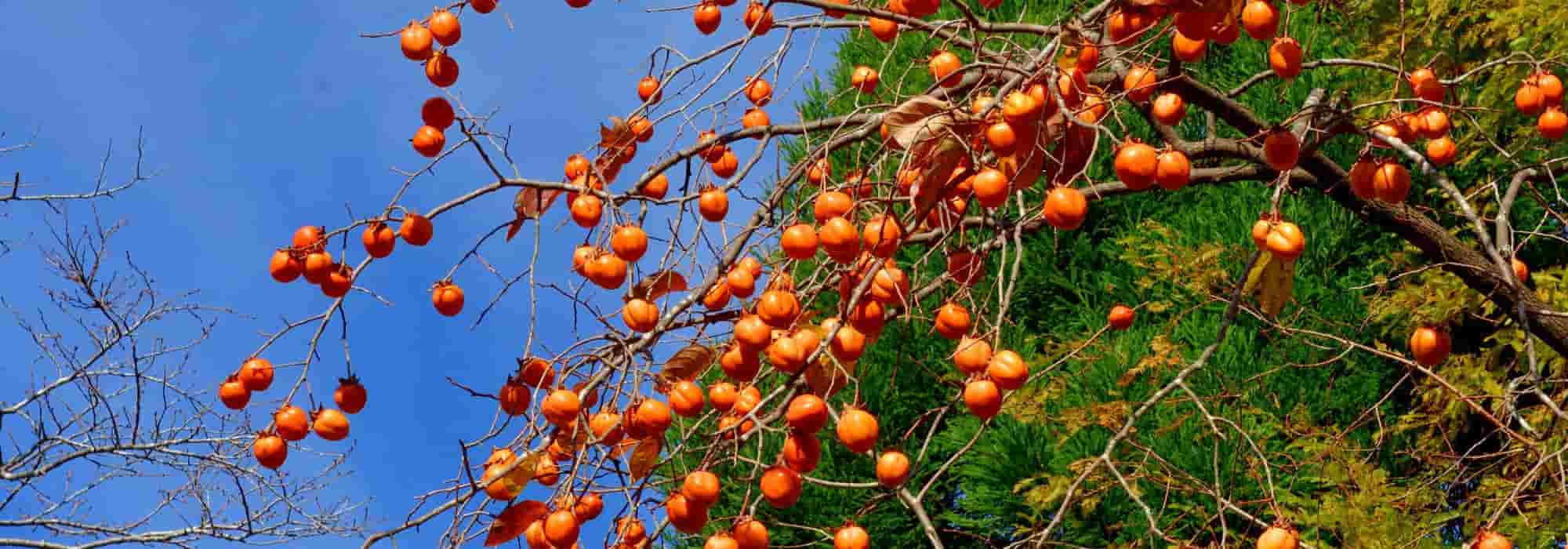
Persimmon tree (Diospyros kaki), also known as kaki, is a fruit tree that aims to be both productive and ornamental. It features deciduous, broad, ovate foliage and displays beautiful autumn colours in shades of orange-red. Spring flowering is ornamental from May to July: female flowers are cream-white, while male flowers are cream, yellow and green. But, once leaves have fallen, the persimmon reveals its great riches: its fruits. Indeed, persimmons reach ripeness between October and February depending on the varieties. And these handsome fruits with orange skins are stunning, hanging from the branches. What’s more, they do not drop and stay attached to the tree.
You have planted a persimmon in your garden or orchard, but it won’t bear persimmons for you? Yet you feel you’re giving it the best care. Let us look at the various reasons that can hinder your persimmon’s fruiting and, above all, what to do to remedy it.
Further reading :

Because it is too young
To obtain beautiful persimmons, patience is sometimes required. Indeed, depending on the varieties, fruit set can be irregular. Just as the flowering is. Some varieties will flower and fruit from the 3rd or 4th year, but for others, you will have to wait up to eight years.
Additionally, most persimmon trees are subject to alternate bearing, so flowering will occur only every other year. To avoid this alternation as much as possible, fruit thinning can be an effective solution.
Similarly, to make fruiting more regular, it is recommended to apply well-rotted manure annually to start with. Thereafter, applying manure every three years should be sufficient to have good-looking persimmons.
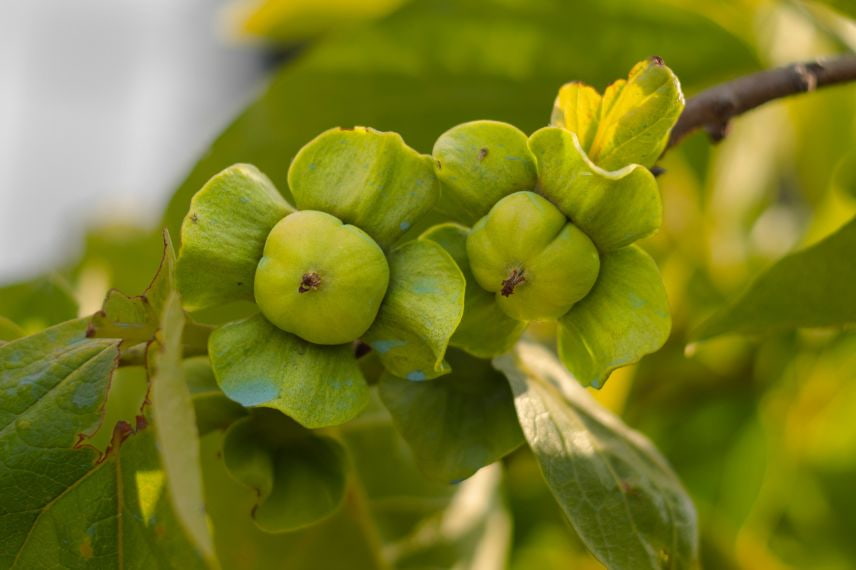
Persimmons in training
Finally, it is not uncommon for flowers to fall in large numbers, which results in absent or insignificant fruiting. This phenomenon is often linked to poor pollination or to a lack of pollination.
Like flowers, fruits can drop during the transformation from flower to fruit, about twenty days after flowering. This fruit drop can have several causes such as excessive moisture, insufficient light during flowering, a lack or an excess of nitrogen, or a phosphorus deficiency.
Because pollination is not taking place properly
On persimmon trees, flowering is unusual. A tree bears male flowers and female flowers. Female flowers are solitary, and open on vigorous branches, male flowers are grouped in threes and carried on slender branches. It is insects that carry out pollination of the flowers, fairly nectariferous. If there are not enough male flowers, pollination will not take place under favourable conditions. And the fruits will be few in number. Similarly, this pollination depends on the presence of insects—bees, butterflies, bumblebees, hoverflies or flies.
Nevertheless, most varieties offered for sale are parthenocarpic, meaning that pollination is not necessary for fruiting. But we obtain aspermous fruits, i.e., seedless. And often in smaller numbers.
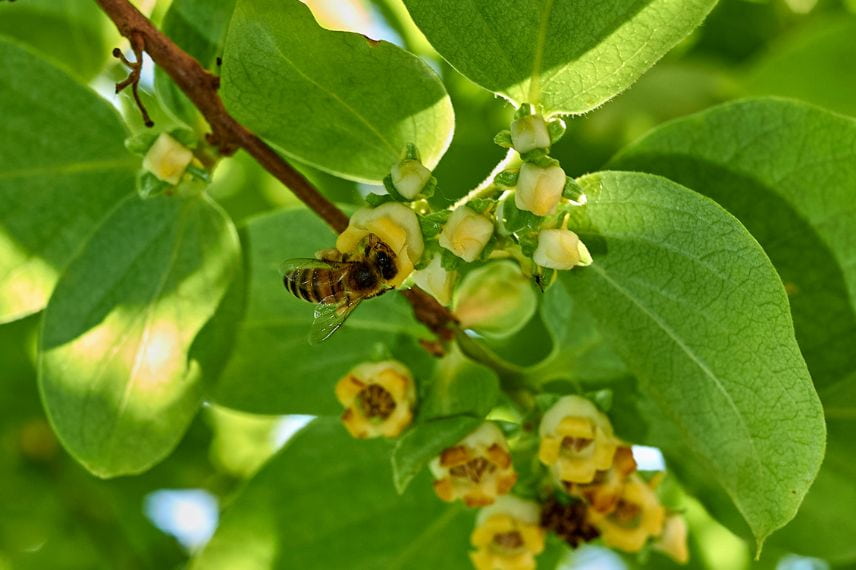
For persimmon trees, pollination occurs thanks to insects or by parthenocarpy
So, to sum up, if your persimmon tree does not produce persimmons, it may be because pollination is not taking place correctly. Consequently, planting another variety can increase the number of male flowers and facilitate pollination.
Because it does not benefit from the best climate conditions
Certainly, the persimmon tree is a fairly hardy fruit tree. The most widely distributed species, Diospyros kaki, shows a hardiness of around -15°C, just like the date-plum persimmon (Diospyros lotus). By contrast, the Virginian persimmon or Persimmon (Diospyros virginiana) proves more vigorous as it is hardy down to -25°C. That said, it can grow almost anywhere.
Nevertheless, a persimmon tree can thrive and offer attractive foliage and a lovely flowering without bearing fruit. Indeed, fruiting depends on fairly strict climatic conditions. First, persimmons appear on the current year’s new shoots. These young shoots, bearing flower buds, emerge fairly early in April or May. And, in many regions of France, spring frosts still rage at this time and literally burn the young shoots that will not bear fruit.
But to bear fruit, the persimmon tree mainly needs warmth in autumn. Indeed, harvest takes place between October and December, with full ripening occurring in autumn. And, this autumn warmth is really found only in the south of France, in the area known as the fig-tree zone. Even if, occasionally (or more regularly due to climate warming), persimmons can ripen in other regions that enjoy a mild autumn.
Finally, the persimmon tree needs a cool period to break its dormancy.
Because planting did not take place under the best conditions
If your persimmon tree yields no fruit, it may be because it was not planted under good conditions. Persimmon trees are mainly planted in autumn, or even in winter, always during the frost-free period. Planting can take place in spring provided it is watered consistently.
But it is mainly an unsuitable soil and poor exposure that can affect fruiting. Indeed, persimmon trees are relatively tolerant of most soil types, perhaps except for the type species Diospyros kaki, which does not tolerate calcareous soils at all. Nevertheless, a deep, well-drained soil, rich in organic matter and with good porosity is always preferable. Generally, persimmon trees do not tolerate excess moisture and soils where moisture stagnates. In such conditions, the fruits drop before they ripen. Similarly, sandy, very light soils lead to low yields, just as soils that are too dry do.
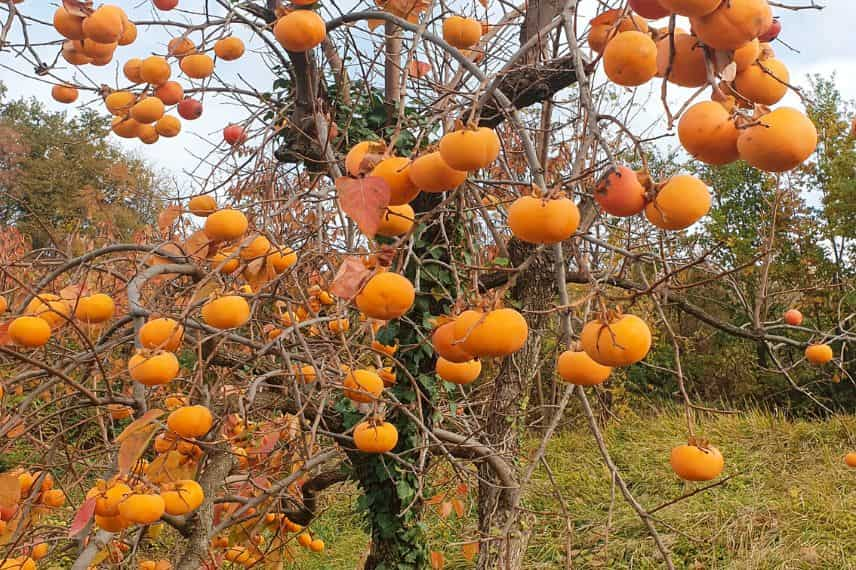
An unsuitable soil and poor exposure can affect fruiting
In terms of exposure, remember that the persimmon tree requires some autumn warmth to fruit well. That is why you should favour a site that is well sheltered from winds and cold currents, sunny and airy. A south-, southeast or southwest-facing exposure is ideal.
Because you’re not giving it the right care
Overall, persimmon trees are not particularly demanding in terms of maintenance, but they do require a few care measures to provide you with beautiful harvests:
- Watering can be essential if rainfall is insufficient, especially in regions with a dry climate or during a heatwave. Watering should be carried out every 3 to 4 days, mainly in spring and more so in summer, before the fruits ripen. However, persimmon trees do not tolerate excess moisture, so watering should not be too plentiful. Remember that too much water will cause the fruits to drop, just as drought will. Note that the Virginia persimmon, with a taproot, has far lower water requirements than other persimmon varieties
- Fertilisation is also essential for a plentiful harvest. In spring, it is recommended to apply a good amount of compost, or better still well-rotted manure. It is also possible to grow green manures at the base of your persimmon, to which you would add an organic fertiliser for fruit trees.
- Soil maintenance around the persimmon is important, as it does not tolerate weeds. Therefore, hoe and weed, or even dig over the soil around the persimmon.
Because it hasn't been pruned correctly
Although the pruning of the persimmon does not directly influence fruiting as it does in some trees, it remains important. However, it must be carried out with care, as a poor pruning can completely compromise fruiting. For reference, fruits appear on current-year shoots. Nevertheless, pruning will enable the tree to strengthen itself and produce larger and tastier fruits.
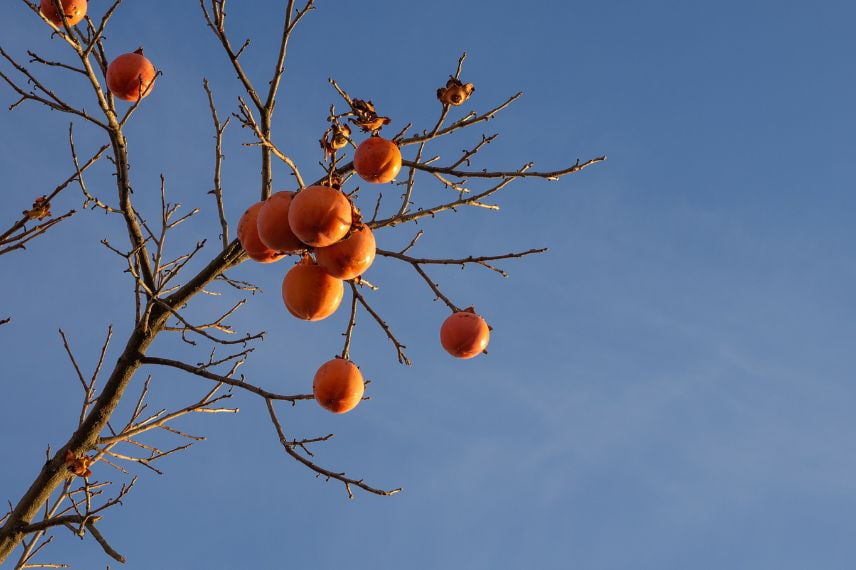
To avoid a lack of fruit, or fruit only at the tips of the branches, pruning is recommended
Pruning that takes place just after harvest allows removing dead branches or those growing inward. It is also necessary to prune the shoots that grew during the year to two or three buds.
Because it is ill or attacked by a parasitic organism
Although moderately susceptible to diseases and pests, the persimmon tree can still become infested. In particular, the Mediterranean fruit fly (Ceratitis capitata), which is particularly attracted by the orange colour of persimmon fruits. This fly is present from early summer. Females lay eggs in the fruits, and the pale-white larvae feed on the pulp of the persimmon. There can be two to three generations of the fly during the season. The fruits cannot be eaten. There are highly attractive pheromone traps for biological control of these flies.
The presence of mealybugs can also affect fruiting, but to a very small extent.
Collar gall can also affect the fruiting of the persimmon tree.
Further reading: Diseases and parasites of persimmon
- Subscribe!
- Contents
Comments