





























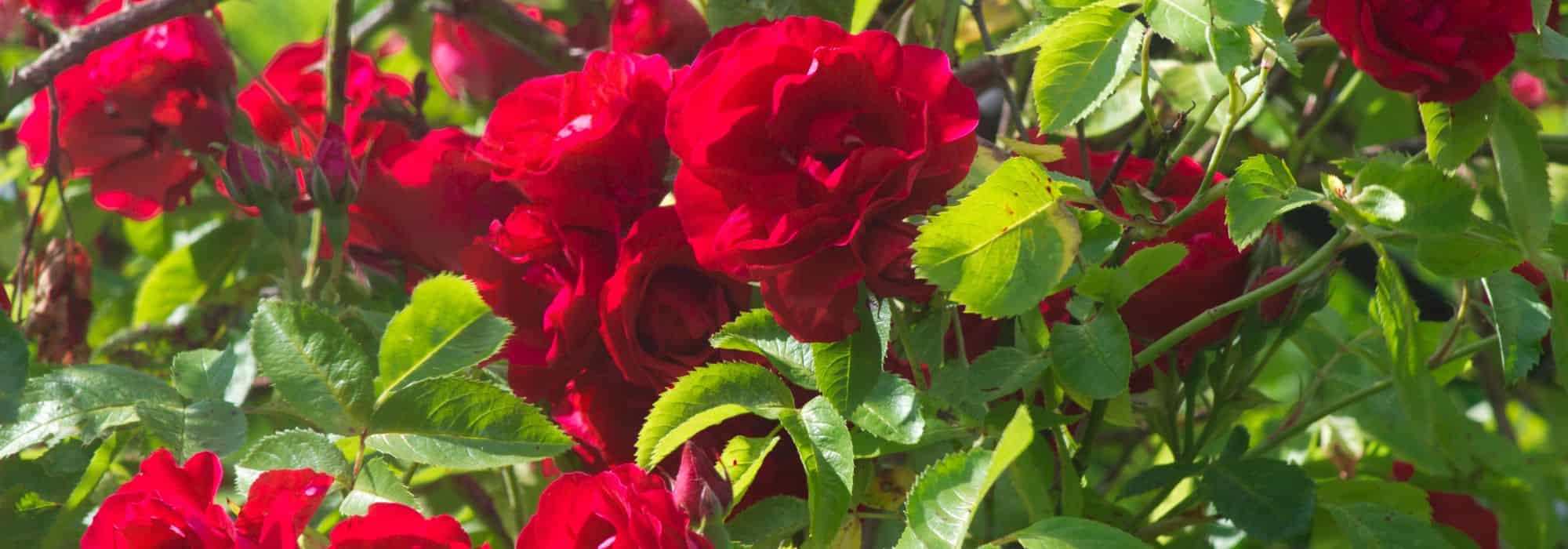
Why isn't my rosebush flowering?
Our tips and tricks to encourage flowering of your rose bushes
Contents
In a garden in bloom, how could you ignore the roses? Magical, dazzling, opulent — roses are all that, whatever the type of rosebushes or the shape of the flowers. Climbing, bush, shrub, groundcover… The rosebush offers almost six months of generous, colourful, fragrant flowering, delighting the heart of the gardener who planted it. Yet, sometimes these rosebushes can be capricious and refuse to flower, leaving the gardener at a loss. What mistakes did he make for this much-loved rosebush not to reward him with its magical flowering? Indeed, the absence of flowers on a rosebush is often a sign of an imbalance in one or more aspects of its planting, maintenance, pruning…
Let’s try to understand the different reasons why a rosebush doesn’t flower. And above all, discover our tips and tricks to put things right and enjoy long-lasting, abundant flowering from your rosebushes.
To learn more: Roses: the best varieties and how to grow them.

Because it is too young (or too old)
If your rose bush isn’t flowering, it may be because it was planted too recently. Indeed, some rose bushes do not flower in the year following planting, but only in the second year. Patience is therefore required and the care you give your rose bush will eventually pay off. Conversely, a very old rose bush may be less floriferous or flower erratically. Thus, the previous owner of my house, bought a few years ago, was proud to tell me that her rose bushes had been planted when she moved in, over 40 years ago… Some still offer a magnificent flowering from June to the first frosts, others will soon be replaced.
Similarly, the problem may be genetic: some cultivars are indeed markedly less floriferous than others. The ‘Décorosiers’ rosebushes are thus renowned for their exceptional floribundity.
Finally, please note that there are repeat-flowering rose bushes that flower for long periods, from May–June until the first frosts, in successive waves. Flowering tends to slow down during the hot summer months. By contrast, a non-repeat-flowering rose only flowers in spring, between May and June, but its flowering is very abundant. Often the old roses and the botanical roses are non-repeat-flowering.
Read also
How to rejuvenate an old climbing rose?Because it was not planted optimally
Planting conditions, and therefore growth, are crucial for rose bushes. Indeed, a rosebush that does not benefit from optimal growing conditions will suffer and will not guarantee its flowering.
A rose bush, although relatively undemanding in terms of soil, prefers rich, fertile, well-structured soils that are worked deeply and perfectly drained. Loam soils suit it perfectly. On the other hand, it will be less comfortable in sandy or stony soils, calcareous soils, soils that are too acidic or humus-bearing, or in very clayey soils. You should therefore move it and improve the soil. A clay soil should be enriched with coarse sand or compost, a sandy soil enriched with leaf mould, compost or manure.
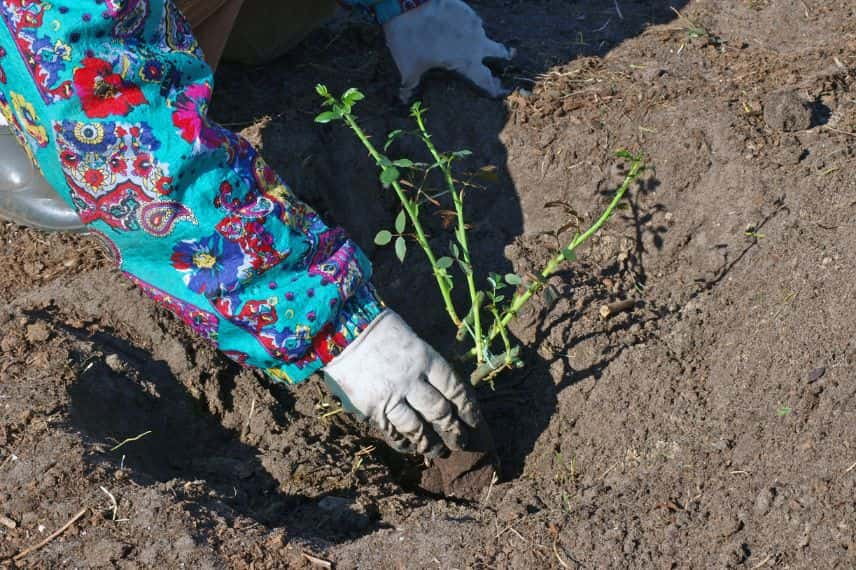
The planting of rose bushes must be done carefully to obtain beautiful flowers
Light is another critical factor in the flowering of rose bushes. Ideally, to obtain good flowering, a rose bush should receive at least 6 hours of direct sunlight per day. A lack of sun can reduce flowering, or even prevent it. That is why it is not recommended to plant rose bushes in the shade of large trees or buildings or in a north-facing exposure. Similarly, a rose bush should be given a sufficiently airy location. Conversely, a rose bush planted against a south-facing wall may suffer from heat and sun glare, which will have consequences for its flowering.
To find out more:
Because it is not properly maintained
Roses are not known to be difficult plants. Their maintenance is relatively simple. But simple does not mean non-existent! Indeed, a few minimal care measures guarantee the flowering of your roses. If you have planted your roses and never tend to them, it is only logical that they will flower less or poorly. A little attention is required:
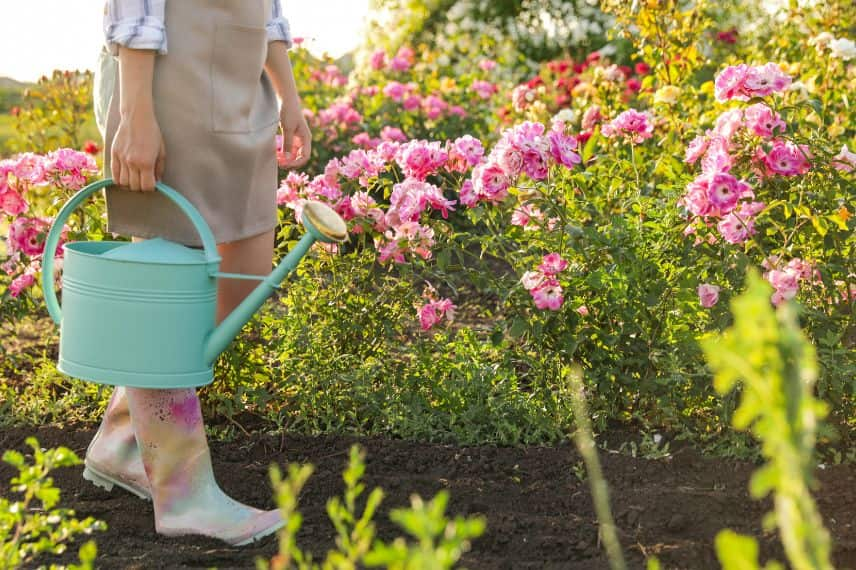
To stimulate flowering, roses need at least minimal care
- Watering is essential: although resilient thanks to their deep root system, the rose bush can suffer from high heat and prolonged drought. To maintain growth and improve flowering, regular waterings are recommended, ideally every 10 to 15 days, but generous ones. Prefer watering at the base.
- Mulching helps to space out waterings, maintain moisture and prevent the spread of weeds. All types of mulch can be applied from May through to October.
- Removing faded flowers is obligatory, not only for aesthetic reasons but also to prevent the formation of fruit that inhibits flowering.
- Protection against the cold: relatively hardy, roses cope fairly well with cold. However, in some regions, winters with recurring frosts down to – 15 °C can affect flowering. Earthing up the roses and mulching with dead leaves are essential to encourage flowering.
- Fertilisation: roses are heavy feeders. For roses, favour a potassium-rich fertiliser (K) which promotes flowering when applied twice a year, at the end of winter and in early July. A fertiliser that is too high in nitrogen encourages foliage growth and even the onset of diseases such as powdery mildew!
- Soil care and weeding are also key elements for achieving good flowering. We recommend regularly hoeing and cultivating the soil around your roses. Alternatively, plant perennial groundcovers at their base, such as hardy geraniums.
Further reading: Caring for roses — the right equipment
Read also
12 thornless or nearly thornless rosesBecause it has not been pruned properly
Pruning is, of course, another key factor for the health and flowering of roses. Indeed, if you do not prune your rose bush, it will develop its growth at the expense of its flowering. Likewise, incorrect pruning or pruning carried out at the wrong time can greatly affect flowering.
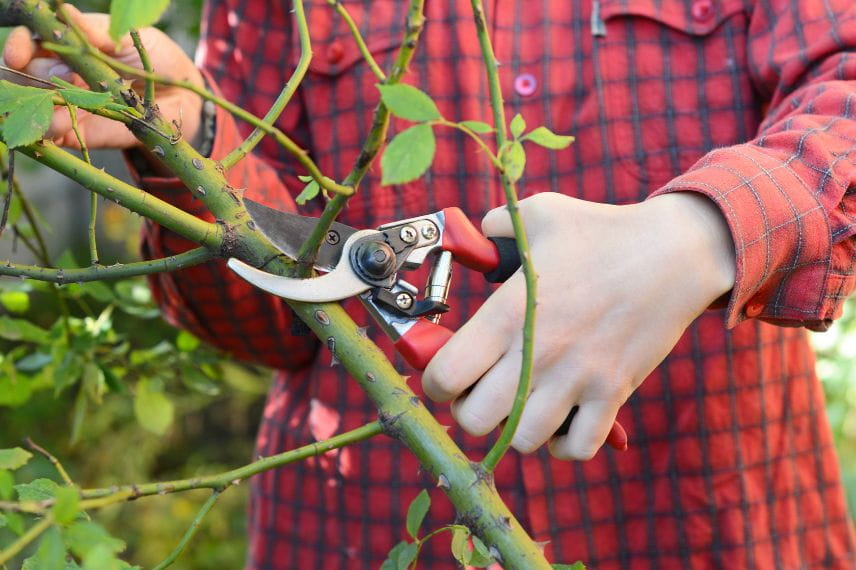
An unpruned rose bush struggles to flower
Overall, roses are pruned between late winter and early spring, that is between February and March, or even April in regions with a cold climate. This pruning consists of removing dead canes or old, dried-up or spindly canes, while balancing the branches of the rose bush. Canes that are not wanted are shortened. With this pruning, the emergence of young shoots is encouraged and the sap will be directed towards them. It is the best way to obtain beautiful flowers. In November and December, you can also lightly prune roses (except in regions with harsh winters) to slightly tidy the branches.
However, non-repeat-flowering roses are pruned at the end of flowering, in July or August.
Further reading :
Because it is diseased or attacked by a pest
Diseases and pests can also be responsible for a lack of flowers on a rosebush. Roses are thus often subject to three distinct diseases: powdery mildew (or rose mildew), black spot disease (downy mildew) or rust. To act quickly, it is essential to analyse the symptoms in order to apply the best natural treatments :
- Powdery mildew is recognised by the greyish felt that coats the leaves, the young shoots and the flower buds. As prevention, avoid overly nitrogen-rich fertilisers and water correctly — infrequently but thoroughly. Spraying a natural sulphur-based fungicidal treatment is effective.
- Black spot disease is fairly easy to spot. Black spots appear on the leaves, which yellow and fall. To prevent this disease, in spring apply a spray of Bordeaux mixture and regularly spray a horsetail decoction.
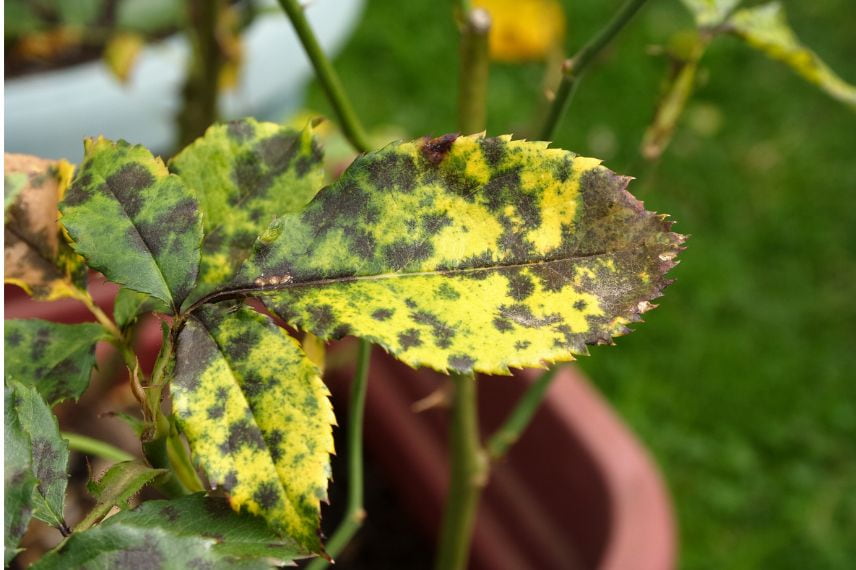
A diseased rosebush is in distress and will have difficulty flowering
- Rust is detected by yellow spots on the leaves, followed by pustules. The leaves become necrotic and die. Again, spraying Bordeaux mixture is recommended. You should also avoid wetting the foliage when watering.
To find out more :
Pest attacks can also inhibit flowering. And there are many of them! I therefore invite you to read Virginie D.’s article to learn to identify and eliminate these pests: Roses: aphids and other pests — how to identify and control them?
- Subscribe!
- Contents

Comments