






























Wrought iron landscaping ideas and inspirations
The perfect decor for gardens
Contents
Wrought iron and its derivatives have been all the rage in the gardening world in recent years, providing charm and poetry to our outdoor spaces. Whether in the form of gates, fences, trellises, or furniture, wrought iron offers a touch of elegance and creates a unique ambience in gardens. It can serve as a partition, a support, or simply as decoration in its own right. Here is a raw material, shaped in a thousand and one ways, that fits just as well in country gardens as in contemporary ones.
How to use wrought iron in the garden? Here are a few ideas to inspire you, depending on your garden’s style.
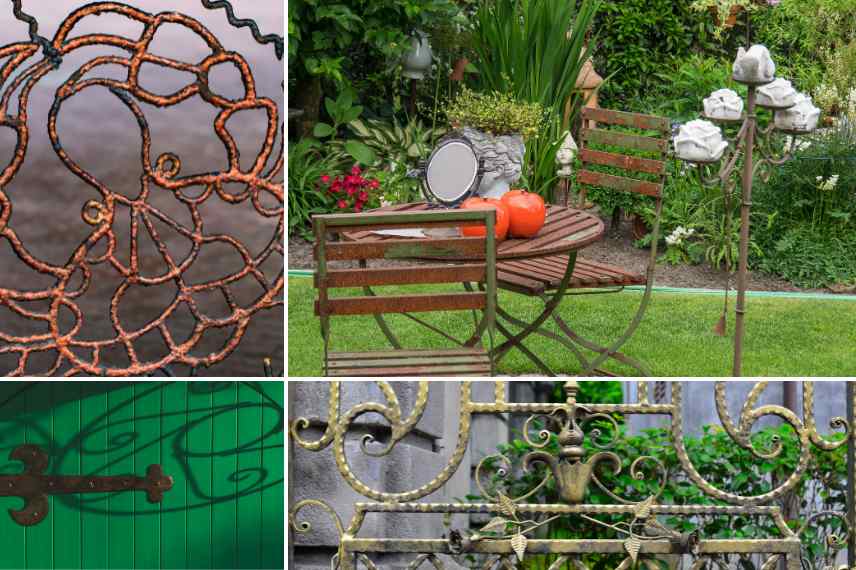
Rusty or painted, raw wrought iron remains a reliable choice for the garden!

Wrought iron: from craftsmanship to sleek lines, a versatile material
Just as the cast iron used for a long time in garden decoration through objects such as fountains or Medici vases, wrought iron, usually openwork, lends itself wonderfully to ornamenting a garden.
This handcrafted material has existed for centuries, and it has withstood the ages while maintaining its popularity. Heated and then worked by hand, hot or cold, using specific tools, it has earned the reputation of art ironwork.
Wrought iron, robust, offers a great diversity of shapes: often curved with volutes, arabesques, spirals, or rosettes, and more recently over time with bars, rods or flatter surfaces, it is also found in the Corten steel, widely used by landscapers. We can finally rely on the concrete reinforcing steel by repurposing it from its building use to compose pretty objects.
Very popular in the late 18th century and in the 19th century, with motifs increasingly graceful, inspired by plant motifs in Art Nouveau, let’s see how to integrate it into the garden!
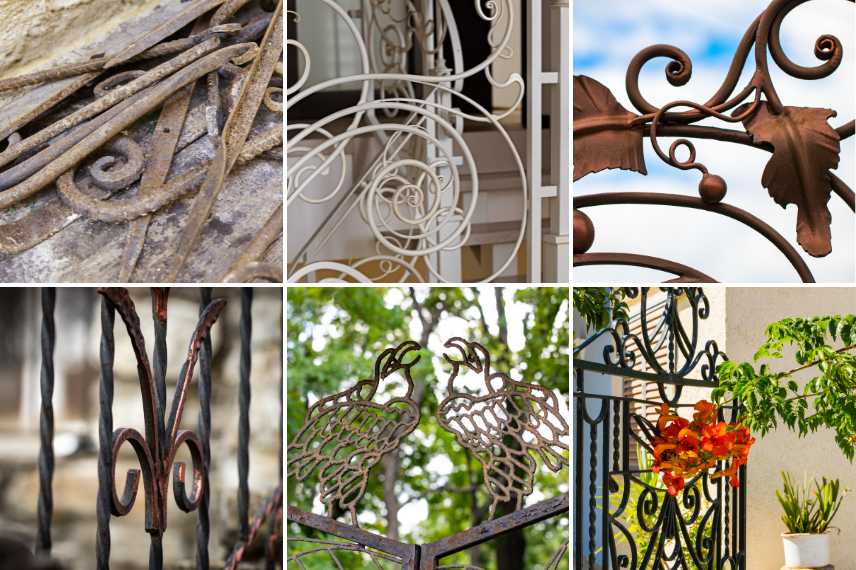
A multitude of shapes and styles for a timeless material
How to use wrought iron in the garden?
Wrought iron and its derivatives, reinforced steel and Corten steel, offer multiple options and uses, as many ways to beautify a garden.
-
As plant supports
Stakes, arches, trellises, obelisks and pergolas in wrought iron bring robustness and a vertical dimension for rambling climbers. They support climbing roses and rambling roses, ornamental vines, jasmine, and all plants that readily reach beyond 3 metres. The reinforced steel posts, modified to varying degrees, are a really nice idea for most plants, blending seamlessly into the vegetation with their rust colour. All of these supports are decorative elements in their own right year-round, even after the plants have defoliated, for the contrast of height and structure they bring.
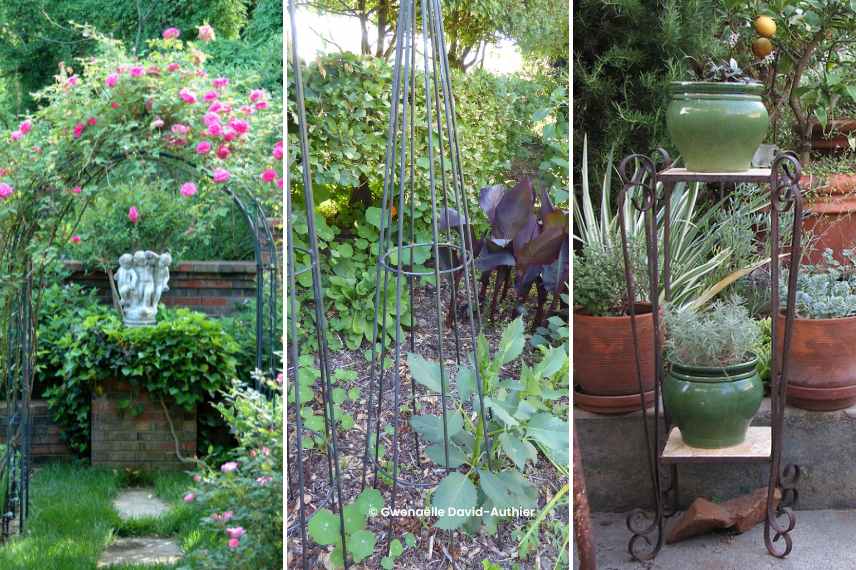
Arches and finials, and pot supports on the terrace, wrought iron highlights climbing plants and pretty pottery
-
As garden furniture
This is a classic and easy-to-reproduce use thanks to the many types of seating (chairs and armchairs, benches, sun loungers, banquette), and tables, whether modern or older, but also in an XXL version in the form of an old-fashioned greenhouse. The durability of this material and timeless aesthetics make wrought iron garden furniture a star, which will stand the test of time.
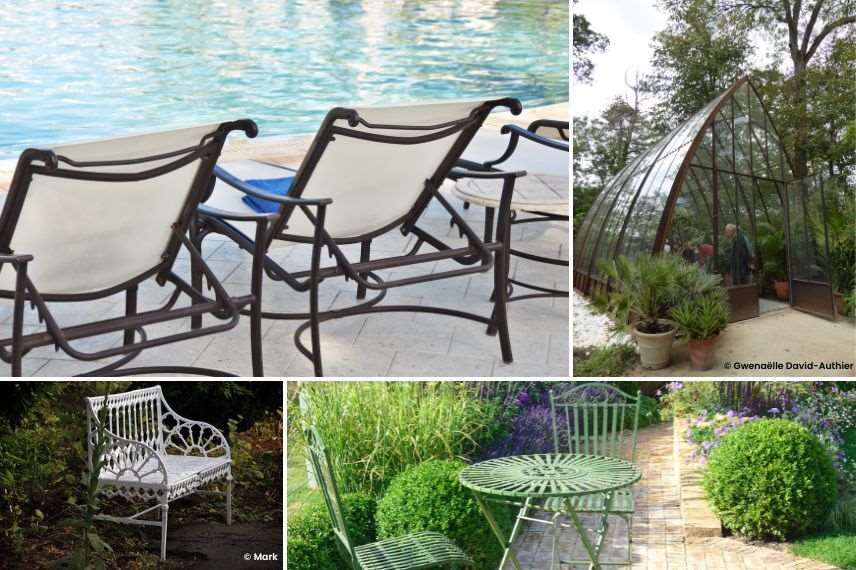
Sun loungers in wrought iron around the pool, an antique greenhouse at Chaumont-sur-Loire, a pristine white bench and a ultra-romantic and small seating area painted in green in echo to the surrounding greenery
-
As a divider
A very handsome option is to use old gates, small grills or panels worked into separators in the garden. They are left rather rusted in this case, and sit as punctuation, the illusion of a barrier, a window, or a passage to another area of the garden.
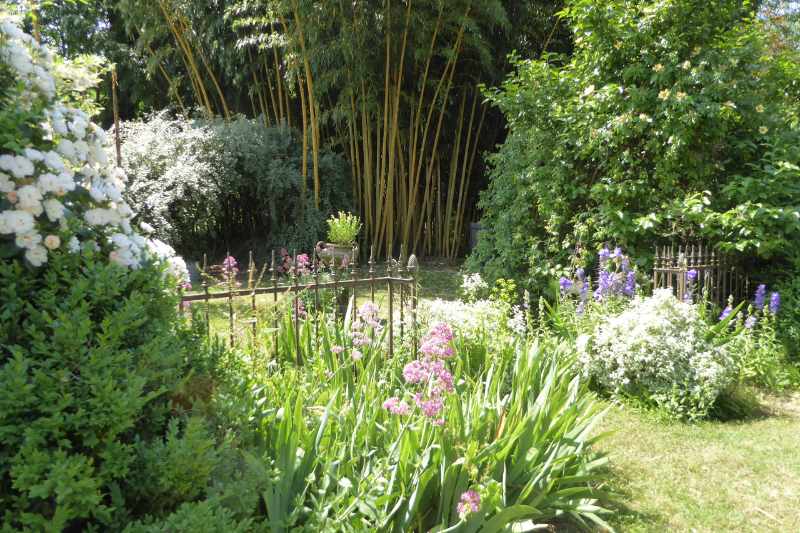
A superb use of wrought iron in a charming garden in Maine-et-Loire (© Gwenaëlle David)
-
As decorative accessory
The possibilities are almost endless depending on the form of the piece found. Of course, wrought iron is a safe bet as a gate or gateway. But it becomes a unique piece and proves particularly ornamental in the form of panels — for instance sourced from old railings — finding their place in borders, or as a small openwork divider. Think of recycling antique balustrades, brackets, rails, festoons and grills. You can also find statues, sculptures, silhouettes, flowers on stems, lanterns, birds or animal motifs, framing pieces… a whole host of objects that will give the garden its own character.

A charming bird on its stand at Jardin d’atmosphères du Petit Bordeaux (72), a wrought‑iron and driftwood stilts at Jardin du Château du Pin (49), Goblin on a stake at Stéphane Marie (50), and a barrier wrapped in vegetation.
-
As a border
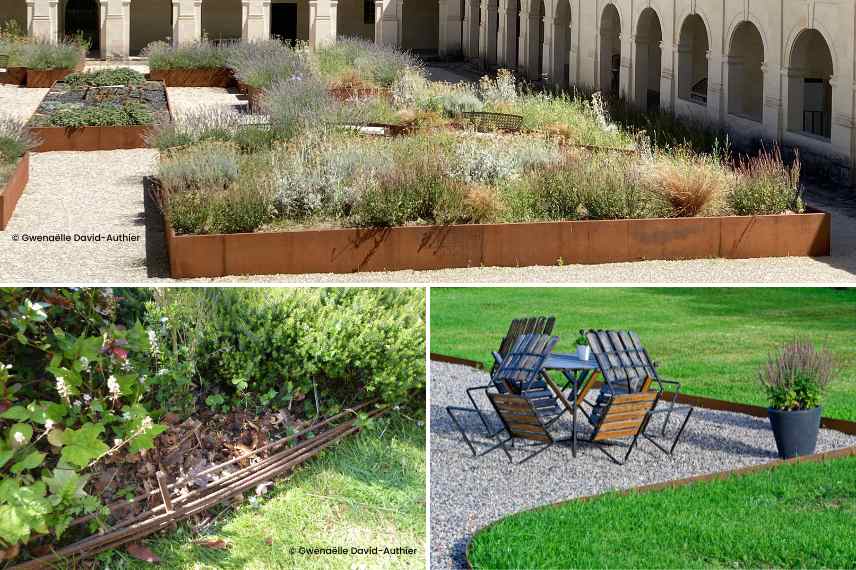
For this use, you can shape a lattice of stacked reinforced steel bars that will define a straight-edged bed, or alternatively use Corten steel to make very pretty planks (these edging strips a few centimetres wide that highlight the borders by delimiting them from a path or the lawn).
Wrought iron and various garden styles
Wherever it is left bare, painted, or with a natural patina giving a weathered look, wrought iron plays with fashion and confidently features in almost every garden style. Although versatile, the decoration should stay sober and coherent by choosing a flagship theme: classic, countryside, bohemian, classic, exotic, design-led, and perhaps humorous. Here are the gardens it best enhances:
-
The English or romantic garden
It’s an ideal setting to house an antique garden seating area, meticulously crafted. A few chairs or benches in the same vein can extend to other areas when the garden is large. This very elegant furniture adds a great deal of poetry to the setting. Gates and fences, with plant-inspired motifs, are the other essential feature of this garden. Of course, pergolas and trellises will welcome the roses that reign in the garden, and the terrace or the borders will bear a few patinated lanterns. Wrought iron is also well suited to country gardens and cottage gardens.
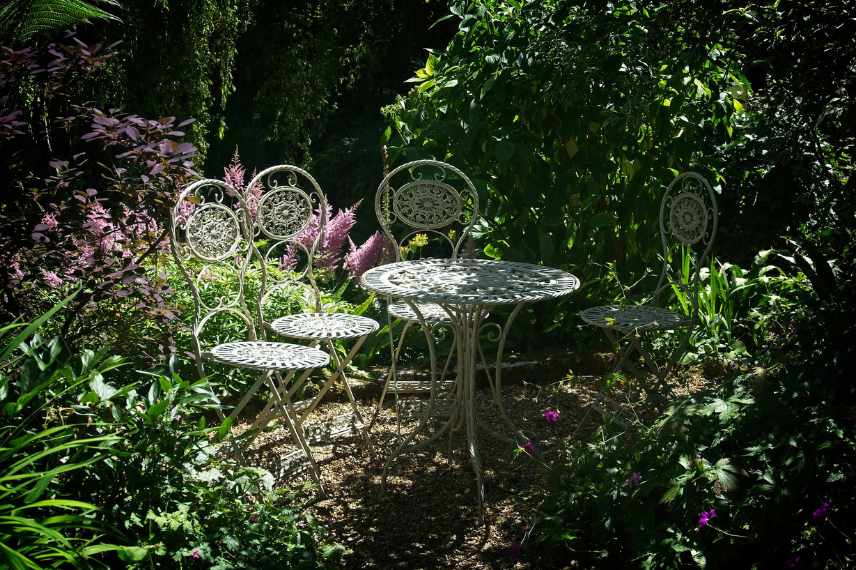
A charming cocoon around this delightful wrought‑iron seating area
-
The Bohemian garden
The bohemian garden allows for small touches of vintage objects and furniture, such as wrought-iron benches that can remain outdoors year‑round. Think especially of lanterns and of black colour or neutral tones, which will pair well with travel-inspired rattan furniture and fabrics already brightly coloured.
-
The naturalistic or rustic garden
Here, wrought iron is used more discreetly, blending into the surrounding landscape. Simple plant supports and discreet wrought‑iron accessories, such as bird feeders or lantern hangers, add a subtle touch of rustic charm to your garden. Openwork lattice screens hidden among a profusion of flowers or grasses are particularly striking. Tables and chairs in wrought iron, weathered by the elements, blend beautifully into a space left to run wild and invite contemplation.
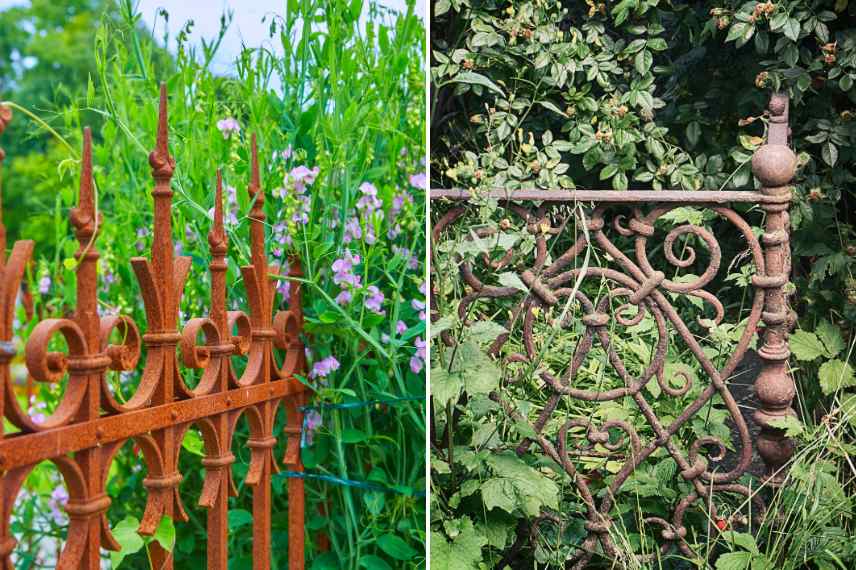
The charm surely works with these pretty rusted elements blending into wild vegetation
-
The contemporary garden
Wrought iron or steel, shaped into clean, geometric lines, also suits more understated, even design-led settings. They are used in a contemporary garden in a more minimalist way than before. With Corten steel in straight or curved forms, in large containers and planters, and also for edging, or in furniture with modern benches and seating. Also create an artistic focal point by playing with large stylised panels of perforated motifs, animal silhouettes or figurative shapes, and original sculptures (spheres, spirals…).
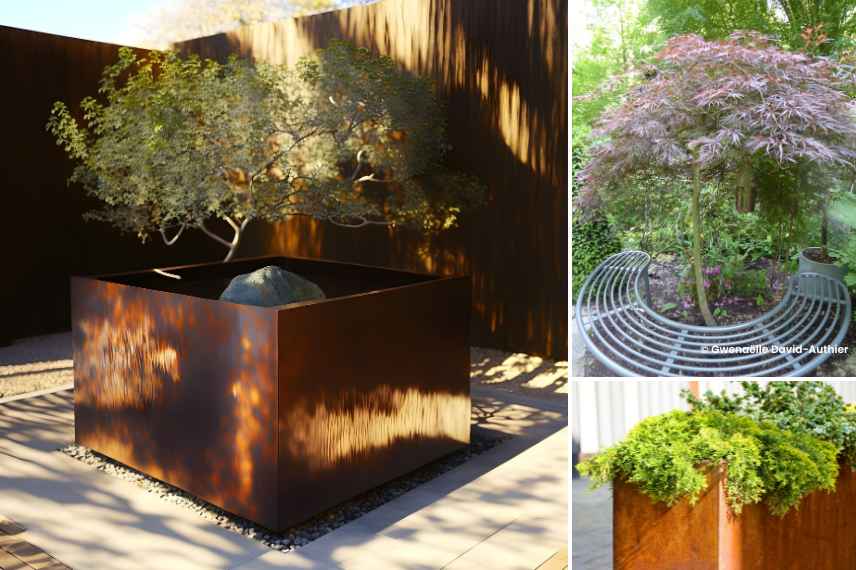
Corten steel as a planter or structuring object; wrought iron with pure lines for ultra‑trendy contemporary gardens!
-
The Andalusian garden
… or Orientalisant! Another fine use of wrought iron in this refined ambience: the visual effect arrives here in the form of moucharabieh screens with openwork patterns, created by railings or grilles as windows in the garden, paravents and claustras and in a garden lounge with a lovely patina. The spaces are magically transformed!

Moucharabieh as in Majorelle Garden, Moroccan wrought-iron lounge, small artisanal table will pair in the Mediterranean garden
-
The French garden
In this symmetrical and highly ordered garden, particular attention is paid to the gates and fences that perfectly complement the formal architecture of the landscape. The statues will also be in the spotlight to complete a grand aesthetic. On a water feature with a bridge, a wrought‑iron ramp adds considerable grandeur.

Elegance of the gate and its wicket gates, refined details, and lantern echo the garden’s classical beauty
-
The exotic garden
Whether it’s a lush patio or a large garden, wrought iron can finally be invited into an exotic-style garden; it will add colonial charm to the atmosphere, with mint-green, pink or orange hues for even greater escapism.
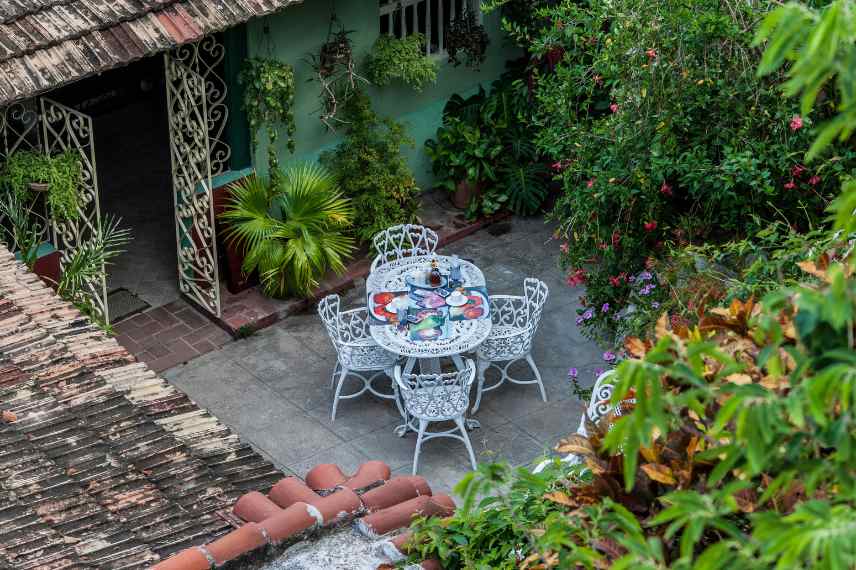 With a few tiles and window bars, wrought iron in hinged leaves and garden seating distills a colonial note
Read also
Living willow weaving: hedge, hut...Some garden layout tips
The aim is not to turn your garden into the back garden of a flea-market dealer! Know how to be sparing with one or two more substantial pieces, to create a striking effect in the garden.
Keep a consistent material and colour scheme for a striking effect: either wrought iron in good condition, painted black or left bare, or rusted pieces that will particularly complement Corten steel…
The placement will be reflexed well in advance, to strengthen the visual impact of the wrought-iron item(s).
Maintenance of wrought iron
Wrought iron requires regular maintenance to preserve its beauty and extend its life. Here are some practical tips to keep the shine of your wrought iron decorative pieces:
- Clean your wrought iron items regularly with warm, soapy water and a soft brush or cloth to remove dirt and dust. You can also clean with acetone if the item is very dirty. Avoid harsh chemicals that could damage wrought iron when it is painted. You can find in the trade protective waxes specifically (wax for metals or for ironwork, colourless, coloured or nourishing) to perfect this cleaning.
- Protection against rust : Apply a coat of varnish or anti-rust paint to protect the wrought iron from the weather and moisture. Reapply this protection regularly to maintain its resistance to corrosion.
- But you may simply want to keep the patina of age, that rust so aesthetically pleasing! Depending on the condition of the pieces purchased, you will dust them gently with a brush or soft brush, and optionally sandblast the element to obtain a more finished look. The pieces thus obtained fit into romantic and rustic or contemporary settings, adding an industrial note, and a textured effect. In my view, it is one of the loveliest uses of wrought iron in the garden!
- Regularly check the fixings of wrought iron elements, such as screws and bolts, and tighten them if necessary. This will ensure the solidity and stability of your wrought iron structures such as benches.
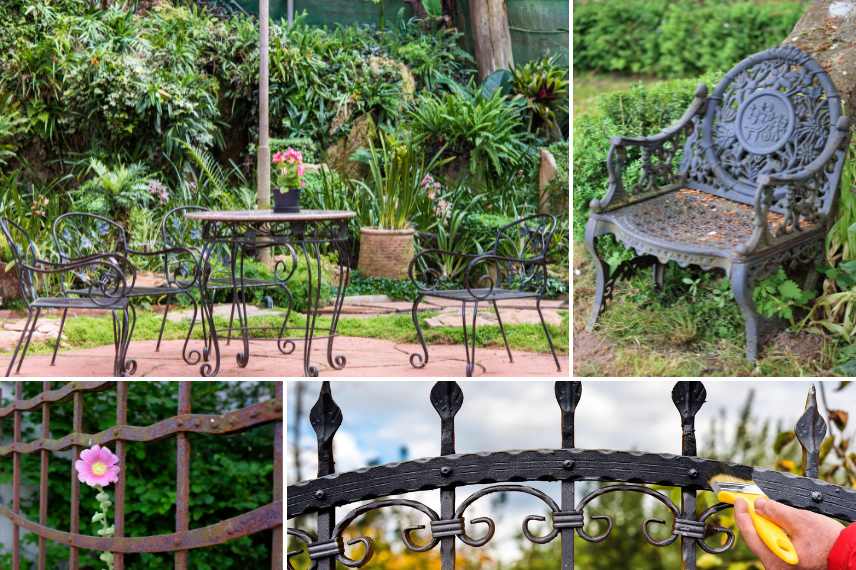
Very well maintained, repainted or left to its patina… or both! Wrought iron lends itself to all tastes
Where can you find wrought iron for your garden?
Finding beautiful wrought-iron pieces can be expensive, so many of us trawl through jumble sales, flea markets and other car-boot sales to find the item with that certain something for the garden. These stand-out pieces have become scarce commodities: I’d advise getting there very early to find them, to beat the professionals to them! Des sites internet biens connus de vente entre particuliers sont aussi très utiles. C’est plus précisément vers les ferrailleurs que se dénichent les petites perles, comme des morceaux de rambardes élégantes de début de siècle, ou encore, on n’y pense pas assez, sur les débuts ou fins chantiers, avec l’accord du chef de chantier. For trouver de beaux objets, pensez aussi aux ventes aux enchères.
Les pièces de confection récente se trouvent facilement dans les magasins spécialisés en aménagement paysager et en décoration extérieure. En ligne, de très nombreux sites proposent une large sélection de produits en fer forgé, allant des éléments de décoration aux meubles de jardin.
Vous pouvez également consulter les artisans locaux qui travaillent le fer forgé et proposent des créations sur mesure… une acquisition qui aura un certain prix.

- Subscribe!
- Contents
Comments