





























Large conifers are essential trees for structuring and balancing a garden in both winter and summer. Their rapid or slow growth, their evergreen or deciduous needles, their decorative cones, and their varied silhouettes are all ornamental criteria that affirm the character of a garden and give it its visual identity. Conifers "sign" the landscapes, highlight the architecture of buildings, and set the tone for a contemporary, Japanese, or more classic garden.
To clarify things a bit and to give you some ideas at the start of this year, I present my 5 favourite large conifers. Choose according to your style, your space, and let your desires guide you.
1) Atlas Blue Cedar (Cedrus libani ssp. atlantica ‘Glauca’), for a classic, "French-style" garden
Among large conifers, the Blue Cedar is surely one of the most commonly planted species in our gardens. Quite hardy, easy to cultivate, and low-maintenance, this large conifer with a very spreading habit creates a breathtaking spectacle on its own. Almost as tall as it is wide (about 15-20 m high and 10-15 m wide), the Atlas Cedar has a pyramidal shape that broadens over time to become tabular. Its lateral branches, adorned with bluish needles that blend with the sky, form a harmonious fan-shaped silhouette that is easily identifiable from afar.
Thanks to this remarkable landscape structure, it is easy to understand why this conifer is often planted in isolation, usually standing proudly in the middle of a large lawn, thus enhancing the surrounding landscape or the architecture of a home. A minimum garden area of 2000 m² is required to appreciate the spreading silhouette of this tree. And there’s no need to plant other trees nearby; its presence is so imposing that it constitutes a strong focal point in the garden. Allow a planting distance of at least 20 m from a house or another tree. Slow-growing in its juvenile stage (a bit faster as an adult), this conifer only forms its definitive silhouette after several decades, so patience is required!
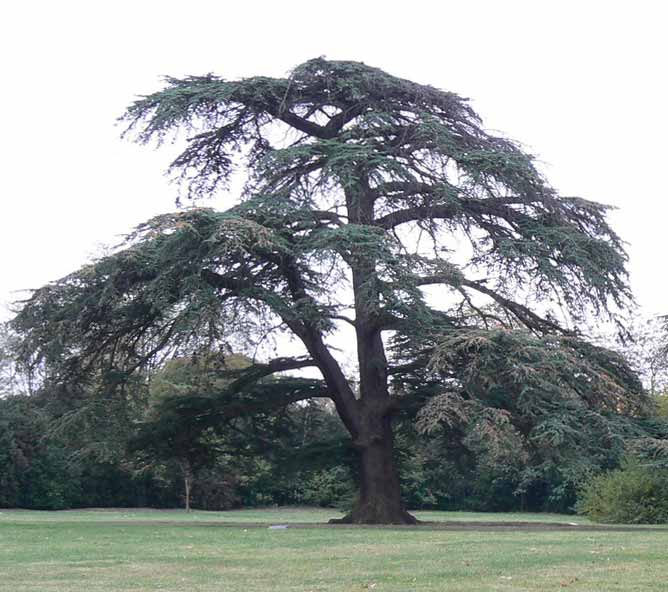
An old specimen of Atlas Blue Cedar in the middle of a large park. If the lower branches are not pruned, the tree branches more easily and offers this striking tabular shape.
NB: Despite its species name "libani," this Cedar does not originate from Lebanon but from Morocco, where it thrives in the Atlas Mountains. The Atlas Cedar is a geographically isolated subspecies of the Cedar of Lebanon that has evolved independently from its original species.
2) Chinese Sequoia (Metasequoia glyptostroboides), for a natural, fresh, and humid garden
Despite its evocative name, this conifer is not a giant, unlike its American cousins Sequoiadendron giganteum and Sequoia sempervirens. The first thing you notice about this conifer is its trunk. Channelled, deeply fissured, and sometimes swollen, it looks like it came straight out of a fantasy tale. Also very decorative, its light foliage, a lovely fresh apple green, turns tawny in autumn. Like the larch, Metasequoia is a deciduous conifer. There’s no need to collect its leaves: its fine needles decompose very quickly and make excellent compost.
Native to China, this pyramidal conifer reaches heights of 25 to 35 m in our gardens. This may still seem quite tall, but this conifer has the advantage of adapting to its environment. It is only when planted in isolation that it can reach a spread of about 10 m, but as soon as it grows near other trees, its shape narrows and its trunk elongates to grow taller. Thus, it can easily be integrated into a large border without occupying too much ground space. It thrives in acidic, fresh, even humid, and rich soils. It is under these conditions that its growth is rapid, growing 50 cm to over a metre per year.
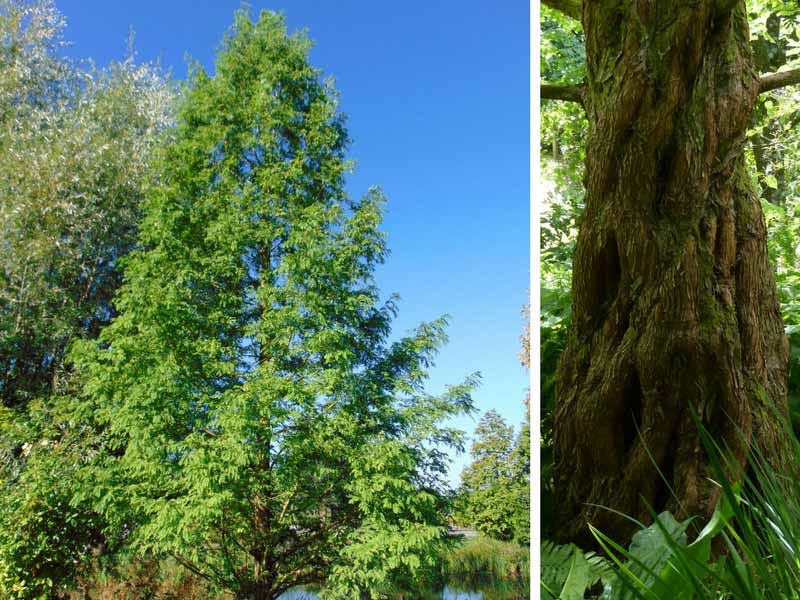
On the left, the Metasequoia with its light branches. On the right, the trunk.
NB: Do not confuse Metasequoia with Taxodium. Growing in wet areas, with a similar trunk appearance and deciduous foliage, these two conifers are very similar in appearance. How to distinguish them? The Metasequoia has opposite foliage (alternate on the Taxodium) and does not produce pneumatophores.
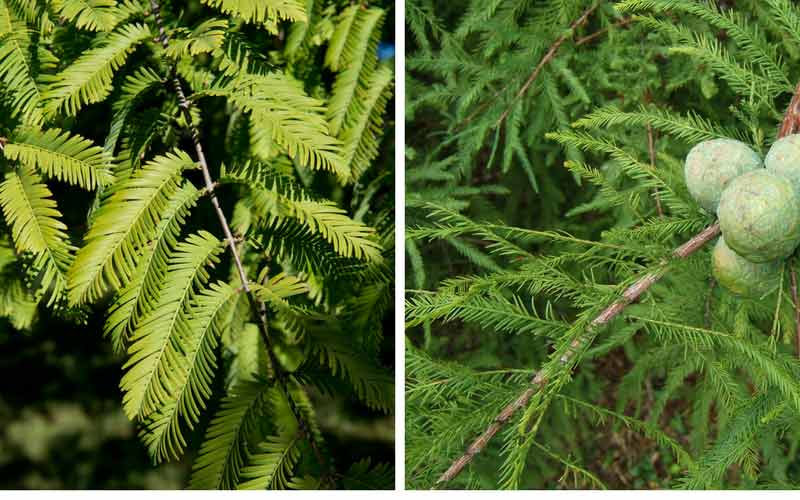
On the left, a branch of Metasequoia; on the right, a branch of Taxodium.
3) Scots Pine (Pinus sylvestris), for a contemporary garden with a southern accent
This is the common pine that grows in many European forests. Close to the Landes Pine (Pinus pinaster), with which it shares the same broad and often twisted silhouette when mature, the Scots Pine prefers the cold and is better suited to northern regions than its southern cousin.
While its silhouette is initially pyramidal, it gradually changes shape as it ages, broadening to form this parasol-like shape that is so striking in our northern gardens, casting a light shade. Unlike most conifers, the branches of the Scots Pine allow light (and rainwater) to pass through, and its roots descend deeply into the soil, keeping the ground cool at its base. To the question "can plants be planted at its base?", the answer is yes! Many ericaceous plants (Camellias, Rhododendrons, Pieris…) can thrive near this pine.
Its growth is initially slow (while it establishes its root system) but accelerates after a few years. It can thus grow by 1 metre per year and easily reach between 6 and 8 metres high in just 10 years! Plant it in poor, well-drained, and deep soil, and you will have an elegant conifer with an original silhouette.
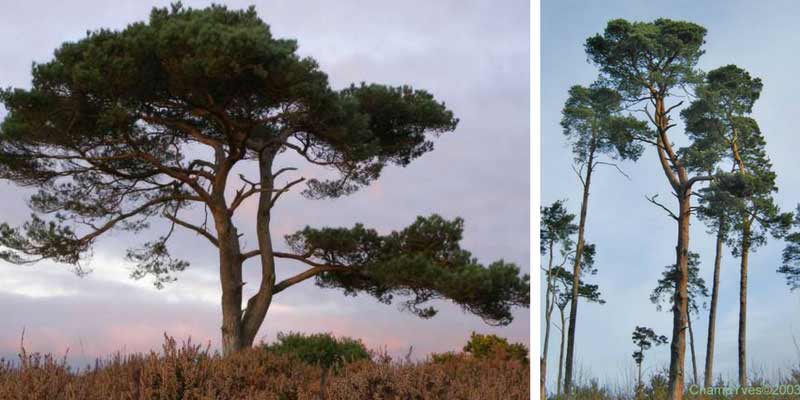
Depending on the training size, exposure, and climate, the Scots Pine will have a different appearance. On the left, exposed to the sun and without training, the very broad branches offer a parasol shape that is so striking (Source: Jim Champion - flickr). On the right, at the edge of a tree, the trunk of this pine, cleared of its branches, offers a more upright shape (Source: Jean Yves Bernoux, ChampYves).[/caption>
4) Giant Sequoia (Sequoiadendron giganteum) for an exotic garden with primitive accents
As its name suggests, the giant sequoia is an imposing tree. Admittedly, its brother Sequoia sempervirens, with a record height of 115 m, easily surpasses it, but with a maximum height of 85 m and a trunk circumference of almost 30 m, the Sequoiadendron holds its own. While it averages 50 m high in our gardens, this conifer primarily grows in height and does not hinder the growth of other plants. Its initially pyramidal to conical silhouette becomes more upright over time. Its trunk, covered in a magnificent thick reddish fibrous bark, widens and becomes bare as it ages, leaving a tuft of branches at the top that provides a light shade.
A true focal point in the garden, the Giant Sequoia should be planted in a strategic location. Allow a planting distance of at least 50 m from a house to have the necessary space to appreciate its monumental structure. With a rapid growth rate, ranging from 50 cm to 1 metre in height annually, this conifer becomes imposing in the garden in no time. In just 10 years, it reaches 10 m high and 30 to 40 m high after 50 years! It is also the conifer with the greatest longevity, as it can live for over 3000 years in its native California. It is a conifer that transcends time and is passed down from generation to generation.
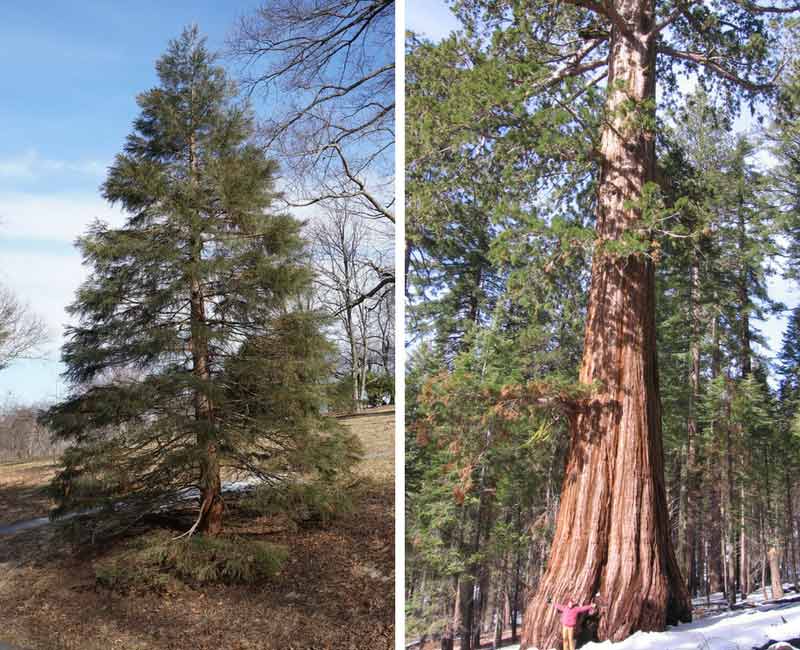 This young specimen on the left is only a few years old. On the right, an adult specimen aged several centuries growing in a forest in the Sierra Nevada (Source: Wikipedia).[/caption>
5) Maidenhair Tree (Ginkgo biloba) for a colourful Asian garden
Among large conifers, the Ginkgo, with its 25-30 m height, is undoubtedly not the most imposing in the garden, but it is certainly not the least spectacular! Its graphic, highly decorative foliage is instantly recognisable thanks to its fan shape. Apple green in spring, the foliage turns entirely golden yellow in autumn before falling, revealing the tree's full ornamental potential.
Erect in its youth, its spread increases with age, and it can extend to over 9 m in diameter if planted in isolation. When associated with other trees or planted in partial shade within a large border, its width will be more modest, and the tree will tend to maintain its upright shape. Easy to cultivate, it requires deep and rather cool soil. Like the giant sequoia, its remarkable longevity allows it to exceed 1000 years.
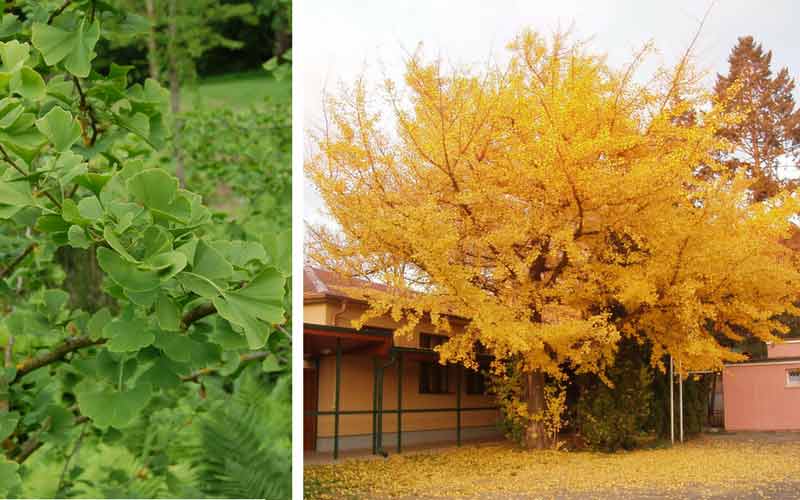 On the left, the characteristic foliage of the Ginkgo. On the right, the tree reveals its golden yellow attire in autumn (Source: Wikipedia).
NB: Like conifers, Ginkgo is classified within the gymnosperms. While genetically it is close to them, taxonomically it is distanced. This is why botanists have classified it in a neighbouring order: the Ginkgoales.

Comments