


Here are two perennials entwining, captured in the moment at the end of spring. The plum-pink flowers of the Poppy 'Patty's Plum' perfectly complement the dark foliage of the Bronze Fennel. The colours harmonise beautifully, and the soft, light foliage of the fennel contrasts with the heavy, symmetrical flowers of the oriental poppy. Here is a scene that is both aesthetic and contrasting, as many gardeners know how to create; however, as beautiful as it is, this scene is the result of chance... or rather a "controlled chance", let me explain:
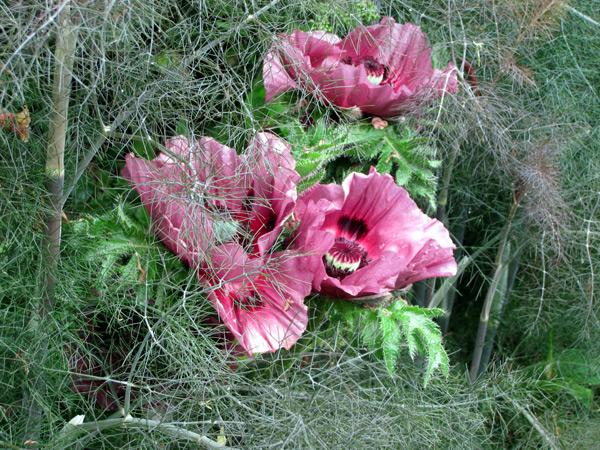 The plum-pink flowers of the Poppy Patty's Plum blend beautifully with the finely cut foliage of the Bronze Fennel
In this large bed, there is a nearly military order; the bushes and perennials have been planted according to their size, flowering time, colour... in a defined location. They bloom at the desired times and develop according to the intended dimensions, leaving little room for chance. As beautiful as it is, this scene, like the old wallpaper in the dining room, eventually becomes tiresome.
Choice No. 1: I remove all the wallpaper. Yes, but it's long and tedious, and I don't have the budget.
Choice No. 2: I move all the furniture and reorganise the space. Yes, but in a year, I will tire of it again.
Choice No. 3: I dress the wallpaper with well-chosen light and mobile decorative elements without disrupting the harmony... or my wallet.
The fennel was my choice number 3; it is a "true-false perennial" very useful for the following reasons:
A perennial is a plant capable of living more than 3 years; the vast majority live 20-50-100 years without much difficulty, but a few do not exceed 3-4 years of lifespan. Fennel, like angelica, valerian, and hesperis, is a short-lived perennial; it does not live very long in the same place and reseeds itself more or less far from the mother plant, but rarely in the same spot. It is a travelling perennial that does not remain fixed like an Aster, Phlox, or poppy in my case, whose stump will grow but will always stay in the same place.
In an established bed, this movement is interesting; it creates an organised disorder, a concept highly sought after in a wild garden and in a meadow garden. However, be careful; as interesting as they are, these travelling perennials should be used sparingly in an already established bed, otherwise the seedlings may become too abundant and poorly controlled.

Comments