


You may have noticed this summer that, with the nice weather, naturalists have made a bit of a comeback, particularly on social media... And, as every year, a certain category of them has taken a stand against an exotic plant. This year, it’s the Buddleia, known as the “butterfly bush,” that is particularly the subject of their ire. Invasive? Dangerous for butterflies?
The debate is simple, classic, but effective:
“You’re nothing but villains who are killing nature!” (the botanists to the horticulturists)
“That’s not even true!” (the horticulturists to the botanists)
Welcome to the playground! And here I am, right in the middle, trying to calm the troops from both camps.
The debate on the Butterfly bush, in detail
We are hearing, reading, and seeing more and more articles, Facebook posts, or television reports on the subject: “Buddleias kill butterflies because the nectar contains caffeine.” These publications generally share a common trait: they treat information superficially and do not delve into the details, all while, of course, citing no sources...
As it stands, it seems that the nectar of Buddleia flowers contains a substance similar to caffeine that could irresistibly attract butterflies, which may end up exhausting themselves and ultimately dying.
I have taken care to write this sentence in the conditional. Indeed, for nearly twenty years, I have heard everything about this plant. Most of the facts (which I will outline below) are established, while one point remains eternally subject to debate: the infamous toxicity of the flowers that has the effect of “drugging” butterflies.
Interestingly, whenever we talk about this potential toxicity of Buddleia flowers, no one mentions any serious scientific publication. Notice how amusing that is...
Scientifically established facts
- Buddleia davidii, the type species, is an invasive plant, an EEE for Exogenous Invasive Species. It tends to thrive in areas disturbed by humans, as it is a bush that prefers poor, stony, and somewhat disturbed soils (it is native to the arid mountains of China): spoil heaps, railway edges, industrial wasteland, abandoned old car parks… but also in particularly vulnerable natural environments such as the silicicolous lawns of Normandy. This is normal, as it is a pioneer species that “prepares the ground” for other plants to establish later. We have other plants in our native flora that can perform this type of work, but Buddleia is remarkably effective since it has a short lifespan: hence its invasive character. Once other plants grow on the substrate created by Buddleia over time, they will shade it, and Buddleia, primarily a light-loving species, will disappear. Vegetation can then develop to the climax, the ultimate evolution of a natural environment: an oak forest, for example. The only downside is that Buddleia does indeed take the place of a useful native plant for wildlife, particularly for insects that have mostly co-evolved with endemic species. For the record, an exotic plant is always less interesting for feeding the larvae and adults of insects.
Nota bene: if you have the type species at home and are concerned about its invasive nature: prune the bush heavily just before seed formation! The problem will be solved.
- Buddleia contains aucubin and other toxic terpenoids by ingestion in its leaves and stems. This is why nothing and no one consumes the leaves. This is the second argument put forward by naturalists: “If butterflies lay eggs on Buddleia, the caterpillars won’t be able to feed.” In fact, this would be a gross misunderstanding of lepidopterans and especially a denial of millions of years of evolution. A butterfly is genetically programmed to lay eggs only on the plant or family of plants that its offspring need. And nowhere else! However, it is true that if in your garden you only have a closely mown lawn, a hedge of thujas, and… a single Buddleia: well, butterflies won’t be able to lay eggs. So, you will have butterflies the first year on your bush and then… nothing. In a garden with a greater profusion of plants, butterflies will quickly visit the flowers of Buddleia and then go lay eggs on nearby plants depending on the butterfly species: nettle, bramble, grasses, buckthorn, legumes, brassicas, umbellifers…
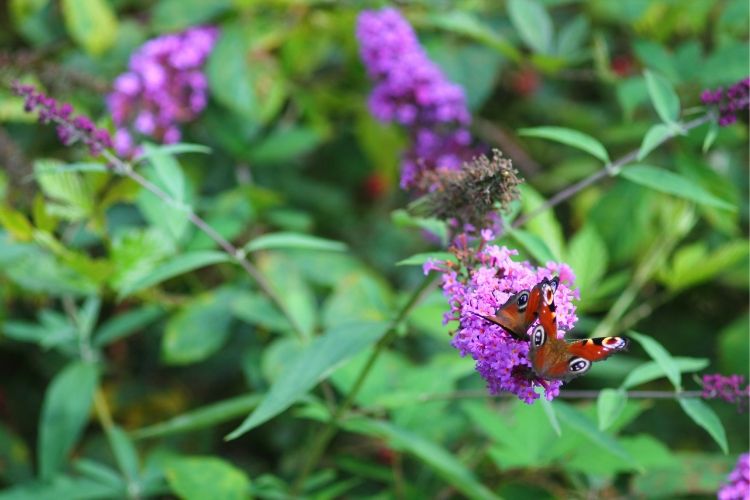
Nota bene: some sources mention that the caterpillar of the Death's-head Hawkmoth and that of the White Butterbur Hawk-moth have adapted to feed on Buddleia leaves in the absence of their true host plants. "Nature always finds a way..."
- The nectar of Buddleia davidii, although produced in quantity, is low in sugar compared to other flowers. It is therefore less nourishing for insects. Note that only lepidopterans with a proboscis can feed on this nectar. Some bumblebees manage to cut the corolla to access some of it. You may also occasionally see a few hoverflies and even one or two wild bees on the flowers, but that is rarer.
- The majority of Buddleia davidii varieties sold commercially are sterile, contrary to what public opinion seems to think. So there’s no need to berate the poor person stacking pallets in your local garden centre for selling Buddleias. Only the type species is invasive, and it is no longer for sale.
- Other species and hybrids of Buddleia pose no problems: B. globosa, B. alternifolia, B. nivea…
What to replace Buddleia with?
If you wish to act on the principle of precaution and avoid planting a “butterfly bush,” then do so! But replace it with native or semi-native plants (Eastern Europe) and leave wild areas in your garden where you will intervene very little. This way, you can truly do your part to try to save what remains of butterflies and avoid falling into general hypocrisy. The classic example being the Sunday moralists who will scold you for having a Chinese plant in your garden but who eat tomatoes in winter, drive a diesel 4X4, and fly four times a year. In short, they are often just big talkers... Let them talk and let’s move forward!
As a conclusion
I do not cast stones at naturalists. Far from it... Their fight is just and necessary. In reality, if they sometimes seem to be acting in bad faith or downright sectarian: it is primarily out of necessity! For decades, no one has listened to them on environmental issues. They have therefore decided to adopt a more easily understandable language for the general public by using simple and precise advice, here in our example: “Do not plant and uproot all Buddleias!” Given what is happening these days, they have no choice but to raise their voices, and too bad if in the process other Buddleias will suffer...
However, it is essential to take the information circulating without a filter on the internet with a grain of salt and to do your own research. Perhaps the nectar is indeed a drug. Perhaps not... This information has been circulating for years, immediately denied by another research team, and then no... or maybe... it depends... In short, we are still only at the speculation stage.
I have personally conducted surveys on diurnal and semi-nocturnal lepidopterans (like the Hummingbird Hawkmoth) for three years at my home. I have observed a significant increase in the number of butterflies as well as greater diversity in species. Yet, I still have a Buddleia. But it is surrounded by several areas of paradise for insects, as I have planted numerous native (or non-native) plants and left some wild areas. So, this bush doesn’t seem so bad after all.
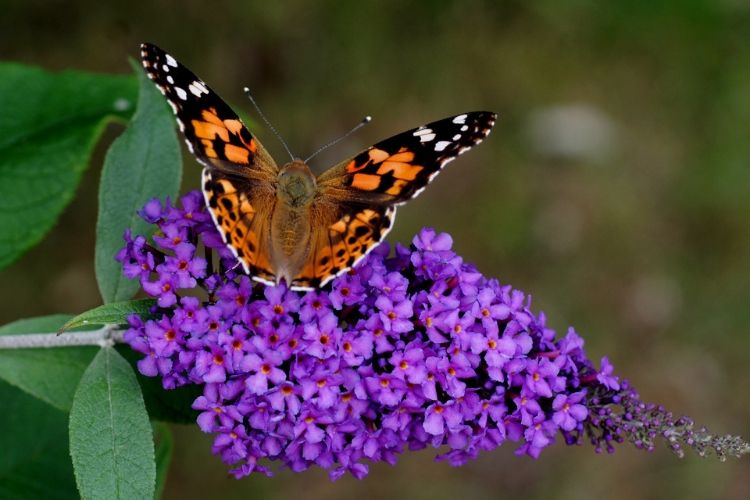
As I write these lines, I see only one Red Admiral on my "butterfly bush" while a wild fennel, a beautiful patch of oregano, an Eryngium planum, and an Hylotelephium spectabile seem to be "the place to be" for lepidopterans at the moment.
I encourage you to also embark on the study of butterflies or insects in general, to draw your own conclusions, and to maintain a critical mind no matter what happens.

Comments