





























A few years ago, I had the opportunity to do some woofing (volunteering) in the Hautes-Alpes with a willow grower – basket maker, and participated in the harvest of willow – I have wonderful memories of a field filled with a multitude of young plants of willows in vibrant colours, red – orange – yellow... a magnificent sight! I learned to make baskets from willow and discovered that living willow hedges or huts can be a stunning decorative element in a garden.
What is referred to as "willow" is Salix intended for weaving. Willow is interesting because it is very flexible and strong. It has long, slender branches that are weakly ramified and easy to weave. It is a deciduous plant: if you create a hut or a hedge from willow, it will be more open in winter, allowing views through the branches. Willow also has the advantage of providing beautiful wood and light, tender green foliage. There are many different species and varieties used for basketry, selected based on their colour and characteristics.
You can do a lot with willow! Sculptures, huts, hedges, arbors, tipis, borders... It is truly possible to have fun and create original elements! Basketry is a beautiful way to combine art and gardening. A few willow objects in a garden add a lot of charm, with a unique and creative touch.
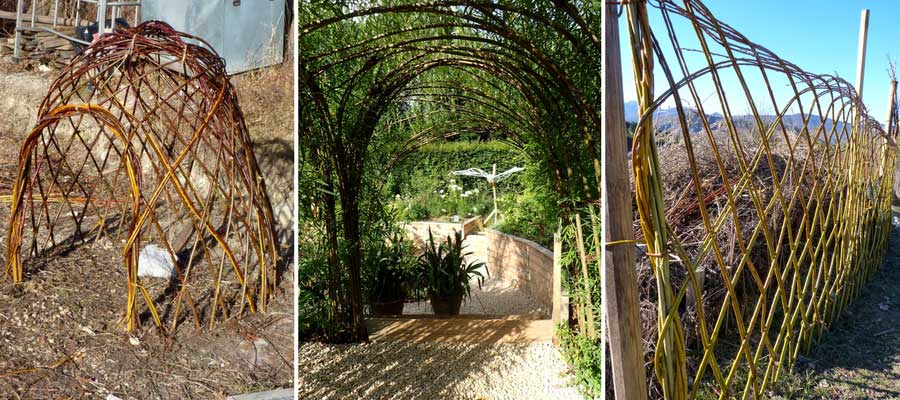
Examples of living willow creations
How to create a living willow hedge?
A living willow hedge is ideal for separating different areas of the garden or creating a boundary along the edge of a property. Very aesthetic, it adorns itself with tender green foliage in spring, and in autumn-winter, this disappears to beautifully reveal the colour of the wood and the detail of the weaving. The advantage is that you can create a custom hedge, with the height you desire, and personalise it.
Willow is a plant that does not like drought: living willow basketry is therefore more suited to soils that remain relatively cool in summer. Willow also prefers deep soils. Some willow producers sell long stems intended for the creation of a hedge. They should measure between 1 and 2 metres in length, depending on the desired height of the hedge. If you do not plant them immediately, you can temporarily keep the stems (for about two weeks) by placing them outside in a shaded spot, with the base of the stems in water. The varieties that seem most suitable for living basketry are Salix alba 'Vitellina' and Salix fragilis.
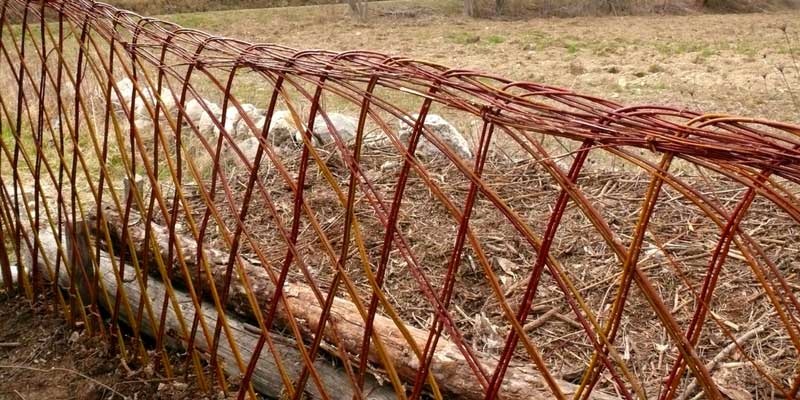 A living willow hedge. The stems are woven two by two, crossing alternately over and under another pair of stems. (photo: Hugues-Mircea Paillet)
Plant between autumn and the end of winter, when the plant is in its dormant phase and no longer has leaves. We recommend weaving the stems two by two for added strength, although a single stem weaving may suffice for a small project.
- To plant a hedge, you should start by working the soil to loosen it while adding some well-decomposed compost. Work the area to about thirty centimetres in width and depth.
- Place a stake at each end of the hedge, then intermediate stakes spaced a few metres apart. Use a string line to ensure you plant straight.
- Stretch two horizontal wires between the stakes (at the top and in the middle) to provide stability to the hedge.
- Plant the willow stems along the string line, with the buds facing upwards. You can plant them in pairs for a small project, but we recommend grouping them in fours for a proper hedge. They should be buried 20 to 30 cm in the soil.
- Weave by taking one stem (if you planted them in pairs) or two stems (if they are in fours) each time. Cross the stems, placing them alternately underneath and then above each other. The space – the void – between the stems should form diamonds. You can secure the stems each time they cross by tying them with a raffia or willow tie.
- When you reach the end of a row (at a stake), secure the stems to the stake and then go back in the opposite direction and continue weaving.
- Water generously.
Continue to water during the first year. Willow is a fast-growing plant: it is advisable to prune it each year, in winter and possibly in summer. You can apply mulch at the base to limit weeding and keep the soil cool.
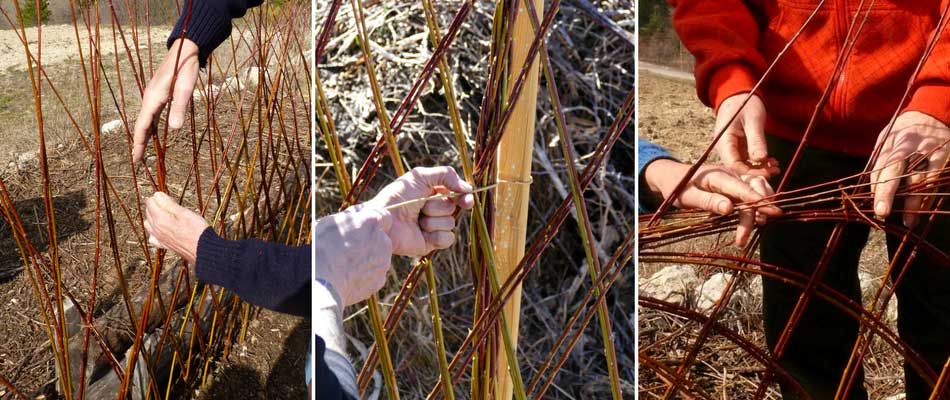 Different stages of weaving a living willow hedge (photos: Hugues-Mircea Paillet)
Further reading...
- Our range of willows and our pre-woven willows
- To discover all the techniques: "I Weave Living Willow - 10 Models to Create in Your Garden" - Terre Vivante
- Discover the basketry and weaving magazine - The Creative Link
- The website of Tresselavie, which offers training and workshops in basketry
- The website of the association The Possible Willow Grove

Comments