





























Detested by some, welcomed by others, snow certainly does not leave gardeners indifferent! Some attribute fertilising properties to it, while others see it as a source of nuisance. So is snow a boon or a real headache in the garden? Let’s try to see things a little more clearly.
Snow, a perfect protection for perennials and bulbs
When meteorologists speak of snow cover, they are not far wrong. It isn’t something you think of at first glance, but when it lies in a layer thicker than 10 cm, snow provides a high insulating value. By trapping air it acts like a duvet and regulates soil temperature. If it falls heavily on soil at 0°C it will keep that soil warm, even if outside temperatures drop to -20°C. It will therefore effectively protect perennial plants and bulbs from a Siberian cold snap!
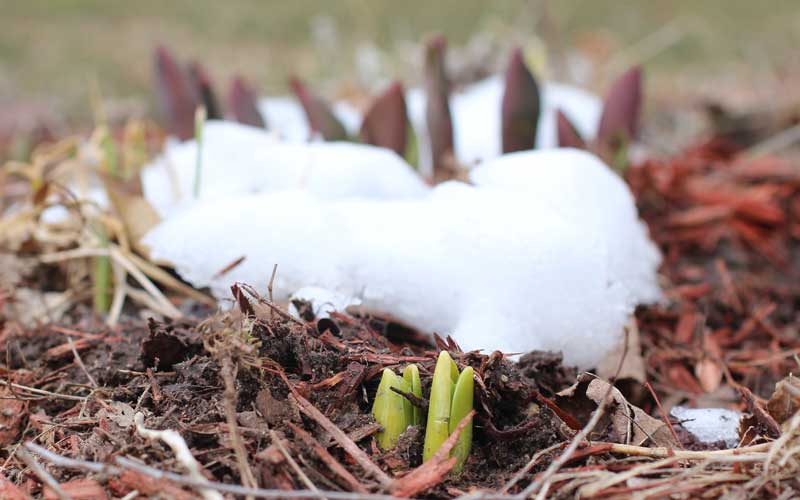
Bulbs are the first plants to benefit from light when the snow melts.
But beware, like any good insulator, it can also play the opposite role. If it falls on soil that is deeply frozen, it will keep it frozen for a long time. Likewise, wet, heavy and more compact snow will not offer the same thermal protection as dry, light snow.
But a calamity for evergreen shrubs!
If perennials are snugly warm beneath the snow, evergreen shrubs are, on the other hand, less merry! Their leafy branches offer a greater grip than those of deciduous varieties. As a result, when the snow is wet, the flakes cling to the foliage and then to the branches, and the branches break under the weight of the snow. It is not unusual to see, late in winter, cypresses or thuja split in two and broken down to the base!
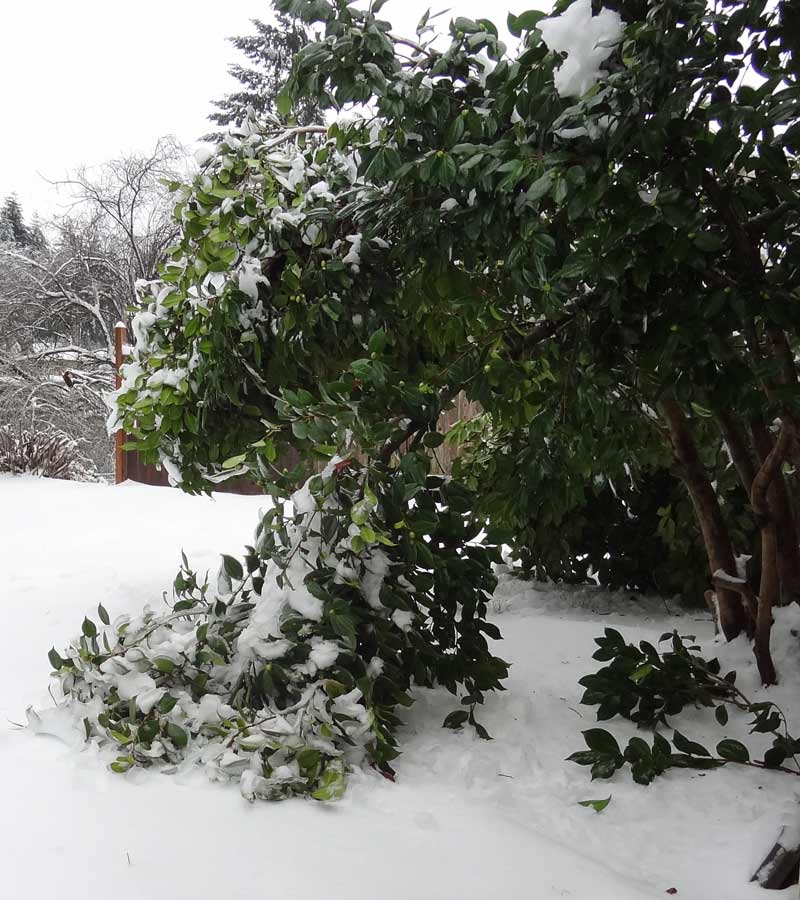
Branch of a Camellia broken under the weight of the snow
On baboons, however, it’s different. The culms do not break but they bend and can, in the long run, either become uprooted or retain an arched shape. Don’t hesitate to remove the snow from your bamboos!
Snow: a natural fertiliser?
Old-timers remember the proverb "Snow in February is worth a good fertiliser", in other words, the nitrogen trapped in snowflakes would diffuse into the soil during melting and would fertilise the land abundantly. Is this a baseless popular belief or a genuine observation?
Seeing the soils green up quickly at snowmelt is not a figment of the imagination. Many gardeners equate this with snow trapping atmospheric nitrogen and releasing it during melt. They forget, however, that soil protected from the cold warms up faster and not everyone realises that snow promotes seed germination. These are the factors that chiefly contribute to the greening of soils.
Several recent studies, reported here by Isabelle Charissou for the Tela Botanica network, show that the hypothesis of snow trapping atmospheric nitrogen and releasing it back into the soil as such is not proven. By contrast, when it melts the water diffuses slowly and helps to retain more assimilable nitrogen than heavy rainfall. Snow therefore allows better water uptake into the soil and keeps it moist deep down for a long time, but it does not act, or hardly acts, as a natural fertiliser.
A real benefit for seed sowing
It is often at snowmelt that many seedlings germinate and emerge from the soil, and this is not due to nitrogen but to the combined action of cold, abrasion and moisture. As it melts, snow acts as an abrasive agent on the seeds and stratifies them. It softens and alters the outer integument of the seed (the seed coat) and frees the germ. Some seeds have embryonic dormancy, and it is the action of cold and water that will degrade the enzymes blocking this dormancy and allow germination.
Apart from the seeds of annual plants that germinate easily, all seeds of perennial plants and shrubs that receive snow germinate more readily. Don’t hesitate to sow your difficult seeds in early January and cover your sowings with snow (if it happens to fall). In March/April the first germinations will be more abundant than usual!

Comments