





























Iris: a prolific perennial that blooms in summer
This year, with the early arrival of warmth across all our regions, we will soon be able to plant or divide garden irises. They need to be in their resting period, filled with reserves and sun-baked, before we can handle their large rhizomes.
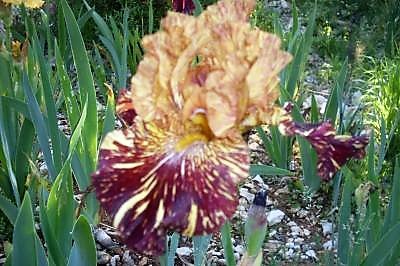
Perhaps you are one of those who offer them every summer to your neighbours, friends, colleagues, and acquaintances. They have likely lost their identity from getting tangled in your flower beds. So, just like me, you offer irises as one would give a basket of plums or apricots in years when the tree yields so much that you are forced to make jam: “For the colour, it will be a surprise! There are white, blue, yellow, orange, pink, and even almost red ones,” I say enthusiastically to my interlocutors.
You who once fell under their spell, are you still as devoted?
The beginning of a passion
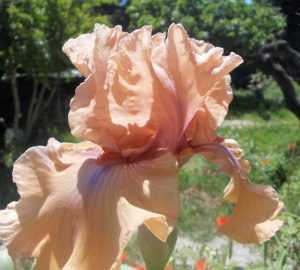
I discovered them an eternity ago, while leafing through a gardening magazine to which I was subscribed. This was long before the invention of the internet… To say that I was thrilled by garden irises would be an understatement. Amazed, captivated, enchanted, and then hooked would be more accurate. So much so that I asked for them as my only reward if I passed my A-levels. That was how it was in our house. I got the diploma, and my first order of irises. The clumsy rhizomes were hastily planted as if hiding a treasure in the family garden, along the edge of the vegetable patch. Today, a few rare anemic survivors remain, which neither neglect, nor weeds, nor shade, nor gastropods have managed to completely eliminate. Years have passed, summers have come and gone, gardens and iris orders too, marked by my crushes that always occurred irresistibly when those in the garden were in full bloom. New colours, new shapes, reserving for the following year those I coveted, I had to have them all!
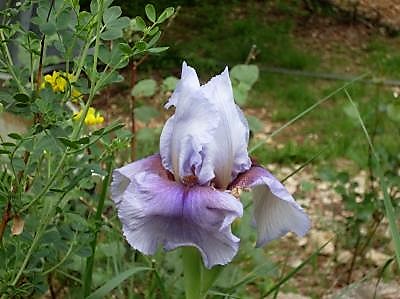
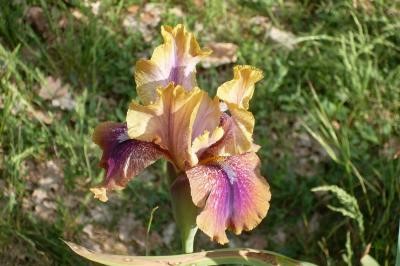
At the moment I fell for irises, I discovered with wonder at a breeder in Var some fantastic hybrids, called “Arilbred”, resulting from cross-breeding between our Iris germanica and botanical species from the arid and semi-desert regions of the Near and Middle East. Probably too difficult to cultivate in our average climates, not floriferous enough, not profitable enough, these wonders gradually disappeared from his catalogue, and no one talks about them anymore. In France, to my knowledge, only one enthusiast (of English origin) offers for sale a few varieties that he hybridises and cultivates with infinite care. I am always on the lookout for these somewhat mythical irises named with lovely Persian, Babylonian, and Phoenician names, names that evoke One Thousand and One Nights or some fabulous Nebuchadnezzar...
A plant not so easy
I must now confess: after having adored garden irises, my enthusiasm has somewhat waned. Here is my testimony:
Many years spent alongside them have taught me that these seemingly robust plants actually require regular care, and therefore quite a bit of time. Let’s not be mistaken: unlike the original irises, extremely austere and nearly indestructible, our stunning modern varieties with their enormous corollas require fairly fertile and sufficiently deep soil to fulfil their promises.
In spring, they must face an army of little soft ogres, without legs and hungry; I remember leading the battle every day by their side to protect the flower spikes. At the crack of dawn, armed with a packet of slug pellets, I keep a keen eye out for the very green nocturnal creature that knows how to be very discreet and rises well before I do!
Garden irises require regular and meticulous weeding on our part, lest we see them smothered by weeds that retain moisture, create harmful shade for their ripening, and provide an ideal refuge for slugs.
Their corollas are sometimes so heavy that they bend the stems to the ground. The wind or rain, of course, exacerbates the problem.
For each variety, once the two or three weeks of spring glory have passed, only the leaves remain, which are ultimately quite ordinary. In summer, if it is dry, they look rather poor.
As greedy and prolific plants, it is advisable to divide and replant them in fresh soil every four years… An impossible mission for an iris collector who has neither much free time nor a truly sunny large garden, that is to say, a real field of cultivation!
Consequently, the distribution of rhizomes becomes a periodic and ritual task, all the more delicate as your relationships, expanded to the widest circle and already cluttered with your gifts, decline your offer while thanking you politely. That is to say, of course, their garden, just like yours, is not extensible!
The wild garden and roadside Iris
All this being said, I wanted to take a moment to pay tribute to our “wild” irises, which have little in common with modern varieties.
Do you remember their flame-like flowers in mauve-violet and blue tones, their almost transparent silky petals? Their authentic scent of old rice powder, warm, sweet, and suave, capable of dressing an entire flower bed on a warm April day? These are the ones you see blooming by the roadside long before the others, when you’re not driving too fast. They are the ones that raise their spikes laden with dozens of flowers in the wind, clinging to a bank, magnificent in their simplicity and dignity in their solitude. You also catch sight of them not far from a well-tended garden, set apart, resurrected on a pile of plant waste where a furious hand has thrown them.
I hold a special place in my heart for those that my ancestor planted in 1896 in his “enclosure” (that’s what we call walled gardens in the South). They have survived abandonment and now form a vast carpet at the foot of a large Mediterranean hackberry that barely manages to prevent them from blooming.
To be honest, I keep these same “wild” ones a bit outside my own garden as they would quickly colonise: every year in summer, I pull up a few rhizomes from the clumps that have become too large to plant them along the private path that leads to my home. There, at the foot of the evergreen hedge, in truly poor soil, they have room to spread and disturb no one. And they are indeed the only ones, along with viper’s bugloss, mallow, chicory, and wild rocket, to grow and bloom with enthusiasm. Among them, some manage to offer flowers even in the shade! Would you believe it? You are right: shade in Provence is often bright!
And since we are talking about dry shade, do you know the Algerian Iris (Iris unguicularis), evergreen, with long grass-like leaves, flowering as early as February under the large trees?
The poor man's orchid
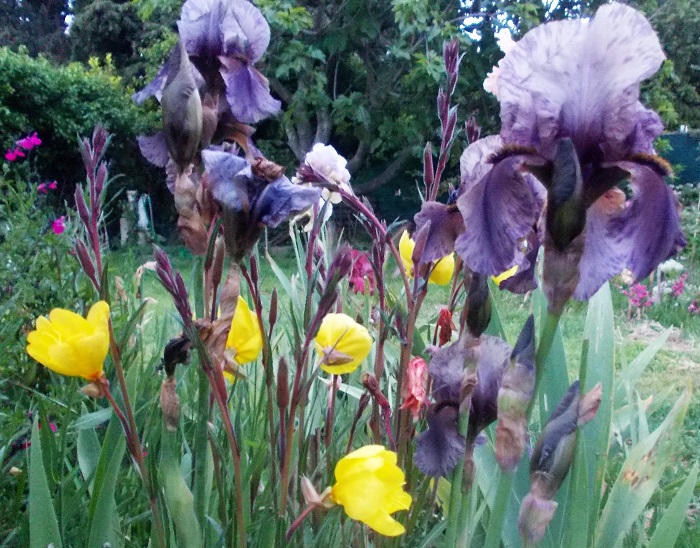
Come on, we still love modern irises. And I love them too: the proof is that I have always taken one or two bags filled with anonymous rhizomes every time I moved. Perhaps out of gratitude towards these plants that have given me so much. I remain attached to their extravagant corollas and feel great respect, yes, for these flowers that are still quite extraordinary.
The garden iris, royal flower, divine messenger of the gods, spirit of the rainbow, leaves a fluid, iridescent, and multicoloured veil in its wake. The original Iris germanica, a hardy plant of poor soil, proudly carries its nickname of ‘Poor Man’s Orchid’!

Comments