





























Whether in the vegetable or ornamental garden, having loose soil is essential for growing plants. In such soil, roots can easily penetrate to absorb the nutrients and water necessary for their growth. Conversely, hard, compacted, impermeable soil will undoubtedly lead to poor and stunted plant growth, even causing root asphyxiation during prolonged rainy periods. We know that roots primarily explore loose soil; they can bypass hard clumps. If loosening the soil is essential for optimal plant growth, should it be turned over?
To till or not to till the soil, a generational question...
Even today, in towns or the countryside, we can see vegetable gardens following the post-war cultural model. The two key words: productivity and cleanliness! Cleanliness through the eradication of adventive plants, the alignment of vegetables, and French-style pathways. Productivity through the use of manures and mineral fertilisers. In this type of garden, soil preparation is done with a rotavator or, if the size allows, with a spade. The soil, regarded as a mere growing medium, is thus turned over, and the fauna is ignored. It is worth noting that the use of manures has enriched the soil with humus.
The life of the soil, often unknown
However, the soil is alive; it is much more than just a growing medium and contains numerous organisms.
The visible fauna of the soil consists of hundreds of species of insects, mites, crustaceans (woodlice), and earthworms. It can be appreciated at three levels:
- The endogean fauna, which lives in the top few centimetres of soil, includes medium-sized worms that dig horizontal galleries and feed, among other things, on dead roots.
- The epigeous fauna, which lives on the surface, in the litter of plant debris, includes red worms and many other animals such as springtails, woodlice, millipedes, nematodes, etc.
- The anecic fauna, composed of large earthworms, which represent 80% of the weight of worms, creates long, permanent vertical galleries. They come to the surface to feed on organic matter and redistribute it, digested, in the form of turricules, both on the surface and throughout the profile of their gallery.
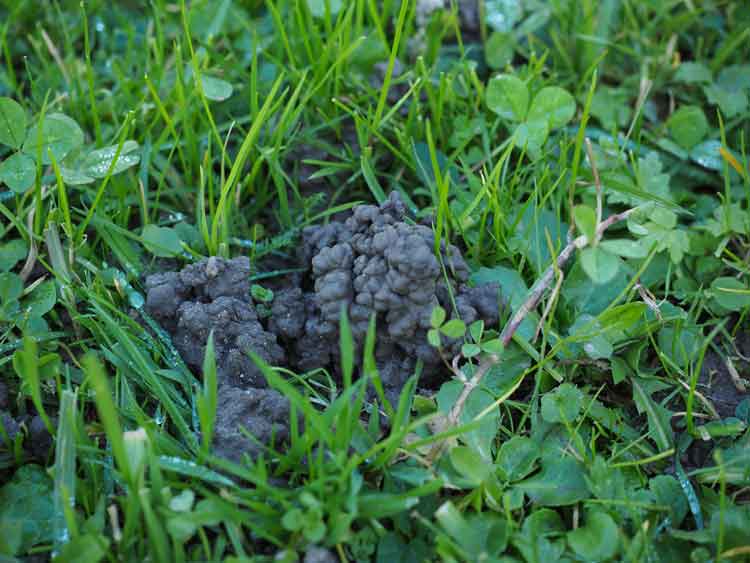
A turricule of earthworms
The effects of tilling with turning
When the soil is turned over, the habitat, galleries of animals, and earthworms are partially or completely destroyed. The epigeous fauna is simply destroyed and buried, and the galleries of the endogean fauna are disrupted. As for the anecic earthworms, their galleries extend below the ploughing zone, and their tunnels are severed, preventing access to the soil surface, up to what is known in agriculture as the "plough pan." Anecic and endogean earthworms will take 2 to 5 years to rebuild their habitat after ploughing, so by turning the soil every year, we give them no chance to reform their galleries.
Returning to the surface of the soil, let’s consider the invisible organisms: micro-organisms. The top layer of soil is the richest in humus and is the site of intense biological activity. Regarding micro-organisms, a simple gram of ordinary humus contains millions of bacteria, yeasts, algae, and fungi. The needs of these micro-organisms are very specific; for example, algae require light, and aerobic bacteria need a sufficient oxygen level. When the soil is turned over, these micro-organisms, deprived of their specific needs, die and disappear.
Let’s also consider the act of tilling itself: Tilling with a spade is tiring, laborious, and bad for the back. Tilling with a rotavator is costly in terms of equipment and fuel. Turned soil also promotes the systematic regrowth of adventive plants and requires more watering, weeding, and hoeing because the soil structure becomes unstable, and a simple rain can lead to surface crusting. Water runs off and no longer penetrates the soil. On an agricultural scale, this leads to the leaching of nutrients and pollution of watercourses.
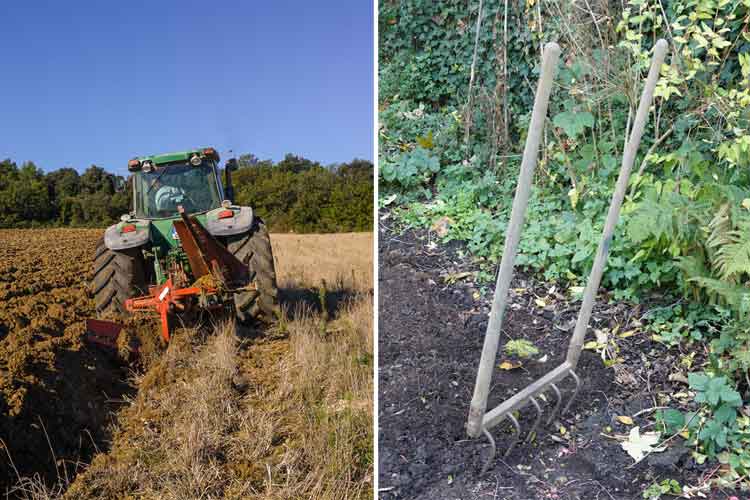 Whether in the field or the garden, tilling destroys soil life - Tools allow for loosening without turning the soil, such as the grelinette.
How to loosen without turning the soil?
You understand, turning the soil is a harmful practice. However, to grow vegetables and plants, loose soil is necessary. To achieve this, it must be decompacted. Two methods are generally used:
- gardening with a permanent soil cover: mulch and bark, cultivated plants, green manures, spontaneous vegetation, compost... (to read: "Mulching, why? How?" and "Green manures: why, how?")
- physically loosening the soil, only when necessary and with appropriate tools such as the grelinette and the fork spade.
A permanent and natural soil cover is a practice that mimics nature. Look, in the forest, leaves fall, forming a litter that gradually decomposes to nourish soil life! In the garden too, this practice will promote soil life and its natural aeration by fauna.
But before achieving naturally loose soil, it will take a few months or even several years! Indeed, going from a soil with little life to a well-fertile and well-loosened soil overnight is utopian and also depends on the original nature of the soil. In the first years, it will be necessary to continue loosening manually in depth but without turning the soil. In practice, in a small garden (around 10 m²), a simple fork spade is used. A larger vegetable garden requires a grelinette.
How to use the grelinette? The grelinette (as well as the fork spade) is planted into the soil, then the handles are pulled towards oneself to lift the soil, and then they are brought back to a vertical position (of course, one always works while stepping back; it would simply be foolish to walk on soil that has just been decompacted!). The soil is thus simply loosened without being turned over. If necessary, clumps are then broken up with a rake and levelled before sowing or planting.
In conclusion: be lazy, outsource soil work but feed your workers!
In summary, avoid turning the soil, trust in soil life while always ensuring it is provided with food to promote its work and natural loosening. It is the fauna that ploughs in place of the gardener. The gardener is simply there to support it; if necessary, one can occasionally use tools to loosen the soil, such as the grelinette. Over the years, you will need them less and less.

Comments