





























Daphne transatlantica Bella Rose
Daphne transatlantica Bella Rose
Daphne transatlantica Bella Rose
Daphne x transatlantica 'ROGALDBR' Bella Rose
Fragrant Daphne
Special offer!
Receive a €20 voucher for any order over €90 (excluding delivery costs, credit notes, and plastic-free options)!
1- Add your favorite plants to your cart.
2- Once you have reached €90, confirm your order (you can even choose the delivery date!).
3- As soon as your order is shipped, you will receive an email containing your voucher code, valid for 3 months (90 days).
Your voucher is unique and can only be used once, for any order with a minimum value of €20, excluding delivery costs.
Can be combined with other current offers, non-divisible and non-refundable.
Home or relay delivery (depending on size and destination)
Schedule delivery date,
and select date in basket
This plant carries a 24 months recovery warranty
More information
We guarantee the quality of our plants for a full growing cycle, and will replace at our expense any plant that fails to recover under normal climatic and planting conditions.
Would this plant suit my garden?
Set up your Plantfit profile →
Description
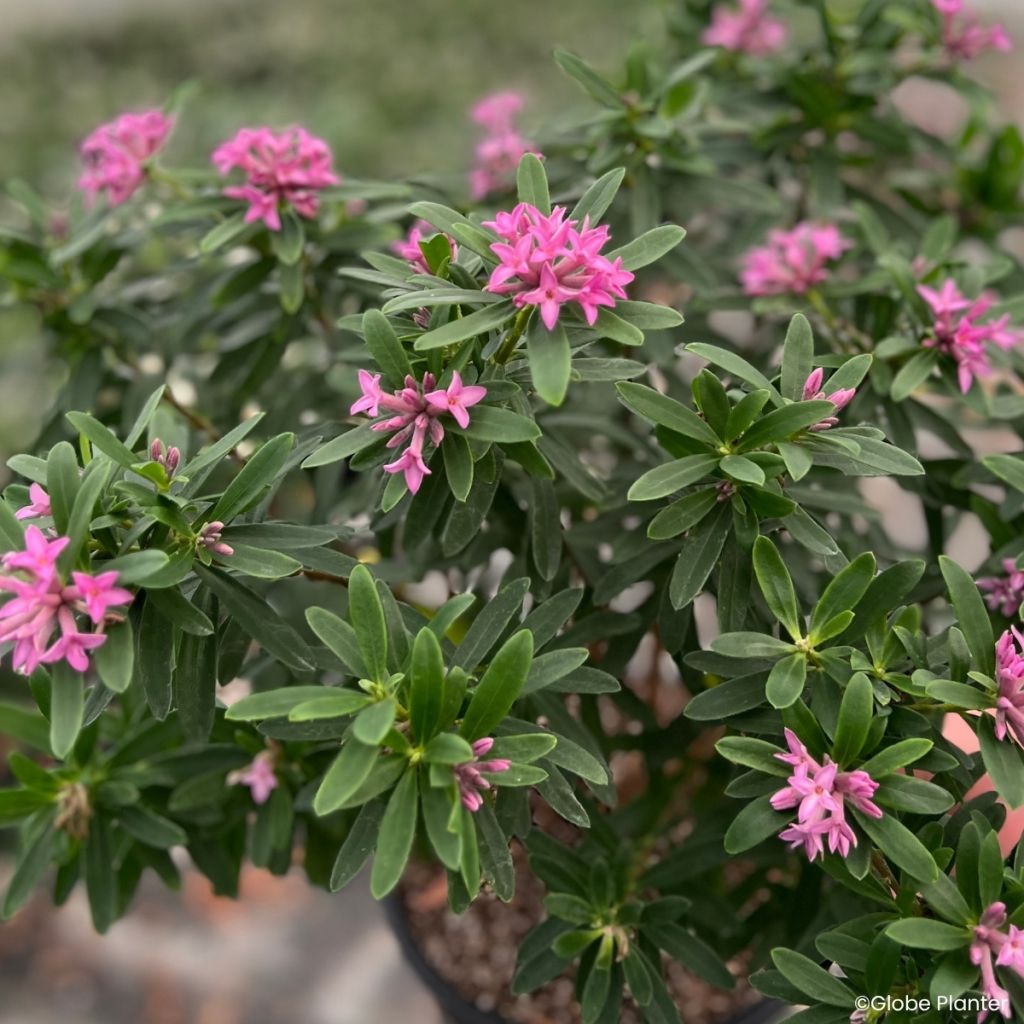
Daphne x transatlantica Bella Rose is a true gem for the garden, combining many attractive features. Its beautiful, dark green, evergreen foliage is ornamental in every season and perfectly showcases its flowering. From spring to autumn, clusters of small, deep pink flowers are renewed, forming a superb contrast against the dark vegetation. The flowers emit a delightful fragrance with notes of Jasmine. This superb bush prefers acidic, humus-bearing, moist and well-drained soils and a sunny, but not scorching, position or partial shade. Its compact size allows it to be grown just as well in a pot, so you can enjoy its captivating scent on a terrace.
Daphne is a genus of the relatively little-known Thymelaeaceae family, whose 44 genera are poorly represented in our gardens, except for Edgeworthia, a very interesting shrub for its colourful late-winter flowering. The Daphne genus is more common, occurring in nature as several dozen species, represented in Asia, North Africa and Europe, notably with Daphne cneorum found in the Alps.
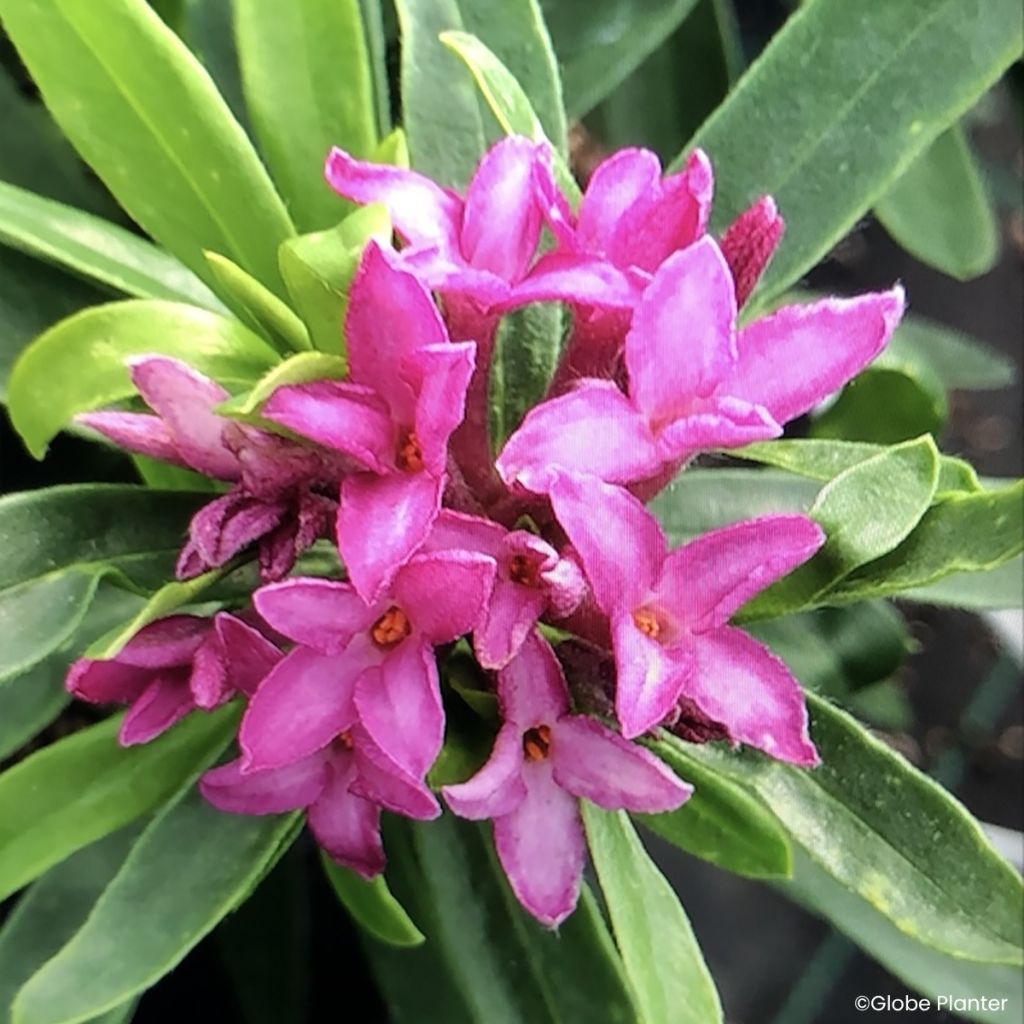
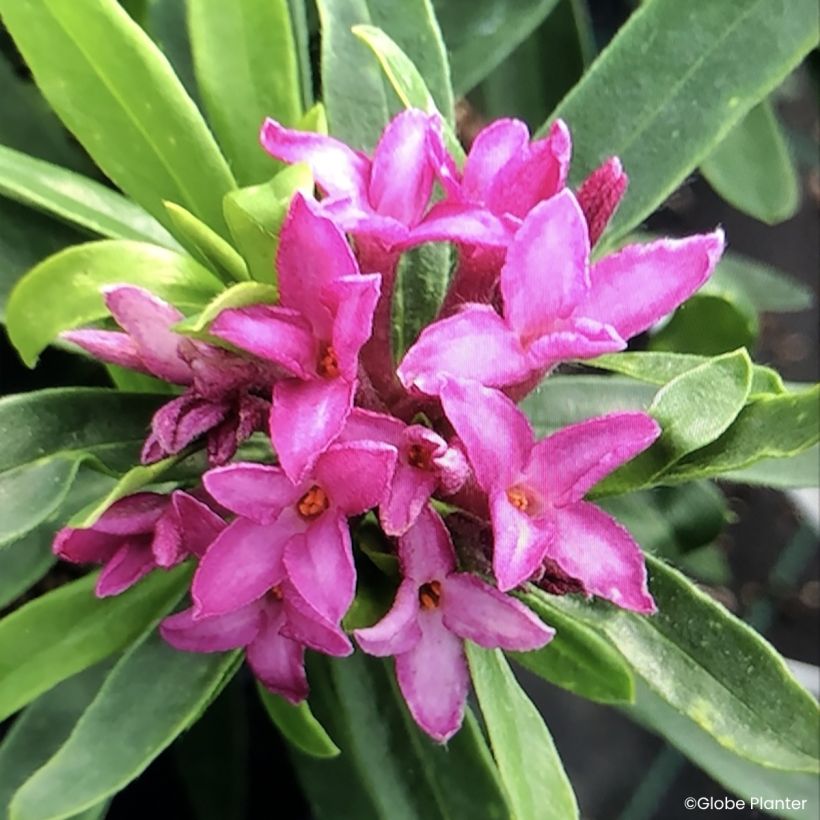
Daphne x transatlantica is an ornamental shrub obtained by hybridisation between two distinct species: Daphne caucasica, with white flowering and deciduous foliage, native to the Caucasus, and D. collina, with evergreen foliage and pink flowers, found on the rocky hillsides and scrub vegetation of the Neapolitan region. This hybrid is well-suited to mountainous areas and tolerates cold well, at least down to -20°C. Its growth is slow, and it naturally retains a beautiful shape, more or less spherical, but with irregular contours, and a very natural appearance, without requiring pruning. Bella Rose is a horticultural variety resulting from a mutation of 'Summer Ice', another hybrid Daphne, but with white flowers. Daphne Bella Rose develops slowly to form a clump approximately 80 cm in all directions when mature. The shoots are clothed in small, narrow and elongated leaves, about 4 cm long by 1 cm wide. Medium green when they emerge, they turn to a darker green later, and their surface is satiny. They are evergreen in mild climates and semi-evergreen in harsh climates. From April, or in May depending on the region, corymbs of a dozen or more small flowers develop mainly at the ends of the shoots. The floral corollas are tubular at the base and open into 2 cm wide trumpets, consisting of 4 pointed petals that give them the appearance of little stars. They are an intense, very decorative pink; they diffuse a powerful fragrance reminiscent of certain Jasmines. The flowering has a slight pause in midsummer before resuming until September or October, thus spanning almost the entire growing season.
Though very appealing, Daphne x transatlantica 'Bella Rose' is still relatively demanding regarding its growing conditions and will suit more experienced enthusiasts. It dislikes excessive sun as well as atmospheric drought and soil dryness, and it cannot tolerate limestone. Its preference is for acidic to neutral, humus-bearing soils, capable of retaining sufficient moisture in summer while being well-draining. Given these very specific conditions, it will, in some cases, be necessary to grow it in a pot, using ericaceous substrate mixed with potting compost. Plant it near a window or terrace to enjoy its delicious fragrance, with acid-loving Heathers. Place it in a bed of ericaceous plants, like Enkianthus with its charming bell-shaped flowers, which you can place in the background. Kalmias or mountain laurels, with their astonishing flowers that have the charm of delicate porcelain, will also be good companions.
Report an error about the product description
Daphne transatlantica Bella Rose in pictures
Plant habit
Flowering
Foliage
Safety measures
Botanical data
Daphne
x transatlantica
'ROGALDBR' Bella Rose
Thymelaeaceae
Fragrant Daphne
Daphne x transatlantica 'ROGALDBR', Daphne x transatlantica Bella Rose
Cultivar or hybrid
ingestion
Cette plante est toxique si elle est ingérée volontairement ou involontairement.
Ne la plantez pas là où de jeunes enfants peuvent évoluer, et lavez-vous les mains après l'avoir manipulée.
Pensez à conserver l'étiquette de la plante, à la photographier ou à noter son nom, afin de faciliter le travail des professionnels de santé.
Davantage d'informations sur https://plantes-risque.info
Planting and care
Plant Daphne x transatlantica 'Bella Rose' in spring or autumn in a humus-bearing, well-drained, acidic to neutral soil; it must be free of lime. The soil it is planted in should remain moist, even in summer. It likes a sunny position in less bright climates or partially shaded further south. Pruning is unnecessary except for removing dead branches. Do not let the soil dry out; use organic mulch around the bush or plant heathers to protect its base. You can grow it in a container: place your daphne in a good horticultural compost, with a layer of clay pebbles at the bottom of the perforated pot to facilitate drainage. Water regularly with non-calcareous water and apply a fertiliser for ericaceous plants. Just like Daphne odora, it can be affected by Marssonina: treat it preventively using a fungicidal spray in spring, before flowering.

Planting period
Intended location
Care
This item has not been reviewed yet - be the first to leave a review about it.
Similar products

Available in 1 sizes
Available in 1 sizes
Available in 3 sizes
Available in 1 sizes
Available in 1 sizes
Available in 1 sizes
Available in 1 sizes
Available in 2 sizes
Haven't found what you were looking for?
Hardiness is the lowest winter temperature a plant can endure without suffering serious damage or even dying. However, hardiness is affected by location (a sheltered area, such as a patio), protection (winter cover) and soil type (hardiness is improved by well-drained soil).

Photo Sharing Terms & Conditions
In order to encourage gardeners to interact and share their experiences, Promesse de fleurs offers various media enabling content to be uploaded onto its Site - in particular via the ‘Photo sharing’ module.
The User agrees to refrain from:
- Posting any content that is illegal, prejudicial, insulting, racist, inciteful to hatred, revisionist, contrary to public decency, that infringes on privacy or on the privacy rights of third parties, in particular the publicity rights of persons and goods, intellectual property rights, or the right to privacy.
- Submitting content on behalf of a third party;
- Impersonate the identity of a third party and/or publish any personal information about a third party;
In general, the User undertakes to refrain from any unethical behaviour.
All Content (in particular text, comments, files, images, photos, videos, creative works, etc.), which may be subject to property or intellectual property rights, image or other private rights, shall remain the property of the User, subject to the limited rights granted by the terms of the licence granted by Promesse de fleurs as stated below. Users are at liberty to publish or not to publish such Content on the Site, notably via the ‘Photo Sharing’ facility, and accept that this Content shall be made public and freely accessible, notably on the Internet.
Users further acknowledge, undertake to have ,and guarantee that they hold all necessary rights and permissions to publish such material on the Site, in particular with regard to the legislation in force pertaining to any privacy, property, intellectual property, image, or contractual rights, or rights of any other nature. By publishing such Content on the Site, Users acknowledge accepting full liability as publishers of the Content within the meaning of the law, and grant Promesse de fleurs, free of charge, an inclusive, worldwide licence for the said Content for the entire duration of its publication, including all reproduction, representation, up/downloading, displaying, performing, transmission, and storage rights.
Users also grant permission for their name to be linked to the Content and accept that this link may not always be made available.
By engaging in posting material, Users consent to their Content becoming automatically accessible on the Internet, in particular on other sites and/or blogs and/or web pages of the Promesse de fleurs site, including in particular social pages and the Promesse de fleurs catalogue.
Users may secure the removal of entrusted content free of charge by issuing a simple request via our contact form.
The flowering period indicated on our website applies to countries and regions located in USDA zone 8 (France, the United Kingdom, Ireland, the Netherlands, etc.)
It will vary according to where you live:
- In zones 9 to 10 (Italy, Spain, Greece, etc.), flowering will occur about 2 to 4 weeks earlier.
- In zones 6 to 7 (Germany, Poland, Slovenia, and lower mountainous regions), flowering will be delayed by 2 to 3 weeks.
- In zone 5 (Central Europe, Scandinavia), blooming will be delayed by 3 to 5 weeks.
In temperate climates, pruning of spring-flowering shrubs (forsythia, spireas, etc.) should be done just after flowering.
Pruning of summer-flowering shrubs (Indian Lilac, Perovskia, etc.) can be done in winter or spring.
In cold regions as well as with frost-sensitive plants, avoid pruning too early when severe frosts may still occur.
The planting period indicated on our website applies to countries and regions located in USDA zone 8 (France, United Kingdom, Ireland, Netherlands).
It will vary according to where you live:
- In Mediterranean zones (Marseille, Madrid, Milan, etc.), autumn and winter are the best planting periods.
- In continental zones (Strasbourg, Munich, Vienna, etc.), delay planting by 2 to 3 weeks in spring and bring it forward by 2 to 4 weeks in autumn.
- In mountainous regions (the Alps, Pyrenees, Carpathians, etc.), it is best to plant in late spring (May-June) or late summer (August-September).
The harvesting period indicated on our website applies to countries and regions in USDA zone 8 (France, England, Ireland, the Netherlands).
In colder areas (Scandinavia, Poland, Austria...) fruit and vegetable harvests are likely to be delayed by 3-4 weeks.
In warmer areas (Italy, Spain, Greece, etc.), harvesting will probably take place earlier, depending on weather conditions.
The sowing periods indicated on our website apply to countries and regions within USDA Zone 8 (France, UK, Ireland, Netherlands).
In colder areas (Scandinavia, Poland, Austria...), delay any outdoor sowing by 3-4 weeks, or sow under glass.
In warmer climes (Italy, Spain, Greece, etc.), bring outdoor sowing forward by a few weeks.