Physocarpus opulifolius Spicy Devil® - Ninebark
Physocarpus opulifolius Spicy Devil® - Ninebark
Physocarpus opulifolius Spicy Devil® - Ninebark
Physocarpus opulifolius Spicy Devil® - Ninebark
Physocarpus opulifolius Spicy Devil® - Ninebark
Physocarpus opulifolius ‘ZLENatalie’ Spicy Devil®
Ninebark, Eastern ninebark
Back-to-school special offer!
Get €10 off for every €50 you spend! And get up to €40 off on a single order.
How does it work?
1. Shop your favourites
Add your favourite plants to your basket. For every €50 you spend (excluding delivery charges, store credit and the plastic-free option), you’ll receive a €10 voucher.
€50 spent = €10 voucher
€100 spent = €20 voucher
€150 spent = €30 voucher
€200 spent = €40 voucher
2. Place your order
Once your basket reaches one of the spending thresholds, place your order. You can even choose your delivery date!
3. Receive your voucher
As soon as your order has been shipped, you’ll receive an email containing your personal voucher code and its value.
4. Use it on your next order
Your voucher is valid for 90 days from the date you receive it. It can be used once only, on a new order worth at least the value of the voucher, excluding delivery charges.
Please note: Vouchers can be combined with other offers, but cannot be split or refunded.
Home or relay delivery (depending on size and destination)
Important: You may be charged customs duties by your country’s customs authorities upon delivery.
Schedule delivery date,
and select date in basket
This plant carries a 24 months recovery warranty
More information
We guarantee the quality of our plants for a full growing cycle, and will replace at our expense any plant that fails to recover under normal climatic and planting conditions.
Would this plant suit my garden?
Set up your Plantfit profile →
Description
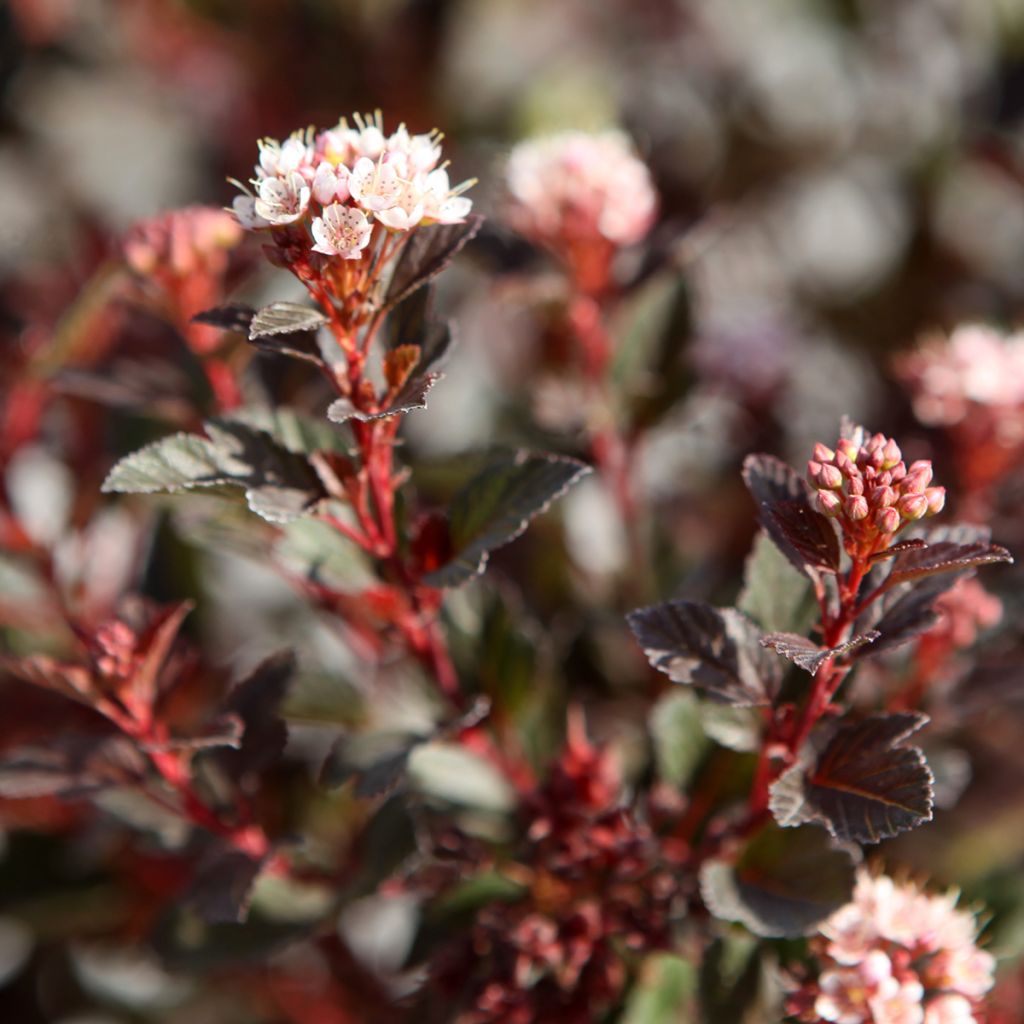
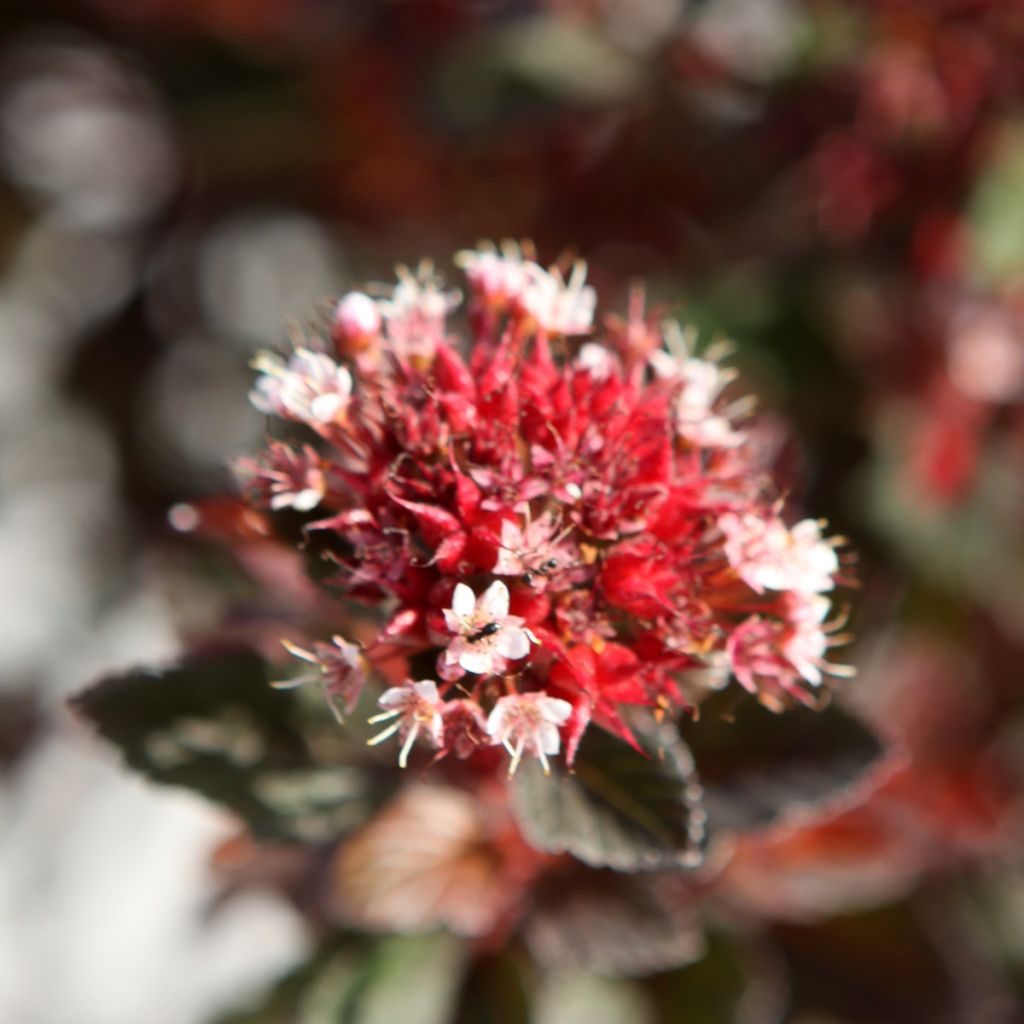
Physocarpus opulifolius Spicy Devil is a very compact variety of Ninebark, perfectly suited to small gardens or container growing. It forms a very dense clump, as wide as it is tall, with colours that change according to the season, featuring a very interesting dominant purple hue for creating contrasting scenes in the garden. Its light pinkish-white flowering is another point of interest in spring and proves useful to pollinating insects, thus promoting biodiversity. In winter, the falling leaves reveal a decorative, exfoliating bark. Easy to grow, it is an excellent plant for cold climates.
Physocarpus is one of the very numerous genera (over a hundred) within the vast Rosaceae family. This family includes most of our fruit trees (Apple trees, Peach trees, Cherry trees...), many ornamental plants (Kerrias, Photinia, Potentilla...), and wild plants from our countryside. There are 13 wild species of Physocarpus, only one of which is native to Asia, with all the others growing naturally in North America. Physocarpus opulifolius was introduced as early as 1687 from the colony of Virginia, the southern limit of its range, which otherwise extends north as far as Quebec. Reaching up to 3 m in height in its native lands, the bush does not exceed 2 m in our regions, and breeders have focused on producing compact and/or coloured varieties to broaden the plant palette.
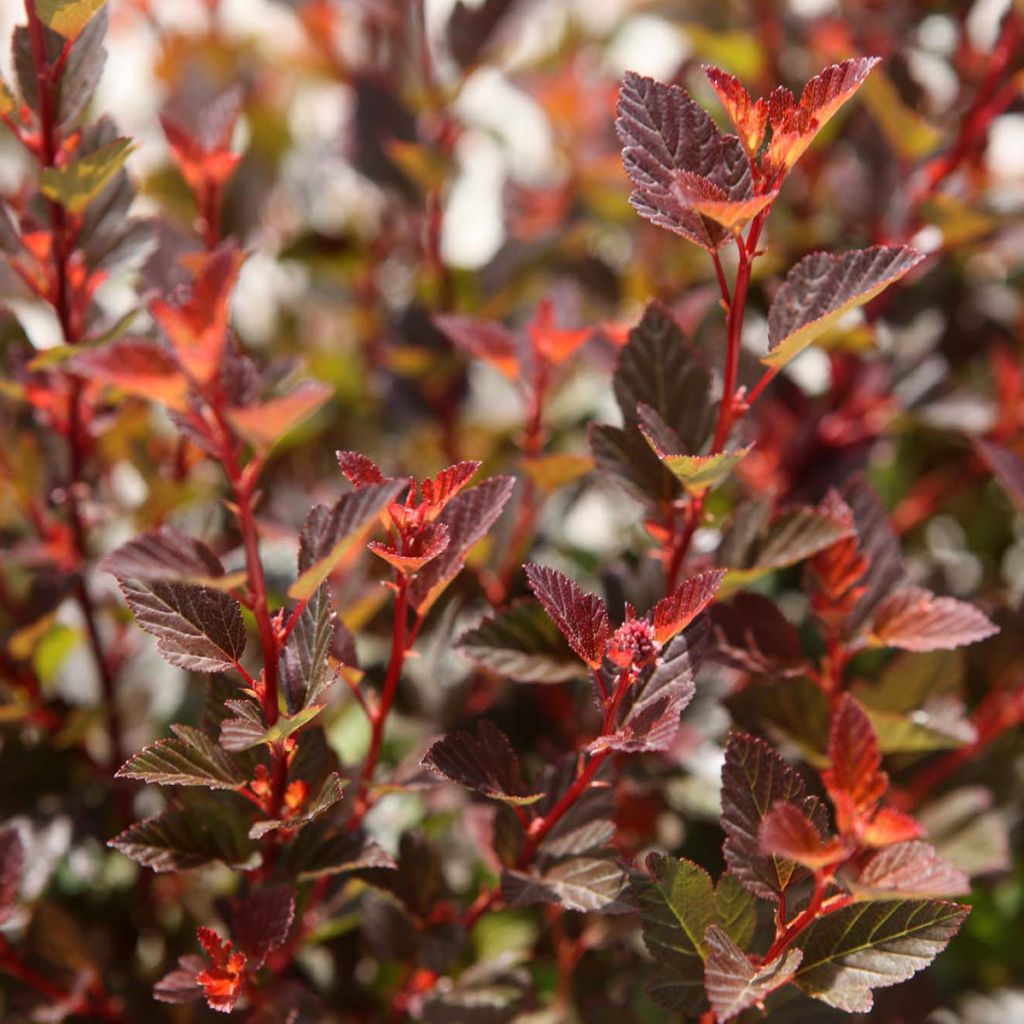
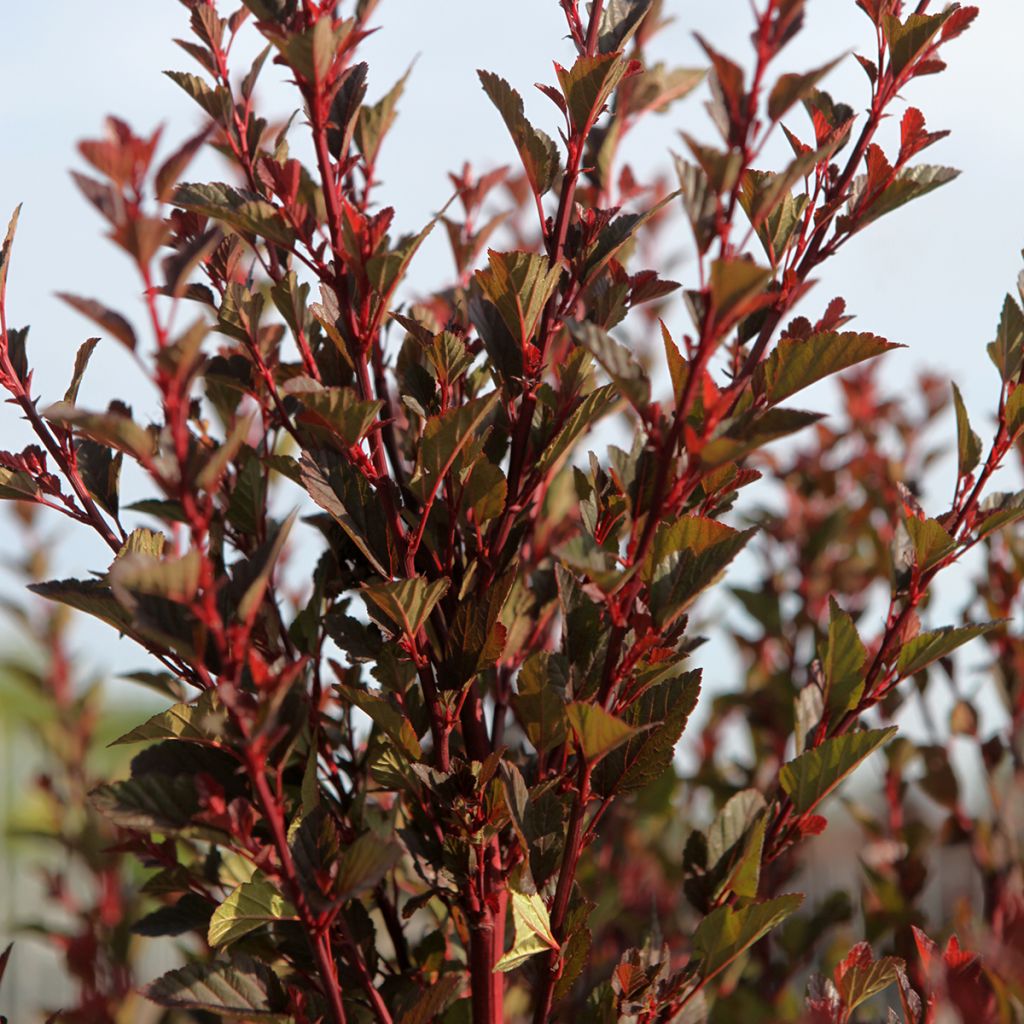
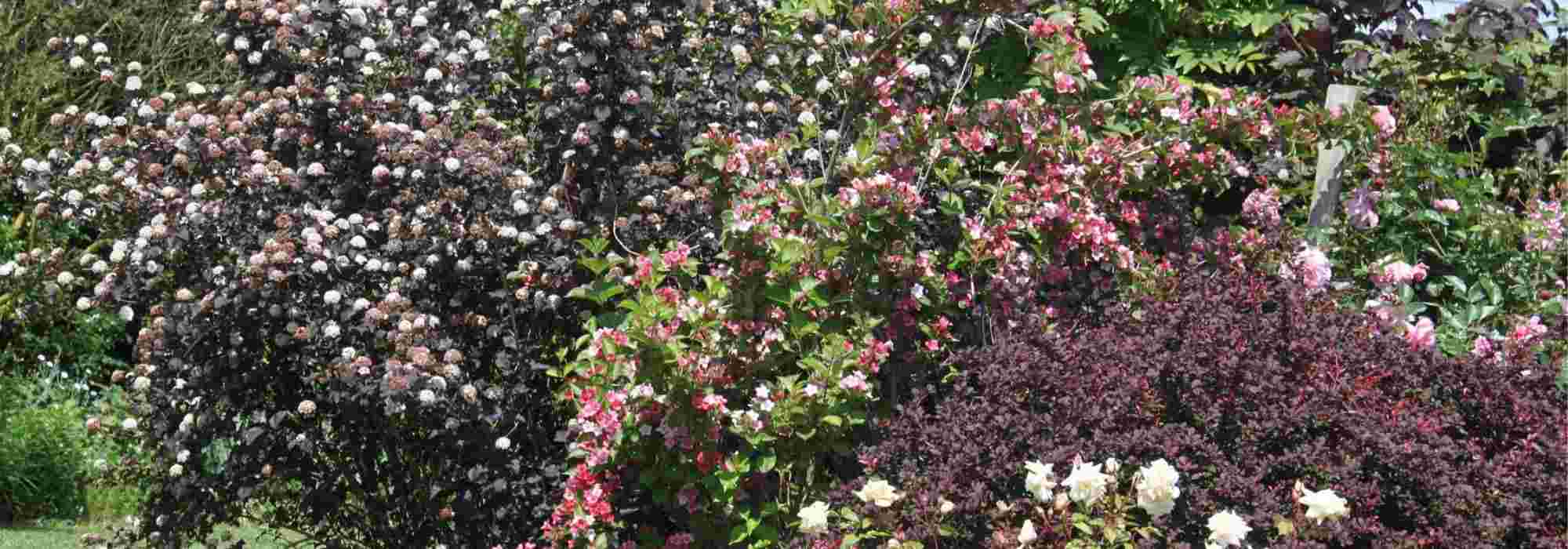
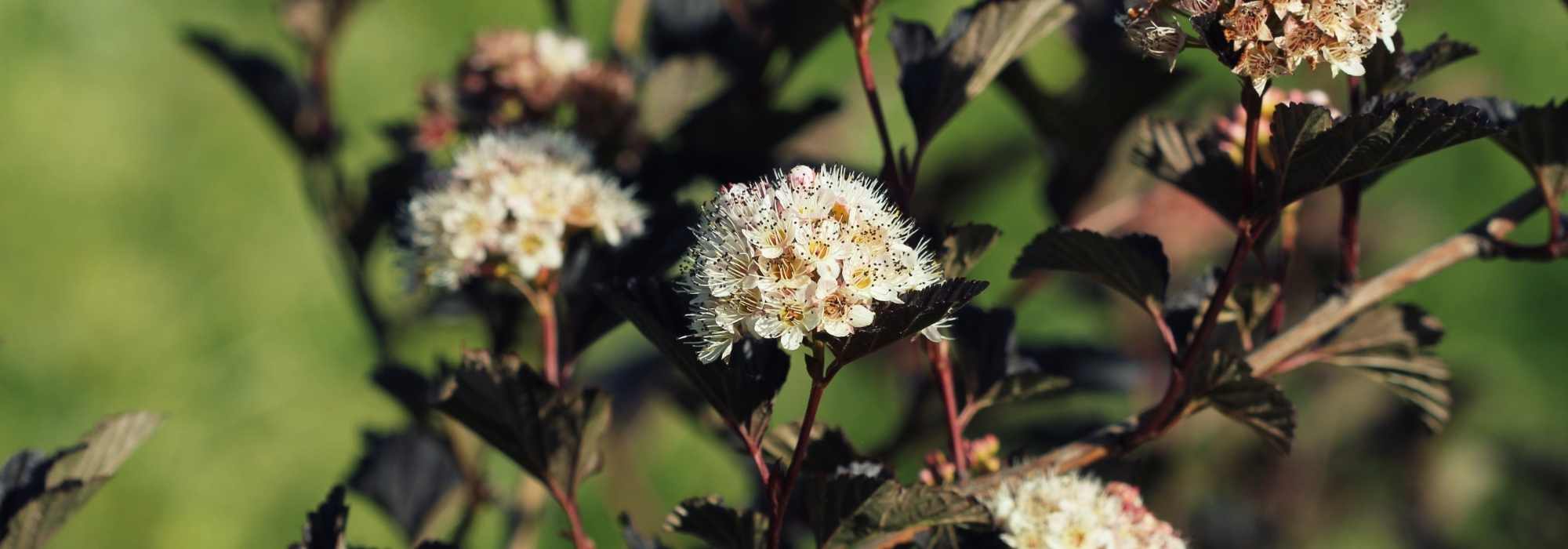
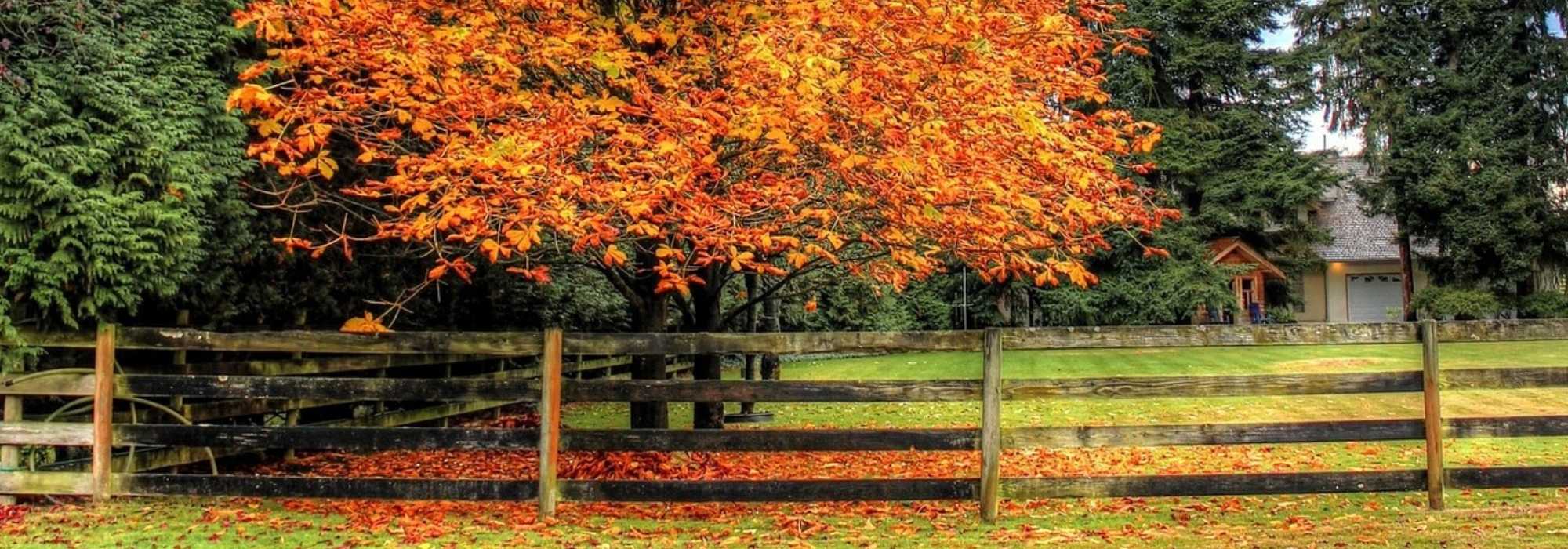
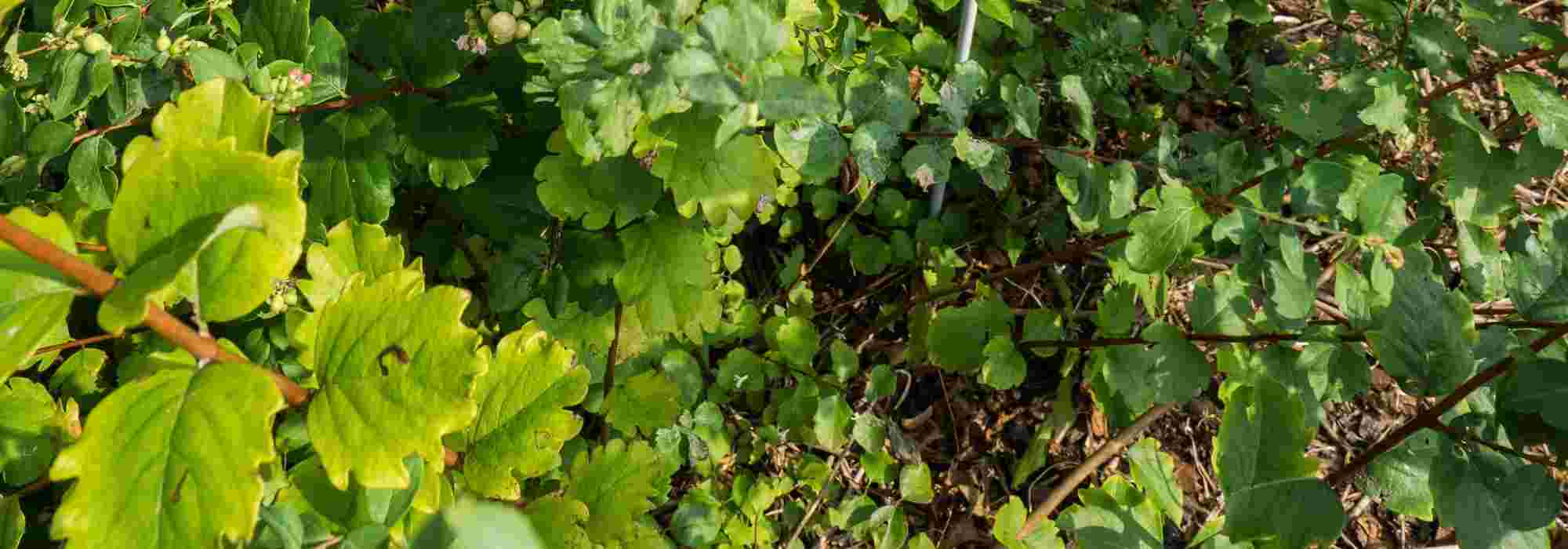
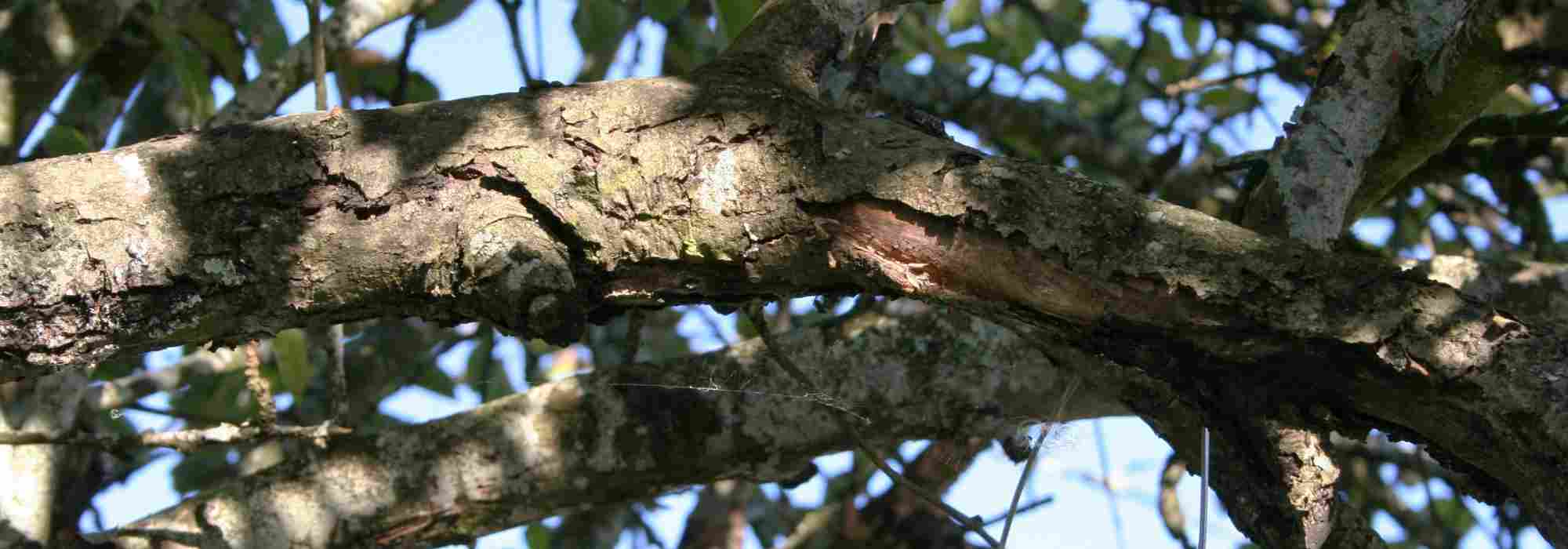
This is the case with Physocarpus Spicy Devil ‘ZLENatalie’, an American introduction from Bailey Nurseries (Saint Paul, Minnesota). Very compact, this small bush forms a very dense clump measuring approximately 1.10 m in all directions. Its habit is generally spherical, albeit with irregular outlines, as the plant sends out a quantity of branches of varying lengths in all directions. This density of vegetation, along with its original colour, instantly captures attention. The small trilobed leaves have a pleasant shape; however, it is mainly their succession of colours throughout the seasons that is attractive. In spring, the young leaves emerge at the tips of the shoots in yellow-orange tones that contrast with the previous leaves which have become reddish. Then, they evolve into a fairly dark purple which will become the dominant shade in summer. Before that, they will have passed through different tones, even a bit of green, to which the light flowering joins from May onwards. The small flowers, less than 1 cm in diameter and pinkish-white in colour, are grouped into flattened corymbs 4-5 cm in diameter. More pleasant than spectacular, the flowering is useful to honeybees as well as to wildlife. In autumn, it is the apotheosis, the plant transforms into a ball of red, orange, and gold. Afterwards, the falling leaves reveal a bark that becomes decorative over the years, exfoliating regularly and thus creating a point of visual interest in winter.
Perfectly at home in continental climates, Physocarpus opulifolius Spicy Devil likes deep, humus-bearing, and cool soils and fears overly hot climates, and particularly atmospheric drought. Under these conditions, it will be necessary to plant it in light shade and water it frequently. Elsewhere, a sunny exposure will allow it to colour well. You can create strong contrasts by planting it alongside plants with golden foliage, such as Cotinus coggygria 'Golden Lady', whose colour variations will combine admirably with its own. As compact as it is, Choisya 'Aztec Gold' will also be perfect in this role and additionally offers a very fragrant flowering. If space is lacking, a simple Heuchera 'Citronelle' planted at its base will create the same effect.
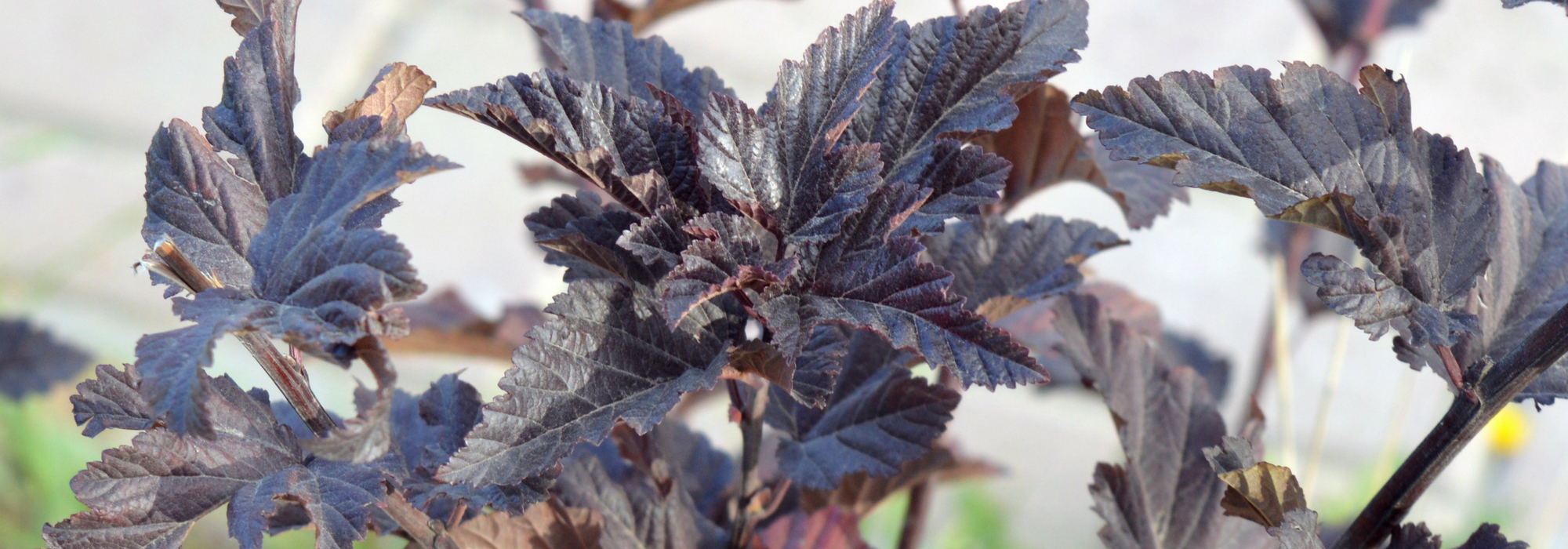
Physocarpus opulifolius Spicy Devil® - Ninebark in pictures
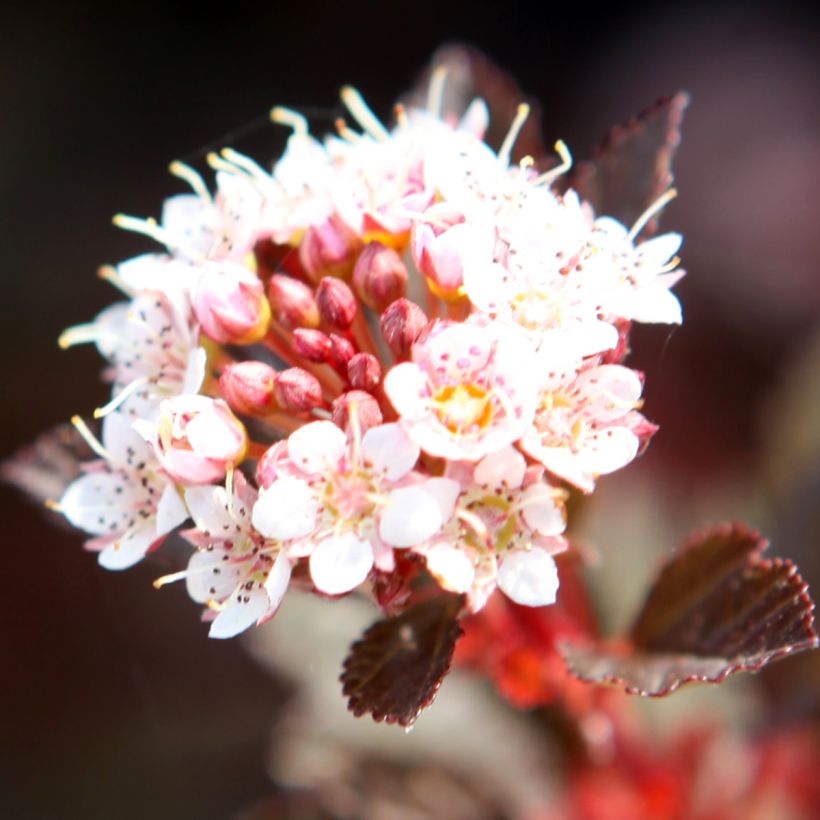
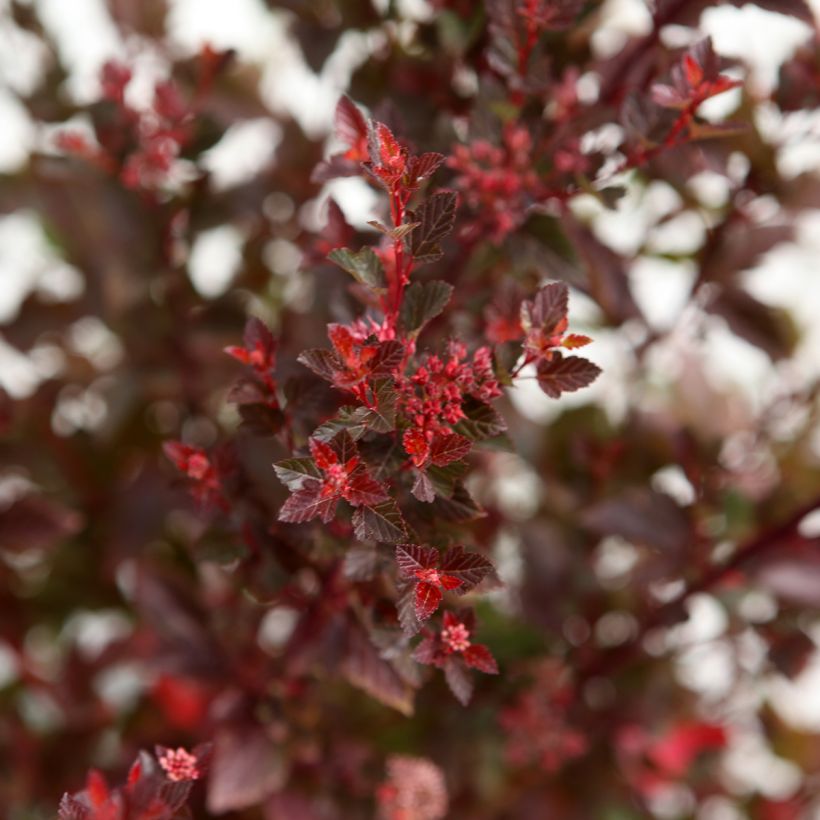
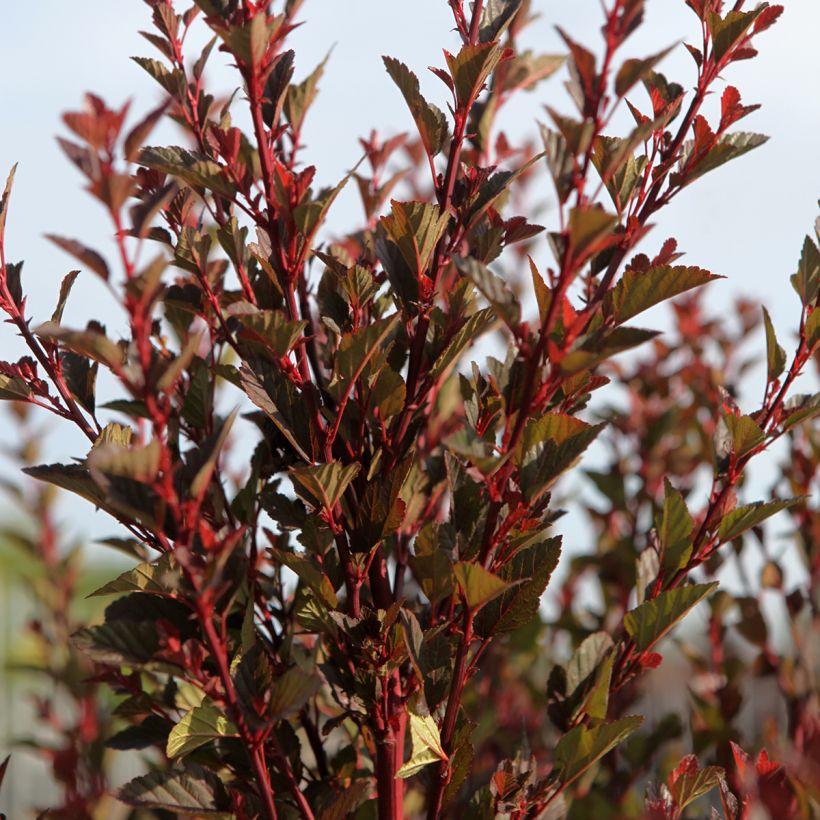
Plant habit
Flowering
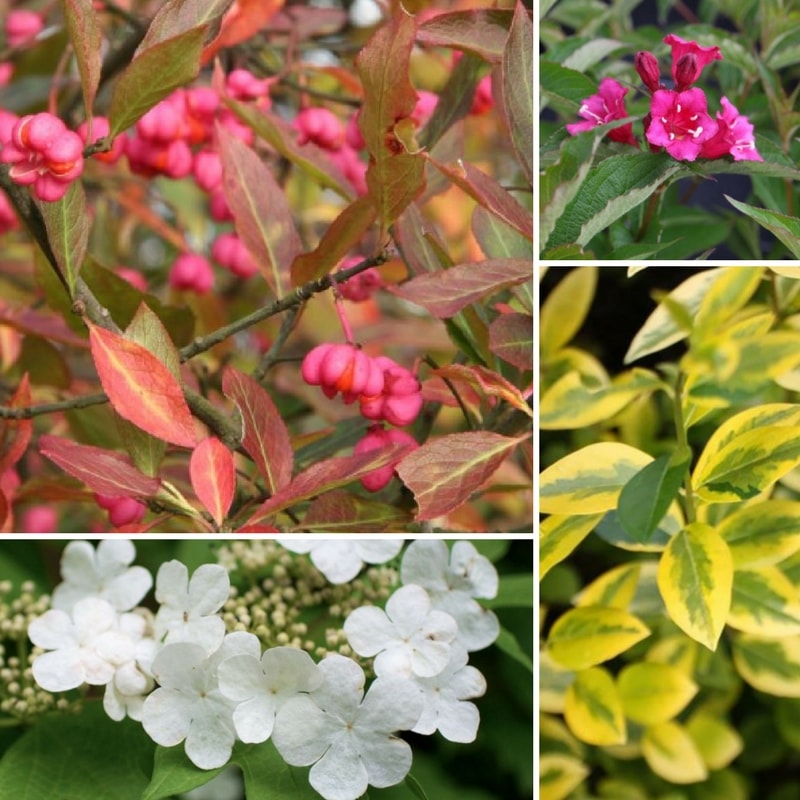
Foliage
Botanical data
Physocarpus
opulifolius
‘ZLENatalie’ Spicy Devil®
Rosaceae
Ninebark, Eastern ninebark
Physocarpus opulifolius ‘ZLENatalie’, Physocarpus opulifolius Spicy Devil®
Cultivar or hybrid
Planting and care
Plant the Physocarpus opulifolius Spicy Devil in deep, humus-bearing, rich and moist, neutral to acidic soil. It dislikes excess lime or acidity. Avoid letting the soil dry out in summer and mist the foliage during heatwaves. Atmospheric dryness is indeed harmful to the leaves, which may dry at the tips. This bush will thrive in partial shade or full sun, but the leaf colours will be more pronounced if planted in a very sunny position. It is a perfect plant for cold climates, hardy down to -25°C to -30°C, but conversely poorly suited to hot and dry climates.
This low-maintenance plant, generally spared from insects and diseases, does not require pruning. Indeed, it is much less likely to become bare at the base compared to cultivars with more vigorous growth.
Planting period
Intended location
Care
Planting & care advice
-
-
-

-
-
-
-
-
This item has not been reviewed yet - be the first to leave a review about it.
Recently viewed products
Haven't found what you were looking for?
Hardiness is the lowest winter temperature a plant can endure without suffering serious damage or even dying. However, hardiness is affected by location (a sheltered area, such as a patio), protection (winter cover) and soil type (hardiness is improved by well-drained soil).

The flowering period indicated on our website applies to countries and regions located in USDA zone 8 (France, the United Kingdom, Ireland, the Netherlands, etc.)
It will vary according to where you live:- In zones 9 to 10 (Italy, Spain, Greece, etc.), flowering will occur about 2 to 4 weeks earlier.
- In zones 6 to 7 (Germany, Poland, Slovenia, and lower mountainous regions), flowering will be delayed by 2 to 3 weeks.
- In zone 5 (Central Europe, Scandinavia), blooming will be delayed by 3 to 5 weeks.
In temperate climates, pruning of spring-flowering shrubs (forsythia, spireas, etc.) should be done just after flowering.
Pruning of summer-flowering shrubs (Indian Lilac, Perovskia, etc.) can be done in winter or spring.
In cold regions as well as with frost-sensitive plants, avoid pruning too early when severe frosts may still occur.
The planting period indicated on our website applies to countries and regions located in USDA zone 8 (France, United Kingdom, Ireland, Netherlands).
It will vary according to where you live:
- In Mediterranean zones (Marseille, Madrid, Milan, etc.), autumn and winter are the best planting periods.
- In continental zones (Strasbourg, Munich, Vienna, etc.), delay planting by 2 to 3 weeks in spring and bring it forward by 2 to 4 weeks in autumn.
- In mountainous regions (the Alps, Pyrenees, Carpathians, etc.), it is best to plant in late spring (May-June) or late summer (August-September).
The harvesting period indicated on our website applies to countries and regions in USDA zone 8 (France, England, Ireland, the Netherlands).
In colder areas (Scandinavia, Poland, Austria...) fruit and vegetable harvests are likely to be delayed by 3-4 weeks.
In warmer areas (Italy, Spain, Greece, etc.), harvesting will probably take place earlier, depending on weather conditions.
The sowing periods indicated on our website apply to countries and regions within USDA Zone 8 (France, UK, Ireland, Netherlands).
In colder areas (Scandinavia, Poland, Austria...), delay any outdoor sowing by 3-4 weeks, or sow under glass.
In warmer climes (Italy, Spain, Greece, etc.), bring outdoor sowing forward by a few weeks.
Shipping country and language
Your country of residence may be:
Your country of residence is:
For a better user experience on our website, you can select:
Your shipping country:
-
 Austria
-
 Belgium
-
 Bosnia & Herzegovina
-
 Bulgaria
-
 Croatia
-
 Cyprus
-
 Czechia
-
 Denmark
-
 Estonia
-
 Finland
-
 France
-
 Germany
-
 Greece
-
 Hungary
-
 Iceland
-
 Ireland
-
 Italy
Italy
-
 Latvia
-
 Liechtenstein
-
 Lithuania
-
 Luxembourg
-
 Malta
Malta
-
 Netherlands
-
 Poland
-
 Portugal
-
 Romania
-
 Serbia
-
 Slovakia
-
 Slovenia
-
 Spain
Spain
-
 Sweden
-
 Switzerland
Language:
-
French
-
 English
-
Spanish
-
Italian
-
German
-
Portuguese
-
Dutch
-
Finnish
My Account
Hello
My wish lists
My cart
Log in / Register
Existing customer?
This form is protected by reCAPTCHA - the Google Privacy Policy and Terms of Service apply.
New customer?
Create an account to track your orders, access our customer service and, if you wish, make the most of our upcoming offers.