





























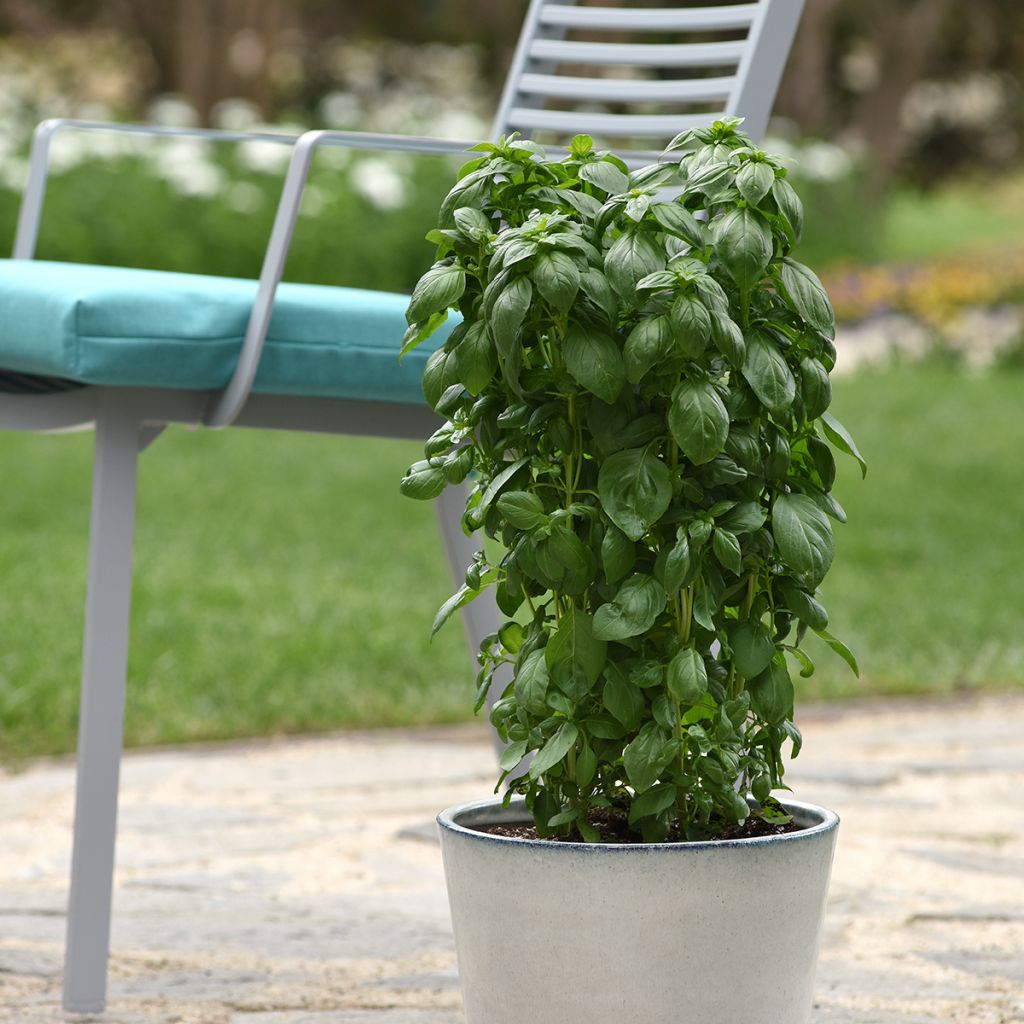
Basil Everleaf® Emerald Tower
Basil Everleaf® Emerald Tower
Ocimum basilicum Everleaf® Emerald Tower
Basil
Special offer!
Receive a €20 voucher for any order over €90 (excluding delivery costs, credit notes, and plastic-free options)!
1- Add your favorite plants to your cart.
2- Once you have reached €90, confirm your order (you can even choose the delivery date!).
3- As soon as your order is shipped, you will receive an email containing your voucher code, valid for 3 months (90 days).
Your voucher is unique and can only be used once, for any order with a minimum value of €20, excluding delivery costs.
Can be combined with other current offers, non-divisible and non-refundable.
Home or relay delivery (depending on size and destination)
Schedule delivery date,
and select date in basket
This plant carries a 6 months recovery warranty
More information
We guarantee the quality of our plants for a full growing cycle, and will replace at our expense any plant that fails to recover under normal climatic and planting conditions.
Description
Le basilic Everleaf Emerald Tower est une variété aromatique hautement appréciée pour son port vertical et compact, bien adapté aux petits espaces, à la culture en pots sur le balcon ou à la plantation en rangs serrés au potager. Sa floraison particulièrement tardive permet des récoltes prolongées tout au long de la saison estivale. Doté de grandes feuilles vert foncé brillantes au parfum intense de basilic de Gênes, il est idéal pour relever plats méditerranéens, sauces ou infusions. Résistant à la montée en graines, il conserve sa saveur plus longtemps que les variétés classiques.
Le Basilic Everleaf Emerald Tower se distingue par sa croissance verticale exceptionnelle, son feuillage dense et sa floraison très tardive, qui permet une récolte prolongée sans montée en graines prématurée. Il montre également une bonne résistance naturelle aux maladies fongiques comme le botrytis, et s'adapte aussi bien à la culture en pot qu’en pleine terre. Cette variété comblera les jardiniers qui recherchent un basilic vigoureux, structuré et décoratif, tout en étant très productif. Les fleurs, riches en eucalyptol et en eugénol, ajoutent à ses vertus apaisantes, antibactériennes et relaxantes.
Au jardin, le Basilic Everleaf Emerald Tower préfère les sols riches, humifères et bien drainés. Il redoute le froid et l’humidité stagnante, et se cultive idéalement en plein soleil, à l’abri du vent. La récolte commence entre 6 à 10 semaines après le semis et peut se poursuivre tout l’été. Pour récolter, il suffit de couper les feuilles à la main ou aux ciseaux dès qu’elles dégagent un parfum intense. En pot, la plante nécessite des arrosages réguliers, mais sans excès, en évitant d’arroser le feuillage. Sur le balcon, vous pouvez l'accompagner de la tomate cerise ‘Balconi Red F1’, du poivron nain ‘Redskin F1’, et du concombre Rocky (mini) F1.
L'utilisation du basilic dans le bassin méditerranéen remonte à l'Antiquité. Chez les Romains, cette plante était l'emblème des amoureux alors que, chez les Grecs, elle symbolisait la haine et le malheur ! Le basilic est une plante condimentaire largement utilisée pour aromatiser et relever les plats. Riche en huile essentielle, il possède des propriétés adoucissantes, anti-inflammatoires et stimulantes.
Le Basilic Everleaf Emerald Tower développe une saveur puissante et traditionnelle, idéale pour sublimer plats méditerranéens, salades, sauces et bien sûr, le fameux pesto. Il accompagne à merveille les tomates, les fromages frais, les fruits d’été ou les viandes grillées. Pour une conservation optimale, gardez les tiges quelques jours dans un verre d’eau au réfrigérateur. Il peut aussi être séché, mais cela atténue son parfum. Et au potager, n’hésitez pas à l’associer aux tomates : en plus d’enrichir vos plats, il les protège naturellement des nématodes, tout en créant une belle harmonie dans les rangs.
Report an error about the product description
Harvest
Plant habit
Foliage
Botanical data
Ocimum
basilicum
Everleaf® Emerald Tower
Lamiaceae
Basil
Cultivar or hybrid
Perennial
Planting and care
Sowing and care: 'Everleaf Emerald Tower' basil enjoys a cool, loose soil, rich in humus. This young plant also requires a partially shaded position to thrive. Basil is sensitive to direct sun exposure, as this tends to scorch the leaves. Basil is a plant that is typically placed in the kitchen garden, but it adapts very well to being grown in a pot in a conservatory or on a balcony.
Sowing: sowing is carried out in spring, from February under a layer or frame and from April in open ground until early summer. Sow in a very well-spaced line in a flat furrow about ten centimetres wide and 2 cm deep. The ranks should be spaced 25 cm apart. Cover the seeds with the soil removed along the furrow and then water. Germination takes between 10 to 15 days. As soon as the first young plants appear, carry out light thinning. The more you stagger the sowing, the longer the harvest period will be. Sowing can be done in a pot to be replanted as soon as the young plant reaches 10 cm (4 to 6 leaves) in height. Basil can remain in a pot to be kept handy in the kitchen if it is well-lit.
When transplanting, space your young plants 20 cm apart in all directions.
Care: basil requires simple watering (or preventive mulching) when the soil dries out. It is lack of water (water stress) that can cause basil to go to seed. Pinch off the flower spikes as soon as they appear, to encourage leaf production. Basil is susceptible to powdery mildew, grey mould and aphids. To combat moulds and powdery mildew, reduce watering and thin out the planting. Against aphids, you can treat the young plants with a water-olive oil mixture.


Seedlings
Care
Intended location
This item has not been reviewed yet - be the first to leave a review about it.
Haven't found what you were looking for?
Hardiness is the lowest winter temperature a plant can endure without suffering serious damage or even dying. However, hardiness is affected by location (a sheltered area, such as a patio), protection (winter cover) and soil type (hardiness is improved by well-drained soil).

Photo Sharing Terms & Conditions
In order to encourage gardeners to interact and share their experiences, Promesse de fleurs offers various media enabling content to be uploaded onto its Site - in particular via the ‘Photo sharing’ module.
The User agrees to refrain from:
- Posting any content that is illegal, prejudicial, insulting, racist, inciteful to hatred, revisionist, contrary to public decency, that infringes on privacy or on the privacy rights of third parties, in particular the publicity rights of persons and goods, intellectual property rights, or the right to privacy.
- Submitting content on behalf of a third party;
- Impersonate the identity of a third party and/or publish any personal information about a third party;
In general, the User undertakes to refrain from any unethical behaviour.
All Content (in particular text, comments, files, images, photos, videos, creative works, etc.), which may be subject to property or intellectual property rights, image or other private rights, shall remain the property of the User, subject to the limited rights granted by the terms of the licence granted by Promesse de fleurs as stated below. Users are at liberty to publish or not to publish such Content on the Site, notably via the ‘Photo Sharing’ facility, and accept that this Content shall be made public and freely accessible, notably on the Internet.
Users further acknowledge, undertake to have ,and guarantee that they hold all necessary rights and permissions to publish such material on the Site, in particular with regard to the legislation in force pertaining to any privacy, property, intellectual property, image, or contractual rights, or rights of any other nature. By publishing such Content on the Site, Users acknowledge accepting full liability as publishers of the Content within the meaning of the law, and grant Promesse de fleurs, free of charge, an inclusive, worldwide licence for the said Content for the entire duration of its publication, including all reproduction, representation, up/downloading, displaying, performing, transmission, and storage rights.
Users also grant permission for their name to be linked to the Content and accept that this link may not always be made available.
By engaging in posting material, Users consent to their Content becoming automatically accessible on the Internet, in particular on other sites and/or blogs and/or web pages of the Promesse de fleurs site, including in particular social pages and the Promesse de fleurs catalogue.
Users may secure the removal of entrusted content free of charge by issuing a simple request via our contact form.
The flowering period indicated on our website applies to countries and regions located in USDA zone 8 (France, the United Kingdom, Ireland, the Netherlands, etc.)
It will vary according to where you live:
- In zones 9 to 10 (Italy, Spain, Greece, etc.), flowering will occur about 2 to 4 weeks earlier.
- In zones 6 to 7 (Germany, Poland, Slovenia, and lower mountainous regions), flowering will be delayed by 2 to 3 weeks.
- In zone 5 (Central Europe, Scandinavia), blooming will be delayed by 3 to 5 weeks.
In temperate climates, pruning of spring-flowering shrubs (forsythia, spireas, etc.) should be done just after flowering.
Pruning of summer-flowering shrubs (Indian Lilac, Perovskia, etc.) can be done in winter or spring.
In cold regions as well as with frost-sensitive plants, avoid pruning too early when severe frosts may still occur.
The planting period indicated on our website applies to countries and regions located in USDA zone 8 (France, United Kingdom, Ireland, Netherlands).
It will vary according to where you live:
- In Mediterranean zones (Marseille, Madrid, Milan, etc.), autumn and winter are the best planting periods.
- In continental zones (Strasbourg, Munich, Vienna, etc.), delay planting by 2 to 3 weeks in spring and bring it forward by 2 to 4 weeks in autumn.
- In mountainous regions (the Alps, Pyrenees, Carpathians, etc.), it is best to plant in late spring (May-June) or late summer (August-September).
The harvesting period indicated on our website applies to countries and regions in USDA zone 8 (France, England, Ireland, the Netherlands).
In colder areas (Scandinavia, Poland, Austria...) fruit and vegetable harvests are likely to be delayed by 3-4 weeks.
In warmer areas (Italy, Spain, Greece, etc.), harvesting will probably take place earlier, depending on weather conditions.
The sowing periods indicated on our website apply to countries and regions within USDA Zone 8 (France, UK, Ireland, Netherlands).
In colder areas (Scandinavia, Poland, Austria...), delay any outdoor sowing by 3-4 weeks, or sow under glass.
In warmer climes (Italy, Spain, Greece, etc.), bring outdoor sowing forward by a few weeks.