





























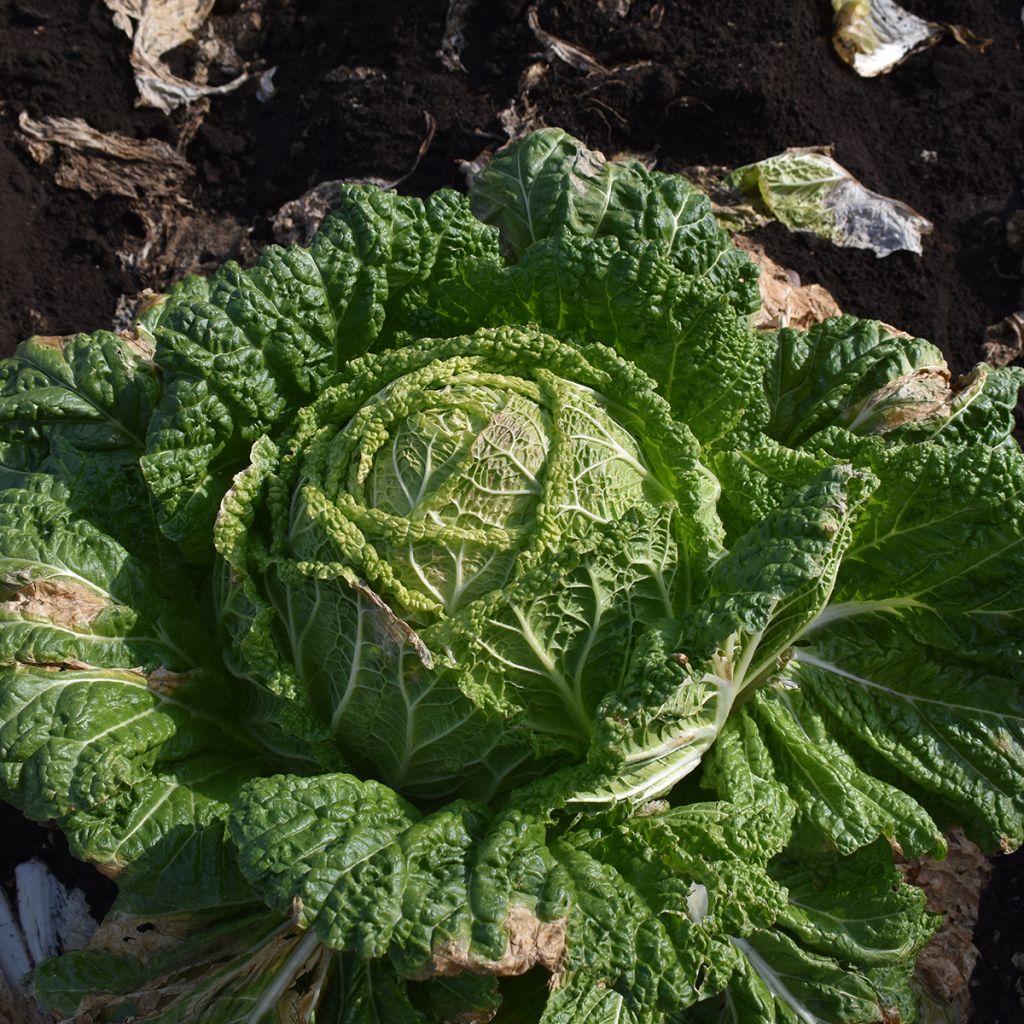
Brussels sprout Groninger organic seeds - Brassica oleracea
Brussels sprout Groninger organic seeds - Brassica oleracea
Brassica oleracea Gros des Vertus 4
Cabbage
Special offer!
Receive a €20 voucher for any order over €90 (excluding delivery costs, credit notes, and plastic-free options)!
1- Add your favorite plants to your cart.
2- Once you have reached €90, confirm your order (you can even choose the delivery date!).
3- As soon as your order is shipped, you will receive an email containing your voucher code, valid for 3 months (90 days).
Your voucher is unique and can only be used once, for any order with a minimum value of €20, excluding delivery costs.
Can be combined with other current offers, non-divisible and non-refundable.
Home or relay delivery (depending on size and destination)
Schedule delivery date,
and select date in basket
This plant carries a 6 months recovery warranty
More information
We guarantee the quality of our plants for a full growing cycle, and will replace at our expense any plant that fails to recover under normal climatic and planting conditions.
Description
Organic Gros des Vertus Savoy Cabbage is a traditional variety recognised for its large, voluminous,s round, slightly flattened, tightly packed head, and its crinkled green leaves with a slightly bluish sheen. Hardy and productive, adapted to temperate and cool climates, it can be grown both in open ground and in raised beds, in rich, moist, well-drained soil. Its great hardiness allows it to withstand the first frosts, but it is recommended to earth it up slightly and mulch its base in winter to protect its growth. Easy to grow, it integrates harmoniously into productive gardens and family vegetable plots, offering a generous harvest throughout the cold season. To be eaten raw or cooked, grated in salads or as an accompaniment. Sow from March to June for a harvest 6 months later.
Also known as crinkled cabbage, curly cabbage or curled-headed cabbage, the Savoy Cabbage bears the Latin name Brassica oleracea sabauda (in Latin, sabauda refers to Savoy). It belongs to the large Brassicaceae family (formerly Cruciferae).
Originating from Italy and more precisely from Milan, this headed cabbage is quite similar to the white cabbage but differs in the crinkled or curly appearance of its leaves. There are many varieties whose production spans from spring to winter. By carefully choosing your seeds and staggering your sowings over time, you can have this vegetable available for a very long period.
The quintessential autumn and winter vegetable, Savoy cabbage withstands the cold well. It is delicious raw in salads but can also be eaten cooked, braised with sausages or even with fish. From a nutritional point of view, this leaf vegetable is remarkable: it is low in calories and very rich in vitamins C and B6, it also contains a lot of fibre and minerals like calcium.
In the garden, like almost all brassicas (Brussels sprouts being the exception), Savoy cabbage is a demanding vegetable, requiring excellent base manure and regular moisture.
Harvest: when its head is full by simply cutting it off at ground level.
Storage: Headed cabbages keep quite well on the plant and can be stored for several days in the refrigerator. They also freeze very well after being blanched for 3 to 5 minutes in salted boiling water.
The gardener's little tip: The cabbage white butterfly (Pieris brassicae), the cabbage's main enemy, is a pretty cream-white butterfly with small black spots that awakens from April-May onwards to wreak havoc all summer by devouring its leaves. Don't be caught off guard and opt for prevention by covering with an insect-proof mesh over horticultural hoops. These meshes are easy to set up and reusable to protect, for example, your carrot and leek crops.
The cook's little tip: the Gros des Vertus Organic Savoy Cabbage is particularly appreciated in cooking for its tender texture and its slightly sweet flavour after cooking. It lends itself to many preparations, notably in potées, soups or as a stuffing, where its flexible leaves facilitate the wrapping of fillings. It can also be pan-fried with a drizzle of olive oil and garlic, or eaten raw in salads, finely shredded, for a crunchy and refreshing addition.
Report an error about the product description
Harvest
Plant habit
Foliage
Botanical data
Brassica
oleracea
Gros des Vertus 4
Brassicaceae
Cabbage
Cultivar or hybrid
Biennial
Planting and care
Sowing:
The germination temperature for organic Savoy Cabbage 'Gros des Vertus' is around 15°C and takes approximately 14 days.
It can be sown under cover from March to April or directly in the ground from May to June for a harvest from August to January.
You can sow direct in situ or produce young plants which will later be transplanted to their final position in the garden.
Preparing young plants: Sow the seeds in a heated environment, from late autumn to late winter, or in a cold frame or nursery bed in the garden for the rest of the year, at a depth of 1 cm in a good seed compost. Cover lightly with compost or vermiculite. Remember to keep the substrate moist but not waterlogged!
When the seedlings appear strong enough to handle, prick them out into pots if necessary and, for sowings under heated cover, gradually acclimatise them to cooler temperatures before transplanting them to the garden, when no more frosts are expected.
Direct sowing: In properly amended and finely worked soil, draw furrows one centimetre deep, spaced 40/50 cm apart. Sow the seeds and cover them with a thin layer of fine soil. When the seedlings are well developed, thin them out, keeping only one young plant every 50 cm or so.
Cultivation:
Grow Savoy Cabbage in full sun. It is a greedy vegetable, requiring well-manured soil, rich in nitrogen and potash. It is advisable to make a generous application of well-rotted compost (about 3/4 kg per m²), preferably in autumn, by lightly forking it in to a depth of 5 cm, after having thoroughly loosened the soil as for any vegetable crop. It is not very tolerant of soil pH, which should be between 5.6 and 6.5. In acidic soil, care must be taken to gradually raise this pH by adding calcium in the form of Dolomite or Lime.
It is a favourable companion for many vegetables such as tomatoes, lettuce... But avoid planting it near other Brassicaceae as well as near courgettes, fennel, corn salad, leeks and strawberries.
Seedlings
Care
Intended location
This item has not been reviewed yet - be the first to leave a review about it.
Similar products
Available in 1 sizes
Available in 1 sizes
Available in 1 sizes
Available in 1 sizes
Available in 1 sizes
Available in 1 sizes
Available in 1 sizes
Available in 1 sizes
Haven't found what you were looking for?
Hardiness is the lowest winter temperature a plant can endure without suffering serious damage or even dying. However, hardiness is affected by location (a sheltered area, such as a patio), protection (winter cover) and soil type (hardiness is improved by well-drained soil).

Photo Sharing Terms & Conditions
In order to encourage gardeners to interact and share their experiences, Promesse de fleurs offers various media enabling content to be uploaded onto its Site - in particular via the ‘Photo sharing’ module.
The User agrees to refrain from:
- Posting any content that is illegal, prejudicial, insulting, racist, inciteful to hatred, revisionist, contrary to public decency, that infringes on privacy or on the privacy rights of third parties, in particular the publicity rights of persons and goods, intellectual property rights, or the right to privacy.
- Submitting content on behalf of a third party;
- Impersonate the identity of a third party and/or publish any personal information about a third party;
In general, the User undertakes to refrain from any unethical behaviour.
All Content (in particular text, comments, files, images, photos, videos, creative works, etc.), which may be subject to property or intellectual property rights, image or other private rights, shall remain the property of the User, subject to the limited rights granted by the terms of the licence granted by Promesse de fleurs as stated below. Users are at liberty to publish or not to publish such Content on the Site, notably via the ‘Photo Sharing’ facility, and accept that this Content shall be made public and freely accessible, notably on the Internet.
Users further acknowledge, undertake to have ,and guarantee that they hold all necessary rights and permissions to publish such material on the Site, in particular with regard to the legislation in force pertaining to any privacy, property, intellectual property, image, or contractual rights, or rights of any other nature. By publishing such Content on the Site, Users acknowledge accepting full liability as publishers of the Content within the meaning of the law, and grant Promesse de fleurs, free of charge, an inclusive, worldwide licence for the said Content for the entire duration of its publication, including all reproduction, representation, up/downloading, displaying, performing, transmission, and storage rights.
Users also grant permission for their name to be linked to the Content and accept that this link may not always be made available.
By engaging in posting material, Users consent to their Content becoming automatically accessible on the Internet, in particular on other sites and/or blogs and/or web pages of the Promesse de fleurs site, including in particular social pages and the Promesse de fleurs catalogue.
Users may secure the removal of entrusted content free of charge by issuing a simple request via our contact form.
The flowering period indicated on our website applies to countries and regions located in USDA zone 8 (France, the United Kingdom, Ireland, the Netherlands, etc.)
It will vary according to where you live:
- In zones 9 to 10 (Italy, Spain, Greece, etc.), flowering will occur about 2 to 4 weeks earlier.
- In zones 6 to 7 (Germany, Poland, Slovenia, and lower mountainous regions), flowering will be delayed by 2 to 3 weeks.
- In zone 5 (Central Europe, Scandinavia), blooming will be delayed by 3 to 5 weeks.
In temperate climates, pruning of spring-flowering shrubs (forsythia, spireas, etc.) should be done just after flowering.
Pruning of summer-flowering shrubs (Indian Lilac, Perovskia, etc.) can be done in winter or spring.
In cold regions as well as with frost-sensitive plants, avoid pruning too early when severe frosts may still occur.
The planting period indicated on our website applies to countries and regions located in USDA zone 8 (France, United Kingdom, Ireland, Netherlands).
It will vary according to where you live:
- In Mediterranean zones (Marseille, Madrid, Milan, etc.), autumn and winter are the best planting periods.
- In continental zones (Strasbourg, Munich, Vienna, etc.), delay planting by 2 to 3 weeks in spring and bring it forward by 2 to 4 weeks in autumn.
- In mountainous regions (the Alps, Pyrenees, Carpathians, etc.), it is best to plant in late spring (May-June) or late summer (August-September).
The harvesting period indicated on our website applies to countries and regions in USDA zone 8 (France, England, Ireland, the Netherlands).
In colder areas (Scandinavia, Poland, Austria...) fruit and vegetable harvests are likely to be delayed by 3-4 weeks.
In warmer areas (Italy, Spain, Greece, etc.), harvesting will probably take place earlier, depending on weather conditions.
The sowing periods indicated on our website apply to countries and regions within USDA Zone 8 (France, UK, Ireland, Netherlands).
In colder areas (Scandinavia, Poland, Austria...), delay any outdoor sowing by 3-4 weeks, or sow under glass.
In warmer climes (Italy, Spain, Greece, etc.), bring outdoor sowing forward by a few weeks.