





























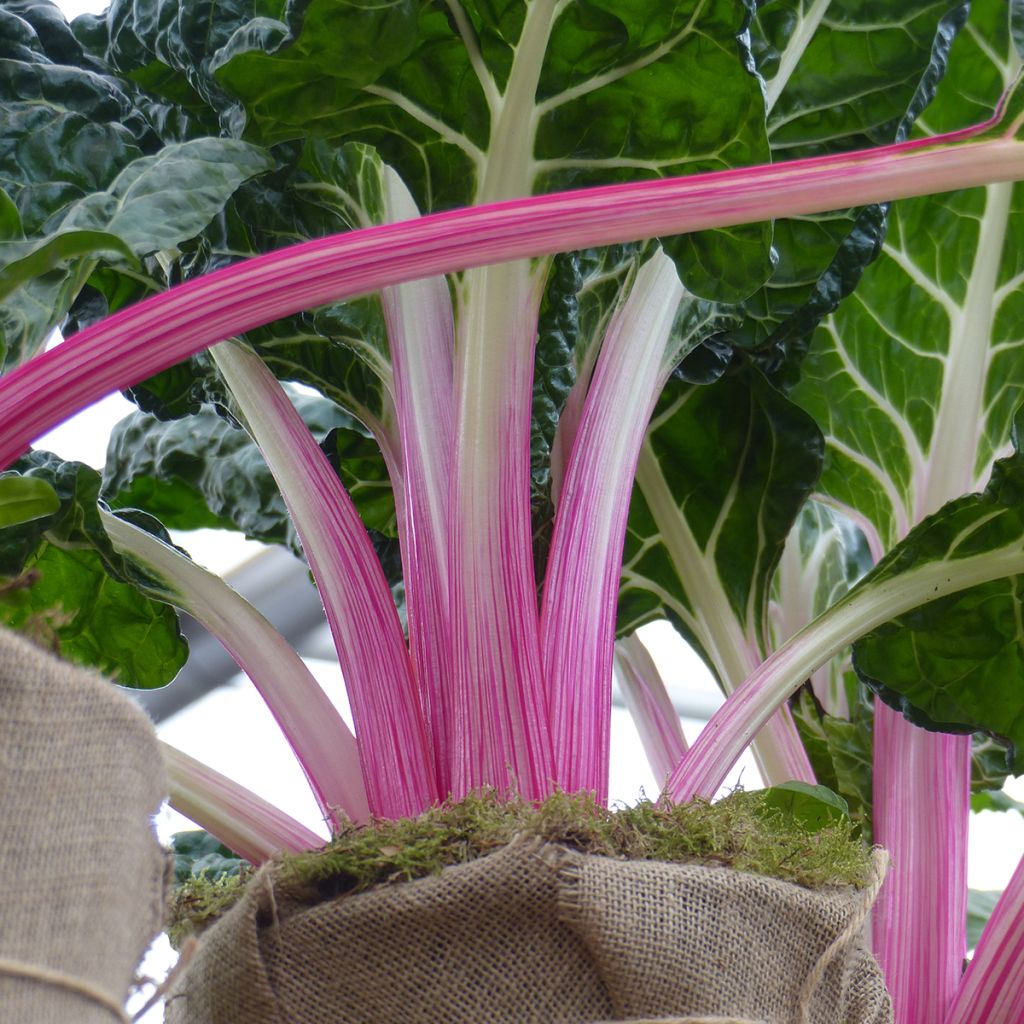
Beta vulgaris var. cicla 'Lipstick' seeds - Swiss chard
Swiss Chard Lipstick
Beta vulgaris var. cicla 'Lipstick'
Swiss Chard
Special offer!
Receive a €20 voucher for any order over €90 (excluding delivery costs, credit notes, and plastic-free options)!
1- Add your favorite plants to your cart.
2- Once you have reached €90, confirm your order (you can even choose the delivery date!).
3- As soon as your order is shipped, you will receive an email containing your voucher code, valid for 3 months (90 days).
Your voucher is unique and can only be used once, for any order with a minimum value of €20, excluding delivery costs.
Can be combined with other current offers, non-divisible and non-refundable.
Home or relay delivery (depending on size and destination)
Schedule delivery date,
and select date in basket
This plant carries a 6 months recovery warranty
More information
We guarantee the quality of our plants for a full growing cycle, and will replace at our expense any plant that fails to recover under normal climatic and planting conditions.
Description
Swiss chard 'Lipstick' catches the eye before delighting the palate: its vivid pink stems stand proudly at the heart of dark green, crinkled and glossy foliage. This robust and generous variety is not bothered by passing heatwaves nor light autumn frosts. It offers long harvests if its leaves are carefully picked as needed.
Sowing: from March to July, directly in position. Harvest: from May until the frosts, according to your needs.
Botanically, 'Lipstick' is a selection of Beta vulgaris subsp. cicla (formerly B. vulgaris var. cicla), more commonly called Swiss chard or leaf beet. All varieties of Swiss chard descend from Beta vulgaris subsp. maritima, a wild Mediterranean plant growing on saline coasts.
This cultivated leaf vegetable has existed since antiquity: mentioned by the Greeks and Romans, distributed throughout the Mediterranean basin for its edible leaves long before the sugar beet root.
'Lipstick' leaf beet continues this tradition, combining decorative character (coloured stems) and good yield, thanks to modern selections that enhance the glossiness of the midribs, their vibrant hue and better tolerance to climate variations.
'Lipstick' Swiss chard in the kitchen:
Its tender and mild young leaves can be enjoyed raw in salads. When mature, the foliage can be cooked like spinach, while its fleshy midribs are used in gratins, steamed or in hearty stir-fries. Low in calories but rich in fibre, vitamins and minerals, it is a tasty and beneficial vegetable to be used in generous, family-friendly cooking.
From a nutritional standpoint: leaf beet has more than one asset. Its leaves are packed with vitamins A, C and K, as well as essential minerals like iron, magnesium and potassium. Rich in fibre and very low in calories, it contributes to a balanced diet while adding colour and freshness to the plate. Like all chard, it contains oxalates, to be consumed in moderation by anyone with a sensitivity to these substances (arthritis, kidney stones).
In the ornamental garden: 'Lipstick' Swiss chard doesn't just nourish: it beautifies. Its pink stems brighten the vegetable garden and also find their place in a flower bed, alongside flowers with warm tones like marigolds, or light tones like cosmos.
In the vegetable garden: as a companion plant, it appreciates being close to carrots, onions or turnips, which share its preference for moist, loose soil.
Harvest: pick the large leaves as needed, the plant will continuously produce new ones.
Storage: a few days in the refrigerator, but the best is enjoyed freshly picked.
The gardener's little tip: a generous mulch keeps the soil moist and improves the flavour of the leaves. Staggered sowings ensure a long harvest period, from spring to autumn.
Report an error about the product description
Harvest
Plant habit
Foliage
Botanical data
Beta
vulgaris var. cicla
'Lipstick'
Amaranthaceae
Swiss Chard
Cultivar or hybrid
Biennial
Planting and care
Sowing 'Lipstick' Swiss Chard:
The germination temperature for Swiss Chard is between 10 and 30°C and takes between 10 and 20 days.
Sow from April to July.
In a previously fertilised, finely raked soil (rich, but without fresh manure).
Directly in situ, as transplanting can sometimes cause premature bolting.
Either: in stations of 3 seeds every 40 cm, covered with a small centimetre of fine soil watered regularly until emergence. Keep the most vigorous young plant at the 3-4 leaf stage.
Or: in a shallow furrow, in rows spaced 40 cm apart, covered with a centimetre of fine soil watered regularly until emergence. At the 3-4 leaf stage, thin out to leave only one young plant every 40 cm.
Maintenance and cultivation of 'Lipstick' Swiss Chard
Carry out regular hoeing and weeding.
Watering should be plentiful and frequent. A soil cover (mulching) is beneficial.
In certain climates (above -6°C), Swiss chard can overwinter in the ground by taking care to mulch them generously. They can also be stored in a trench.

Seedlings
Care
Intended location
This item has not been reviewed yet - be the first to leave a review about it.
Similar products

Available in 1 sizes
Available in 1 sizes

Available in 1 sizes

Available in 1 sizes

Available in 1 sizes

Available in 1 sizes

Available in 1 sizes
Available in 1 sizes
Haven't found what you were looking for?
Hardiness is the lowest winter temperature a plant can endure without suffering serious damage or even dying. However, hardiness is affected by location (a sheltered area, such as a patio), protection (winter cover) and soil type (hardiness is improved by well-drained soil).

Photo Sharing Terms & Conditions
In order to encourage gardeners to interact and share their experiences, Promesse de fleurs offers various media enabling content to be uploaded onto its Site - in particular via the ‘Photo sharing’ module.
The User agrees to refrain from:
- Posting any content that is illegal, prejudicial, insulting, racist, inciteful to hatred, revisionist, contrary to public decency, that infringes on privacy or on the privacy rights of third parties, in particular the publicity rights of persons and goods, intellectual property rights, or the right to privacy.
- Submitting content on behalf of a third party;
- Impersonate the identity of a third party and/or publish any personal information about a third party;
In general, the User undertakes to refrain from any unethical behaviour.
All Content (in particular text, comments, files, images, photos, videos, creative works, etc.), which may be subject to property or intellectual property rights, image or other private rights, shall remain the property of the User, subject to the limited rights granted by the terms of the licence granted by Promesse de fleurs as stated below. Users are at liberty to publish or not to publish such Content on the Site, notably via the ‘Photo Sharing’ facility, and accept that this Content shall be made public and freely accessible, notably on the Internet.
Users further acknowledge, undertake to have ,and guarantee that they hold all necessary rights and permissions to publish such material on the Site, in particular with regard to the legislation in force pertaining to any privacy, property, intellectual property, image, or contractual rights, or rights of any other nature. By publishing such Content on the Site, Users acknowledge accepting full liability as publishers of the Content within the meaning of the law, and grant Promesse de fleurs, free of charge, an inclusive, worldwide licence for the said Content for the entire duration of its publication, including all reproduction, representation, up/downloading, displaying, performing, transmission, and storage rights.
Users also grant permission for their name to be linked to the Content and accept that this link may not always be made available.
By engaging in posting material, Users consent to their Content becoming automatically accessible on the Internet, in particular on other sites and/or blogs and/or web pages of the Promesse de fleurs site, including in particular social pages and the Promesse de fleurs catalogue.
Users may secure the removal of entrusted content free of charge by issuing a simple request via our contact form.
The flowering period indicated on our website applies to countries and regions located in USDA zone 8 (France, the United Kingdom, Ireland, the Netherlands, etc.)
It will vary according to where you live:
- In zones 9 to 10 (Italy, Spain, Greece, etc.), flowering will occur about 2 to 4 weeks earlier.
- In zones 6 to 7 (Germany, Poland, Slovenia, and lower mountainous regions), flowering will be delayed by 2 to 3 weeks.
- In zone 5 (Central Europe, Scandinavia), blooming will be delayed by 3 to 5 weeks.
In temperate climates, pruning of spring-flowering shrubs (forsythia, spireas, etc.) should be done just after flowering.
Pruning of summer-flowering shrubs (Indian Lilac, Perovskia, etc.) can be done in winter or spring.
In cold regions as well as with frost-sensitive plants, avoid pruning too early when severe frosts may still occur.
The planting period indicated on our website applies to countries and regions located in USDA zone 8 (France, United Kingdom, Ireland, Netherlands).
It will vary according to where you live:
- In Mediterranean zones (Marseille, Madrid, Milan, etc.), autumn and winter are the best planting periods.
- In continental zones (Strasbourg, Munich, Vienna, etc.), delay planting by 2 to 3 weeks in spring and bring it forward by 2 to 4 weeks in autumn.
- In mountainous regions (the Alps, Pyrenees, Carpathians, etc.), it is best to plant in late spring (May-June) or late summer (August-September).
The harvesting period indicated on our website applies to countries and regions in USDA zone 8 (France, England, Ireland, the Netherlands).
In colder areas (Scandinavia, Poland, Austria...) fruit and vegetable harvests are likely to be delayed by 3-4 weeks.
In warmer areas (Italy, Spain, Greece, etc.), harvesting will probably take place earlier, depending on weather conditions.
The sowing periods indicated on our website apply to countries and regions within USDA Zone 8 (France, UK, Ireland, Netherlands).
In colder areas (Scandinavia, Poland, Austria...), delay any outdoor sowing by 3-4 weeks, or sow under glass.
In warmer climes (Italy, Spain, Greece, etc.), bring outdoor sowing forward by a few weeks.