


5 late autumn flowering bulbs
Bulbous plants to brighten up gardens, balconies or terraces between October and December
Contents
There are many autumn-flowering bulbs, which take over in the garden once the busy summer season has ended. Most of them flower from September, but there are varieties that flower later. These plants with bulbs or tubercles will create a real transition between autumn and winter, sometimes flowering until the first frosts. Their precious flowering will brighten the garden at a time when it is mainly the showy foliage that provides the spectacle.
Easy to grow in well-drained soils (no standing moisture), these plants can even naturalise and come back year after year. Here is our selection of five types of bulbs that flower from October to December.

Saffron crocuses
If we know spring crocuses well, which are among the first bulbs to reveal the tips of their petals at the end of winter, there are also autumn varieties.
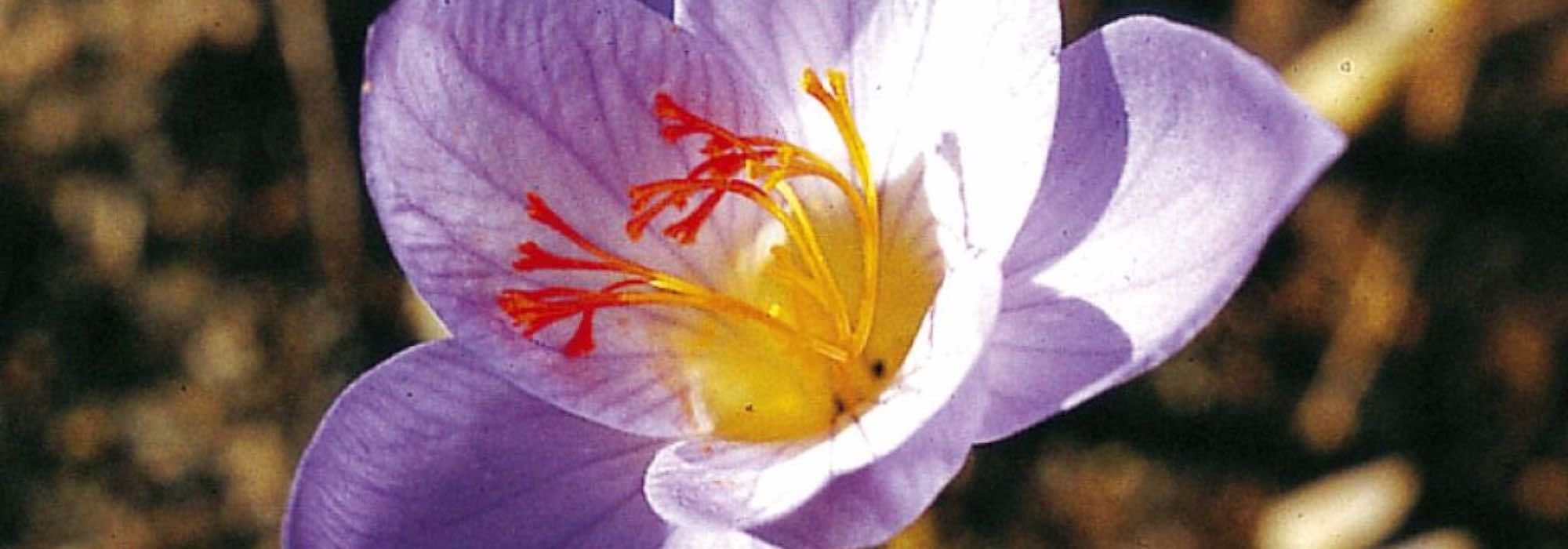
Among those that flower in October–November, firstly mention the famous Crocus sativus or Saffron Crocus. It is from this bulb, originating from the Middle East, that the aromatic stigma are extracted which yield the precious red spice. Each corm of this plant (storage organ resembling a bulb) produces one to two large flowers of about 10 cm in diameter, with the characteristic cup-shaped form. In terms of colour, they display a pretty violet shade veined with lilac. Long scarlet filaments and golden-yellow stamens emerge from the centre of the flowers, adding a touch of pep.
This autumn crocus is compact, reaching 15 cm in height and 10 cm across. It is grown in full sun, in well-drained soil (standing moisture can prove fatal to it), even calcareous and dry in summer. Its hardiness is around -15°C. The plant is in dormancy during summer and wakes up in autumn. The fine, linear leaves, which often appear after the flowers, persist through winter.
Also discover the Crocus cartwrightianus ‘Albus’, a saffron crocus less common. Yet, its pure white flowering is just as ornamental.
Pair them with early spring bulbs, such as the snowdrops, to enjoy a staggered flowering.
For more information: Saffron crocus, growing it and harvesting it
Read also
How to store summer bulbs?Crocus speciosus
Here are more crocuses that reveal themselves in late autumn: the Crocus speciosus. The variety ‘Cassiope’ produces broad, cup-shaped flowers about 6 cm across. The petals, lavender-blue veined, reveal a heart of bright orange stigmas and a pale yellow throat. This colourful flowering will bring a real touch of brightness to the garden from October to November. The dense foliage is green with a silvery tint. It emerges after flowering. Fairly similar, but a shade lighter, the flowering of the variety ‘Conqueror’ bears pale blue veined with violet.
These Crocuses are hardy (down to -20°C). They require well-drained soil in a sunny position.
Autumn crocuses are planted in summer and grown in mass for a striking effect of volume and colour. They can be planted in a flowering container, in the vegetable garden, or in a rock garden. They will also create pretty carpets to brighten a lawn that’s a little too dull. Pair them with other bulbs that will flower from the end of summer, such as Colchicums or Naples Cyclamen.
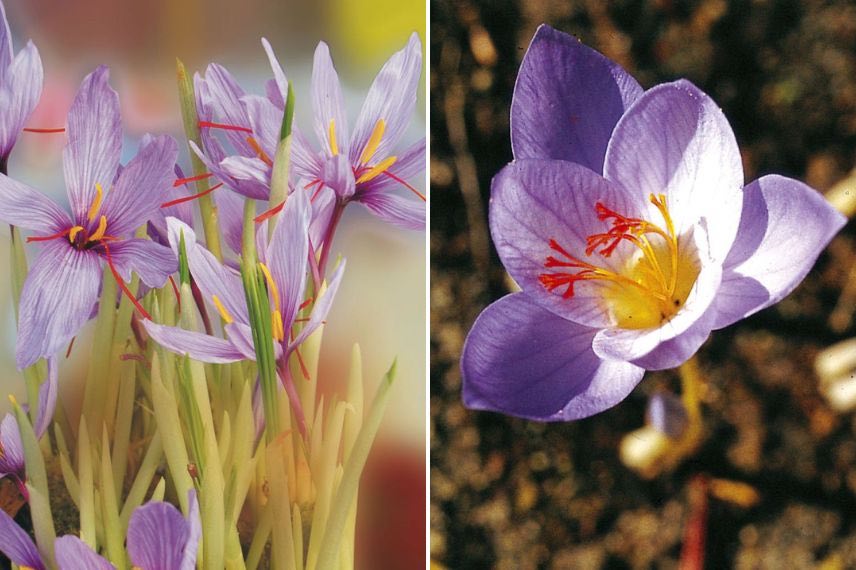
The saffron crocus, Crocus sativus, and the Crocus speciosus ‘Cassiope’
Nerine undulata
Nerines are summer-blooming bulbs valued for their delicate, elegant flowering. They are composed of slender tepals in ribbons that curl to varying degrees. The flowers appear at the top of a stiff stem, about 50 cm tall. While most Nerines flower from late summer, some species will require a little extra patience from the gardener before they can be enjoyed.
This is the case with Nerine undulata, a species that deserves to be better known. It indeed rewards us with a long flowering period that can last almost two months in late autumn, from October to November. This bulbous plant produces slender flowers with delicately undulating petals in a soft pale pink. They are grouped into small, delicate bouquets, borne on stems rising from the foliage. Unlike other Nerines, its ribbon-like foliage also has the advantage of being almost evergreen: it only briefly disappears after flowering, before starting again, even in frosts (down to -8°C).
Let’s also mention other species that bloom in late autumn.
- Nerine flexuosa is also known as the “spider lily”, in reference to the shape of its twisted and delicately sculpted petals. There are pink varieties or white ones.
- Nerine bowdenii (Bowden’s Nerine) is one of the most widespread species, which flowers in large pink umbels, typical of the species. The flowers are even larger in the variety ‘Pink Triumph’, or in a more vivid colour in ‘Isobel’.
- Nerine sarniensis ‘Corusca’ stands out for its flowers in a rare vermilion red with a gold iridescence, stunning in autumn light.
These Nerines are also only moderately hardy (-6°C to -12°C, depending on the species). They can be grown in the ground in mild regions of the Mediterranean or Atlantic, for example in a border bed. Elsewhere, pot cultivation is ideal to shelter them from severe winter frosts. Provide them with a sunny position, in light, well-drained soil. Choose their location carefully in advance, as these plants do not like being moved. Always grow them in clumps, as their flowering can be irregular.
For more information: Nerine: planting, growing, care.
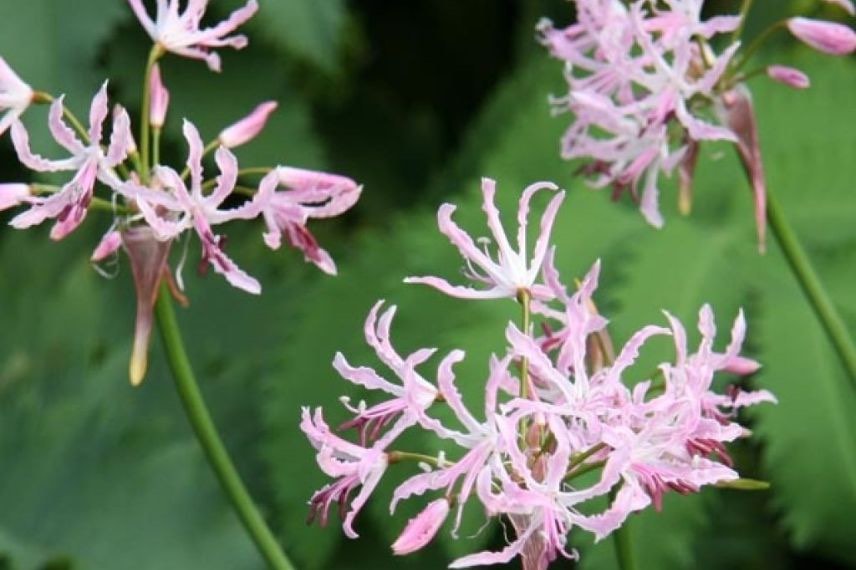
Nerine undulata
Read also
Growing summer bulbs in potsDahlia imperialis
The Dahlia imperialis is a giant dahlia, the largest in the genus.
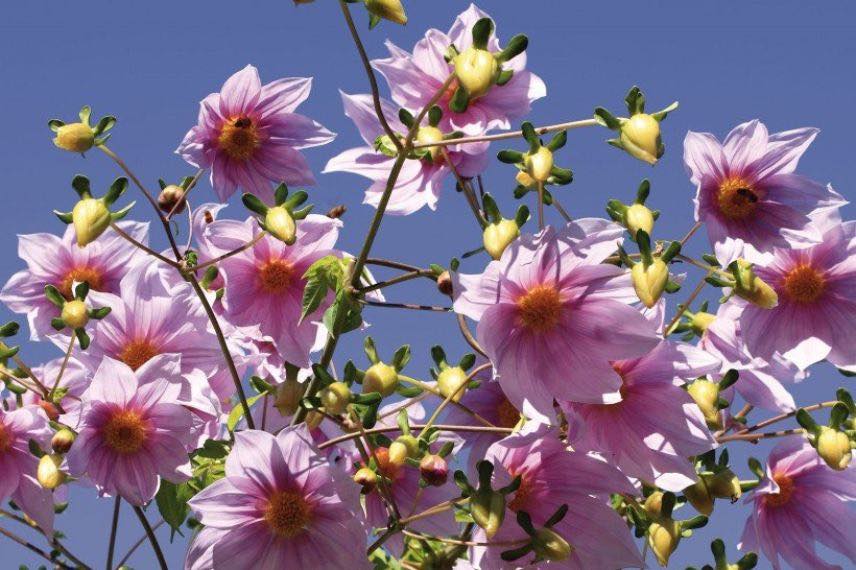
The flowering of Dahlia imperialis begins late in autumn and lasts until December. Only strong winds and the first frosts can stop it. It comprises single flowers of around 13 cm, slightly inclined and with a delicately crumpled appearance. They reveal a pink shade leaning toward pale lavender, highlighted by a contrasting orange-yellow heart. In the variety ‘White’, they are naturally white.
With this Dahlia, natural luxuriance and ringed stems resembling bamboo give an exotic air, adding even more ornamental interest.
Its hardiness is limited to -5°C (a little higher if the plant is protected by a thick mulch and in dry soil). This giant will therefore be suited to mild climates that do not experience early frosts for outdoor cultivation.
Provide it with a sunny, sheltered exposure, in soil that remains cool. It will be perfect alongside exotic foliage, such as palms or banana trees.
For more information: Dahlia: planting, maintenance and cultivation tips and Dahlia imperialis, easier to grow than you think!
Hedychium villosum
Hedychiums, also known as ‘wild gingers’, are attractive rhizomatous plants with an exotic appearance. They usually flower from late summer into early autumn. The species ofHedychium villosum ‘Tenuiflorum’ cultivar stands out for its later flowering, which occurs around November. Smaller than most of its relatives, it will reach about 60 cm in height and 40 cm in spread.
This ornamental ginger produces spider-like, wild-looking flowers arranged in spikes. They are white with contrasting red bracts.
The long, slender leaves persist if protected from frost. They resemble bamboo.
Not very hardy (down to about -6°C); this plant can be grown in a pot outside the milder regions of the country. Provide it with a rich, well-drained but moist substrate. Hedychium villosum appreciates partial shade. This rhizomatous plant will look wonderful in a pot or exotic-inspired container, for example beside dwarf Cannas, which will bloom from the end of summer.
For more information: Hedychium: planting, growing and care.
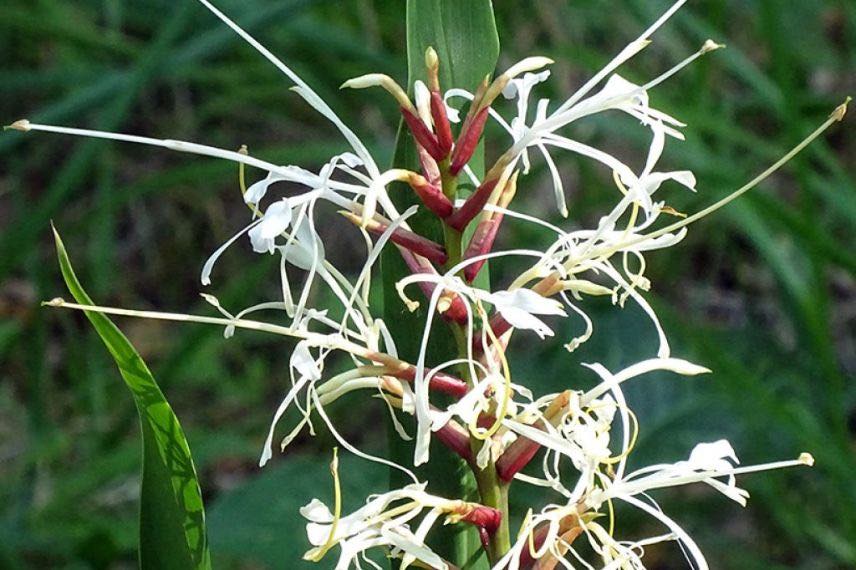
Hedychium villosum ‘Tenuiflorum’
- Subscribe!
- Contents

Comments