






























6 drought-resistant vegetables
vegetables that are low in water requirements
Contents
Restrictions on water mean that more and more of us want to grow frugal and drought-resistant vegetables in our gardens. Even sun-loving vegetables like peppers and aubergines, traditionally grown in warm, sunny regions, require a significant amount of water during the summer months. Do you want to create a garden without watering and are wondering which vegetables do not need water? Discover our selection of 6 drought-resistant vegetables to diversify your crops and preserve the precious resource of water!

Chickpea
Plant of the Fabaceae family (legumes) and a well-known ingredient in Mediterranean cuisine, chickpea (Cicer arietinum) is increasingly being cultivated in our vegetable gardens. Low-maintenance, it does require sunlight; it is therefore ideal for southern vegetable gardens. However, it can also be grown further north, provided it is given perfectly drained soil and a full sun exposure, as it is particularly sensitive to moisture and cold.
The chickpea is an annual herbaceous plant that can reach 1 m in height, cultivated for its edible seeds which are very rich in assimilable carbohydrates and plant proteins. Summer drought is of no concern to the chickpea, and it can even be beneficial. Its extensive root system allows it to seek out the nutrients it needs and hosts nodules containing nitrogen-fixing bacteria, making it a plant that thrives in poor, stony, and dry soils. The fruit is a small pod about 3 cm long and 1.5 cm wide, containing one to two spherical seeds.
Chickpeas are sown in rows spaced about 40 to 50 cm apart. Watering is only necessary at the beginning of the seedling development; afterwards, it is unnecessary. However, weeding is essential until the plants are sufficiently developed. Hilling is done when the plants reach about twenty centimetres, and harvesting occurs when the pods are dry, usually at the end of August.
→ What if you grew chickpeas? ALL OUR TIPS FOR SOWING, MAINTAINING, AND HARVESTING CHICKPEAS
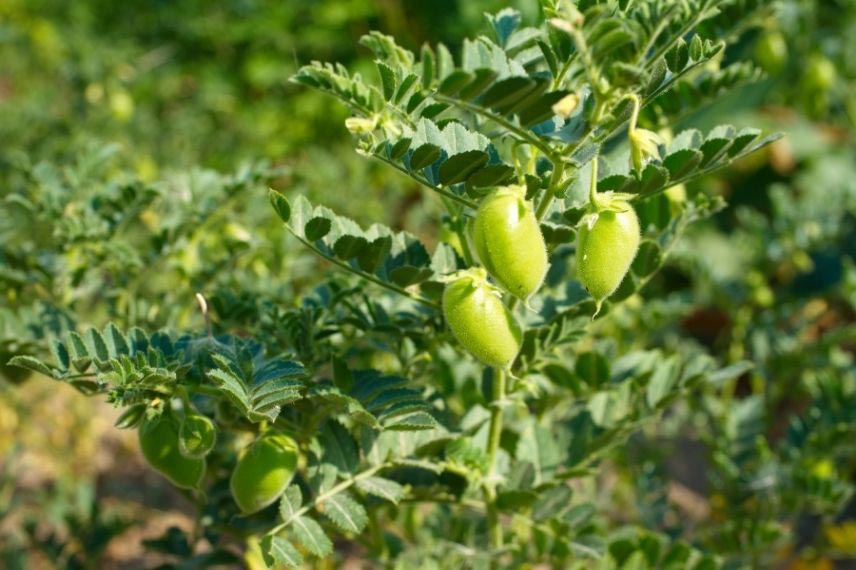 Chickpea plant</caption]
Vitelotte potato
Ancient semi-early variety, the Vitelotte potato is notable for its dark purple flesh and thick, dark blue, almost black skin. Its elongated, knobbly tubers with floury flesh are perfect for mash or soups. With a tendency to absorb less oil during cooking, they also yield very crispy chips.
Traditionally planted between mid-March and May, depending on your climate, you will harvest this unique potato 120 to 150 days after planting. Low in water requirements, the Vitelotte potato does not need watering unless the weather remains dry for an extended period and flowering is underway. It is easy to grow in rich, light, well-drained soil, and in a sunny position.
→ To grow the Vitelotte like an expert, check out our guide on THE POTATO: PLANTING, CULTIVATION, HARVEST
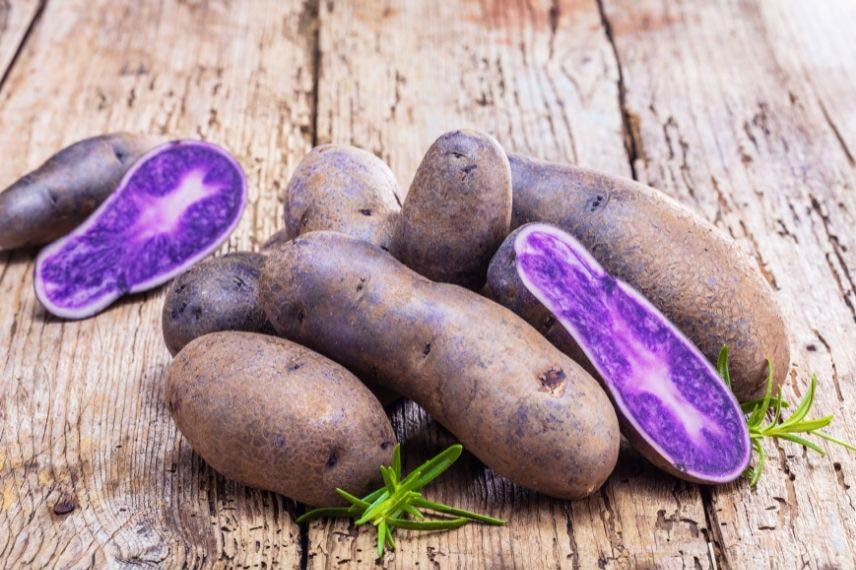
The characteristic colour of the Vitelotte potato
Discover other Vegetable gardens
View all →
Available in 1 sizes
Available in 1 sizes
Available in 1 sizes
Available in 1 sizes
Available in 1 sizes
Available in 1 sizes
Available in 1 sizes
Available in 1 sizes
Available in 1 sizes
Available in 1 sizes
Jerusalem artichoke
Also known as Jerusalem Artichoke or Earth Pear, the Jerusalem Artichoke (Helianthus tuberosus) is an ancient root vegetable that is easy to grow and low-maintenance, requiring watering only in cases of prolonged drought and high temperatures. Watering should be kept minimal to prevent the tuber from rotting.
Planted in spring, from late February to June, or in September – October for a winter harvest, this perennial plant from the Asteraceae family will produce attractive sun-yellow flowers similar to those of the sunflower, which is its close relative. You can rediscover its delicately flavoured tubers, reminiscent of artichoke, rich in phosphorus, potassium, and vitamins, cooked in gratins, soups, sautéed, or in salads. It is one of the easiest vegetables to grow, with a great capacity to multiply. To prevent it from becoming invasive, ensure it has an appropriate space and let nature take its course!
→ To rediscover this ancient vegetable, read our sheet JERUSALEM ARTICHOKE: PLANTING, HARVEST, CULTIVATION
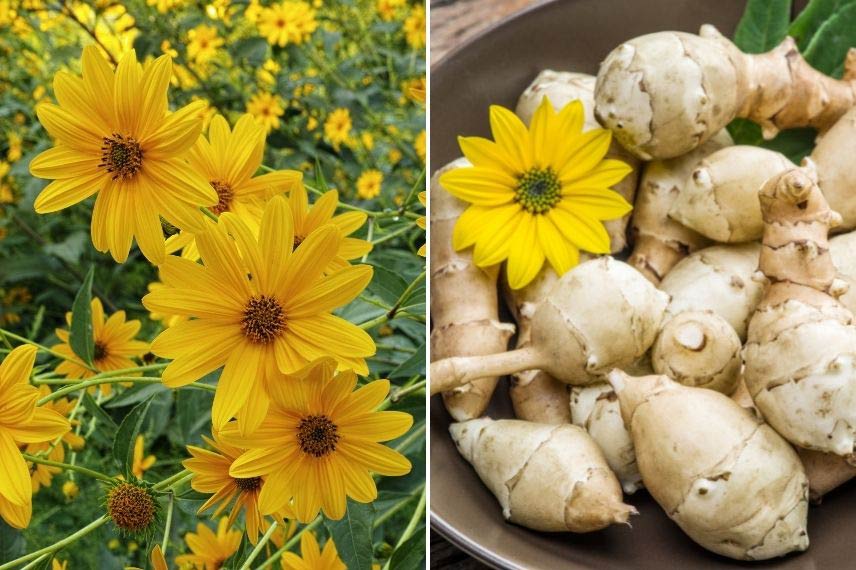
Flowers and tubers of Jerusalem artichokes
Perpetual leek
Ancestor of the leek traditionally grown in our gardens, the perpetual leek (Allium ampeloprasum), also known as perennial leek, is an ancient vegetable that has the unique characteristic of remaining in place for several years in your garden; it is therefore particularly interesting for permaculture enthusiasts. The perpetual leek produces small, particularly tasty boles that can be cooked in the same way as other varieties of leek. The leaves, grouped in compact tufts, should be cut 2 cm above the soil and will regrow with each harvest.
Easy to grow and very hardy (down to -25 °C), the perennial leek tolerates drought very well and prefers rich, well-drained, sandy, and slightly calcareous soils. It is planted from March to October, with a harvest period from September to May.
→ Interested in growing perennial vegetables? Find our tips on 10 perennial vegetables for a sustainable and self-sufficient garden
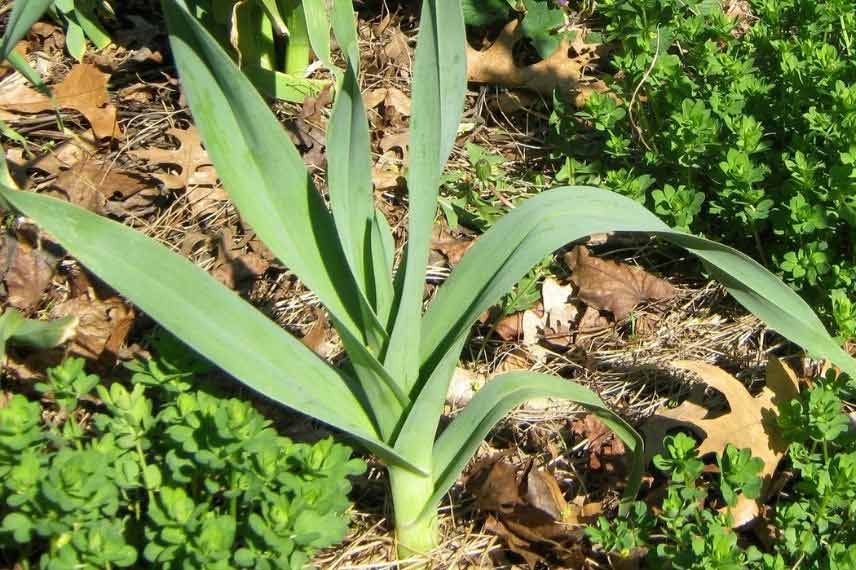
Perennial or perpetual leek
The Peruvian Oca
Of a particular flavour between potato and sorrel, Peruvian Oca is grown for its small, swollen tubercles, with colours ranging from yellow to red. Planting is done from these tubercles in April and May, and the plant, with foliage similar to that of clover, forms a bushy clump.
The oca prefers deep, rich, well-drained soils, requires hilling, and needs very moderate watering, mainly in case of drought. It is consumed cooked, but unpeeled, like a potato. The leaves, which are also edible, can be eaten in salads.
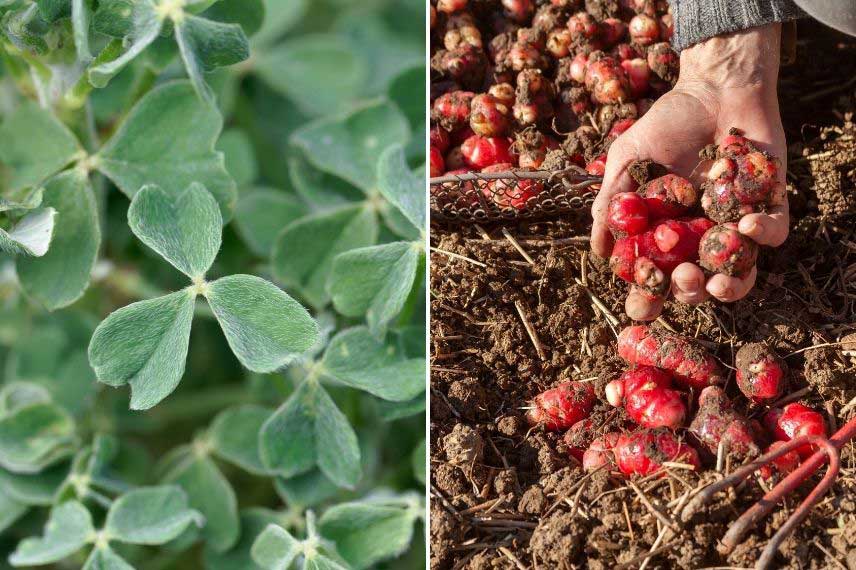
Peruvian Ocas: detail of edible leaves and tubercles
Purslane
Annual creeping plant, purslane produces numerous fleshy leaves with a very mild flavour, low in calories and rich in antioxidant properties. They can be consumed raw, cooked, or pickled in vinegar.
Particularly drought-resistant, purslane can establish itself spontaneously in the garden, but it would be a shame to consider this salad, full of benefits, as an adventive. Robust and easy to care for, purslane requires nothing and grows very well without water, even in summer.
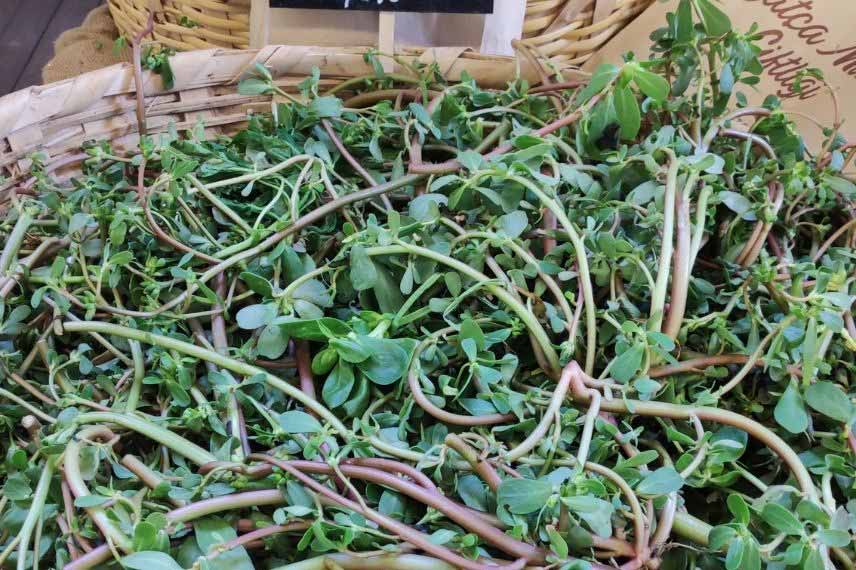 Harvesting purslane
→ Our best tips for growing PURSLANE: SOWING, GROWING, AND HARVESTING

- Subscribe!
- Contents

Comments