





























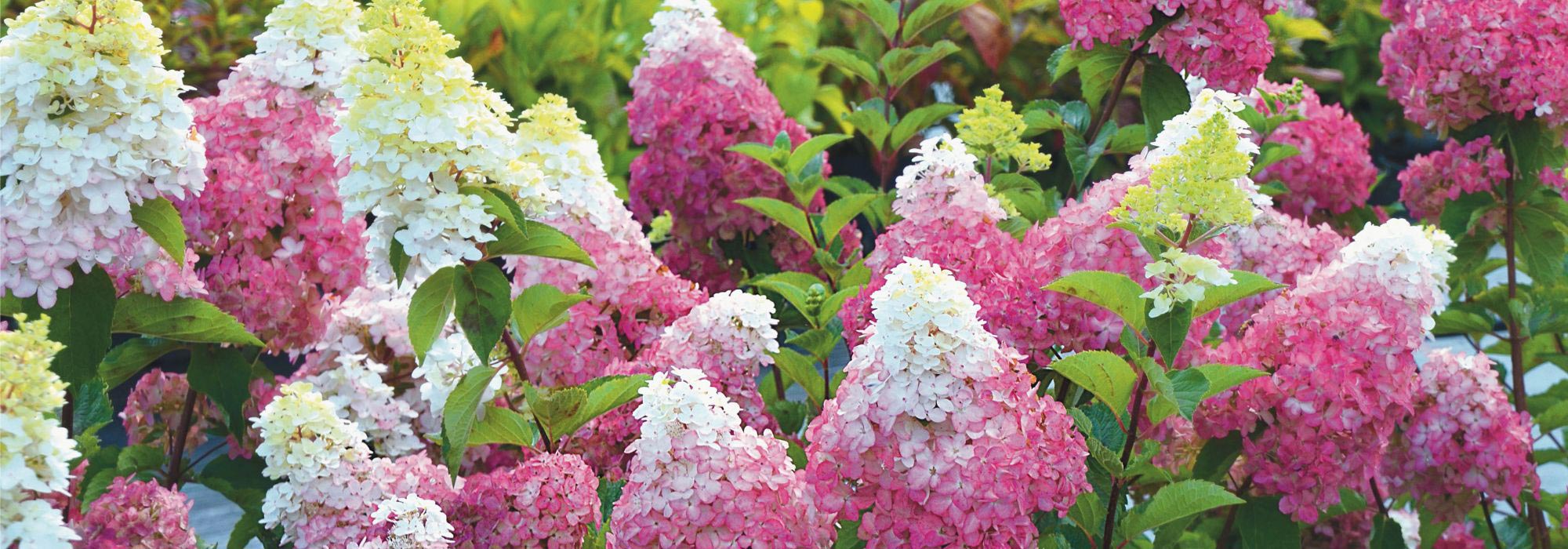
6 hydrangeas for the sun and drought-resistant
Selection of hydrangeas that thrive in sunny conditions, in the garden or in pots
Contents
We love hydrangeas for their long and impressive summer flowering, as well as for their sometimes very ornamental foliage in autumn.
While we are well acquainted with Hydrangea macrophylla that thrive in shade, did you know that many varieties also grow very well in sunlight and can even withstand drought? They indeed develop over time a root system that allows them to draw water from deep within the soil.
We have therefore selected 6 hydrangeas for sunny locations, to be grown in the ground or in pots, for small or large gardens.

Hydrangea quercifolia ‘Snowflake’: beautiful double flowers and stunning autumn foliage
Hydrangea quercifolia are highly valued for their stunning autumn foliage. The leaves also have the distinctive feature of resembling those of the pedunculate oak, hence their name (Quercus meaning “oak” in Latin).
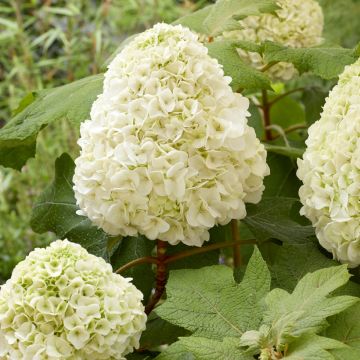
But ornamental foliage is not the only asset of ‘Snowflake’! This variety rewards us indeed all summer long, from July to October, with beautiful double flowers. They form elongated and curved panicles, initially white-anise, then shaded with washed pink.
In autumn, its leaves change colour: from green, they turn to a vibrant red-brown in sunny exposure.
Hardy and easy to grow, ‘Snowflake’ will thrive in full sun in light, even calcareous soil. Once well established, it will tolerate occasional drought without watering.
Its modest silhouette (1.5 metres in height and 1.2 metres in spread) is well-suited for pot cultivation, to brighten up terraces or balconies all summer long.
Additionally, discover our tips in the article “Potted Hydrangea: Planting and Care”.
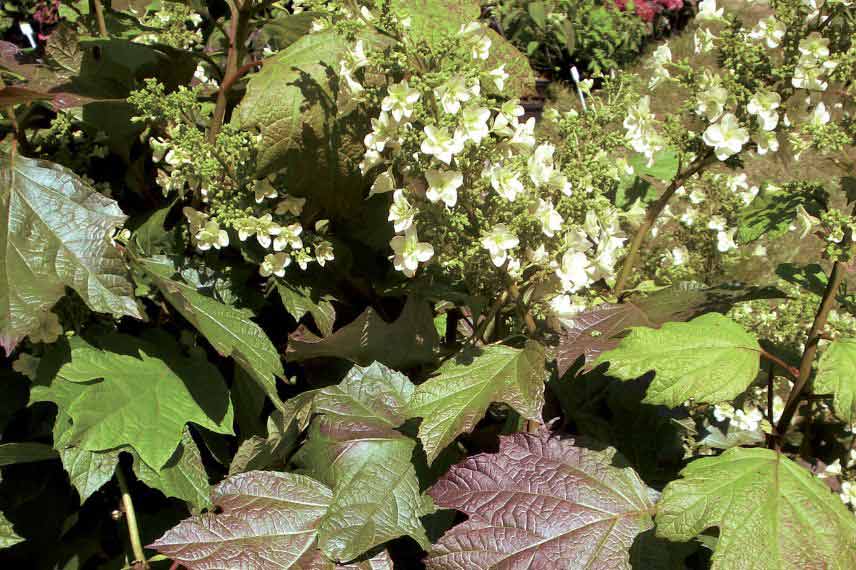
Hydrangea quercifolia ‘Snowflake’
Read also
Hydrangeas: planting, pruning and careHydrangea paniculata 'Grandiflora': a robust and floriferous classic
‘Grandiflora’ is a popular variety of Hydrangea that never disappoints. All summer long, from July to September, it offers us large conical inflorescences measuring 30 to 40 cm, in panicles. The colour is dynamic: first greenish-white, then cream-white, before taking on pinkish hues at the end of the season. The floral spikes persist throughout the winter, even beautifully covered in frost.
To top it off, the foliage is also attractive: in autumn, before falling, it adorns itself with beautiful seasonal colours of bright golden yellow.
This large, fast-growing hydrangea reaches between 2.5 to 4 metres in all directions at maturity. In terms of shape, it forms a large, compact, bushy bush, with branches gracefully bending in summer under the weight of the flowers. ‘Grandiflora’ will shine in the garden, whether planted alone or in a flowering hedge. Don’t hesitate to use its flowers in either dried or fresh bouquets.
Paniculate hydrangeas enjoy sunny locations, as they need plenty of light to bloom well. Easy to grow, hardy, and low-maintenance, it only requires well-drained soil that does not retain too much water to thrive. After 2 to 3 years, its deep rooting will even allow it to withstand temporary drought. Just be sure to care for the planting and avoid placing it in competition with trees or hedges with overly dominant root systems.
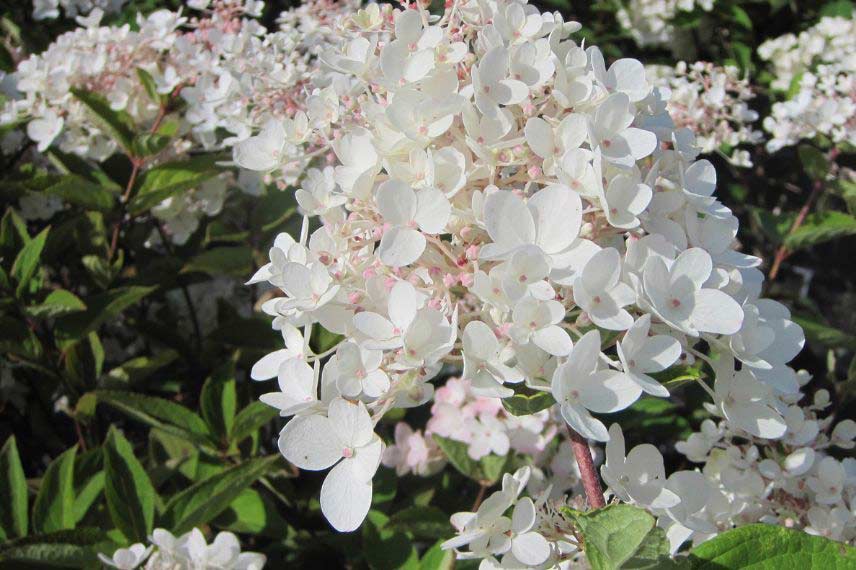
Hydrangea paniculata ‘Grandiflora’
Discover other Hydrangeas
View all →
Available in 3 sizes
Available in 1 sizes
Available in 1 sizes
Available in 3 sizes
Available in 1 sizes
Available in 1 sizes
Available in 1 sizes
Available in 2 sizes
Available in 2 sizes
Available in 2 sizes
Hydrangea paniculata ‘Mega Mindy’: stunning cotton candy-like inflorescences
‘Mega Mindy’ not only brightens up the summer season: this variety also puts on a show in autumn!
From July until the frosts, the bush produces large inflorescences measuring 25 cm long, reminiscent of candyfloss. Initially white, they gradually take on colours, turning pale pink, then dark pink, and even red. A sunny exposure is necessary to achieve these beautiful hues.
‘Mega Mindy’ is quite tolerant and will not require acidic soil to thrive, unlike Hydrangea macrophylla. It also has the advantage of being able to withstand occasional drought, as well as heavy rains, to which its sturdy branches will prove resistant.
At maturity, our bush will reach between 1.5 and 1.7 metres in height with a spread of 1 metre.
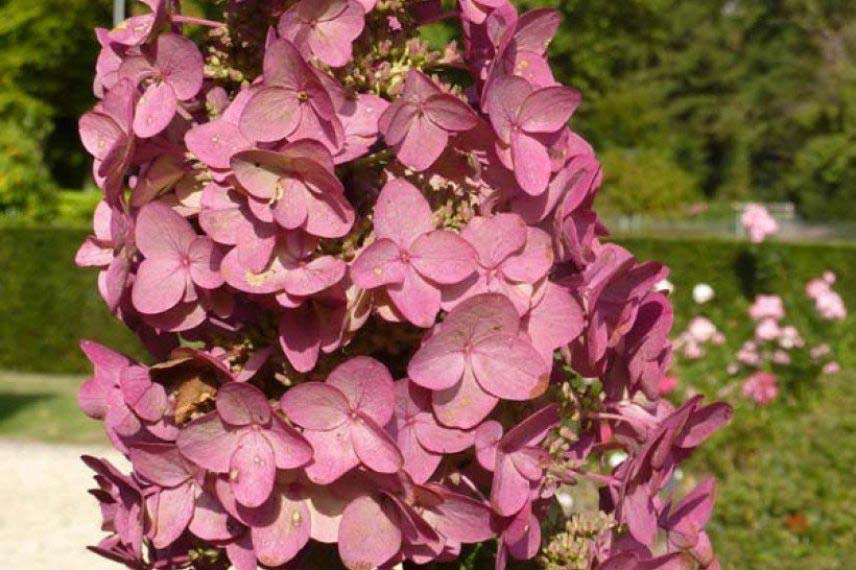
Hydrangea paniculata ‘Mega Mindy’
Read also
Hydrangeas: how to choose them?Hydrangea quercifolia ‘Gatsby Star’: a low-maintenance variety that tolerates sun and drought.
‘Gatsby Star’ is a charming and tolerant oak-leaved hydrangea. It offers a delicate flowering in long, pale greenish-white panicles during summer, which are very bright. These consist of well-double sterile florets with pointed petals, resembling adorable little stars forming generous clusters.
As with all hydrangeas of this species, the finely cut foliage is also very ornamental. In autumn, it reveals splendid red and purple hues, providing a dazzling display.
Reaching 2 metres in all directions, this hydrangea can be used as a standalone plant or in a lovely flowering shrub hedge. This variety has the advantage of thriving in both full sun and partial shade, in all types of soil, even calcareous ones. Once established, after 2 to 3 years, it will tolerate drought well. Its developed root system will enable it to seek water in the deeper layers of the substrate, where the soil rarely dries out.
Easy to cultivate and very hardy: it’s a reliable choice for both natural and well-maintained gardens.
Hydrangea quercifolia ‘Ice Crystal’: a robust variety with uncommon autumn colours
Long flowering, evolving ornamental foliage, and good resilience: the oak-leaved hydrangea ‘Ice Cristal’ has many advantages in the garden!
Its flowers provide a long-lasting display all summer until October: they form beautiful upright clusters of cream-white. Depending on the soil type, they may take on green or pink hues at the end of the season.
The evolving foliage is equally interesting. The leaves are initially silvery in spring, before turning almond green in summer. But it is the purplish colour that appears in autumn that makes it unique, where other hydrangeas typically turn red. Finally, the delicate velvety grey-silver powder covering the foliage is the origin of its name, meaning “ice crystal”.
In sunlight, the autumn colours of this hydrangea will be enhanced, but this variety prefers to be sheltered from the hottest rays or full southern exposure.
Its ramified, compact, and stocky silhouette allows it to withstand both wind and adverse weather conditions. Slow-growing, this bush will reach about 1.2 metres in all directions after a few years. Low-maintenance, our hydrangea is also capable of tolerating calcareous soils, heat, and occasional drought.
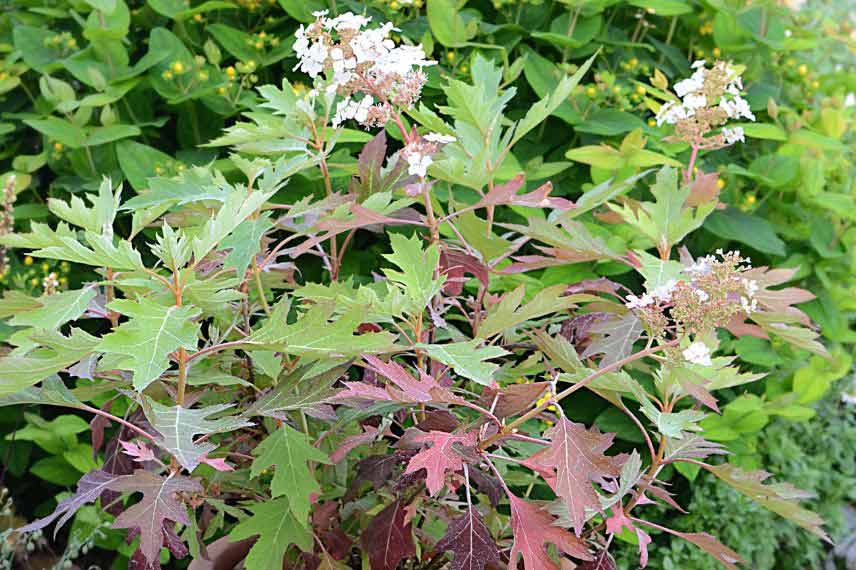
Hydrangea quercifolia ‘Ice Crystal’
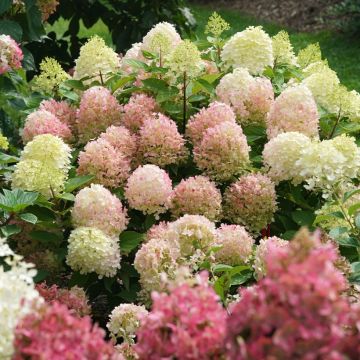
Hydrangea paniculata ‘Fraise Melba’: bicoloured flowers and beautiful autumn foliage
’Fraise Melba’ is a little gem of a hydrangea for sunny spots. Hydrangeas paniculata are indeed unfazed by sunny exposures or moderate summer drought.
This is an improvement on the highly regarded variety ‘Vanille Fraise’. The inflorescences form well-dense conical panicles, with stunning colours: initially ivory white, they gradually turn pink, creating bicoloured clusters, then red with the coolness of the night.
The foliage is equally impressive: initially dark green, it takes on purplish hues in autumn, providing an additional aesthetic touch.
This abundant flowering is supported by sturdy stems, capable of holding the weight of the flowers even after rain. Fast-growing, this variety will reach about 2 metres in height and 1.5 metres in spread at maturity.
Hardy, tolerant of soil type, and requiring no pruning, this variety will thrive in borders or as a standalone feature.
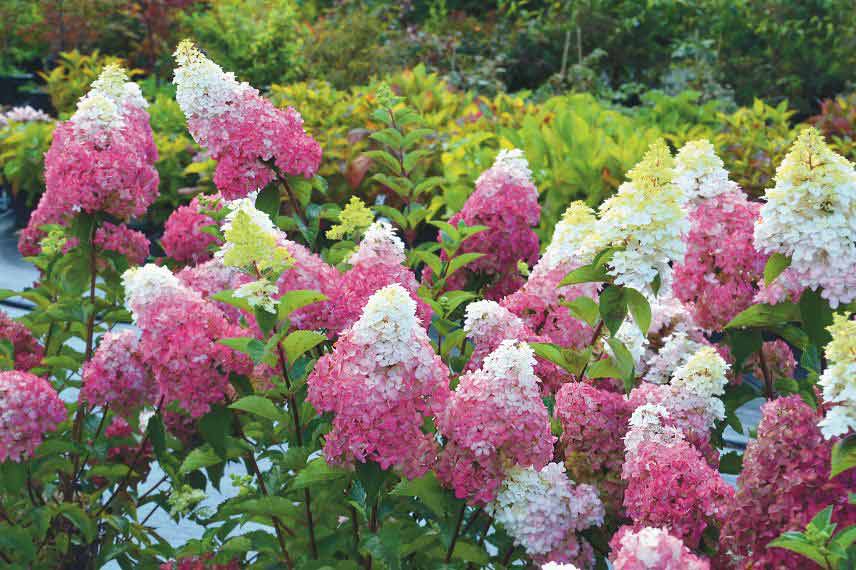
Hydrangea paniculata ‘Fraise Melba’
- Subscribe!
- Contents

Comments