





























6 perennials with late winter flowering
To flower the garden, terrace, or balcony even during the cold season
Contents
To liven up the garden during the cold season, nothing beats winter-flowering perennials! Grown in pots or in the ground, they bring colour and volume, helping to combat the monotony of short days. Those that reveal themselves at the end of winter also serve as a marker, as they herald the imminent return of warmer days.
To brighten up your garden, terrace, or balcony at the end of winter, here is our selection of 6 perennials that flower between mid-February and the end of March.

Helleborus abchasicus: a generous purple flowering
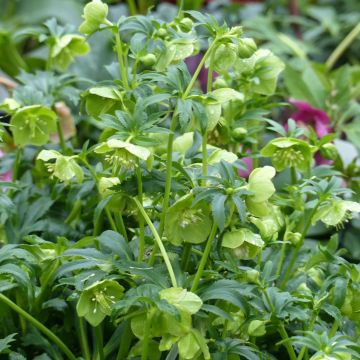
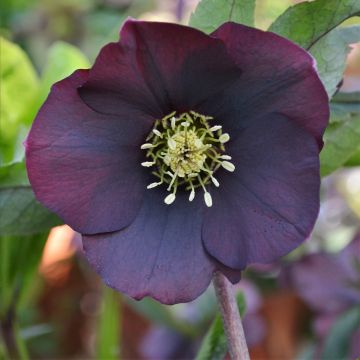
TheAbkhazian hellebore (Helleborus abchasicus) is an Eastern hellebore that waits until the end of winter to flower. From February to March, and even into April, it produces lovely single cup-shaped flowers, measuring 4 to 5 cm in diameter. Their petals are dark pink tinged with purple, and the centre consists of a bright cream-white nest of stamens. The flowers have a trailing habit, gently nodding towards the ground, preventing the frequent winter rains from pooling in their hearts.
This long and generous flowering will brighten shaded or partially shaded areas, sheltered from the hottest rays of the sun. The fading flowers are also ornamental, drying poetically on the stems instead of falling.
Meanwhile, the foliage is evergreen, continuously renewing itself to form a lovely clump of shiny dark green leaves.
Reaching 40 cm in height and 30 cm in spread, this hellebore can be planted in a container to create a beautiful winter pot or in a window box. In the garden, grow it at the edge or in a border with perennials that have staggered flowering times or with bushes.
This relatively unknown variety is, however, easy to care for: it proves to be robust, very hardy (down to -20°C), and fast-growing. Grow it in all types of soil, even heavy (clay).
For more cultivation tips, read our article: Hellebores: how to plant and grow them ?
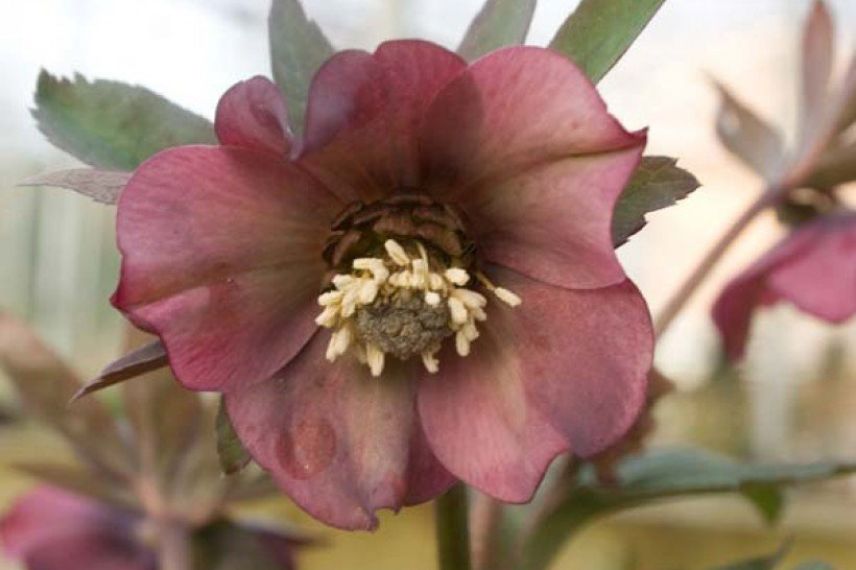
Helleborus abchasicus
Read also
Winter-flowering shrubsBergenia (x) cordifolia 'Rosenkristall': a colourful groundcover in late winter
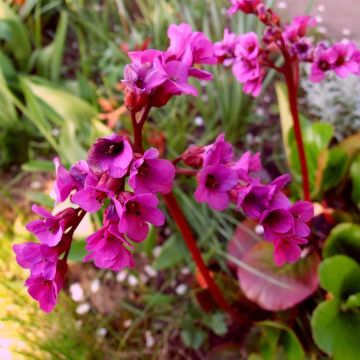
‘Rosenkristall’ is an early-flowering bergenia, blooming between February and March. This “shoemaker’s plant” rewards us with a generous display of light pink flowers. The flowers appear at the end of tall, fluffy flower stems tinged with bronze, forming delightful little colourful bouquets. Their dark pink centre reveals pretty stamens, creating a very simple and natural style.
The bergenia is a perfect groundcover for partial shade, to be placed in areas sheltered from the scorching rays of the sun. Its evergreen foliage remains decorative in all seasons. It consists of small, rounded, leathery leaves that display a bright green colour. Under the influence of cold, they sometimes beautifully take on red hues.
Its compact and creeping silhouette, reaching 30 to 40 cm in all directions, adorns all types of soils. Undemanding and easy to cultivate, our bergenia tolerates even poor substrates, as long as they are not too dry. Strong, resilient, and low-maintenance, it thrives in pots or in the garden, to define a border, brighten up a rockery, dress the foreground of a flowerbed, or the base of deciduous trees.
For more cultivation tips, read our article: “Bergenia, shoemaker’s plant: planting, cultivation, maintenance.”
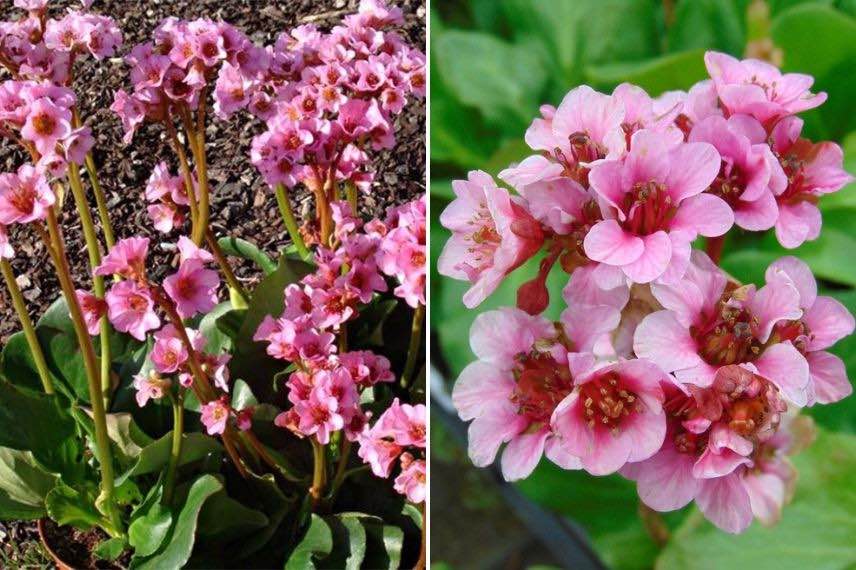
Bergenia Rosenkristall
Discover other Winter flowering perennials
View all →
Available in 1 sizes
Available in 1 sizes
Available in 0 sizes
Available in 1 sizes
Available in 2 sizes
Available in 1 sizes
Available in 1 sizes
Available in 1 sizes
Available in 2 sizes
Available in 1 sizes
Lachenalia ‘Rupert’: exotic-looking flower spikes
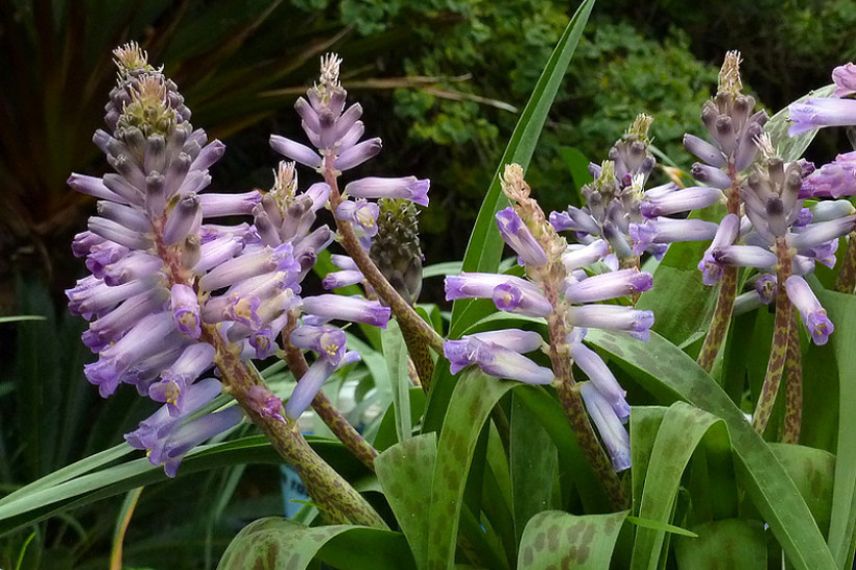
The Lachenalia ‘Rupert’ or Cape cowslip is a charming perennial bulb that adds a touch of exoticism in winter. Between February and March, it rewards us with a lovely flowering reminiscent of hyacinths. Atop an original pale green stem speckled with brown, the inflorescences emerge. They consist of several astonishing tubular flowers, measuring about 4 cm long. These flowers display shades of mauve, pale pink, or purplish, creating a very soft palette visible for nearly a month.
Its foliage, equally exotic in appearance, is made up of long, wide ribbon-like leaves, which serve as a backdrop for the flowering. They are green, speckled with brown. Deciduous, they disappear in summer.
This small bulb reaches a height of 30 cm and a spread of 20 cm. From its South African origins, it has retained a low hardiness, tolerating only light and brief frosts down to about -3°C. It will thrive in open ground in the mildest gardens of the Mediterranean region, also providing the dry soil it needs in summer for its dormancy. Elsewhere, it can be easily grown in pots, stored under cover during winter. It will brighten up a cold greenhouse or conservatory during the short days of the season.
Provide the Cape cowslip with a sunny position in soil that is fairly rich in organic matter but well-drained (not retaining excess water). Keep the substrate slightly moist throughout the growth period.
Once considered a rare plant a few years ago, it is now the subject of hybridizations, leading to cultivars better suited to our growing conditions.
Lachenalia ‘Rupert’
Read also
6 climbing plants for winter floweringCyclamen coum: an adorable little perennial with winter flowers
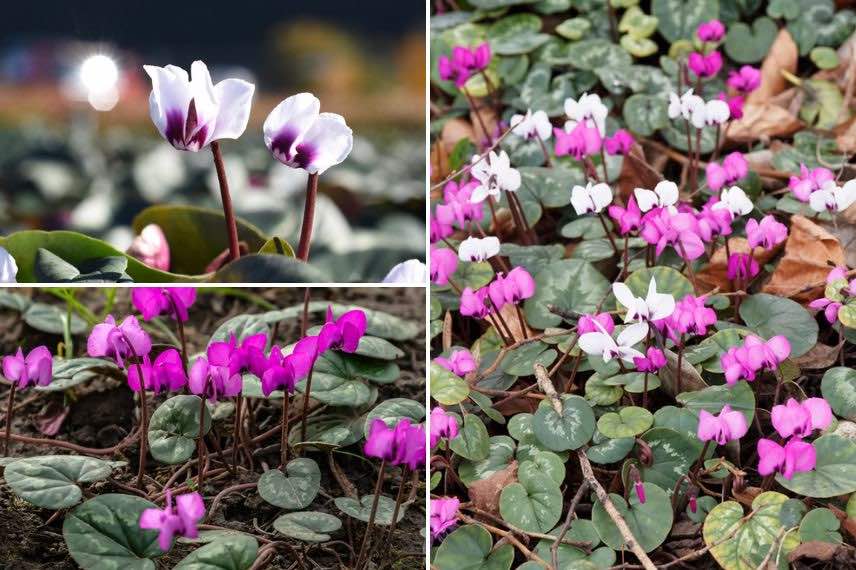
Cyclamen coum is a small perennial plant with great qualities. It is primarily appreciated for the charm of its flowers, whose rounded petals curled back resemble butterfly wings. They can be fuchsia pink to add a touch of vitality, or white for a softer, more refined style. Their darker centre reveals a hint of purple. For Cyclamen coum, flowering occurs in late winter, between February and March-April, depending on the climate.
The foliage is equally interesting: it appears as small round leaves that resemble mini water lilies. Its dark green colour marbled with silver adds an extra ornamental note in winter and lasts until the end of spring, before disappearing for the summer rest.
The Cyclamen coum has a small stature, reaching only 10 cm in height and 20 cm in spread. Hardy and easy to grow, it thrives in partial shade, in a lovely flowering pot or in the ground. In the garden, plant these winter flowers in groups on a rather plain lawn to quickly create vibrant carpets of colour. Cyclamens have the advantage of naturalising easily, returning faithfully year after year without intervention. They also look wonderful in a border with spring or summer bulbs that will take over the flowering, as well as in shaded rockeries.
For more growing tips, read our article: “Cyclamen: planting, growing, and care”
Cyclamen coum
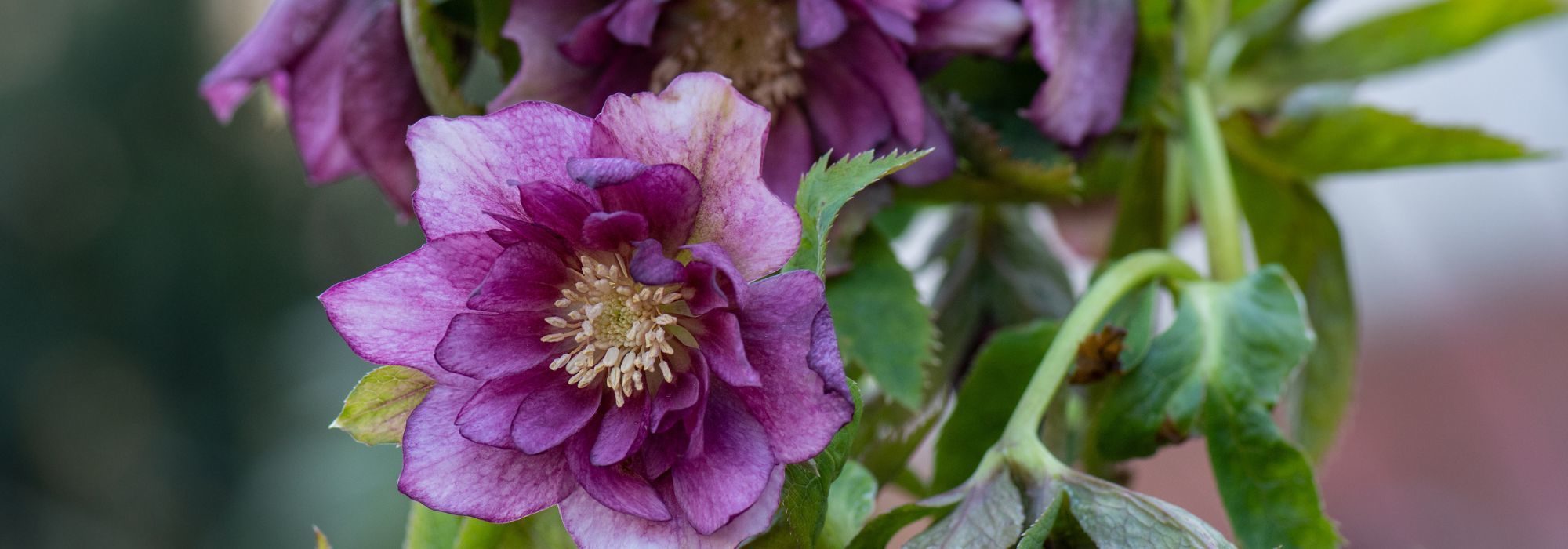
Helleborus orientalis ‘Double Picotée’: a sophisticated and colourful flowering
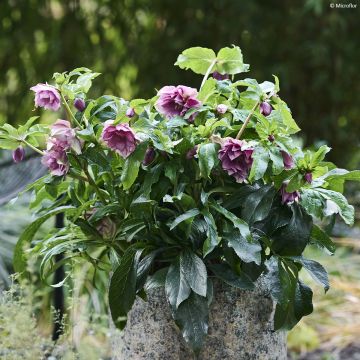
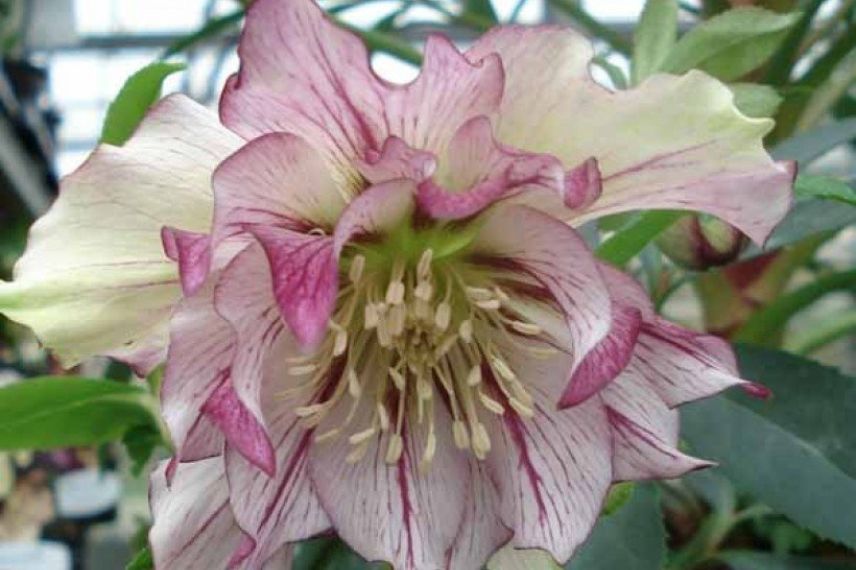
Another hellebore, as these flowers are undoubtedly among the star perennials of winter! This one offers a very different style from our previously mentioned Abkhazian hellebore. The variety ‘Double Picotée’ is indeed more sophisticated: it presents us with a double, bicoloured flowering. The flowers, measuring 5 to 7 cm in diameter, are cup-shaped. They consist of numerous petals, resembling true undulating frills. They display a white-ivory colour, edged and striated with dark pink. At the centre, a light green heart is revealed, enhanced by white stamens. These winter flowers appear between late January and March, depending on the regions.
As for the foliage, it boasts a dark green colour that contrasts beautifully with the flowers. The leaves continuously renew themselves throughout the year, creating an impression of persistence. The clump reaches about 40 cm in height and 30 cm in spread.
Like all oriental hellebores, ‘Double Picotée’ is easy to cultivate. Strong and hardy despite its delicate appearance, this perennial will brighten up the darker areas of the garden: borders, clear undergrowth, etc. Its small silhouette also allows for pot cultivation, perfect for dressing up terraces and balconies at the end of winter.
Feel free to use the flowers to create lovely winter bouquets.
Helleborus orientalis ‘Double Picotee’
Primula hybrida: vibrant flowers to brighten the end of winter
Hybrid primroses enchant the garden with their vibrant colours at the end of winter. In February and March, lovely bouquets of flowers emerge. They are perfectly complemented by dark green, crinkled foliage that develops in a rosette.
Choose from the different varieties:
- ‘Charlie Deep Blue Edge F1’ with its intense bright blue corolla, accented by a fine white edge around the perimeter and a contrasting yellow centre;
- ‘Rubens Yellow F1’, whose double flowers form true yellow pom-poms;
- ‘Charlie Wine Red Edge F1’, which prefers a dark red edged in white and illuminated by a yellow centre;
- ‘Charlie Orange F1’ for its bright and vibrant orange flowers.
These perennials with a low and stocky silhouette (15 cm in height and 20 cm in spread) will thrive in pots or window boxes, perfect for dressing window sills, balconies, or terraces. Of course, they are also ideal candidates for beds or borders. Provide them with a partially shaded location in a substrate rich in organic matter, remaining cool to moderately moist.
For more cultivation tips, read our article: “Primrose: planting, cultivation, maintenance, and companion planting”.
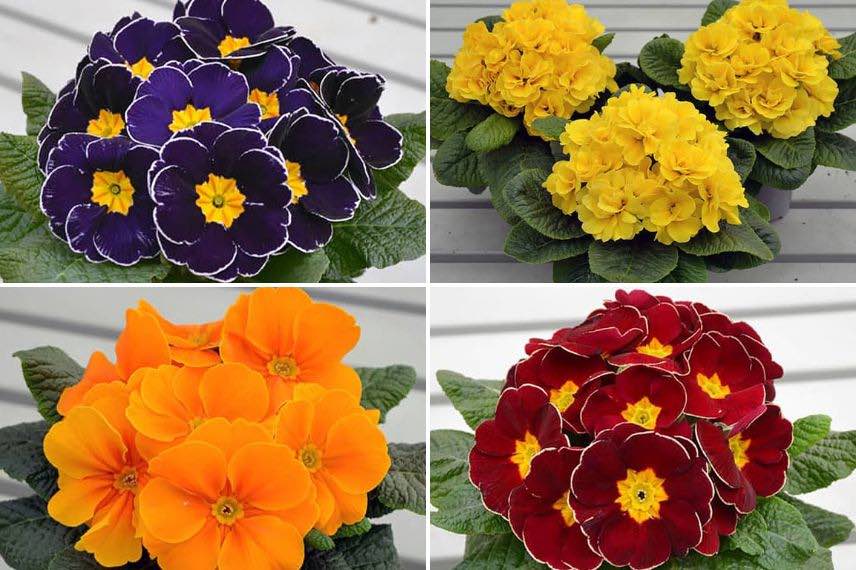
Primula hybrida: ‘Charlie Deep Blue Edge F1’, ‘Rubens Yellow F1’, ‘Charlie Wine Red Edge F1’, ‘Charlie Orange F1’
- Subscribe!
- Contents
Comments