





























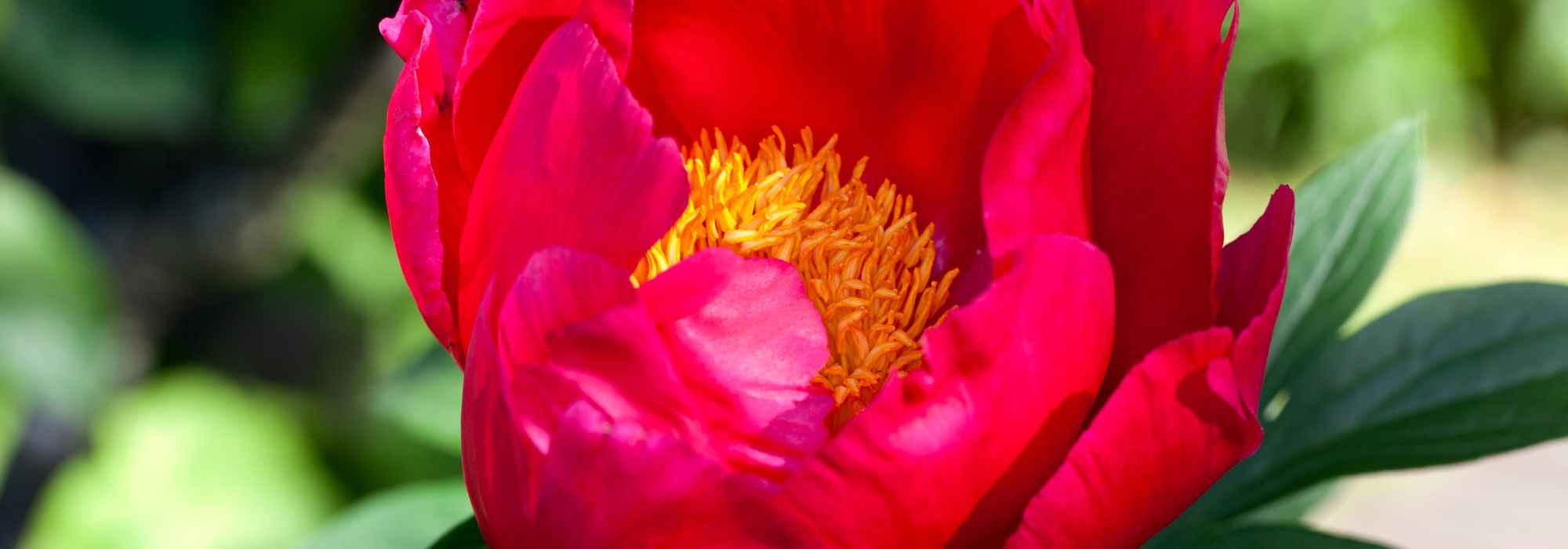
6 red-flowered peonies
Red like a peony
Contents
Peonies come in a beautiful range of colours, and those with red flowers give special definition to spring borders. While peonies with pink flowers charm with their romanticism, peonies with red flowers do indeed warm the garden immediately.
Many red peonies are of botanical origin, but striking reds are found among numerous shrubby or herbaceous hybrids, from pinkish and poppy-red to purplish red… hence the expression ‘red as a peony’!
Here are 6 peonies for red gardens or passionate gardeners, and our tips for planting and combining them well.

Paeonia tenuifolia
Let’s start with a peony quite different from the others. The fern-leaved peony or Paeonia tenuifolia is a herbaceous perennial of botanical origin. Growing only 40 and 50 cm tall, it comes from the Balkans and western Russia. It is distinguished by its ultra-fine foliage made up of thread-like leaflets, giving it an incomparable lightness. This very dense, graphic foliage is its main attraction, but its red flowering, although very short-lived, draws every eye. First of all, when the flower buds, globose, enliven the foliage beautifully. While the single, cupped flowers are small (5 cm in diameter when fully open), this botanical peony, also encountered under the name goutte de sang, is prized for its intense scarlet red colour. The centre of the flower contrasts nicely with the golden stamens. Paeonia tenuifolia blooms early, from mid-April.
Invite this astonishing peony into a border with some white and red tulips for a very fresh scene (for example the early red tulip ‘Largo’ with a similar red and Fosteriana tulips ‘Purissima Design’).
N.B.: the Paeonia tenuifolia ‘Plena’ is the double-flowered version with even more finely cut foliage. There is also a pink-flowered variant of the fern-leaved peony: Paeonia tenuifolia ‘Rosea’, whose foliage is slightly lighter.
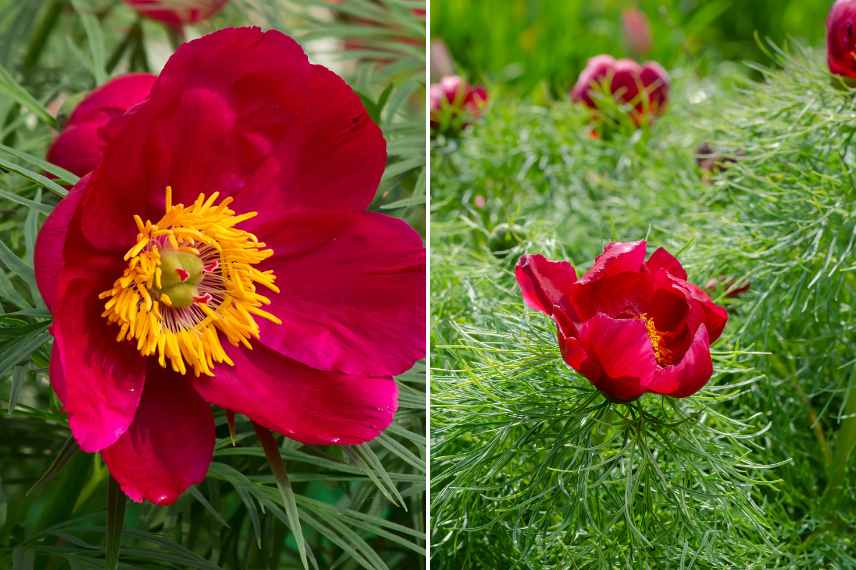
Paeonia tenuifolia
The Paeonia lactiflora 'Diana Parks'
The Chinese peony ‘Diana Parks’ is a dazzling beauty. Bred in 1942 in the United States, it still causes a sensation in the garden. Its large, very double flowers are an intense poppy red. It forms a beautiful crown with the lower petals, rounded and seeming detached from the centre of the flower. The heart of the flower is a large pompom made up of finer, pointed petals, without stamens. Tall (75 cm to 95 cm), this peony is considered an early peony as it flowers in the second half of April. Last but not least: its fragrance! Plant it in a sunny position, sheltered from cold winds, in soil rich in organic matter and very well drained. The generous size of its flowers makes it an excellent cut flower for creating cut flower arrangements.
Some columbines flowering at the same time will keep it good company, allowing it to shine brilliantly!
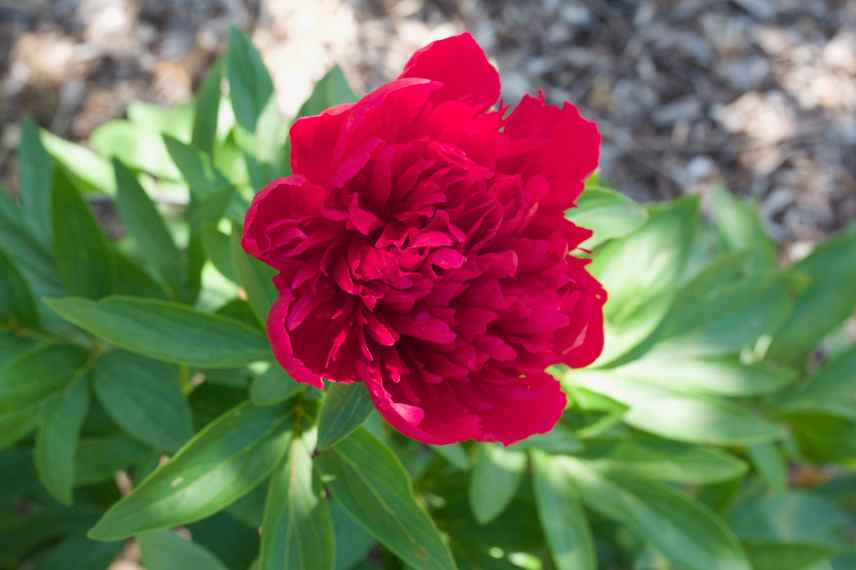
Paeonia lactiflora ‘Diana Parks’ (© FD Richards)
The Paeonia lactiflora 'Rubra Plena'
The peony ‘Rubra Plena’ is one of the reddest and oldest peonies, a herbaceous perennial of great beauty that produces a magnificent explosion of sumptuous flowers in spring. From April, the large buds reveal a very dark red, the double flower then opens, sometimes as late as June, in large pompon-like clusters of crimson red that gradually lightens to a fuchsia pink by the end of flowering. The flowers measure no less than 15 cm in diameter. The bright green foliage surrounds the clump, which reaches up to 70 cm in height with a wider spread; it remains ornamental even after the flowers have faded. The peony ‘Rubra Plena’ needs a sunny position or a slightly part-shaded spot to flower well. Don’t forget to allow for staking and plant it in rich, well-drained soil — it can be grown throughout France thanks to its hardiness.
Pair it with astrantias for a guaranteed touch of charm!
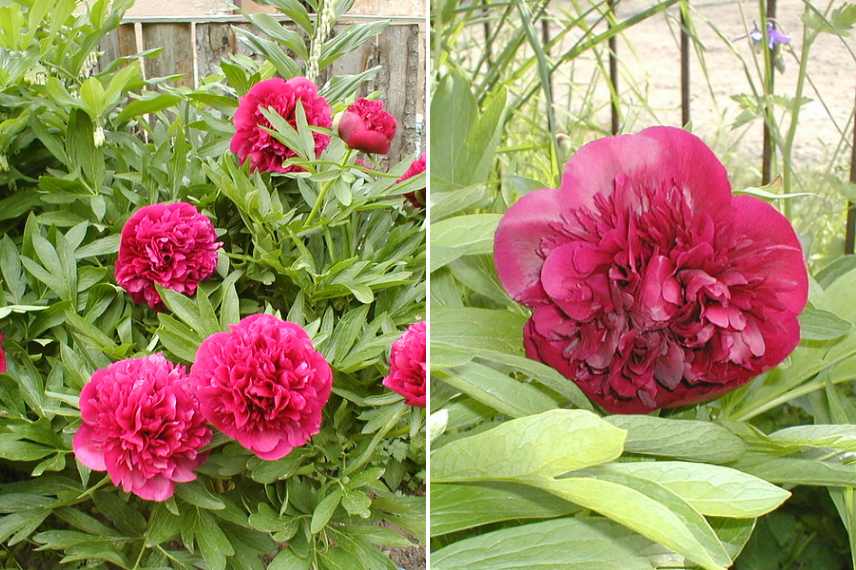
Paeonia officinalis ‘Plena Rubra’ (© Stefan Bamira)
Read also
Choosing the Right PeoniesThe botanical peonies: Paeonia officinalis and Paeonia humilis
Here are two other red peonies of European origin, somewhat resembling the fern-leaf peony with their single flowers. It is endangered in its natural habitat (southern Europe).
Even smaller in size than Paeonia tenuifolia, Paeonia officinalis measures about 30 to 40 cm in height, and also bears solitary bright red, very fragrant flowers, 10 to 12 cm in diameter. The centre is a cluster of golden-yellow stamens. It blooms in May or sometimes in June. Its foliage is deeply divided, sometimes villous on the underside. It is prized for its wild character, far from the sophistication of the many hybrids it has given rise to. It is also a melliferous plant that is planted in natural gardens, or even in a medicinal or cottage garden. Give it a well-drained, fertile soil (an application of compost in autumn is useful), which remains cool. It thrives in a sunny position or in light partial shade. Des poppies and ferns are interesting companions for this wild beauty.
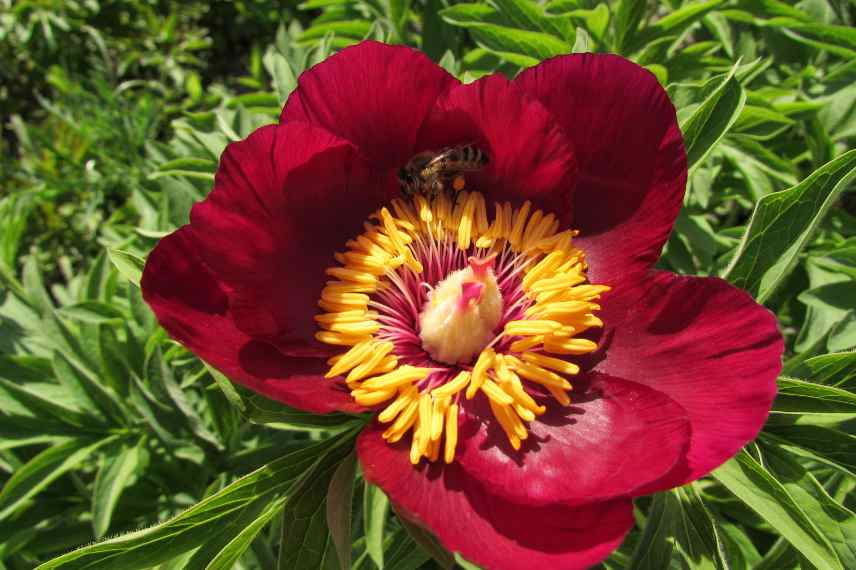
Paeonia officinalis
Paeonia humilis also grows wild in southern Europe, on rocky slopes, hence its common name mountain peony. This peony is therefore of interest for warm, dry climates, as it tolerates drought better than other peonies. Its flowers are a deep cherry red, sometimes purplish red. It also provides a beautiful contrast with the cluster of yellow stamens. Small like its cousin the officinal peony, it will be splendid in a sunny rockery, with companions such as a few lavenders or teucriums.
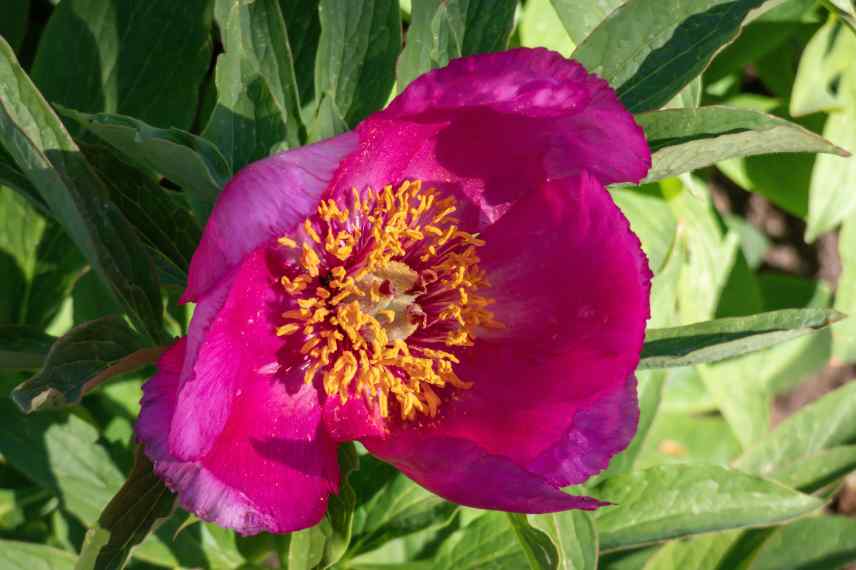
Paeonia humilis
The Paeonia suffruticosa 'Shima Nishiki'
Let’s finish this small selection of red peonies with a very original cultivar, which displays not only red but also white and pink! ‘Shima Nishiki’ is a Japanese peony that will appeal to lovers of exceptional peonies, or to complete a collection. This multicoloured shrub peony bears its large flowers (at least 15 cm), semi-double, in April. A plant rarity that can, however, flower in a single colour, but it is when variegated in the three colours or bicolour red and white that it is most often seen, sublime, early in spring. Its divided foliage is a beautiful bronze-green. The ‘Shima Nishiki’ peony is a tall peony, reaching 1.20 to 1.50 m, with a similar spread after a few years. It should therefore be placed towards the back of the border with other white peonies, red and pink, or ideally planted alone to enjoy this unique sight.
N.B.: the suffruticosa peonies require some special care: avoid morning sun in regions where frosts persist late into the season. Their grafting point should be buried at about 10 cm. They prefer a well-draining loamy soil, ideally slightly acidic.
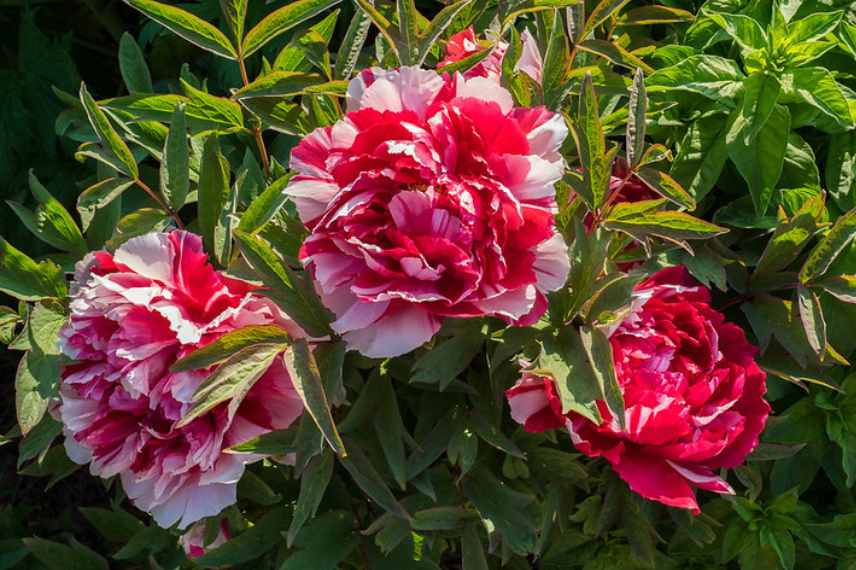
Paeonia suffruticosa ‘Shima Nishiki’ (© FD Richards)
- Subscribe!
- Contents
Comments