


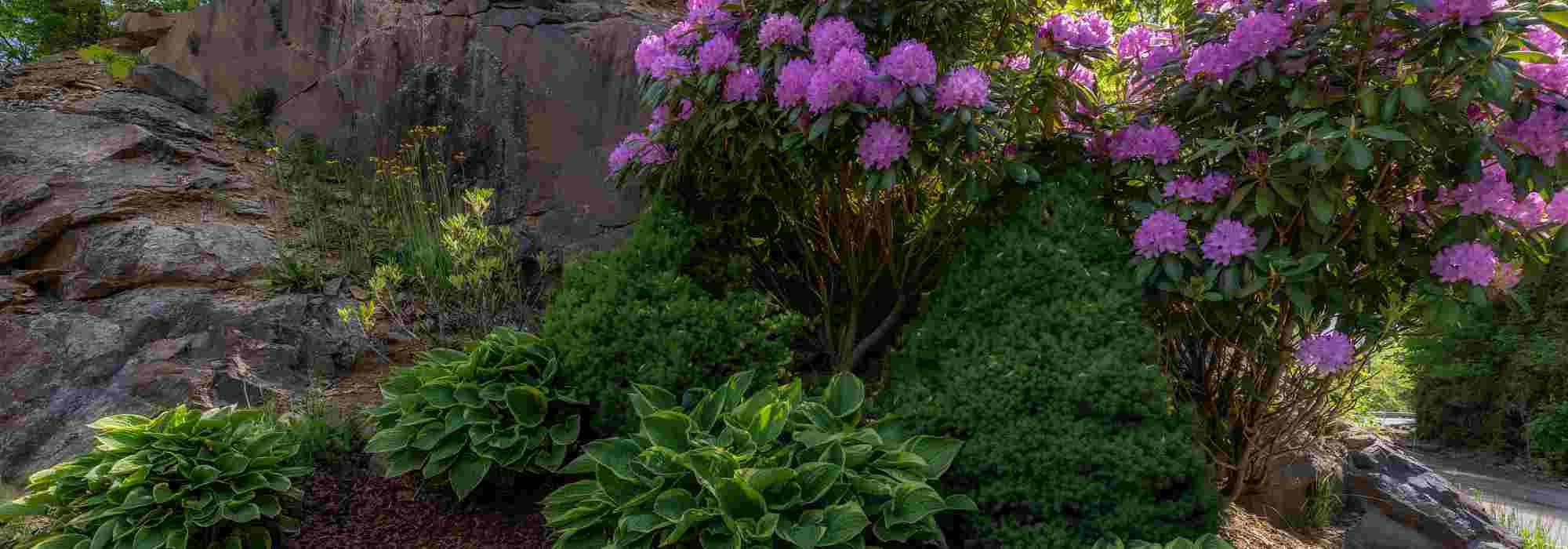
6 landscaping tips to create a shade garden
Transform a shaded garden into a soothing cocoon or a lush haven!
Contents
A garden bathed in shade, or very shaded, can seem discouraging at first glance : the light is lacking, making it hard to imagine it as a pleasant space, but also because the diversity and qualities of shade plants are often less well known to the general public. Nevertheless, shady corners and shade gardens hold superb atmospheres, from classic to exotic, provided they are laid out wisely.
Do you have a shade garden and aren’t sure how to make the most of it? Follow our practical tips, the mistakes to avoid, the right plant palette, and a few examples to prove to you, even in pictures, that these gardens are real treasures of greenery.
→ Discover all our articles dealing with the theme of shade in the garden in our advice part.
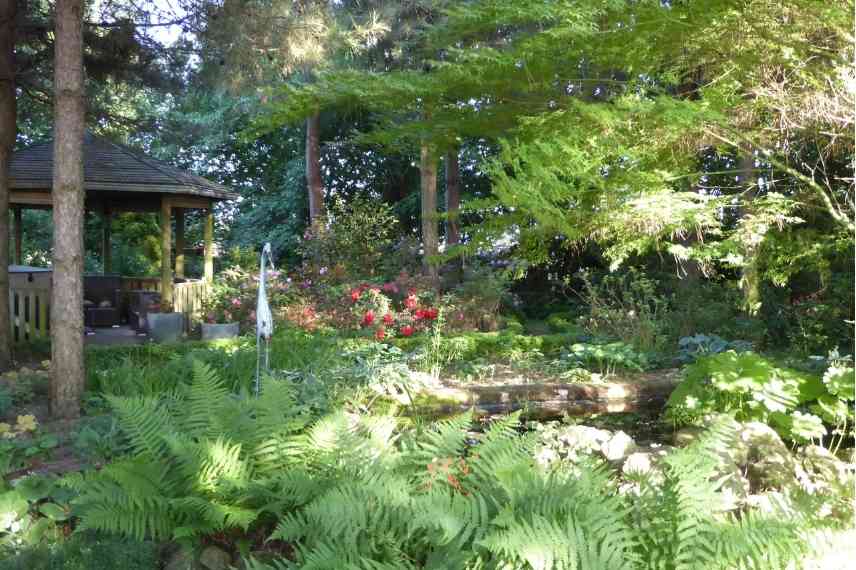
Mireille’s Garden in Anjou (© Gwenaelle Authier)

The shade garden challenge
Because they are subject to particular conditions, some gardens receive little light. This is often the case in urban settings, where small gardens enclosed by walls or surrounded by tall buildings become landlocked and inevitably deprived of sunlight. It is also the result of areas of gardens shaded by the foliage of large, ancient trees, sometimes evergreen, which cast a dense shade.
Advantages and disadvantages
People tend to focus on the drawbacks of a shaded garden when they inherit one and begin planning its design. It often looks dreary, far from the image people have of a garden! Let’s not pretend: the reduced light means you won’t be able to grow many classic, eye-catching flowering displays that require a minimum amount of sunlight. As for the lawn, you may have to rethink it a little, as depending on the depth of shade, it may be impossible to grow. It also often looks rather dreary in the shade if it’s not wisely designed.
But a very shaded garden is actually enjoyable in many ways: in summer, the season when we make the most of it, it is a true haven of coolness and provides a sense of calm. It suffers less from heatwaves, and with climate change, it becomes a real asset in city gardens in particular. It is also normally less water-hungry, which means more time for yourself and savings on watering. Finally, this shade garden generally requires less maintenance if well designed, with the right plants that grow fairly slowly and require less pruning. And you’ll see, with fewer flowers, it is also much more original by leaning more on the shapes and textures of the foliage.
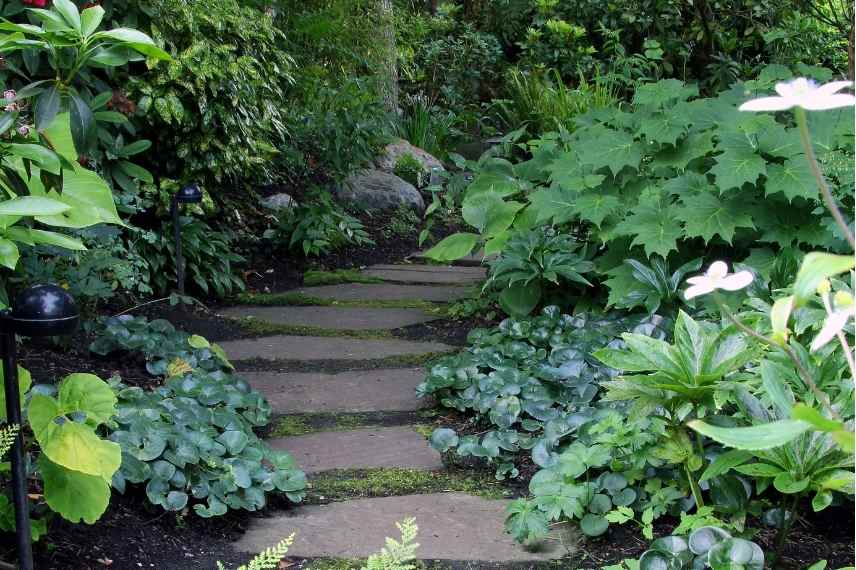
A garden enhanced by the shapes and colours of the foliage: the distinctiveness of a shaded garden!
Read also
Designing a North-facing gardenBefore planting: light pruning, shade identification and soil preparation
In this garden where light is limited, many plants thrive best in a subdued partial shade. The first task, therefore, is to bring a little more light by pruning the tallest trees with care, namely by applying transparency pruning (read Olivier’s tips). This will help to let a little more light reach the ground.
Once this preparatory work is done, identify the brightest areas, which may receive a little sun, even if faint: you can plant in these spots plants whose flowering tolerate partial shade. These will most likely be along borders or in the central parts of the garden.
Finally, one often has to undertake a more meticulous soil preparation in a shade garden: root competition from trees or evergreen shrubs forming a hedge dries out the soil, and you’ll need to learn to garden in dry shade.
Sometimes, conversely, the area at the foot of walls remains constantly damp or poorly drained, which can promote fungal diseases and root rot. It is then essential to improve drainage and choose plants that tolerate damp conditions.
→ Also read: Light in the garden: exposure, sunlight, shade and brightness.
Adopt a garden style
In this soft light-and-shade ambience, one thing is certain: you will create a unique garden, and perhaps equip it with a collection of astonishing plants. But even before selecting the plants, think about the type of garden you prefer. You will give it a distinctive character.
A shade garden lends itself particularly to two garden styles: the Japanese-inspired garden and the exotic jungle garden, two worlds radically different, equally delightful, that tolerate a wide range of shade-loving plants. In large gardens, the shaded areas are those that will be treated as understorey. Finally, in a small space, You can even consider a romantic garden.
For each of these worlds, you will adopt a different plant palette to suggest the desired atmosphere, often mysterious (see below in the plant palette).
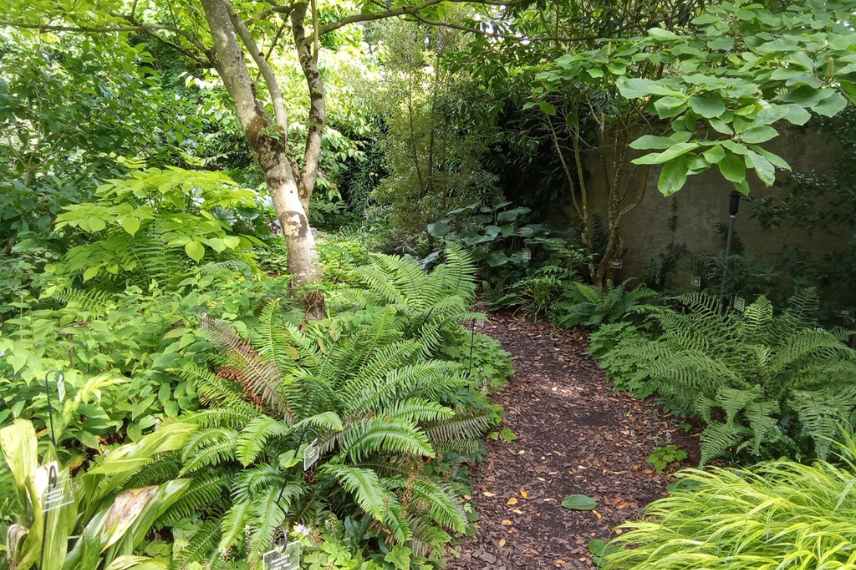
The Angers Arboretum shade garden: a charming understorey ambience, punctuated by wood-chip paths (© Gwenaelle Authier)
Which shade-loving plants to choose?
Due to their orientation and the lack of light for much of the day, shade gardens require planting of species that enjoy dense shade or, at best, a little sun in the morning. Although many plants adapt to these conditions, the choice is somewhat more limited than for sun-filled gardens.
Our tips
- In the wide range of shade plants, opt for bold foliage plants that are striking in colour, and ones that will provide structure and depth — shade gardens especially need them!
- Use several variegated foliage, which instantly brighten the shade.
- To prevent your garden or shaded corner from becoming too dreary and bare in winter (this is particularly true for city patios or garden areas visible from a bay window or large window, for example), plant a few evergreen shrubs, perennials and evergreen groundcovers.
- If you are lucky enough to have a garden bordered by walls that cool the soil considerably, install hydrangeas macrophylla and serrata, or climbing hydrangeas, looking beautiful for much of the year.
- If you opt for a garden style such as the exotic garden, use exotic shade plants and XXL foliage; for a zen garden, there are plenty of choices to be made mainly among ericaceous plants (Rhododendrons, Pieris, Enkianthus…) and by placing a handsome evergreen shrub in topiary (box, Lonicera nitida, holly). For a romantic garden, ivy, box, foxgloves, ferns, white Hydrangeas and shade-loving roses will be essential.
Our pick
It focuses on plants that tolerate difficult conditions (urban environments, dry shade or very damp shade), plants with character and some shrubs that can be pruned into balls to add graphic presence. In terms of flowering, in this context opt for foamy, airy or lush inflorescences such as Hydrangeas balls, always at home here.
- Shrubs: Viburnum davidii, Aucuba, Fatsia japonica, Mahonias, Rhododendrons, Skimmia japonica, Nandina domestica, box or Lonicera nitida, holly, Hydrangea macrophylla or serrata
- Beautiful foliage: Epimedium, Liriope, Saxifraga, Rodgersia, Hostas, ferns, Petasites, Carex (sedges), Pulmonaria, Veratrum nigrum (in partial shade)
- Elegant flowering: Digitalis, Tricyrtis, Geranium macrorrhizum, Hellebores, Cimicifuga (in partial shade) Kirengeshoma palmata, Lysimachia ciliata, Rodgersias, Iris foetidissima…
- Groundcovers: Pachysandra, Galium odoratum, Aegopodium, lamiums… (read also The best groundcover shrubs for dense shade)
- Spring bulbs to naturalise for shade: which do well when trees have not yet leafed out — wood anemone, ramsons, Eranthis, wood hyacinth, Cyclamen coum…
→ See also: 6 perennials for a north-facing garden; The best hardy geraniums for shade; 6 shrubs for a north-facing garden; Shade-perennials with long flowering periods; Design a shady border: which shade plants to choose for your garden?; Shade plants: 5 easy new perennials and Brighten shady areas with spring bulbs!
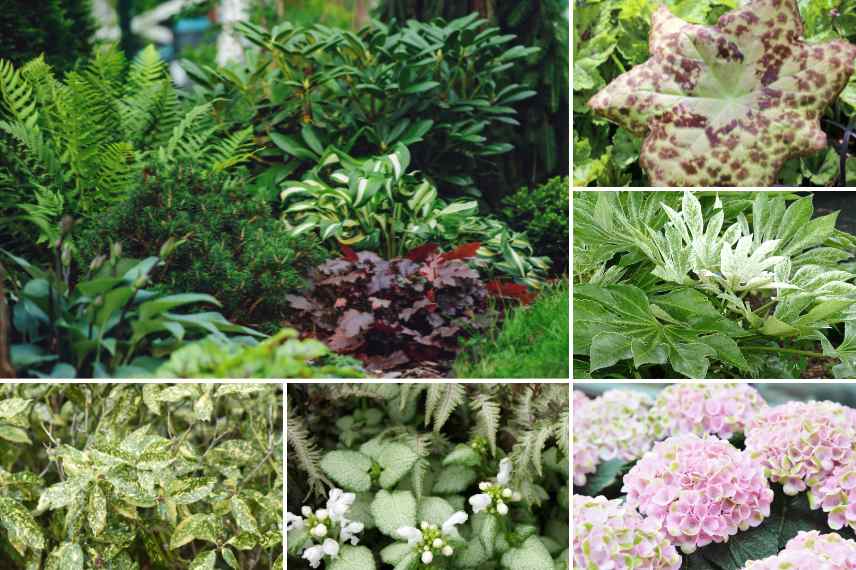
Ferns, hostas, Podophyllum ‘Spotty Dotty’, Aucuba ‘Variegatum’, Lamium and hydrangea
The essential role of colour
Because the colour palette is more limited in a shaded garden, here are a few tips to highlight it.
- Playing with white, silvery and variegated colours creates an illusion of light. These hues appear in the flowering — many are white among shade-loving plants — which is very handy, and also in the foliage. Shade-loving flowers also come in soft tones, pink and mauve, which will brighten the garden.
- Bring lightness through the shapes of the foliage and the flowering: Saxifrages, Thalictrum, Astilbes, Japanese Anemones…
- Insert silvered foliage, marginated with cream or speckled with white : Lamium ‘White Nancy’, Ilex aquifolium ‘Silver Queen’, Athyrium niponicum ‘Pictum’, etc.
- Prefer golden varieties of certain plants: for example the golden version of the Dicentra spectabilis ‘Gold Heart’ or Aucuba ‘Golden King’
- Incorporate some very bright green flowers chosen from the hellebores, Daphne laureola, woodland euphorbias, etc.
- Select some original cultivars to ensure a striking aesthetic (Podophyllum ‘Spotty Dotty‘, Coleus purple and anise, heucheras veined with purple, garden orchids, Caladium pink or white, splashed with white or yellow, Acanthus ‘White Water’, pulmonaria ‘Mrs Moon’…)
You can also try a white monochrome garden in a very shaded garden. By choosing suitable plants, it provides a perfect setting for refined plants.
→ Read: 10 white azaleas to brighten up the garden; 7 roses for shaded gardens; 7 perennials with grey or silver foliage.
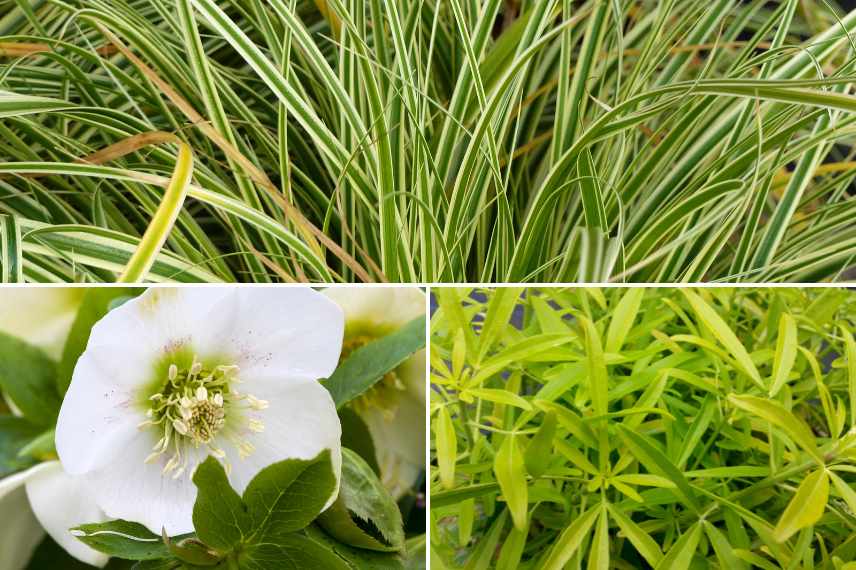
Carex ‘Evercream’, white hellebore, Choisya ternata ‘Aztec Pearl
Beyond the plant life... landscaping tips
To transform your shady garden, add colour or materials. Used in moderation, they bring brightness, a focal point or reflections that banish gloom. You can:
- Enhance the sense of coolness with a small pool or a fountain.
- Play up the gloom, with moss, stones and rockeries (perfect for infusing romance or a Japanese-inspired mood).
- Use construction materials in light or warm tones : bricks, stone, pebbles, white or terracotta surfaces on a wall, provided you clearly define a single colour or material as an anchor.
- Introduce bold colours into furniture or décor (the complementary red to green is ideal in dimly lit areas, but white or lime greens, slate blues, etc.) : it should remain elegant and be used sparingly (as below with a red bench at Caradec). Glazed pots in a courtyard, or pots in stoneware or terracotta bring in warmer orange-toned hues.
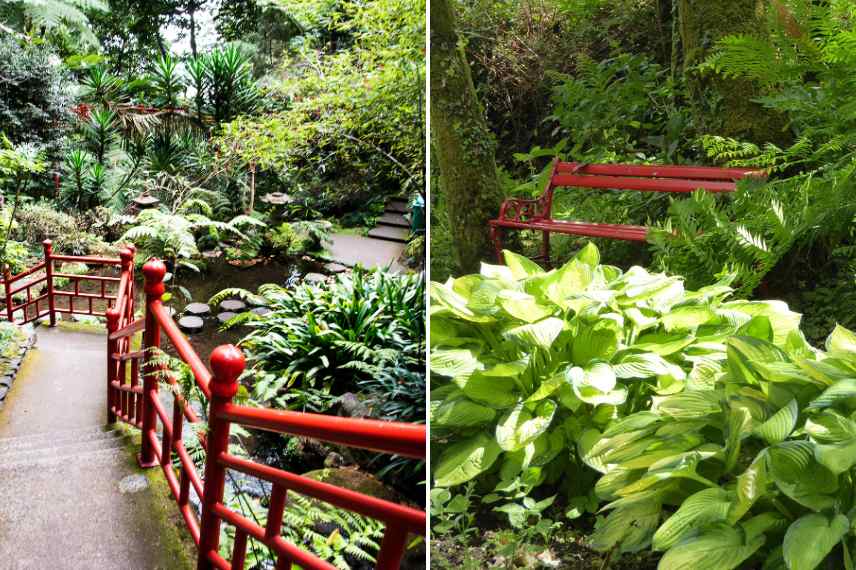
Monte Palace Gardens in Madeira and Jardin de Caradec in Morbihan (photos by Gwenaëlle Authier)
- Integrate decorative objects with large jars, decorative spheres for minimalist gardens, glazed pottery chosen in a single hue to bring colour (turquoise, blue, red…). Furniture, such as coloured or neutral benches and seating, in stone or light rattan, also makes a lovely foray into a shaded garden.
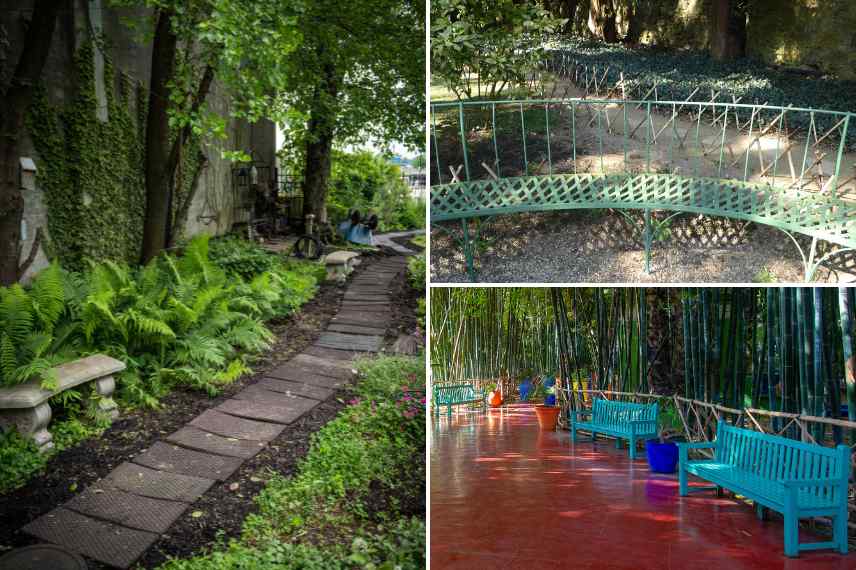
Stone bench and winding path, green-painted bench in Maulévrier Garden (49), turquoise benches in Majorelle Bamboo Garden in Morocco
- Dare to incorporate a handsome structure or architectural elements : a pergola, a gloriette, or even small gazebo or kiosk in the largest gardens. Here too, their colour, often chosen white, will easily brighten the area.
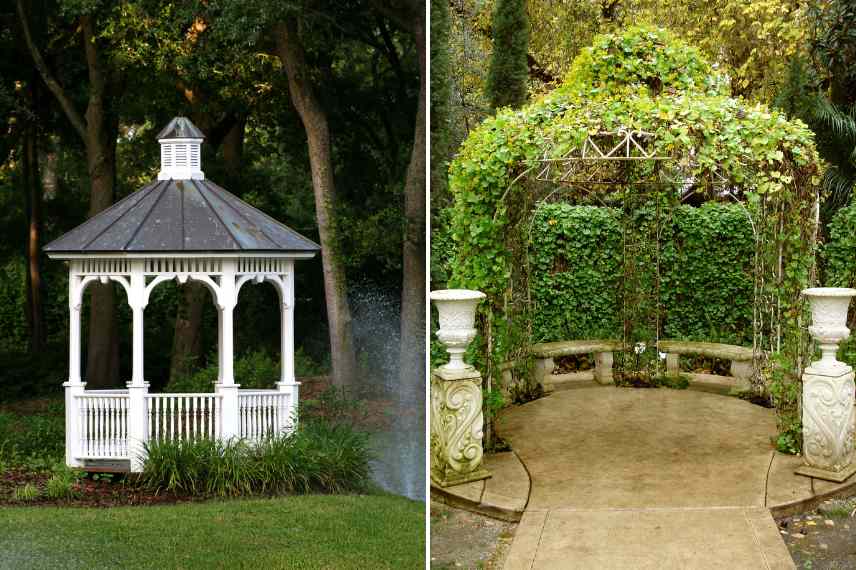
White paint on this kiosk brings a sense of freshness, as does the handsome pergola on the right.
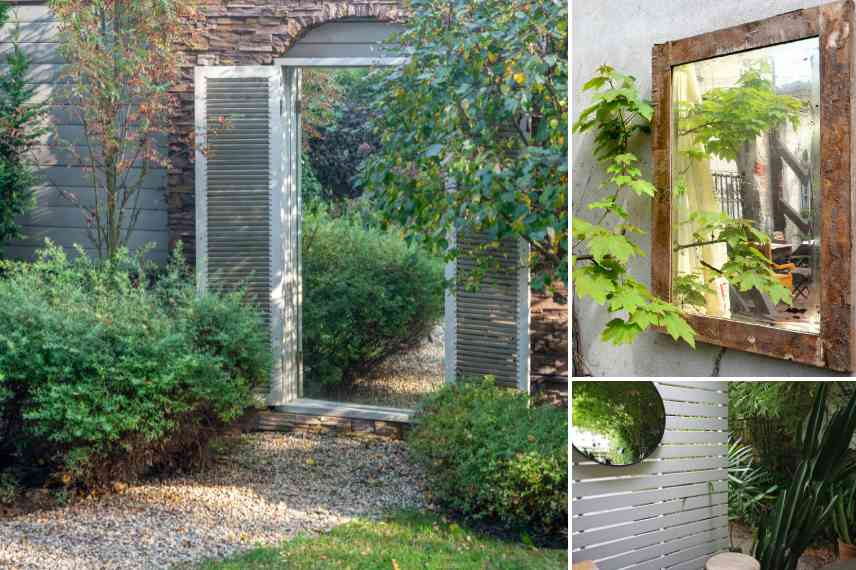
- A large mirror fixed to a wall is another trick to reflect the few rays. Love it or loathe it, but you can always give it a go!
- Play with lighting : lanterns, fairy lights and garlands to cast a soft glow as evening falls.
Mistakes to avoid
Latest tips for a successful shade garden!
- Don’t choose shade plants just because you want lots of flowering: it’s a lost cause… and doomed to fail! At worst, the plants will seek the sun through phototropism, giving them a spindly and twisted appearance. The right plant in the right place matters, especially in shady areas, and there are so many beautiful ones that it would be a pity not to showcase them in this unique garden!
- Only choose plants in the same shade of green : a shade garden needs more than just dipping into the broad palette of this colour: yellow-green to chartreuse, blue-green, metallic green, sage green, khaki green, etc. Also a few purple foliage plants if paired with white flowers to avoid a dreary effect.
- Subscribe!
- Contents
Comments