





























7 Mediterranean trees
A selection of trees for warm and dry climates
Contents
The Mediterranean flora boasts incredible diversity and a millennia-long adaptation to drought, heat, and poor, stony soils. Among this flora, southern trees can create beautiful Mediterranean gardens, but they can also now adorn more northern gardens, provided their cold tolerance is respected and they are planted in well-draining soil.
If, when it comes time to plant, you wonder which tree to plant in the south, which trees can withstand full sun, or which are drought-resistant, discover our selection of 7 Mediterranean trees and their hardiness ratings to consider acclimatising them in other regions.

Olive tree - Olea europaea
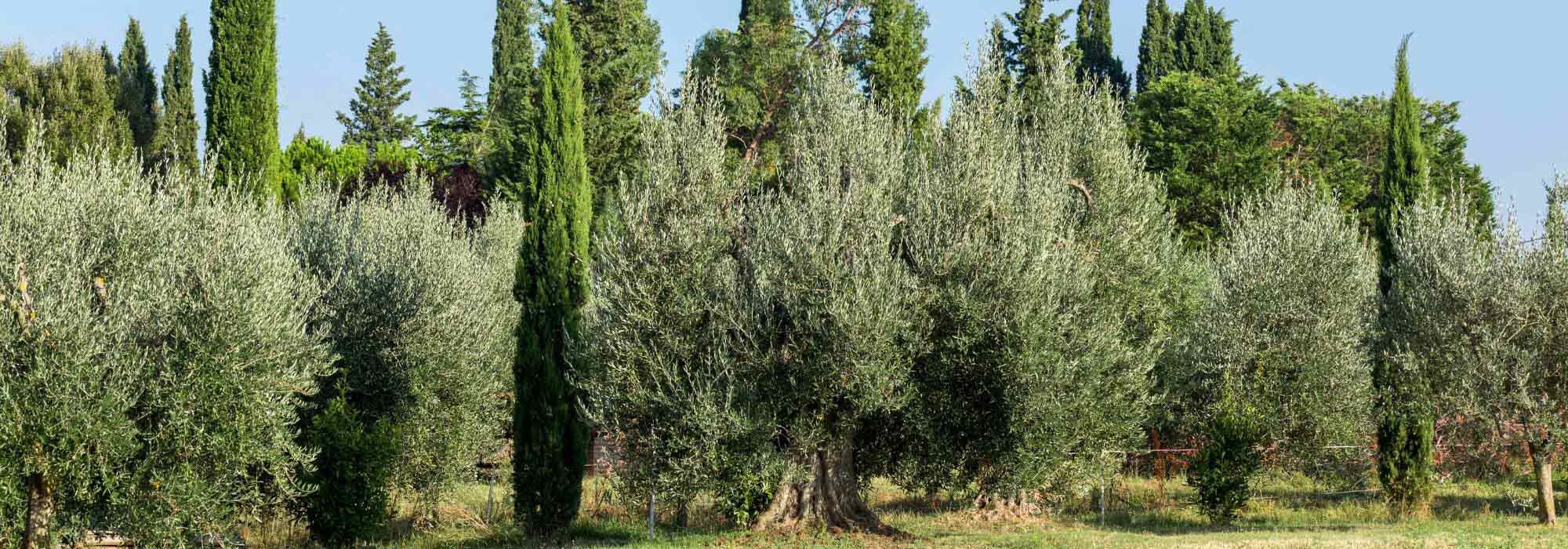
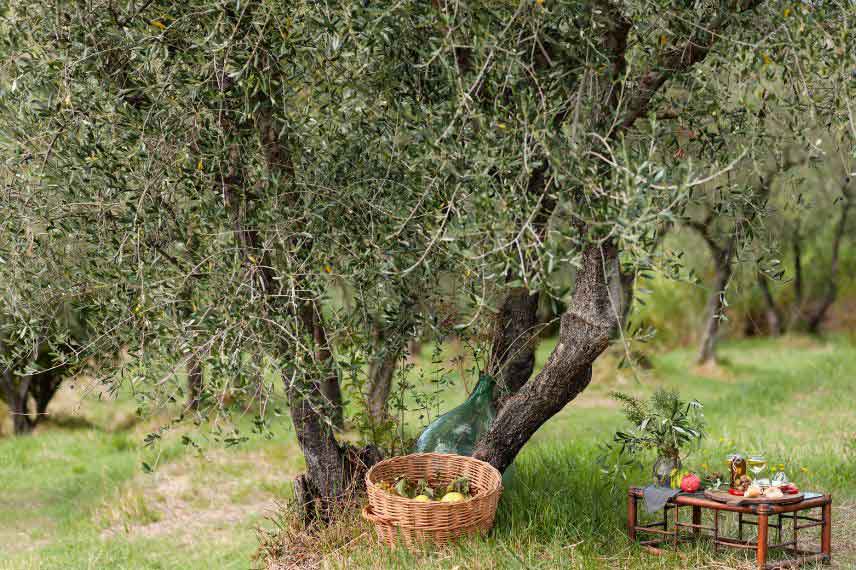
How can we talk about Mediterranean trees without starting with the Olive tree? This essential of the dry garden, typical of the southern landscapes it evokes with its mere presence, is known to all. Its silhouette with a nodose and rough trunk and its silver evergreen foliage conjure warmth and sunshine, yet it can now be found in many regions. The Olea europaea or Common Olive belongs to the olive family. Its cultivation is believed to have emerged in Crete between 3,500 and 5,000 BC, before spreading throughout the Mediterranean basin.
It can reach a height of 5 to 10 m, but its growth is slow and it responds well to pruning, allowing it to be managed in small spaces. The ‘Cipressino’ variety is particularly interesting for its compact and upright habit, ideal if space is limited in width.
Both an ornamental tree and a food provider, the Olive tree prefers deep, well-drained, dry soil, even calcareous and stony. It withstands summer drought exceptionally well and requires a sunny position sheltered from cold winds, especially outside the zone… of the olive tree! (the southern part of the southeast quarter, in areas with a temperate Mediterranean-type climate). It will then demonstrate exceptional longevity.
→ The Olive tree cannot tolerate temperatures below -12 °C and does not produce olives north of the Loire. Enthusiasts of this beautiful tree in unsuitable regions can still consider adopting it in a large pot, to be protected from severe cold in winter.
Judas Tree - Cercis siliquastrum
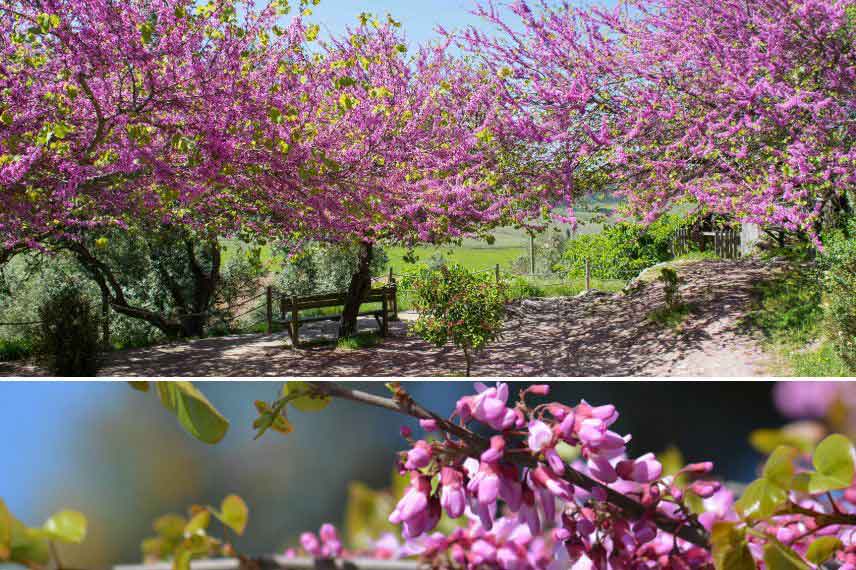
The Judas Tree – Cercis siliquastrum is one of the most beautiful specimens of Mediterranean flowering trees, adorned with bright pink blooms in March-April. It originates from regions near the shores of the Mediterranean and the Black Sea. Its multitude of flowers appears before the leaves and attracts pollinating insects. It is one of the few trees to be cauliflorous, meaning that its papilionaceous flowers grow in tight clusters directly on the trunks.
At maturity, the Judas Tree, also known as the Gainier, reaches about ten metres with a spread of approximately 4 m; its modest dimensions make it suitable for planting in small spaces. Its heart-shaped deciduous leaves are a lovely light green, turning golden yellow in autumn.
It tolerates all types of soil, even dry and poor, and prefers well-drained earth, where it will withstand drought very well once established. However, it will need regular watering during the first few seasons in case of drought to allow its root system to develop. It enjoys full sun or partial shade.
→ Being somewhat frost-sensitive when young, the Judas Tree can withstand temperatures of around -10 °C once well established. Young shoots may suffer during significant frosts in early spring: protection with a winter fleece can be beneficial in the first few years during severe cold spells.
Discover other Shrubs for Mediterranean climates
View all →
Available in 1 sizes
Available in 1 sizes
Available in 2 sizes
Available in 1 sizes
Available in 1 sizes
Available in 1 sizes

Available in 2 sizes
Available in 1 sizes
Available in 1 sizes
Available in 1 sizes
The Holm Oak - Quercus ilex
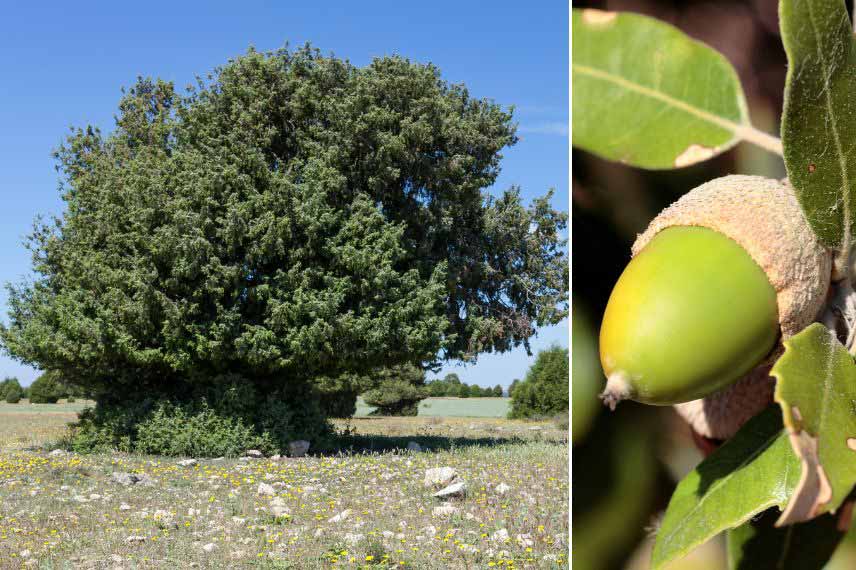
The Mediterranean region is the birthplace of this species of oak for dry and sunny situations. The Holm Oak – Quercus ilex – is an evergreen tree that once covered most of the Mediterranean lands, from the coastline up to 1400 m in altitude. Very accommodating, the Holm Oak, also known as the Yeuse, thrives in both dry atmospheres and near the sea. Its leathery foliage, dark green on top and silvery grey underneath, remains present throughout the year, densely adorning its vigorous branches. Its fruits are acorns, favoured by wild boars in the Mediterranean forest.
Slow-growing, the Holm Oak requires almost no maintenance and boasts an impressive longevity, with some specimens reaching 1000 years or more. It grows to a height of 15 to 20 m and about ten metres in width. Its dense canopy effectively shades sun-scorched areas all year round, which it itself does not fear, even in the hottest hours. It can thrive in all soils, even the most ungrateful and stony, as long as they are well-drained.
→ Hardy down to -15 °C, the Holm Oak fears neither sea spray, nor strong winds, nor the most extreme temperature fluctuations between biting cold and scorching heat.
Cork Oak - Quercus suber
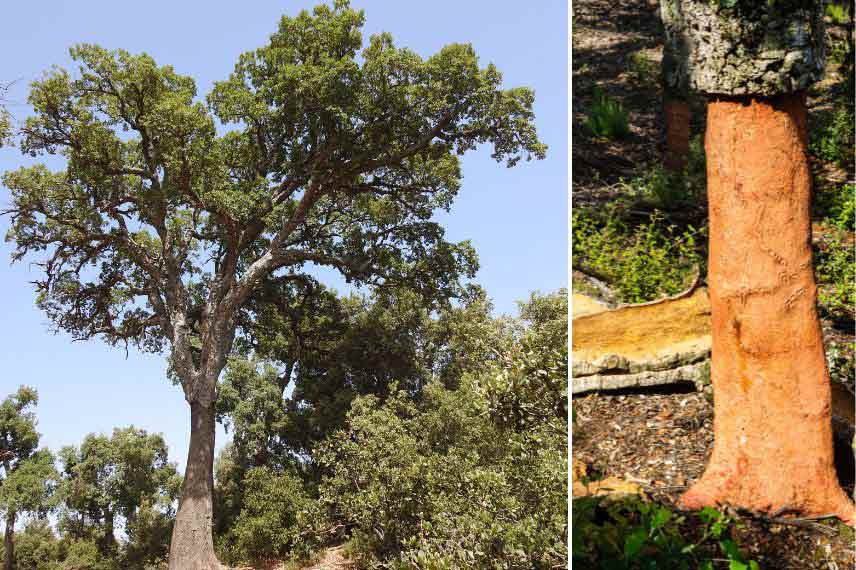
Traditionally cultivated in southern Europe, where it originates, the Cork Oak – Quercus suber – is reputed to thrive in the poorest soils. It is a Mediterranean forest tree and evergreen, known for its thick and spongy bark: cork. In addition to reducing the tree’s water loss, this bark, which can reach 25 cm in thickness, is a natural adaptation to fires, as cork is an excellent insulator and during forest fires, the fire does not reach the sapwood, the living part beneath the bark. New shoots can thus regrow quickly.
This extremely austere tree stands out for its picturesque appearance: its habit is stout, consisting of a relatively short and very wide trunk bearing few, spreading branches that support a sparse and spreading crown. Its growth is slow during the early years, and at maturity, it averages 11 to 12 m in all directions. The leaves of the Cork Oak, evergreen, are leathery and serrated. They are dark green, lighter on the underside.
Of great sobriety, the Cork Oak loves sunlight and is capable of withstanding drought. It fears heavy, compact, and calcareous soils; it therefore requires acidic soil to thrive.
→ The Cork Oak is wary of severe frosts but can nonetheless withstand short periods of frost down to -15 °C. Its leaves begin to brown as soon as the temperature drops below -5 °C. Not fearing sea spray, it can be planted along the coast.
The Stone Pine - Pinus pinea
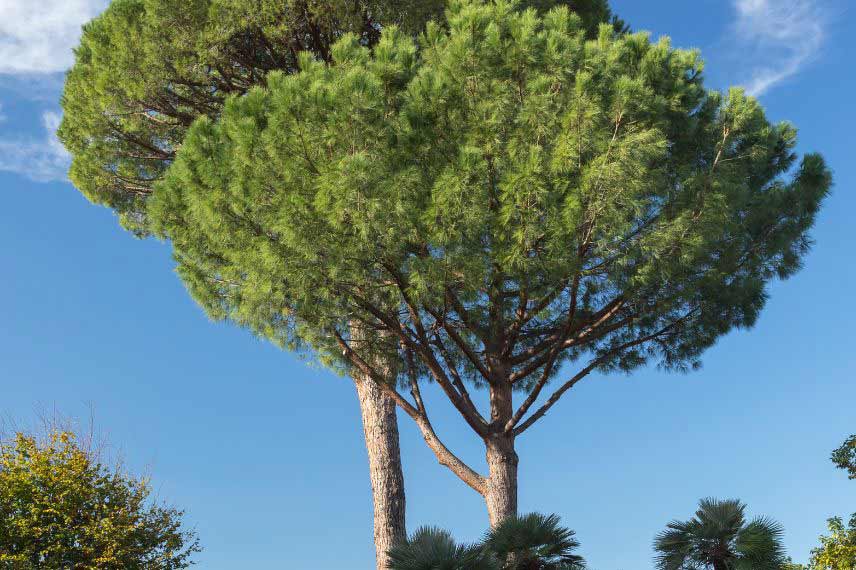
To adorn large Mediterranean gardens, the Umbrella Pine – Pinus pinea – stands out immediately. If given enough space, this magnificent conifer native to the Mediterranean basin will reach an adult height of around twenty metres with a spread of about 10 m. And when provided with optimal growing conditions, namely well-drained, rather poor, lime-rich soil and full sun exposure, this undemanding tree will gradually spread to eventually form a true evergreen canopy that is dense after about ten years.
The leaves, which are evergreen, are soft and less prickly needles of a beautiful light green. Flowering occurs in spring, and both male and female cones coexist on the same tree. After pollination, the female cones develop into large pine cones, which, after three years, open their large scales to release edible pine nuts. This majestic conifer is very well adapted to salt spray and drought.
→ The Umbrella Pine is quite hardy and is not afraid of wind. However, young specimens may be susceptible to severe frosts, while older specimens can tolerate temperatures down to -12 °C; thus, it can be planted in the south and almost up to the Loire.
The almond tree - Prunus dulcis
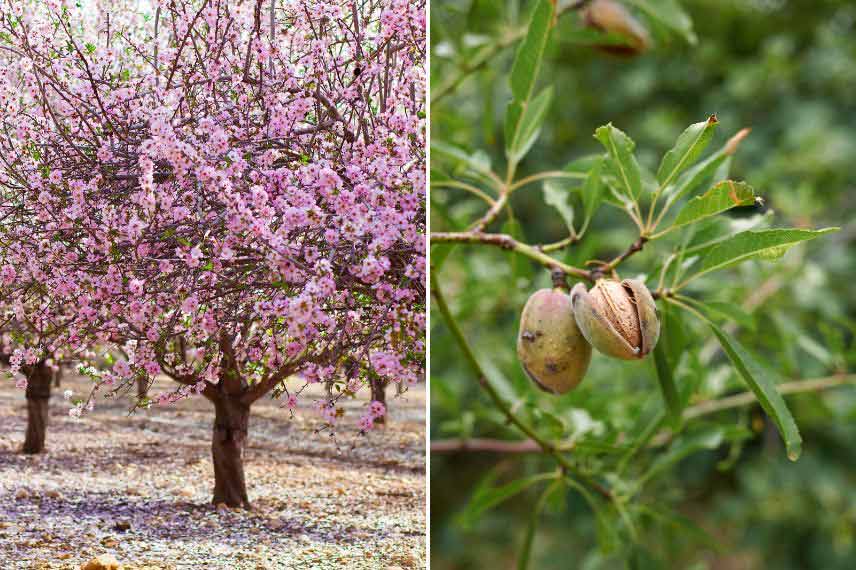
Tree appreciated for its wonderful spring flowering and its tasty fruits, the almond tree – Prunus dulcis – is a proud representative of Mediterranean flora. It descends from the Caucasian almond tree – Prunus fenzliana – a bush native to Armenia, Turkey, and Iran. It has been cultivated for several millennia around the Mediterranean and in many arid regions. Benefiting from rapid growth in the first years after planting, the almond tree forms a small tree 8 to 10 m high and 6 to 8 m wide with an upright habit that tends to round out with age. Its deciduous foliage consists of medium green, shiny leaves with a greyish-green underside.
The flowers of almond trees appear before the foliage, between late winter (January-February) and early spring (March); it is indeed one of the first trees to bloom, heralding the imminent return of spring. Its flowers are white tinged with pink or distinctly pink depending on the individual. They are highly nectariferous and delight bees and other pollinating insects that feast on them during their first spring outings. While the wild almond tree produces bitter almonds, numerous horticultural selections have led to the creation of varieties with sweet almonds.
Particularly hardy and undemanding, the almond tree is suited to even the most challenging growing conditions. It prefers warm climates, tolerates drought, and dislikes wet soils.
→ Hardy down to -25 °C, the almond tree can be planted in many regions of France. However, it will thrive best in the south, as its early flowering is at risk from frosts. Some late-flowering varieties can, however, be planted north of the Loire, provided they grow in a well-sunny location and especially sheltered from cold winds.
The fig tree - Ficus carica
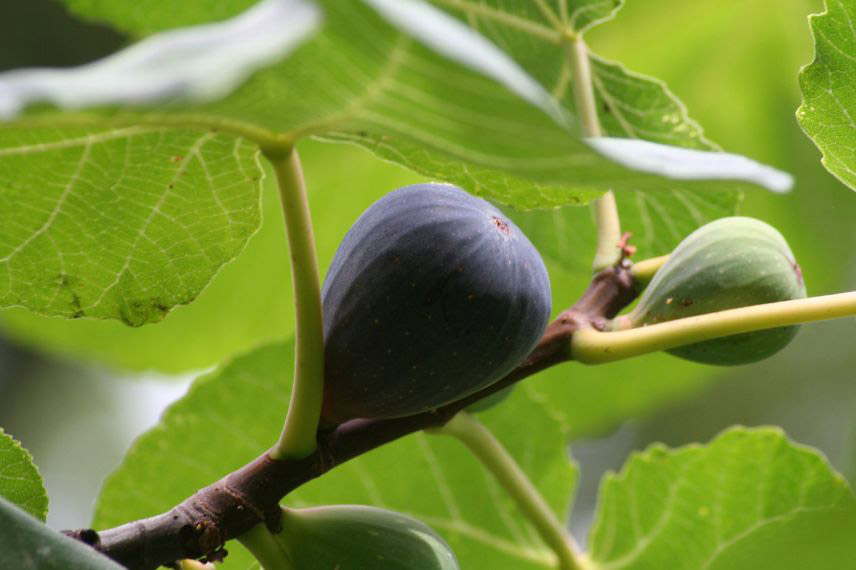
Typical fruit tree of the Mediterranean region, the fig tree – Ficus carica – evokes sun and warmth. With a powerful and running root system, it forms a small vigorous tree, ramified, with a rounded and spreading habit, and a trunk that is often twisted, rarely exceeding 3 to 5 m in all directions at maturity. Highly ornamental, it offers both delicious sweet figs, purple or green, and a superb opulent foliage made up of large rough leaves that are bright green turning yellow in autumn. Among the varieties of fig trees, we distinguish unifera varieties, producing a single harvest in autumn, and biferous varieties, fruiting twice a year.
The numerous varieties of fig trees adapt to all soils, even poor, stony, and dry, or even rocky, but prefer deep, loose, and rather calcareous soils.
→ The fig tree is quite a hardy tree that will regrow from the stump down to -12/-15 °C and appreciates a sheltered position from strong winds, especially in the colder regions. To fruit well, it requires a sunny and warm exposure, particularly in summer during the ripening of the fruits.

- Subscribe!
- Contents

Comments