


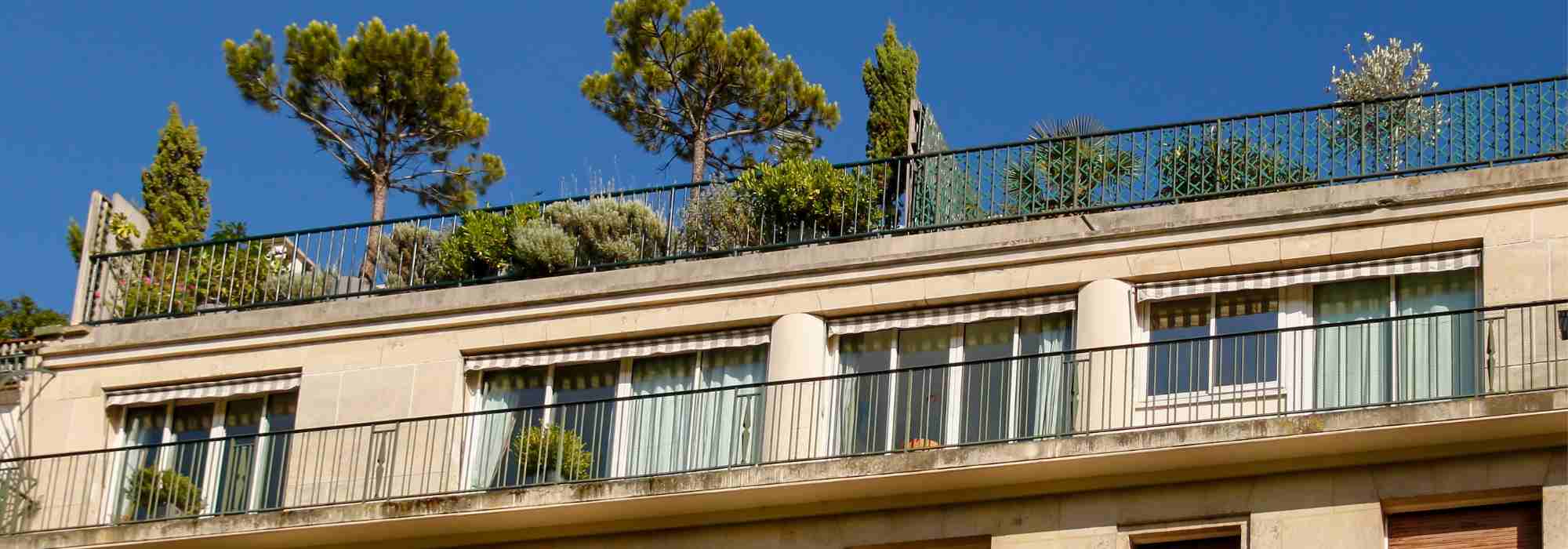
9 landscaping tips for a rooftop terrace
Our rooftop garden ideas!
Contents
The rooftop is a dream for many! With breathtaking views of the city or surrounding landscape, a spacious platform adding a lovely living area and a green oasis during the warmer months, and no overlooking neighbours as it towers above everything else… some city dwellers have eyes only for it when searching for a property.
While the size of a rooftop can vary from a few square metres to a vast esplanade, its design should not be taken lightly, especially considering load constraints and necessary permissions.
Regulations, materials, plants, style… we’ll tell you everything you need to know to create a rooftop worthy of the name!
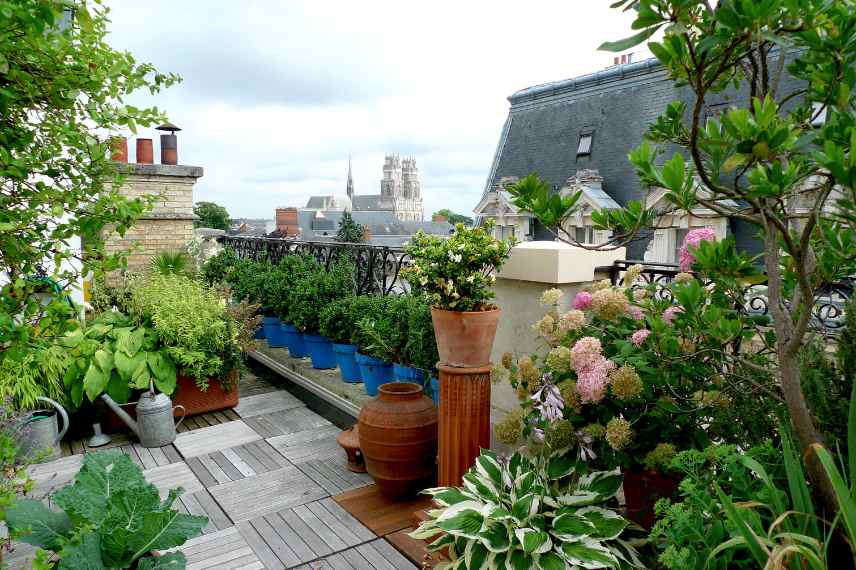
The accessible rooftop: a dream space for city dwellers craving greenery

Ensure the feasibility of the project
Let’s start with the least glamorous but most important and delicate part: regulations and permissions. Because when it comes to a rooftop terrace, it often involves a shared ownership situation… where everyone must adhere to a minimum set of rules. This is especially true for an existing rooftop terrace that crowns a building.
-
Load-Bearing Capacity
First and foremost, it is essential to ensure that the project is feasible; therefore, a thorough feasibility analysis is crucial. The load-bearing capacity of the roof is a key element to consider. It determines the maximum amount of weight the structure can support (the weight of plants and soil, furniture, a potential spa, gravel or tiles, and the people who will use this space). A study conducted by an architect, project manager, or structural engineer is therefore essential to ensure the safety of your project. Be cautious with older houses from the 1950s that may not have modern structures. The allowable load per square metre for development varies between 350 and 1200 kg for what is termed “intensive” greening (tree stratum and perennials). For new constructions, it is important to anticipate this load-bearing concept well in advance to budget and size it correctly.
- Necessary Permissions
Moreover, if you are in shared ownership, you will need to obtain the agreement of the other co-owners, as the development of a rooftop terrace affects the entire building.
In France, construction regulations are strict. The development of a rooftop terrace may require a prior declaration of works or a building permit, depending on the size and height of the construction. Additionally, some municipalities prohibit the construction of rooftop terraces in new buildings, as outlined in their local urban planning (PLU), with regional architectural criteria favouring pitched roofs. Be sure to check with your local council or a planning expert to obtain all necessary permissions.
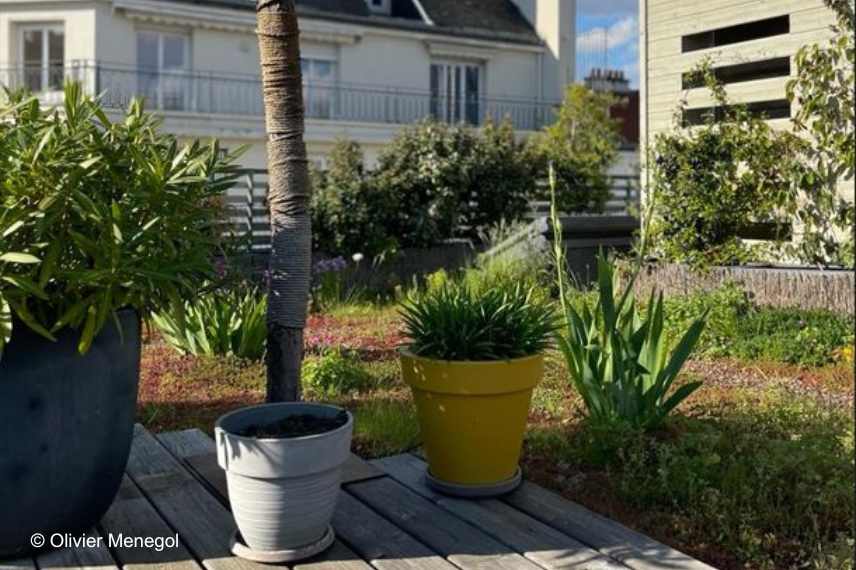
A little slice of paradise in the heart of Paris! It’s possible, provided you have all the necessary permissions in place.
Check safety and waterproofing standards
There are certain common constraints for suspended landscaping such as the roof terrace:
-
Safety
Once the feasibility of your project is confirmed, the aspect of safety must be prioritised. In France, safety standards (NF) are strict for the development of roof terraces. It is obligatory to install a guardrail of at least one metre in height, fixed to the structure. This guardrail must be robust enough to withstand horizontal pressure, ensuring the safety of all. It is equipped with a handrail. Furthermore, the surface of your terrace must be non-slip to prevent accidents, especially in wet conditions.
-
Waterproofing
A crucial point, rainwater and irrigation must not infiltrate the roof support and the insulation layer. A waterproof membrane must be placed between the insulation layer and the drainage layer. This can be made of poured asphalt or bitumen-coated sheets, glued and weighted down.
-
Rainwater Drainage
Rainwater drainage is another major technical aspect to consider when developing a roof terrace.
The roof terrace is, by definition, flat. It cannot drain rainwater as quickly as a pitched roof. Therefore, it is essential to prevent water stagnation that could damage the building’s structure by causing infiltrations, or overload, and root asphyxiation. An efficient drainage system, combined with a high-quality waterproof membrane (EPDM, TPO…), is key to ensuring proper water management. A thickness of between 5 and 12 cm of drainage layer is generally recommended. The DTU (unified technical document), which includes the standards to be followed for your home, will guide you in the specifications. It is also useful to add a filtering layer above this drainage layer (such as geotextile Bidim or polypropylene).
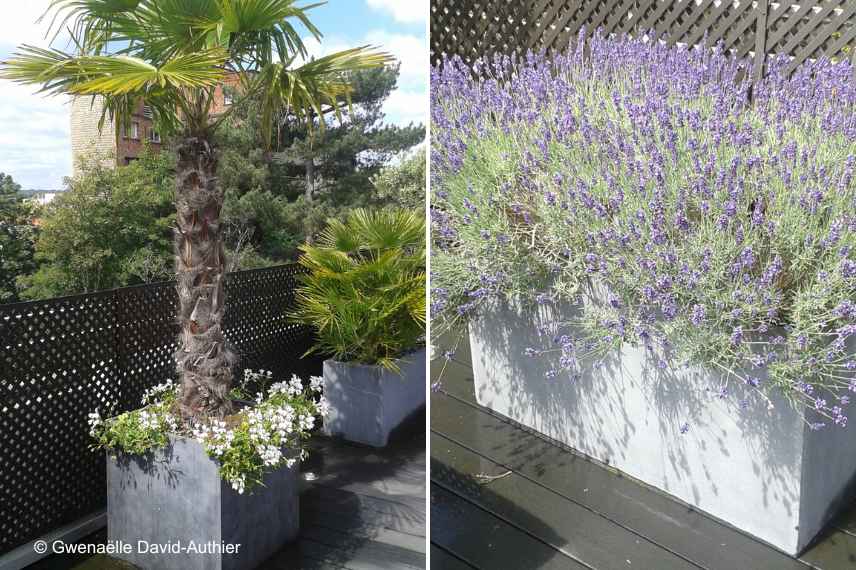
On this roof terrace, the guardrail is complemented by an aesthetic screen, enhancing safety and serving as a privacy barrier. (© Gwenaelle David-Authier)
Create a cocoon while considering the views
One of the challenges when designing a rooftop terrace in an urban environment is the proximity to neighbours. Some buildings can indeed rise as high or even higher than yours, with a direct view into your beautiful space. To create privacy, several solutions exist:
- Plants can act as a natural barrier: dense-foliaged bushes growing up to 2m, such as non-running Fargesia bamboos, create a green screen without taking up too much space when planted in tall, long planters. Select a majority of evergreen foliage if you use your terrace beyond the summer months.
- Wooden, glass, or perforated steel panels or trellises also serve to shield against prying eyes while adding an aesthetic touch to your space.
- The arrangement of plants itself acts as a visual barrier when placed around the perimeter of the roof and contained in large planters (contemporary models offer the most options).
- Structures supporting fabric canopies, such as shade sails, set up in summer, also provide a bit of tranquillity.
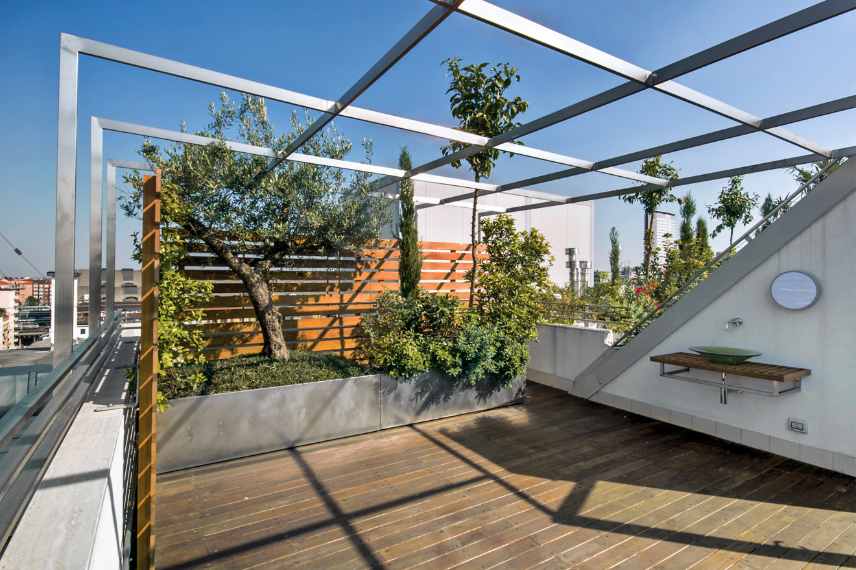 A wooden slatted trellis, aesthetically pleasing, combined with some plantings, is enough to significantly reduce the overlooking from the neighbouring building.
→ Also read Virginie T.’s tips on How to hide from neighbours on a budget? and Marion’s advice on How to hide a high overlooking view in your garden?
Provide sufficient shade
Reverberation on a rooftop terrace will vary depending on the type of covering and its colour. Nevertheless, it remains a surface that is heavily exposed to sunlight, reflecting and accumulating heat in summer. One of your primary concerns will be to attenuate this by installing heat protection measures: climbing plant pergolas, giant parasols, or shade sails, and of course, suitable climbing plants and bushes (see below).
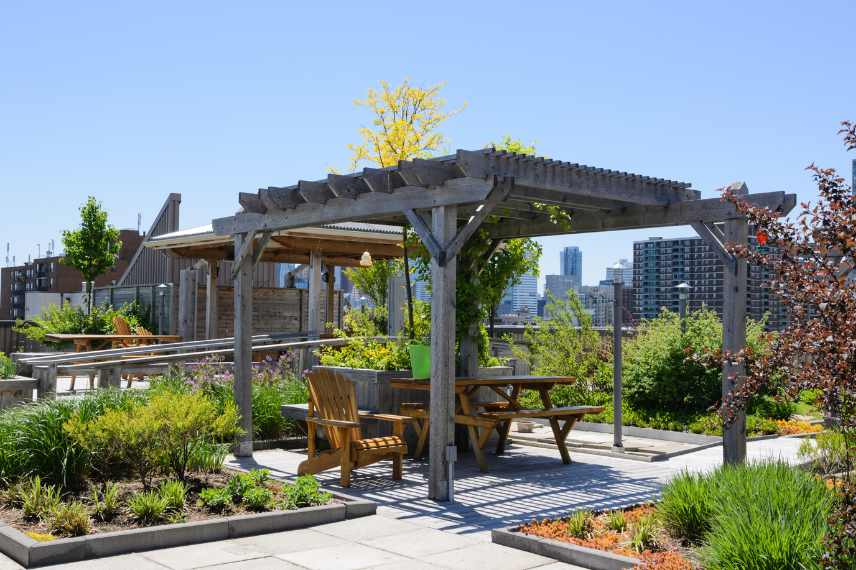
→ Also read our tips on shading a terrace: which plants to choose?
Counter the wind
The rooftop terrace is certainly the most open space there is, exposed to winds that can vary in strength depending on the height of surrounding buildings, as well as your region of residence. It is essential to choose plants that can withstand the wind that can be quite harsh. Groundcover plants have the advantage of not suffering from these conditions, just like perennial groundcovers, which also remain low. However, we need some taller plants, and your choice should include the notion of bushes or grasses with a flexible habit that won’t break under the force of the wind, as well as evergreen bushes known for their excellent wind resistance (read our article 10 wind-resistant shrubs).
Adapt the plant palette
Greening a rooftop terrace is almost imperative in the context of climate change, helping to combat heat islands. However, the environment of a rooftop terrace is harsh for plants: strong wind exposure, intense sunlight, air pollution, temperature fluctuations, and heat accumulation on often mineral soil… It is therefore essential to choose particularly robust species that can withstand all these challenges and thrive well in pots. Use bushes, trees, and herbaceous plants, ideally melliferous and suited to the local climate (drought, rainfall).
Here are some examples:
- trees: choose compact or dwarf varieties of birches, Japanese maples, Carpinus japonica…
- shrubs: euonymus, Olearias, Phillyrea, Eleagnus, Pittosporum, Osmanthus, oleander, and Escallonia in mild climates, Abelia, Photinia, cotoneasters, heathers, Lonicera pileata, etc.
- climbing plants: jasmines, honeysuckles, clematis, ivy…
- grasses: Miscanthus sinensis, panicums, Pennisetums, fescues… among others
- perennials: it is advisable to choose species that are particularly drought-resistant: Sedum spectabile, lavenders, as well as all summer or spring bulbs.
- A low stratum composed of rock garden plants (Arabis, Iberis, Hypericum olympicum, Dianthus, Euphorbia myrsinites, Armeria maritima, etc).
Regarding maintenance, it is ideal to install a drip irrigation system from the water supply, especially in large areas. In winter, since the plants are grown in pots, protection will be put in place for some.
You can go further and try green roofing! It offers a lush aesthetic and improves the thermal insulation of the building. This technique is unique due to the very thin layer of substrate that nourishes the plants (between 3 and 12 cm, up to 30 cm for a so-called “semi-intensive” greening). It can be mixed with a part of the “classic” rooftop terrace, in a dedicated area, when the ground surface is very large, enhancing the garden effect on the roof! Another advantage is that green roofing requires very little, if any, maintenance compared to pot cultivation and remains economical. Various types of Sedums (stonecrops), grasses, and perennials are planted. This is referred to as extensive greening.
→ Read also 7 trees to grow in pots on a balcony or terrace, 7 plants for green roofs, and How to create a green roof?
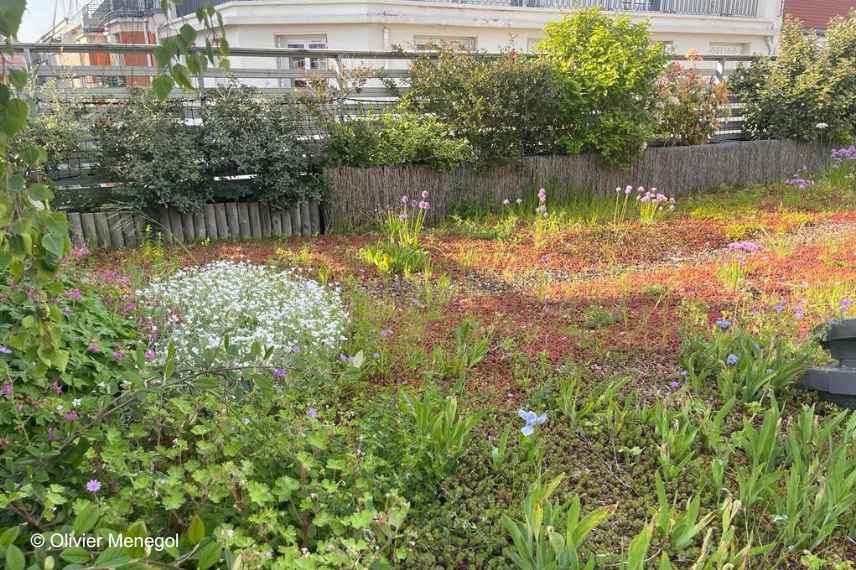
A true garden has emerged on this Parisian terrace, combining pot plantings and green roofing © Olivier Menegol
Opt for lightweight materials
We have seen that regulations impose standards regarding loads. Four elements will weigh on a rooftop terrace:
-
Containers
The choice of containers for your plants can quickly become inappropriate on a rooftop terrace, especially if it is large, increasing the load if they are heavy. Focus your choice on lightweight and durable pots or troughs to preserve your structure. Containers should be light enough not to burden the roof structure while being weather-resistant. Materials such as resin or fibreglass are often preferred, as they do not unnecessarily add weight to the structure. Calculate the total weight in the end (including substrate and plants) to ensure you comply with the specifications of your building (or home). Don’t forget to check that your pots are drilled to allow for water drainage.
- Substrates
On a rooftop terrace, substrates must also meet the requirements for permissible load. Topsoil is often mixed with expanded clay or other materials to lighten the containers (water-retaining agents like rock wool).
- Coverings
Another important aspect of load-bearing on a rooftop terrace is the coverings. The choice should be made for the lightest options, but it all depends on the permissible load, which must be carefully calculated in your design.
-
Furniture
Opt for lightweight furniture made of aluminium, galvanised steel, or composite materials like woven resin, which have the advantage of being weather and UV resistant.
Divide a large rooftop terrace into sections
On large rooftop terraces, the aim is to recreate several zones as one would in a garden. The overall effect can appear somewhat artificial, even cold, if only a few windbreak plants are juxtaposed. Moreover, this way of structuring the space provides a windbreak effect when the various elements are positioned wisely.
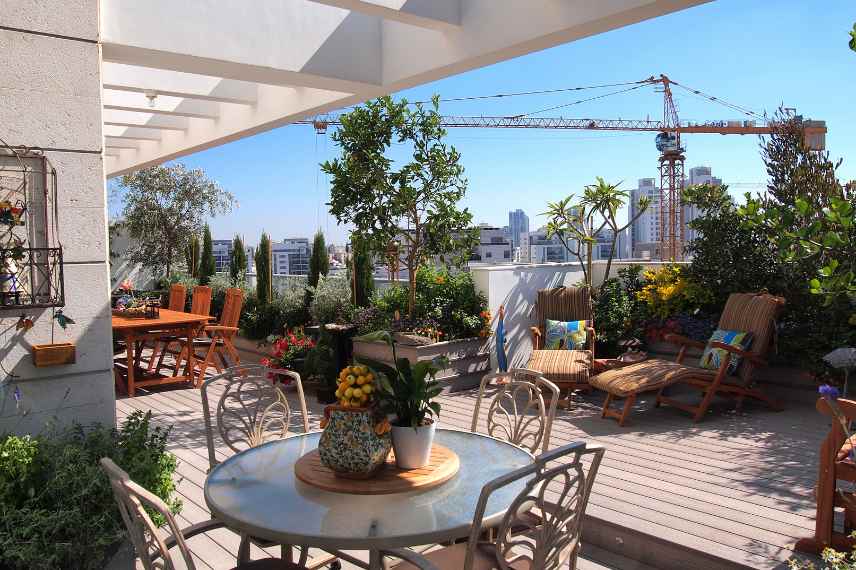
A lounge area, dining area, and relaxation corner punctuate this Parisian rooftop terrace.
Thus, on larger spaces, there is ample opportunity to add “outdoor furniture”, such as a fire pit for the evening corner, a large pergola that will both dress the space and add volume, as well as a terrace serving as a wooden or paved platform, defining a relaxation area or dining corner. A different surface, such as a (beautiful) synthetic lawn or an elegant outdoor carpet, is also a good way to visually define the spaces. A slatted screen serves the same purpose of separation.
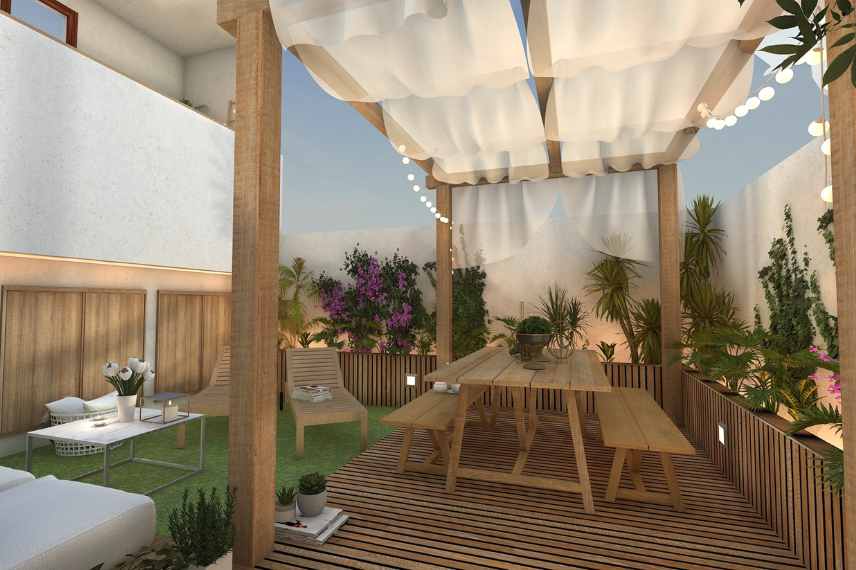
In this project, the use of different surfaces on the ground dresses and structures the rooftop terrace.
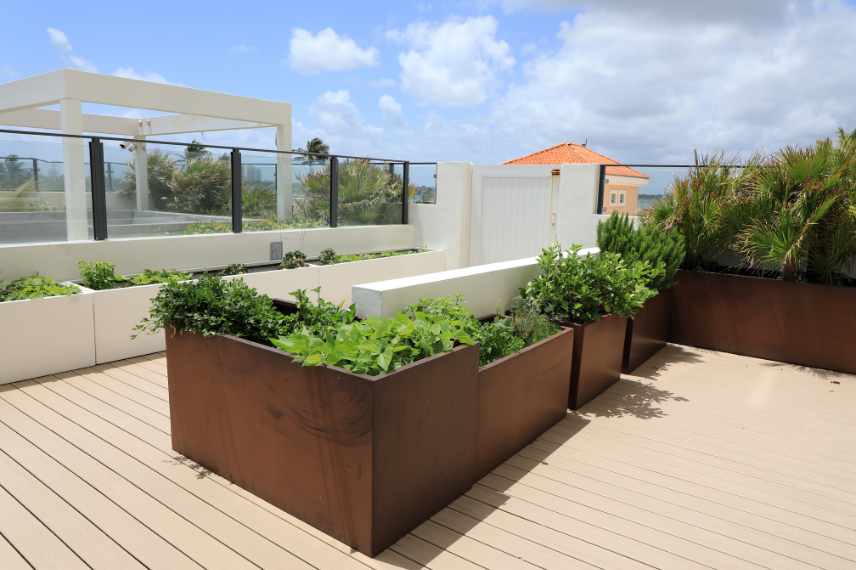
Compartmentalisation is also achieved through large planters that create distinct zones or small intermediate corridors, as shown below.
Define your style!
The flat roof of a loft or duplex may not necessarily be designed in the same way as a small terrace roof within an old building or that of a house from the 1930s or 1950s. However, terrace roofs accessible by a staircase that does not lead directly to the apartment or living areas can certainly be enjoyed to explore a style different from that of the interior decor.
Regarding the desired atmosphere, large spaces and modern architect-designed houses are enhanced by a contemporary spirit where grasses can play a significant role, being both light and elegant, while the small terrace roofs of older houses or buildings benefit from reinforcing a cocoon-like aspect through an exotic or rustic style, featuring dense vegetation.
The environment also plays a crucial role, with terrace roofs in densely populated areas requiring more thoughtful greening efforts.
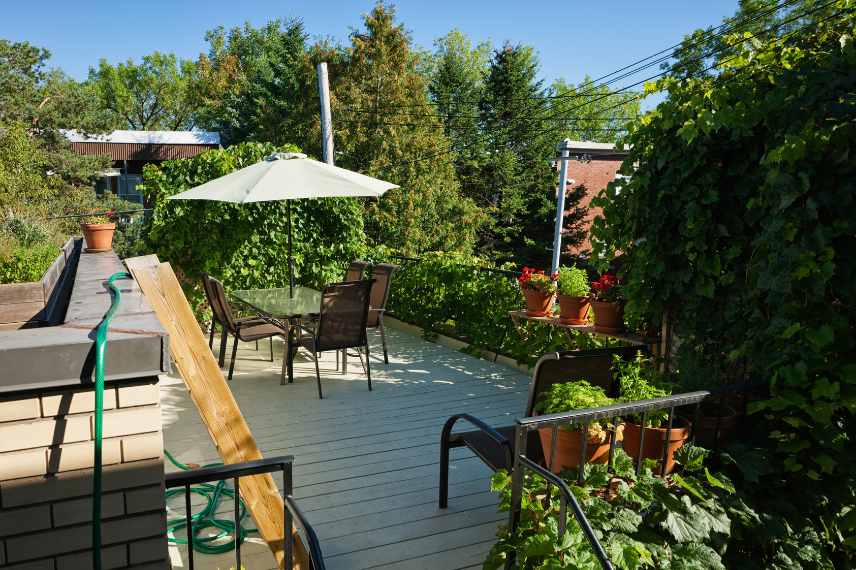
This small house in the countryside benefits from a wooded environment, hence the reduced landscaping in terms of vegetation.
- Subscribe!
- Contents
Comments