





























9 ornamental fruit trees
Our selection of beautiful ornamental fruiting trees
Contents
Choose a tree! A decision sometimes difficult for a gardener who must look ahead. Indeed, a tree endures and occupies a substantial space in a garden, which must be taken into account from planting. Beyond these two primary criteria, the choice also depends on its hardiness, its soil and exposure requirements, the persistence of its foliage, and its usefulness…
And then come the purely aesthetic criteria. A tree will be selected for the beauty of purple, variegated or glossy foliage… For a spectacular, abundant, fragrant or long-lasting flowering, or a coloured bark that reveals itself in autumn. And then one can also choose a tree for its fruiting, edible or purely decorative, original in shape or colour, which can blaze in autumn or brighten the winter gloom. Some of these fruits will even delight the birds.
Discover our selection of nine trees with highly decorative fruits that will enchant your gardens.

Turkish hazel (Corylus colurna)
The Turkish hazel (Corylus colurna), sometimes called Turkish hazel, forms, in maturity, a majestic and powerful tree with a pyramidal and slender habit. It can thus reach around 20 m in height with a spread of 8–9 m. Like all hazels, this species, native to the southeast of Europe and Asia Minor, is monoecious, that is to say, it bears pendulous male aments, grey to bronze in colour, and purple female flowers, far less conspicuous.
This flowering gives rise to an unusual fruiting. Indeed, the flowers produce clusters of 3–5 fruits that, at the base, fuse with the involucres in the form of glomerules or tufts. These clusters form an astonishing conglomerate, highly ornamental in September and October. Beyond its novelty, this fruiting is productive. The solitary hazelnuts are firmly enclosed in a glandular, sticky cupule. Their flavour is very pronounced.
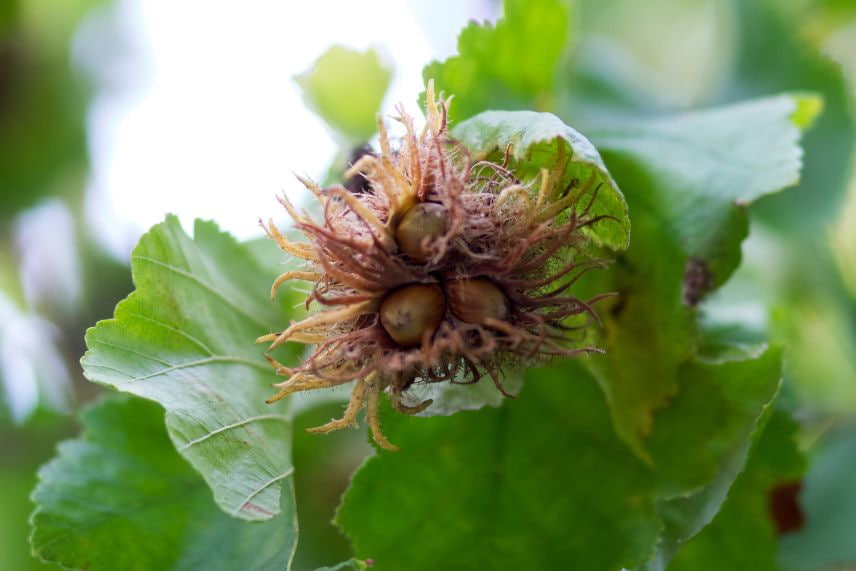
Fruits of Corylus colurna
The Turkish hazel is an easy-care ornamental tree that tolerates drought, wind, pollution, salt and dust. It adapts perfectly to urban environments, in parks and large gardens. Any soil will do, though calcareous and deep soils are preferred.
Read also
6 climbing plants with decorative fruitsRowan (Sorbus aucuparia)
Very common in our countryside, the rowan (Sorbus aucuparia) brings joy to birds, which find plenty to feast on during winter. As a native variety, the rowan forms a small, highly branched tree with an oval or rounded crown, reaching 5 to 15 m in height. Its fruiting takes the form of beautiful coral-red berries, globular and glossy, 8 to 10 mm in diameter. These fruits, known as rowan berries, appear from the end of August and persist throughout the winter. Juicy but predominantly tart, these fruits are eaten only when cooked into jams or in eau-de-vie.
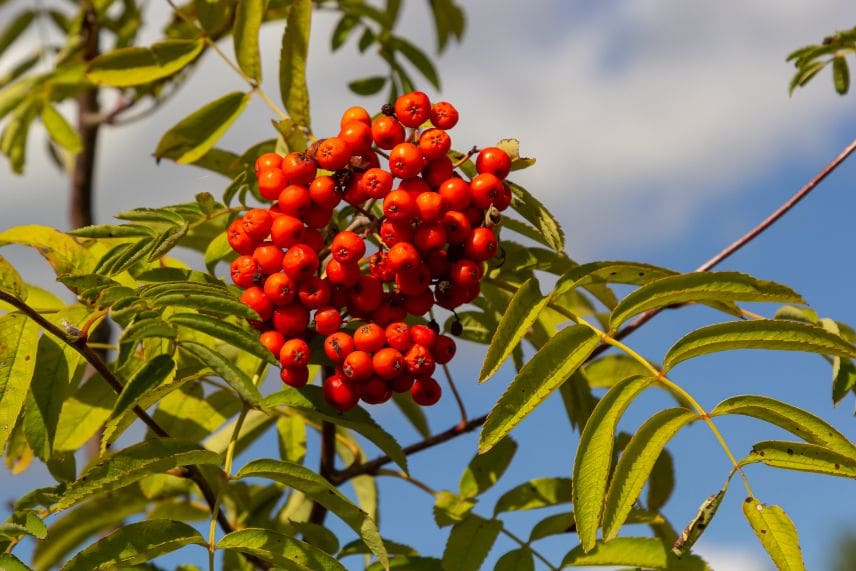
Fruits of the rowan (Sorbus aucuparia)
The rowan also features handsome odd-pinnate foliage, formed of 11 to 15 linear leaflets, which takes on a beautiful yellow-to-red colour in autumn. As for flowering, it occurs in April–May in white, flattened and velvety panicles. Very melliferous, these flowers attract swarms of nectar-seeking insects and pollinators. One more reason to invite the rowan into your garden!
There are several varieties with diverse characteristics, among which ‘Autumn Spire’ stands out for its purple autumn foliage and its orange-yellow berries.
Sorbus aucuparia prefers cool, slightly acidic to neutral soils. It will thrive in sun as well as in partial shade and requires no special care. It is hardy well beyond minus 20°C.
Ornamental apple tree (Malus)
The ornamental crabapple (Malus) offers a wide range of small deciduous trees, most with a rounded, compact habit. In gardens, these woody plants, which can reach 8 m in height and 5–6 m in width, are prized for their beauty at two periods of the year. In spring, in April–May, a profusion of five-petalled flowers, grouped into umbels or cymes, appears on the twigs, just before leafing. This flowering lights up spring with its white, pink or red colours.
Then, in autumn, the colour fireworks continue with the appearance of perfectly round drupes, 0.5–1 cm in diameter. Orange or red, these fruits are highly decorative but can also be used to make jellies.
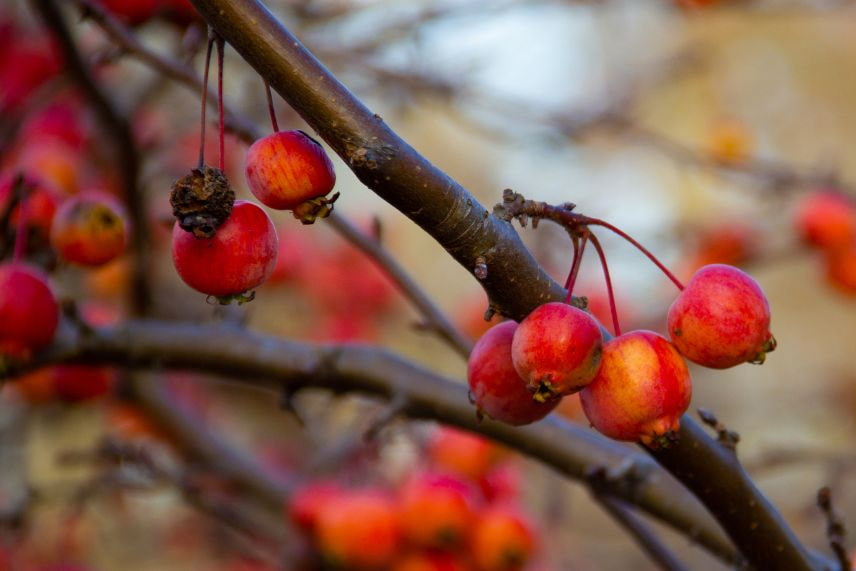
Fruits of Malus
There are many varieties. ‘Coccinela Courtarou’ stands out for its pink-purple flowering and its very generous fruiting in both number and size, with a beautiful red-purple colour.
Malus should be planted in good garden soil, preferably fertile, cool and well-drained. It thrives in sunny locations but not scorching heat, and is especially sheltered from cold winds.
Liquidambar styraciflua, or American sweetgum.
Liquidambar is a deciduous tree, renowned for the sumptuous autumn colours of its leaves, ranging from orange, coppery, golden or scarlet. However, this tree, typically grown to 15–20 m, with alternate, petiolate and palmatilobate leaves, is also notable for its fruiting. Following a discreet spring flowering, male aments and spiny female glomerules, greenish-yellow in colour, appear, giving rise to fruits that take the form of brown, spherical capsules attached to the branches by long peduncles. These fruits persist throughout the winter, until they release small winged seeds. However, you will need to be patient to discover these remarkable fruits, as Liquidambar only bears fruit after 25 years of cultivation!
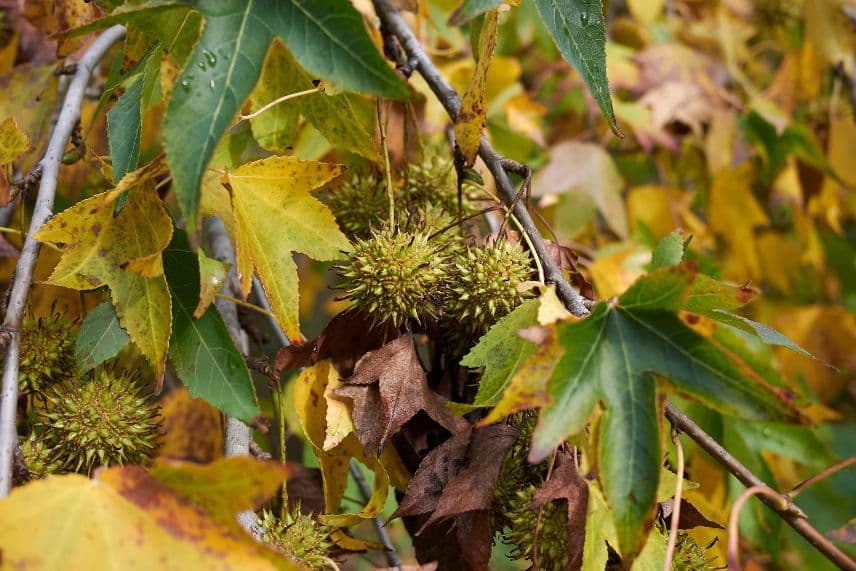
Fruits of Liquidambar
Hardy down to -15 to -20 °C, Liquidambar is grown in heavy, cool, rich, well-drained soil of clay or clay-loam type with a tendency to be acidic. Sunny, well-sheltered sites from cold winds suit it perfectly.
Golden rain tree (Koelreuteria paniculata)
As its name suggests, the Golden rain tree (Koelreuteria paniculata) is native to China and Korea. A French common name -soap tree- that also hints at one of its characteristics: its berries are rich in saponin, and can act as soap thanks to their foaming properties.
Sometimes called the golden rain tree, the Koelreuteria paniculata forms a tree 6 to 8 m tall, with a robust habit, a rounded silhouette and a relatively small, open crown. This deciduous tree, with odd-pinnate, alternate leaves, comprising 7 to 15 leaflets, irregularly crenate, is ornamental in July–August as its golden-yellow flowering is abundant. Upright in terminal panicles, these flowers tower above the foliage. The hotter the summer, the more abundant the flowering! Then, very quickly, the flowers give way to lantern-shaped, capsular fruits about the size of a hazelnut. These trilocular fruits are equipped with a very fine membrane that shifts from pale green to brown in autumn as they reach maturity. These fruits, which can remain on the tree until spring, develop black seeds, as large as small peas.
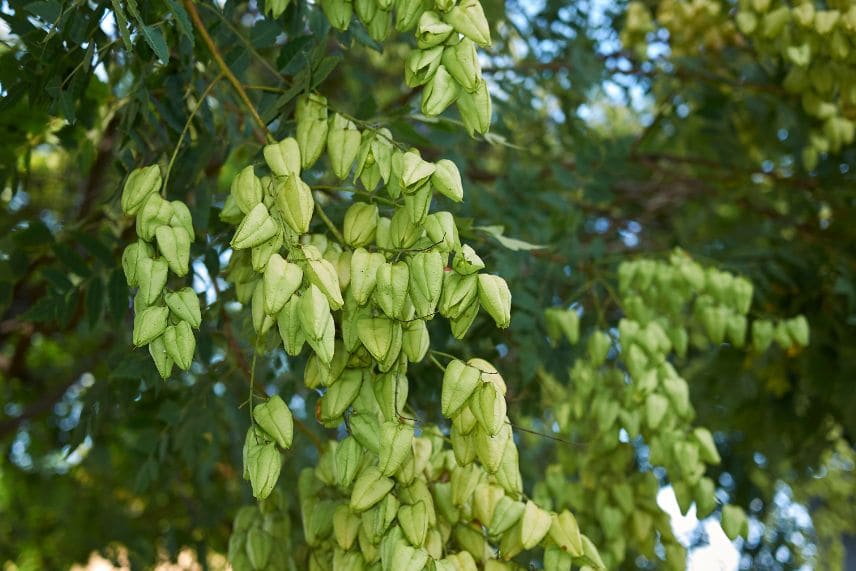
Fruits of Koelreuteria paniculata
Hardy to -20 °C, easy to grow, the Chinese soap-tree thrives in all soil types provided they are light and well-drained. It also prefers warm, sunny positions, and especially shelter from cold winds.
The chinaberry tree (Melia azedarach)
The chinaberry tree (Melia azedarach), also called bead tree or necklace tree, is a small tree that hardly exceeds 9 m in height, with a 4 m spread.
With deciduous foliage, divided into numerous oval, pointed leaflets, which turn from bright green to yellow in autumn, the chinaberry tree also stands out for its unusual fruiting.
After the spring flowering in loose panicles, consisting of small pale lilac tubular flowers, clusters of round fruits appear, initially coloured acid green.
As they develop, these fruits take on a honey-yellow colour.
These fruits stay on the tree for a long time, even after the leaves have fallen, attracting birds that feed on them.
Seeds, resembling grains of brown rice, escape from them.
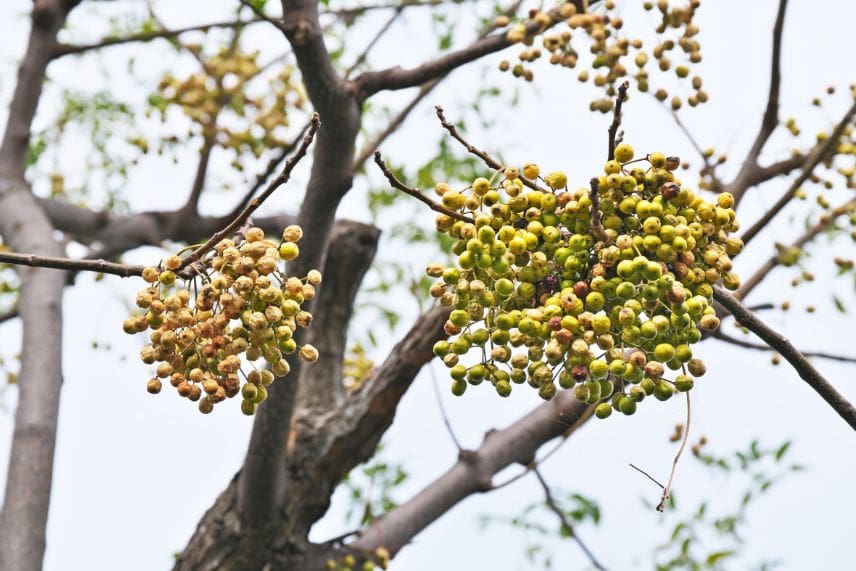
Fruits of Melia azedarach
The chinaberry tree prefers ordinary, well-drained soils that are deep, slightly moist and fairly rich.
It also needs a site sheltered from cold winds, but it can tolerate full sun as well as partial shade or shade.
It is hardy to -12°C.
The Peruvian pepper tree (Schinus molle)
The Peruvian pepper tree (Schinus molle) is a small tree native to the tropical and subtropical regions of South America. That said, it is moderately hardy (to -6°C) and suited to gardens in hot climates where it will easily withstand intense heat and drought. This evergreen tree with a rounded crown and attractive drooping branches has foliage composed of numerous leaflets, linear, lanceolate and odd-pinnate. When crushed, these leaves release a peppery scent.
From June to November, flowers bloom, grouped in elongated panicles, pale yellowish-white in colour. Then, on the female plants, peppercorn-sized fruits appear and colour to beautiful shades ranging from pink to carmine.
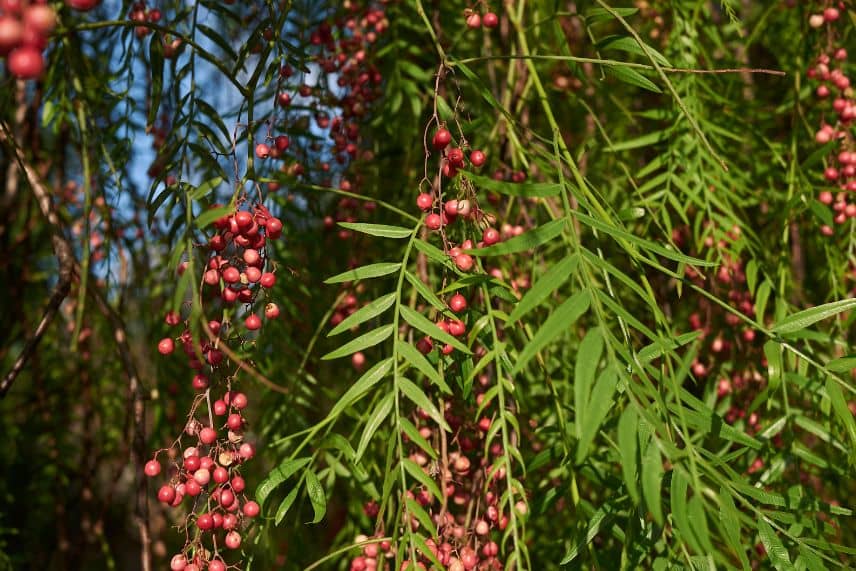
Fruits of Schinus molle
The Peruvian pepper tree needs a sunny location and protection from cold winds. It also requires deep, loose and neutral soil. Fast-growing, it is difficult to cultivate in pots.
Idesia polycarpa
Idesia polycarpa is a deciduous tree, about 15 m tall with a 12 m spread, with a very elegant habit. Its heart-shaped leaves are highly prized for their bright green colour, which takes on lovely yellow hues in autumn. Flowering occurs in pendulous clusters bearing small yellow-green flowers that are very melliferous. The female plants then bear an interesting fruiting: large clusters bearing spherical red-purple berries that hang from the tree for almost the entire winter. These fruits can be eaten raw or cooked. This tree shows good hardiness down to -15°C.
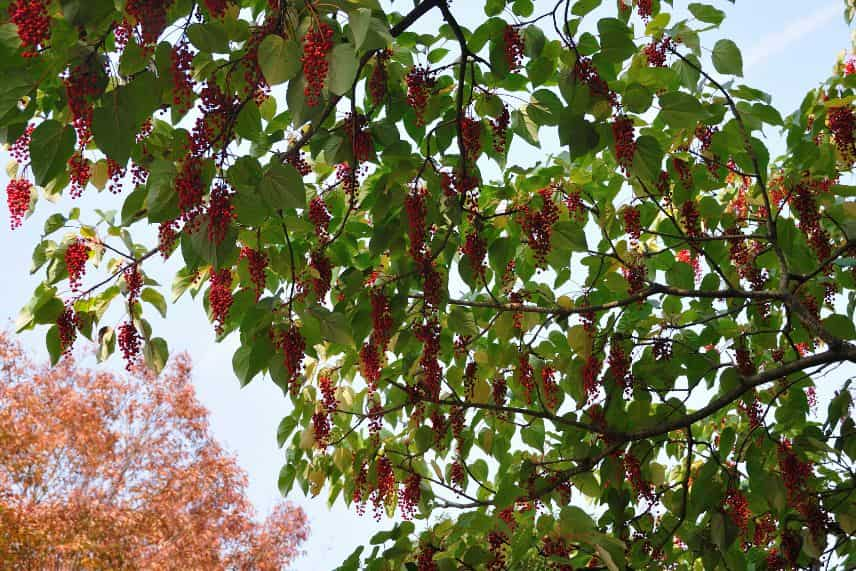
Fruits of Idesia polycarpa
Idesia polycarpa is planted in neutral to slightly acidic, fertile, cool and well-drained soil. It also needs a sunny position sheltered from cold winds to protect its flowers from late frosts.
Paulownia or Empress Tree
Paulownia, also known as the imperial tree, is impressive in every respect. Starting with its height of 10 to 15 m and its spread, both of which require a large garden. Then, on bare shoots, clusters of bell-shaped flowers in a delicate lavender-mauve appear. This fragrant flowering also attracts numerous pollinating insects due to its melliferous properties. The giant foliage appears soon after, dense and lush. In autumn, it turns yellow as the flowers give way to particularly ornamental seed pods. The Paulownia is hardy to -20°C.
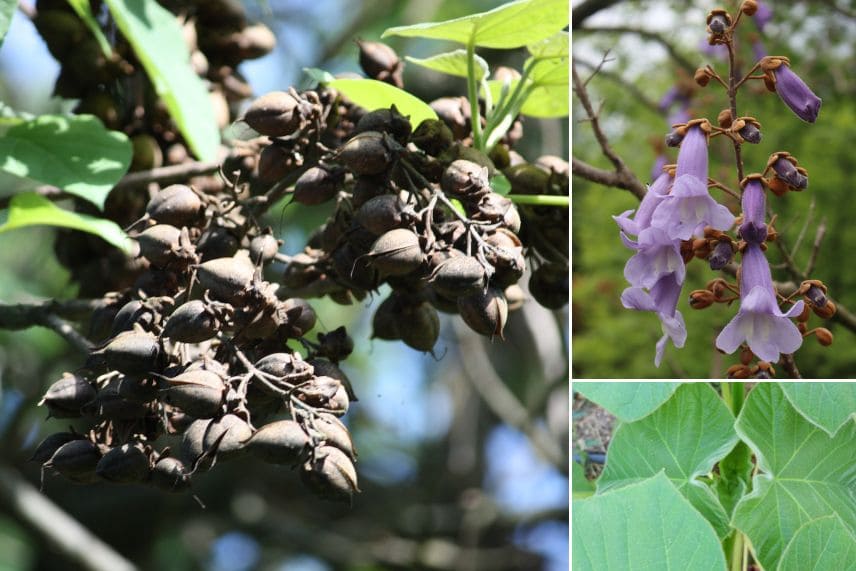
Dry fruits, flowers and Paulownia foliage
The Paulownia requires a deep, well-drained soil, the exact soil type matters little. It also needs a sunny or part-shaded position, and above all well sheltered from winds that can break its branches.
A few more ideas...
- The Arbutus andrachne or Cyprus strawberry-tree with very red berries reminiscent of strawberries
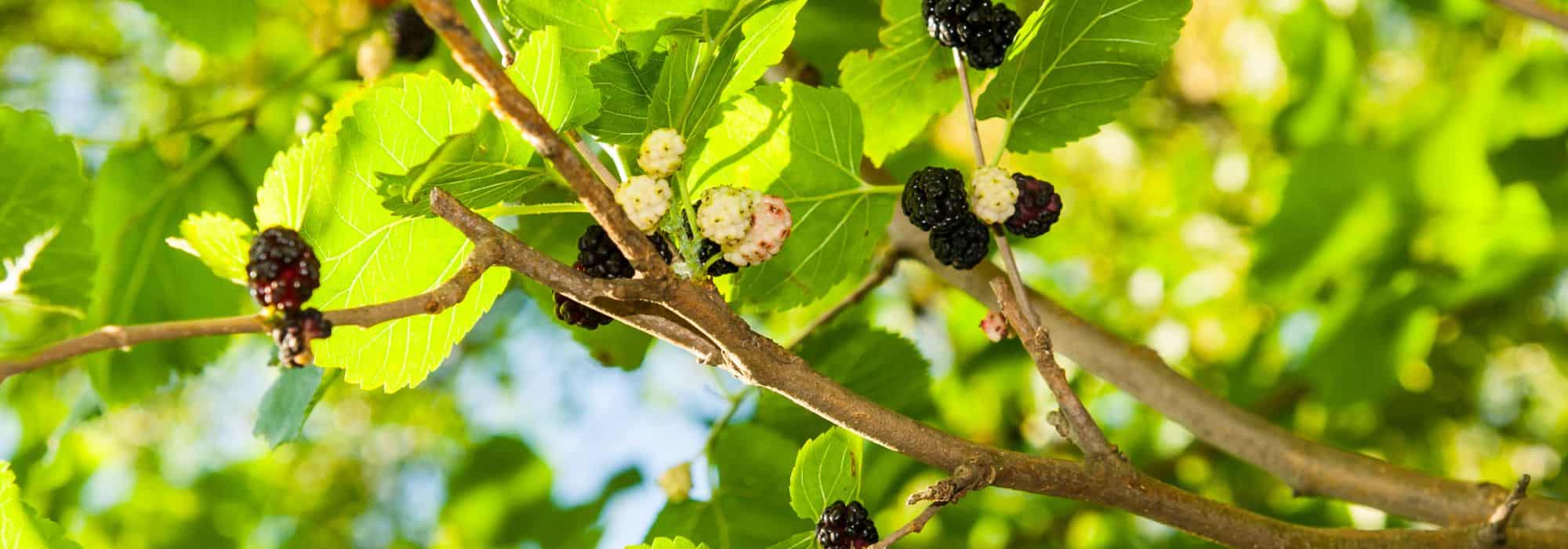
- The white mulberry (Morus alba) with very juicy mulberries
- The Japanese medlar (Eriobotrya japonica) with edible orange fruits
- The magnolia grandiflora with cone-shaped reddish fruits…
- Subscribe!
- Contents
Comments