





























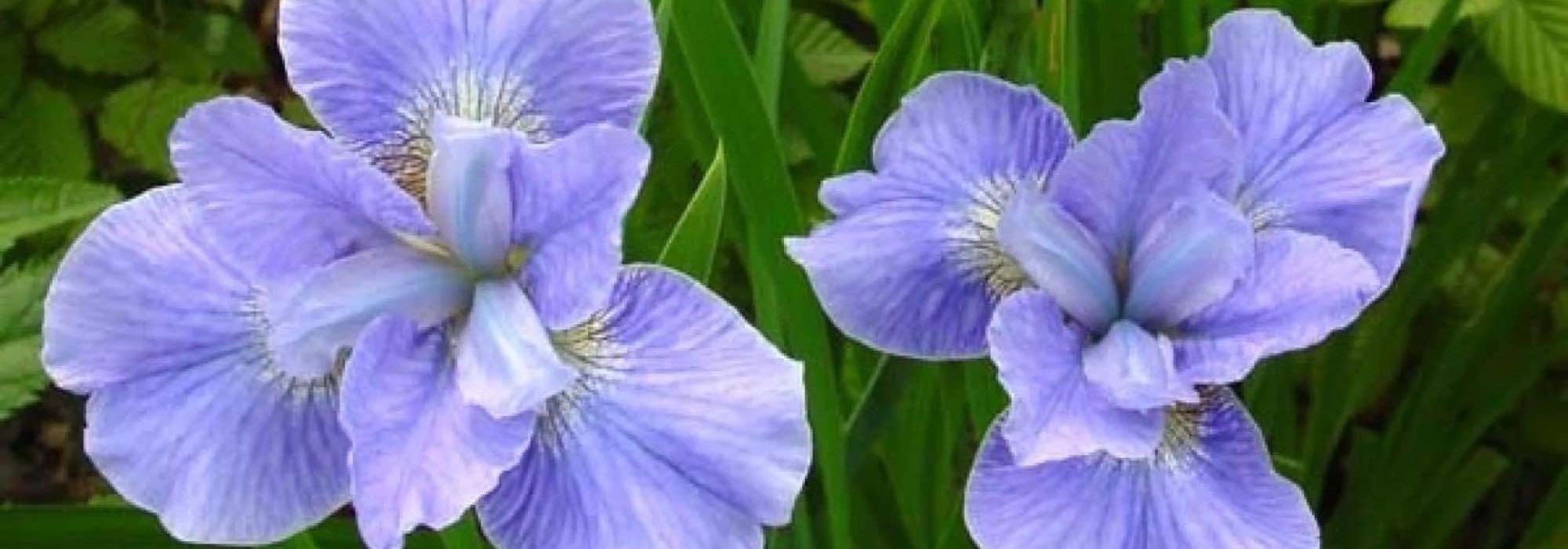
9 superb water irises with blue flowers
Our selection
Contents
Water irises are perfect for enhancing your ponds and wetlands. Among the many varieties, blue irises are captivating, displaying their pastel blue or deep blue flowers, enriching the landscape with their soothing colours. Discover the varieties that thrive in full sun as well as in partial shade, and learn how to integrate them harmoniously into your aquatic landscape for a spectacular effect throughout the season. Here is our selection of the nine best blue-flowered water irises!

Siberian iris - Iris sibirica 'Persimmon'
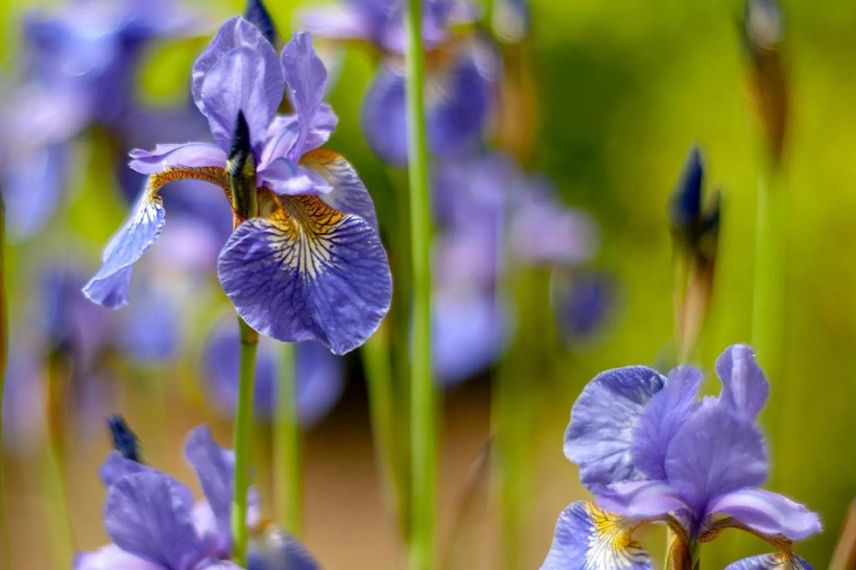
Iris sibirica ‘Persimmon’ features pure blue flowers adorned with dark blue veins and white and yellow markings at the base, from May to June. Siberian irises, with an upright clump-forming habit and narrow foliage, are ideal for damp soils; they are hardy and suited to well-drained soil kept moist in summer. They thrive near water features, provided their roots do not stay submerged in winter, and enhance gardens of various styles, from romantic to contemporary.
This cultivar reaches a height of 80 cm, up to 1 m during flowering, and spreads to around 50 cm. It requires a sunny position for best flowering, but tolerates light shade in hot regions.
In cool, moist conditions, this iris pairs well with other plants such as Monbretia and Camassia.
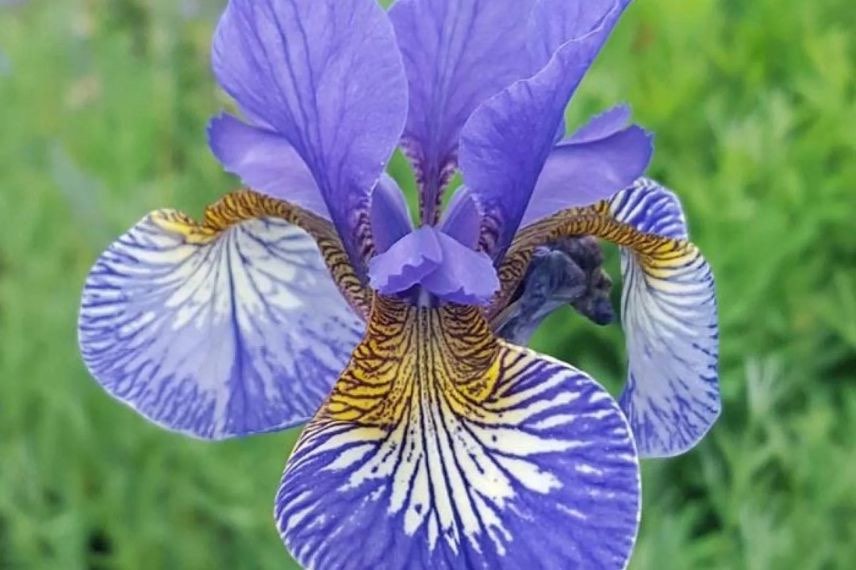
Japanese iris - Iris ensata 'Sugar Dome'
Iris ensata ‘Sugar Dome’ offers large, double flowers of a soft blue-violet, veined with white, blooming in July. Ideal for acidic, damp soils, it does not tolerate calcareous soils. Japanese irises thrive on damp banks and in marshy areas, their fibrous rhizomes spreading best in peat soil.
‘Sugar Dome’ has won several horticultural awards for its robustness and beauty. This variety reaches about 1 m in height when flowering and spreads to 50 cm. It has deciduous, mid-green foliage, with long, slender leaves bearing a central vein. The flowers, 15 cm in diameter, display mid-blue undulating sepals and white petals tinged with yellow, centres illuminated by vivid yellow markings.
Grown in damp conditions in summer, but avoiding winter immersion, Iris ensata are perfect for aquatic gardens and can be paired with plants such as Anemone rivularis and Darmera peltata to create attractive displays on banks or gentle slopes where water collects naturally.
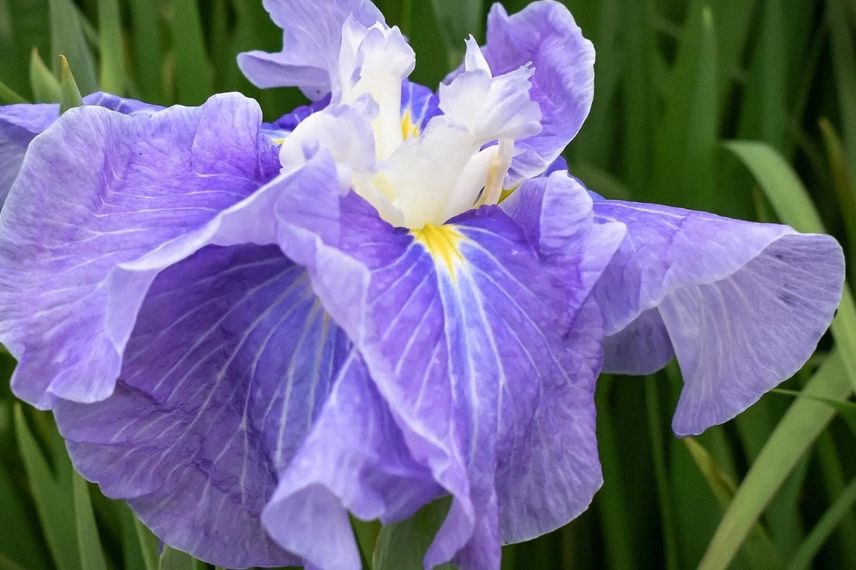
Siberian iris - Iris sibirica 'Blue Moon'
The Iris sibirica ‘Blue Moon’ displays stunning flowers in deep blue, slightly purplish, veined with dark purple with hints of pale yellow at the base of the petals. Flowering in May and June, this cultivar thrives in well-tilled soil and is not particularly demanding in terms of maintenance.
It can reach 80 cm in height, or 1 m during flowering, with the tuft’s spreading up to 50 cm. Its growth is slower than that of Iris germanica. The flowers, which appear in late spring and early summer, are composed of three sepals and three petals.
In practice, the Iris ‘Blue Moon’ is ideal for the edges of water or constantly damp areas, but it also thrives in a traditional garden soil if it is well-drained and kept moist, notably with mulching and regular watering every fortnight in summer. In the garden, this variety excels in settings such as romantic or English gardens. 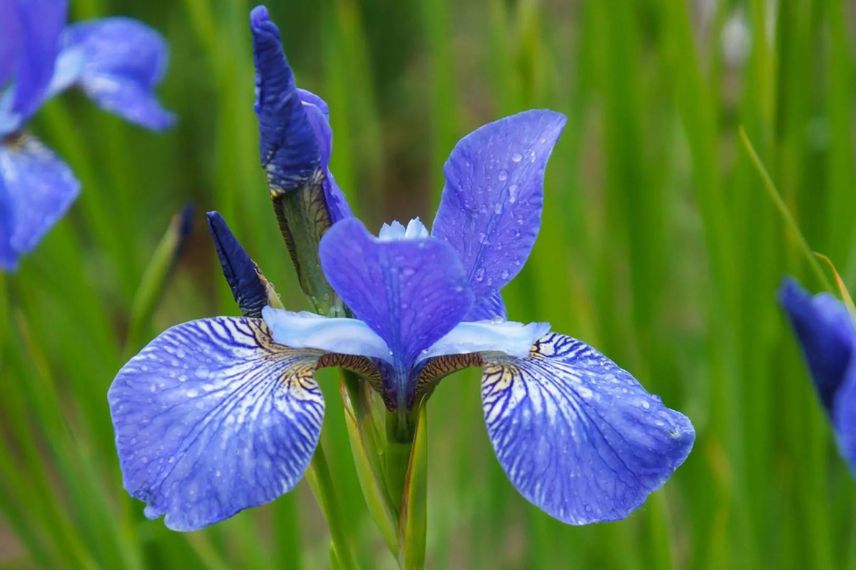
Read also
How to plant and care for water irises?Japanese water iris - Iris laevigata 'Latour-Marliac'
Here is a variety that can keep its feet in the water all year round: the Iris laevigata ‘Latour-Marliac’ is an elegant water iris variety, displaying splendid deep-blue flowers in spring. These flowers have three erect petals topped by three drooping petals, smaller in size than those of Japanese irises but no less spectacular, and are adorned with a yellow central stripe tinged with green.
Easy to grow, the Iris laevigata prospers in full sun on moist soil. Its rootstocks can remain submerged year-round in shallow water, 5–15 cm deep. The Latour-Marliac variety, with its upright foliage reaching 30–40 cm tall, grows well in width over time thanks to its rootstocks.
The flowering of this variety occurs from June to July, with each flowering stem bearing 2–4 flowers measuring 6–8 cm in diameter. For a striking mass effect, plant Iris laevigata ‘Latour-Marliac’ in groups of 3–5 specimens. Ideal for sunny displays, it can be complemented in the foreground with small blue flowers such as brook Veronica or marsh forget-me-not.
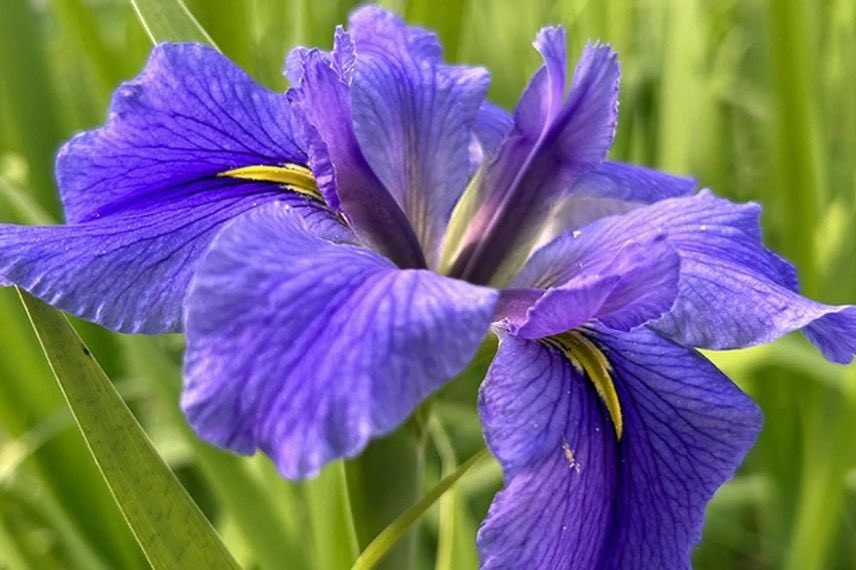
Siberian iris - Iris sibirica 'Blue King'
The Iris sibirica ‘Blue King’ stands out for its large flowers in a vivid royal blue, veined with white at the throat, which bloom in June.
The Iris ‘Blue King’ is an excellent addition to damp gardens, whether naturalistic, English or contemporary in style. It pairs well with other plants suited to damp soils, such as daylilies or Meadow Rue, thereby enriching the displays in mixed borders.

Japanese iris - Iris ensata 'Mme Bigot'
The Iris ensata ‘Mme Bigot’ is a rare variety with large, rounded flowers, delicately veined with dark blue on a background washed with pale blue. Its flowers, which open flat, are highlighted by bright yellow at the base of each petal, and they are ideal for cut flower arrangements.
The cultivar ‘Mme Bigot’ can reach up to 90 cm in height when in bloom, with medium-green foliage forming a bristly, upright base. Its flowering, which takes place from June to August depending on the climate, lasts about three weeks, during which flowering stems bear 2 to 3 large flowers of 12 to 15 cm in diameter.
This cultivar pairs harmoniously with the Physostegia virginiana or with the meadowsweet.
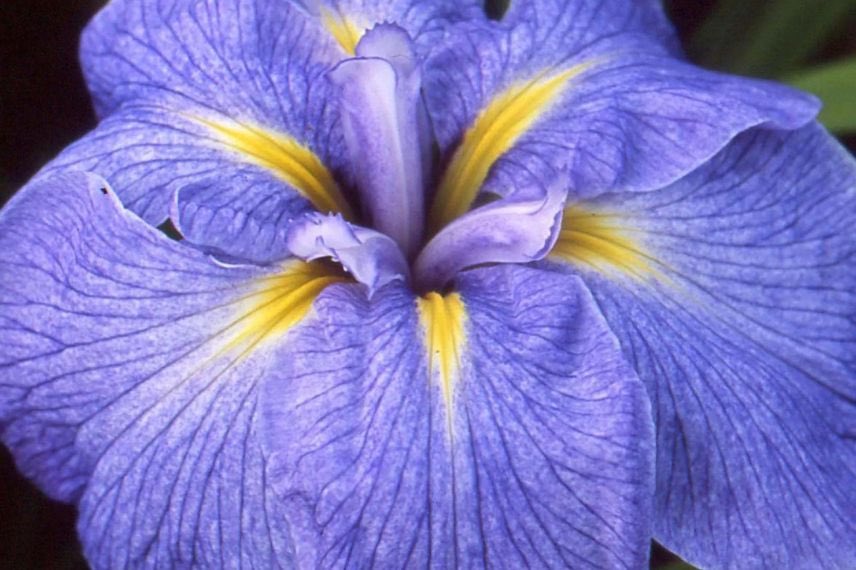
Siberian iris - Iris sibirica 'Dear Delight'
The Iris sibirica ‘Dear Delight’ blooms early in the season with delicate sky-blue flowers adorned with fine navy stripes. Very similar to the Japanese iris in terms of cultivation, it thrives in rich soil, but a partly shaded position helps prolong its flowering. This cultivar flowers from May to June for around three weeks to a month.
Smaller than the Japanese iris, with flowers reaching up to 10 cm in diameter, Iris sibirica ‘Dear Delight’ offers deeper colours and a finer form. The flowering stems rise to about 1 m in height, while the dense foliage reaches 60 cm.
Suitable for cold climates and damp conditions, this iris is ideal for pond margins or borders that stay cool and damp even in summer.
Pair Iris sibirica ‘Dear Delight’ with moisture-loving plants such as hostas or the astrantias.
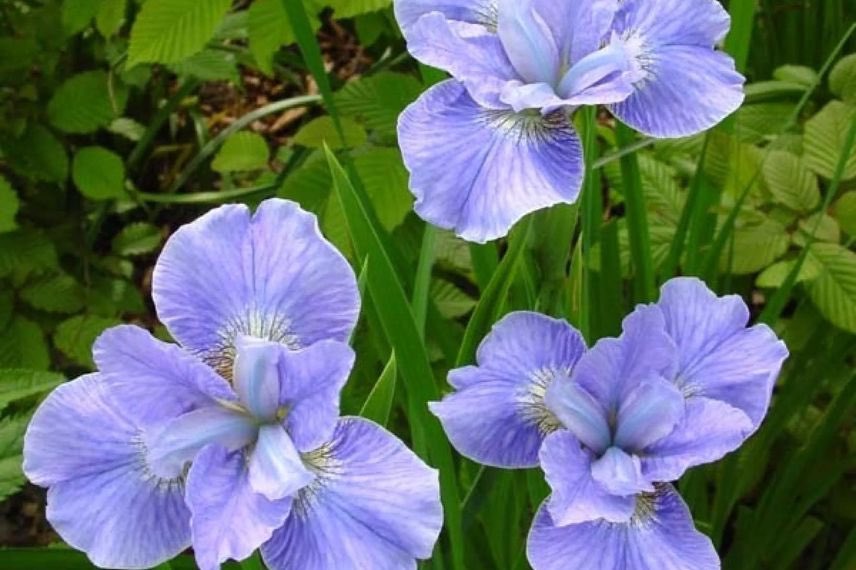
Japanese iris - Iris ensata Dinner Plate 'Ice Cream'
The Iris ensata Dinner Plate ‘Ice Cream’ is an exceptional Japanese water iris variety, with large pastel double flowers, comparable in size to a dessert plate. This mid-season variety blooms in July.
The ‘Ice Cream’ variety, part of the ‘Dinner Plate’ series known for its oversized flowers and its vivid colour palette, reaches about 60 cm in height and 50 cm in width when in full bloom.
The summer flowering of this variety features large flowers, 15 cm in diameter, each flower comprising six flattened, undulate sepals, topped by three smaller petals and three erect styles. The bluish-mauve hues of the petals and sepals, veined with a darker shade and almost white at the edges, are brightened by vivid yellow markings at the centre.
Ideal for the margins of ponds and basins, the Iris ensata ‘Ice Cream’ harmonises perfectly with other Iris ensata in the ‘Dinner Plate’ series, as well as with Astilbes, Lysimachias and Ligularias, for example.
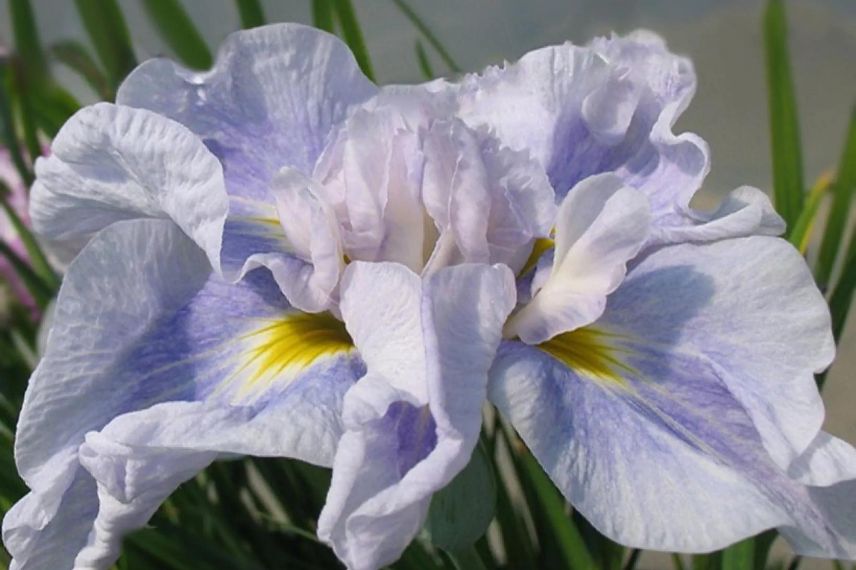
Siberian iris - Iris sibirica 'Fran's gold'
The Iris sibirica ‘Fran’s Gold’ is remarkable for its almost bright yellow foliage that contrasts superbly with the blue-violet flowers that appear in spring.
Discovered by chance in a garden in 2014 and shortlisted for Plant of the Year 2022 at the RHS Chelsea Flower Show, this cultivar forms a dense clump of leaves that remains attractive for many months.
This iris, which reaches about 1 metre in height with a foliage spreading 50–60 cm, grows in upright clumps from spring. The flowering stems bear flowers with three sepals and three petals, opening successively, from early May to early June depending on climate. These flowers are blue-purple in colour with yellow maculations at the throat and purple veins.
For a striking display, plant Iris ‘Fran’s Gold’ in mass near a water feature or in soil that is consistently moist. It pairs well with other moisture-loving plants such as delphiniums and purple loosestrife.
- Subscribe!
- Contents
Comments