





























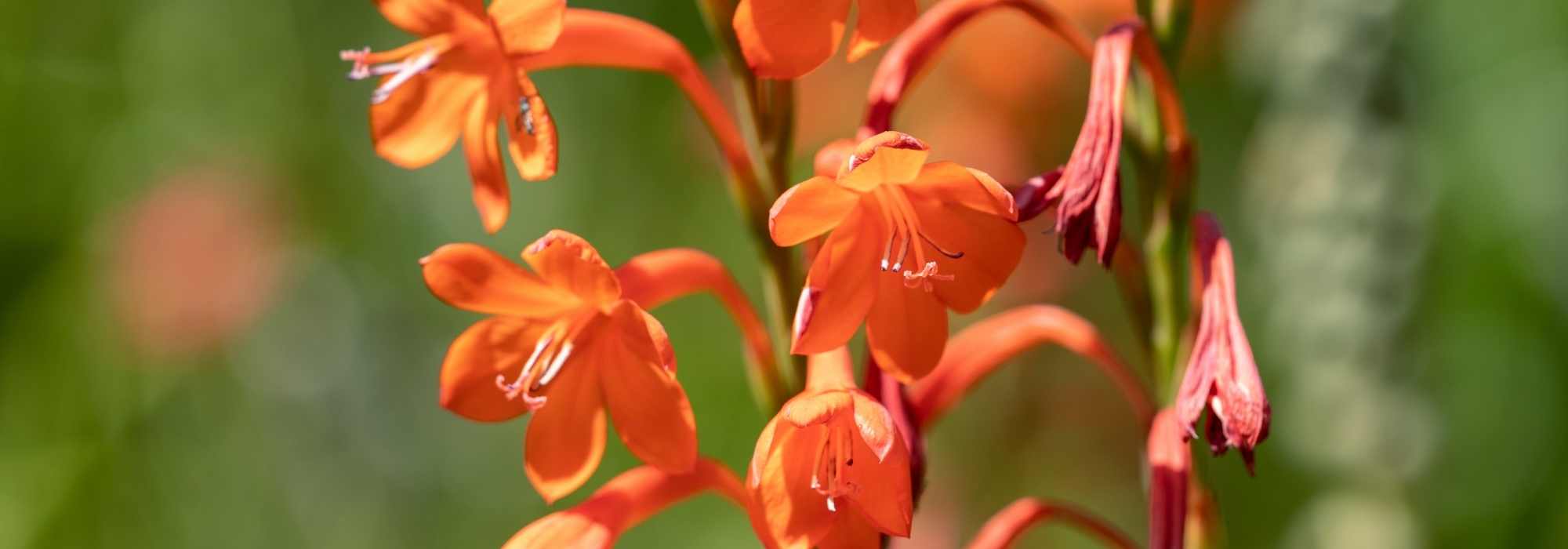
Pairing ideas with Watsonia
5 romantic, graphic or exotic ideas!
Contents
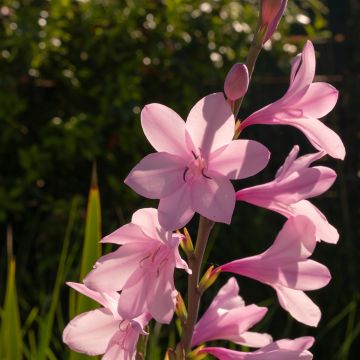
The Watsonia is a perennial bulbous plant that offers trumpet-shaped flowers in pink, white, orange, peach pink, or red, blooming in spring or summer depending on the variety, atop sword-shaped foliage. It bears its original inflorescences up to 1.40 m in height, making it a structurally transparent plant.
Frost-sensitive, it can only be easily grown in open ground in Mediterranean climates or along the Atlantic coast, in pots that need to be brought indoors during winter in less temperate regions. If you wish to plant it in open ground in a less temperate climate, it can be cultivated similarly to gladioli, which are lifted in autumn and replanted the following spring.
Planted in full sun or partial shade, in rich, cool, and lime-free soil, it flowers in borders, slopes, mixed-borders, or even on terraces.
Alongside other summer perennials, it allows for the creation of various atmospheres, whether romantic, natural, graphic, or exotic in the garden or on the terrace.
Discover our 5 ideas for beautiful combinations with Watsonia!
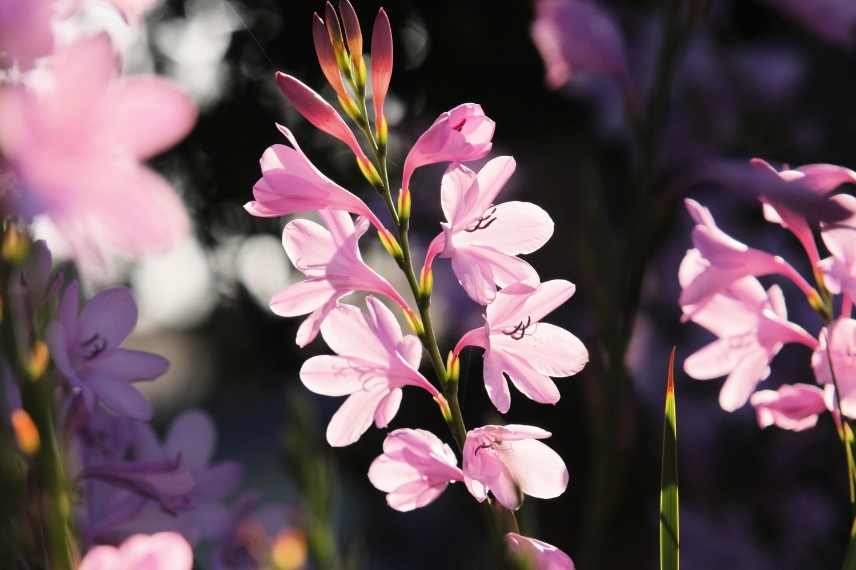 Watsonia: a beauty to discover… and to pair in the garden!

In a border with an exotic flair
With their highly structured flowers and often spicy colours, Watsonias are interesting for creating exotic, lush, and disorienting scenes. They are easy to combine in a vibrant summer border where the soil remains cool. Choose blooms in warm and bright colours: yellow, orange, red. Place a few palms in the background, such as the Chamaerops humilis. You will create a contemporary association by pairing Watsonia meriana with Kniphofia ‘Tawny King’, for example, with its upright spikes in a gradient of orange, very stylish. The tritomas complement these light-flowering perennials well.
Integrate the graphic silhouette of a New Zealand Flax, Phormium ‘Pink Panther’, which forms a clump of linear pink leaves edged with bronze, brown, and ruby red. A Libertia ixioides ‘Taupo Sunset®’, a beautiful perennial with grass-like foliage variegated in bronze green, yellow, and orange, will also enhance this exotic tableau. Plant alongside some Crocosmias (‘Emily McKenzie’) in the same tones, clumps of Alstroemeria, and Gladiolus with their dazzling flowers. A Cactus Dahlia ‘Ludwig Helfert’ with double orange flowers will bloom at the same time. In an exotic setting in a Mediterranean climate, consider the Strelitzia reginae, Leucospermum ‘Copper Carnival’, and Cannas with their stunning inflorescences.
Finally, to temper the heat of these powerful spicy accents, opt for some soft-stemmed grasses like Stipas pennata and calamagrostis. They will help balance and nuance this fiery tableau by adding structure and infinite lightness. You will achieve a magnificent summer scene.
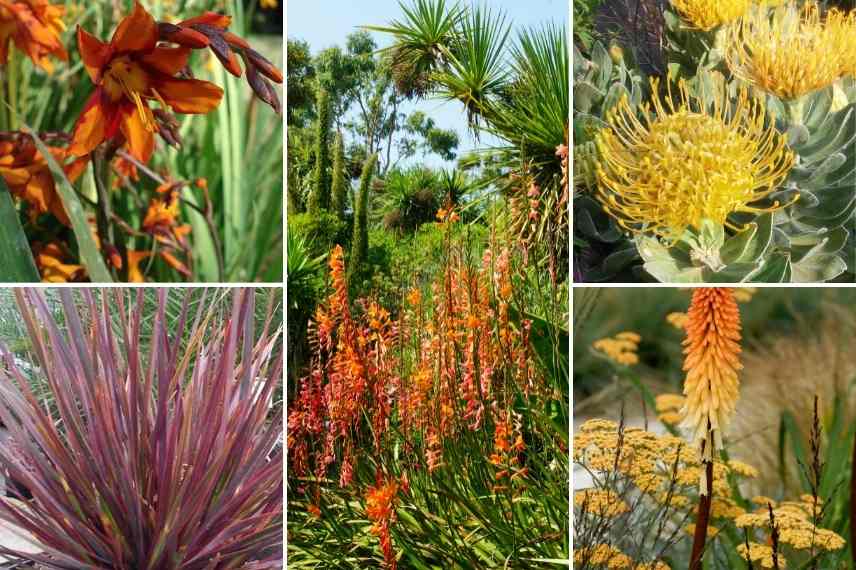
Watsonias at the centre, associated in an exotic border with Crocosmias, a Leucospermum ‘Copper Carnival’, Libertias ixioides, tritomas, and Stipas pennata
Read also
Watsonia: planting, careIn a chic and romantic mixed border
In a romantic garden, you can choose Watsonias with softer blooms in shades of white, pink, or peach, such as the very delicate Watsonia pyramidata ‘Peach Glow’, whose flowers display a particularly bright peach pink. This type of variety allows for the creation of an elegant display. Plant them in the background. For a backdrop, consider an Acanthus with its ample, cut foliage. In this iconic English garden bed, perennials and annuals coexist effortlessly and bloom profusely. The flowering of Watsonias occurs just after that of daffodils and will accompany those of Asian lilies like ‘Broken Heart’, so be sure to include these lovely bulbous plants.
You will achieve extreme refinement by combining everything with the white blooms of gaura, Penstemon digitalis ‘Husker Red’, daylilies, and Alstroemeria ‘Inca Ice’ or agapanthus, beautiful plants that thrive in similar growing conditions.
Complete with simple-flowered perennials like columbines, centaureas, astrances, and Dierama pulcherrimum, or “Angel’s Fishing Rod,” with its graceful spikes of pink bell-shaped flowers. Add delicacy with paniculate gypsophila. At the edge, a very elegant clump of Libertia formosa, a true white cloud in early summer, should beautifully enhance this tender, floral environment.
To soften the slightly rigid habit of the Watsonias, we also recommend pairing them with pennisetum, a soft and airy grass.
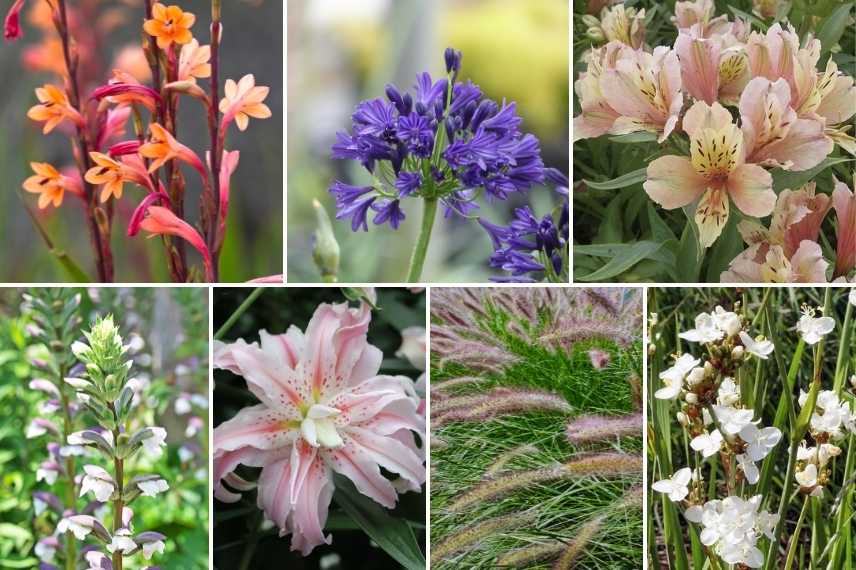
Watsonia, Agapanthus ‘Royal Purple’, Alstroemeria ‘Inca Ice’, Acanthus mollis, Asian lily ‘Broken Heart’, Pennisetum alopecuroides, and Libertia formosa
Discover other Watsonia
View all →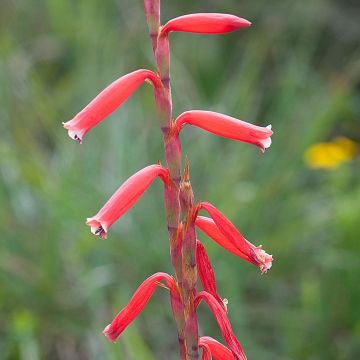
Available in 1 sizes
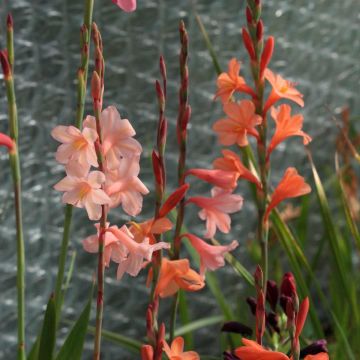
Available in 1 sizes
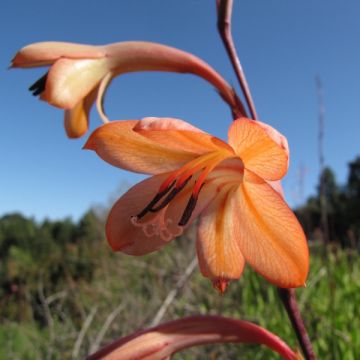
Available in 2 sizes
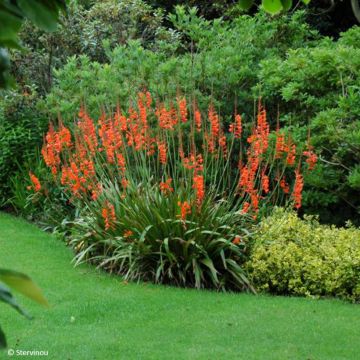
Available in 1 sizes
Available in 1 sizes
In a sunny rockery
Watsonias thrive in full sun in a substrate that remains cool during their growing season in summer. With their tall, graphic spike-like inflorescences, they are perfect for adding character to a minimalist rockery where the soil does not dry out too much. Plant a Watsonia aletroides with watermelon-red flowers. Low-growing or creeping perennials in warm colours will complement the small clumps of 60 cm in height that it forms. Choose from Helianthemums in matching colours, and dwarf gladioli (Nanus/papillons).
Opt for alpine and succulent plants to create a carpet of colourful and original foliage at their feet: houseleeks, Echeveria ‘Devotion’, creeping sedums, and Eucomis vandermerwei with its quirky pineapple-shaped flowers, tinged with chocolate purple.
The Festuca glauca ‘Elijah Blue’, which forms lovely, very blue clumps, will also be a good companion.
You can surround your plants with white gravel or pumice.
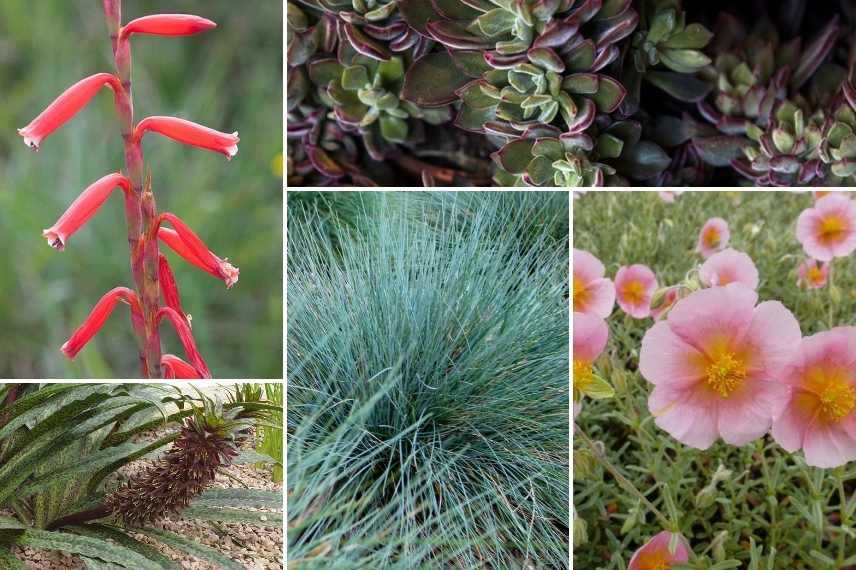
Watsonia aletroides, Echeveria ‘Devotion’, Eucomis vandermervei, Festuca glauca, and Heliantemum ‘Rhodanthe Carneum’
→ Discover our guides to create a rockery and choose plants suitable for a sunny rockery.
On a a slope in a Mediterranean garden
Frigid, Watsonia naturally finds its place in Mediterranean-style gardens. It thrives in warm, sunny environments and pairs beautifully with other large, colourful and/or exuberant flowers. Plant it in full sun, on a slope that is not too dry, as Watsonia requires water during its flowering period. If space allows, consider opulent Aloes, such as Aloe arborescens, which will set the scene with their spectacular appearance and graphic form. A beautiful Agave americana providing an equally graphic presence and some cordylines chosen in purple tones will add rhythm and complete the picture.
In terms of flowering, you can create stunning combinations with the fiery colours of Crocosmias, Kniphofia uvaria, and the softer hues of Agapanthus. Easily compose a very colourful scene in summer by also pairing it with Hesperaloe parviflora with its bright coral-red flowers. Add a touch of wildness with some clumps of Muhlenbergia rigens, a perennial and evergreen grass, and temper these strong hues with the grey foliage of Artemisia ‘Powis Castle’.
→ Discover our tips for creating a Mediterranean garden, and our range of Mediterranean perennials.
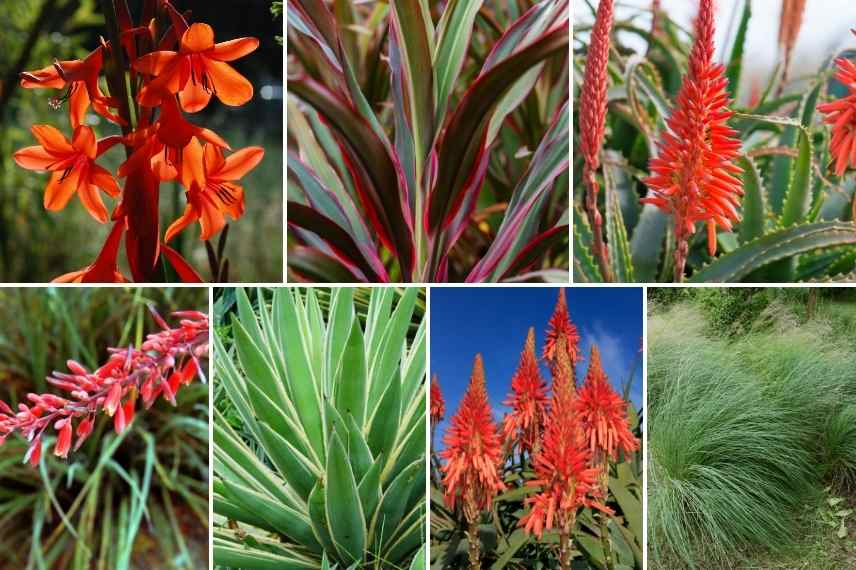
Watsonia, cordyline, Aloe arborescens, Hesperaloe parviflora, Agave americana, Muhlenbergia rigens
In a contrasting warm/cool wedding
Dare to create contrasting combinations and surprising idylls! The orange-toned flowers of Watsonias pair beautifully with blue, their complementary colour. A few touches of orange are enough to add depth and warm up a composition with cool hues. Plant alongside Agapanthus ‘Graphite® Blue’, Salvia patens with gentian blue flowers and the Amsonia ‘Blue Ice’, a perennial with bright glacier blue flowers, easy to grow in the sun in soil that does not dry out in summer.
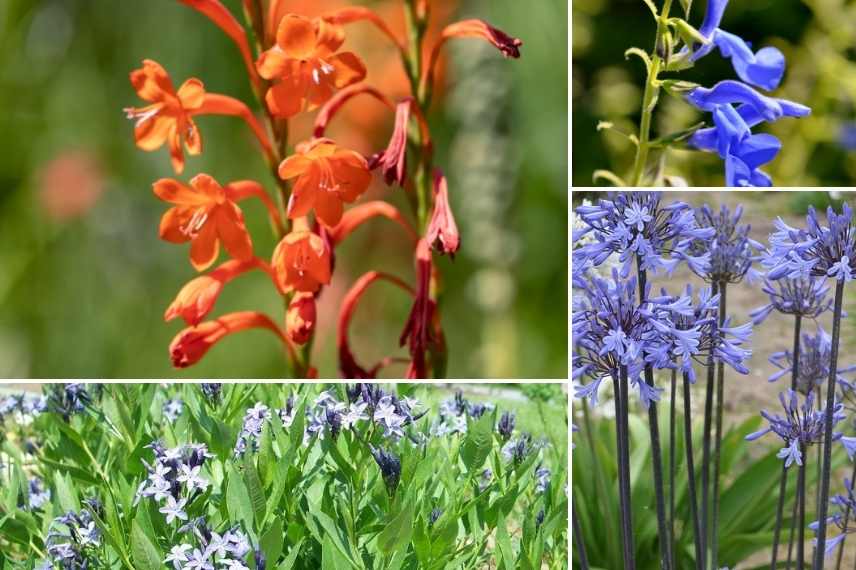
Orange Watsonia, Salvia patens, Amsonia ‘Blue Ice’ and Agapanthus ‘Graphite® Blue‘
- Subscribe!
- Contents
![[watsonia_tips title="Watsonia: Ideas and Tips"]](https://en.promessedefleurs.eu/blogwp/wp-content/uploads/2022/07/Associer-le-watsonia.jpg "Associate the {glossary}Watsonia{/glossary}")
Comments