





























Pairing ideas with Tigridia or peacock eye
6 successful pairing ideas
Contents
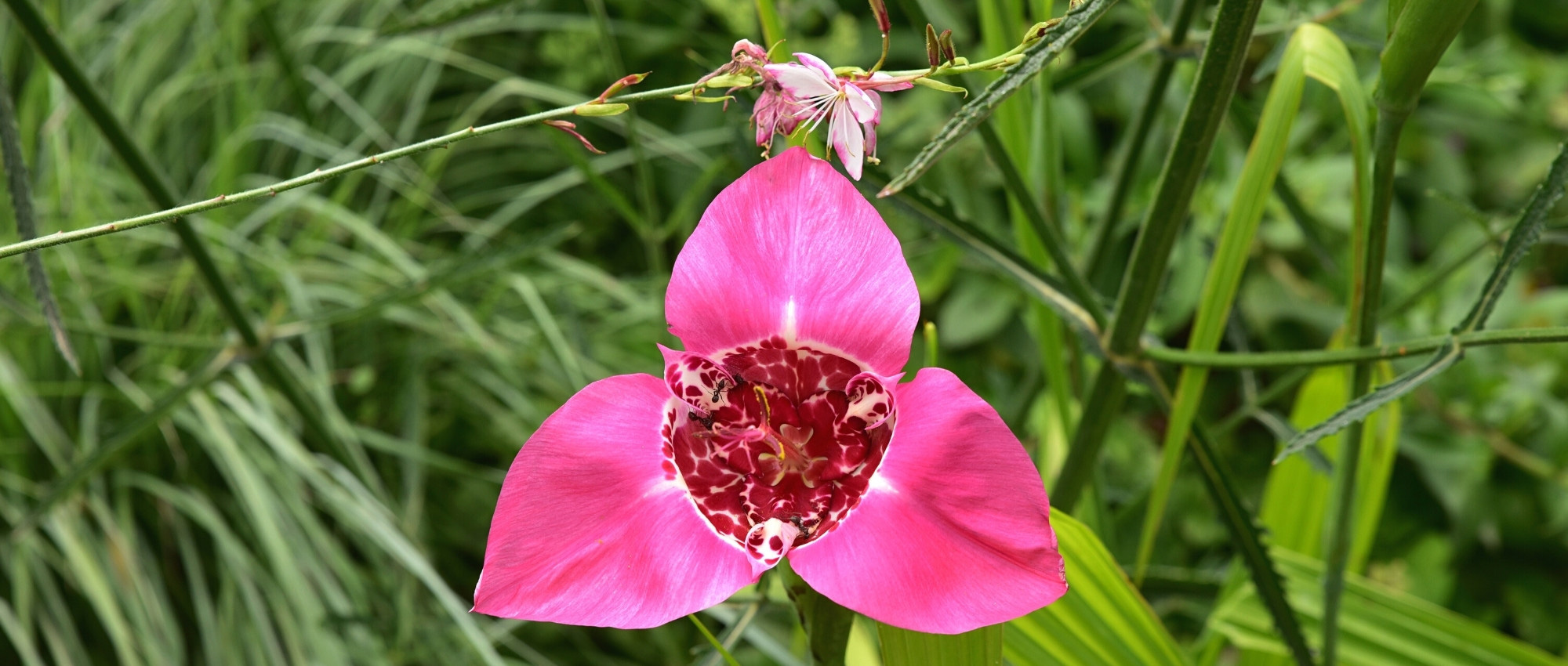
Tigridia, like Trigidia Pavonia, is a stunning perennial still very little known, native to Central America, and which offers beautiful triangular flowers in summer, with vibrant shades: red, yellow, orange, pink, white… enhanced by beautiful dark red or purple macules at the centre of the flower. Intense and contrasting, Tigridia flowers never go unnoticed! They are not very hardy plants (down to -5 °C), but they can be grown in pots to be brought indoors in winter, in regions where the climate does not allow their cultivation in open ground. Tigridias are perfect for creating an exotic and warm atmosphere, but they also adapt well in more classic borders, alongside perennials with colourful flowerings.
Discover in this guide our best ideas for pairing Tigridia and creating harmonious borders!

In an exotic and lush garden
With its original flowering and warm hues, Tigridia integrates very easily into an exotic-style garden. To accompany it, opt for the flowers of kniphofias, crocosmias, cannas, daylilies… Discover also the spotted iris, Belamcanda chinensis, which bears star-shaped orange flowers speckled with red in summer. Incorporate plants that stand out with their giant leaves, such as Gunnera, Tetrapanax, palms, bananas, hostas, fatsias… This will create a truly lush setting. Discover the Schefflera taiwaniana, which has superb foliage divided into fine elongated leaflets, and has the advantage of being hardy down to -12 °C. You can also install some climbing plants, such as akebias, passionflowers, clematis or bignonia.
Explore our sheet “Exotic garden: all our tips for designing it” and our inspiration page “Exotic atmosphere”
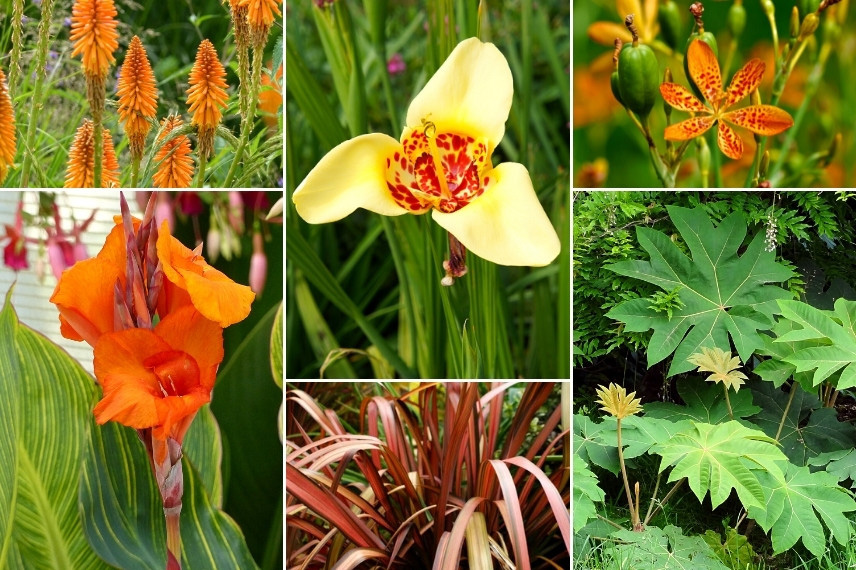
Kniphofia ‘Fiery Fred’, Tigridia pavonia ‘Canariensis’, Belamcanda chinensis, Canna striata, Phormium ‘Pink Panther’ and Tetrapanax papyrifera ‘Rex’
Read also
Tigridia: planting, growing and careIn a colourful mixed border
Tigridia will integrate seamlessly into a more traditional flowerbed: you can enjoy its bright and colourful flowering to create a mixed border with vivid and warm tones. For example, choose the yellow-flowered Tigridia, Tigridia pavonia ‘Aurea’, or the red-flowered variety, Tigridia pavonia ‘Speciosa’. Plant it alongside echinaceas (for instance, the beautiful variety ‘Big Kahuna’, with orange flowers), gaillardes, agastaches, achillées, gauras, and penstemons. Also consider dahlias: their flowers come in a very rich palette of colours, often bright, sometimes very intense. We recommend dahlia ‘Arabian Night’, with large double flowers in burgundy red. Don’t hesitate to incorporate some grasses as well: they will add structure and lightness to the flowerbed. You might choose, in particular, Chinese fountain grasses, stipas, or the stunning Calamagrostis ‘Karl Foerster’, which can reach up to 1.6 m in height.
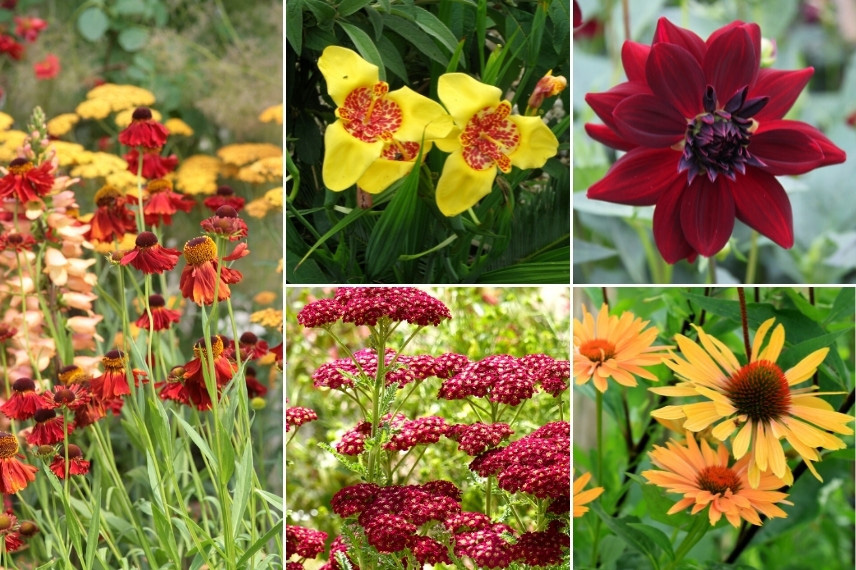
Scene with Helenium ‘Morheim Beauty’, Digiplexis illumination ‘Chelsea Gold’, and Achillea ‘Terracotta’, Tigridia pavonia ‘Aurea’ (photo peganum), Dahlia ‘Arabian Night’, Achillea millefolium ‘Red Velvet’, and Echinacea ‘Big Kahuna’
Discover other Tigridia
View all →
Available in 1 sizes
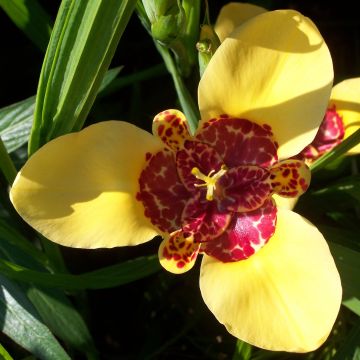
Available in 1 sizes
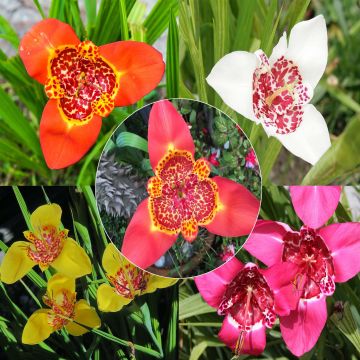
Available in 1 sizes
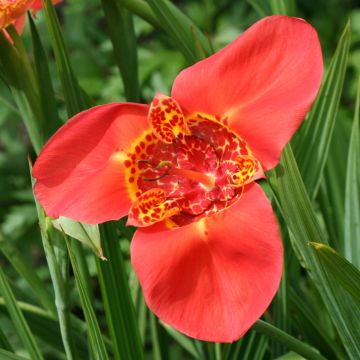
Available in 1 sizes
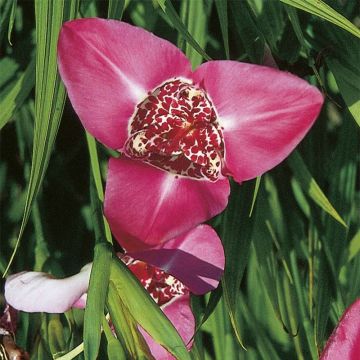
Available in 1 sizes
In a pot on the terrace or balcony
Tigridia is a rather tender plant, and its planting in open ground should be reserved for regions with a very mild climate, such as the Mediterranean coast, where the risk of frost is low. In other regions, it is better to grow it in a pot, which allows for easy sheltering during winter. You can create a beautiful exotic decor on your terrace or balcony with Tigridia, for example by pairing it with phormiums, agapanthuses, and oleanders. Also consider palms like the Chamaerops humilis ‘Vulcano’, which has a compact and bushy habit, making it well-suited for pot cultivation. Discover also Senecio mandraliscae, a beautiful succulent plant with bluish foliage and a very exotic style, which should be sheltered during winter. For flowering, consider Delospermas and Osteospermums, which offer often very colourful daisy-like flowers.
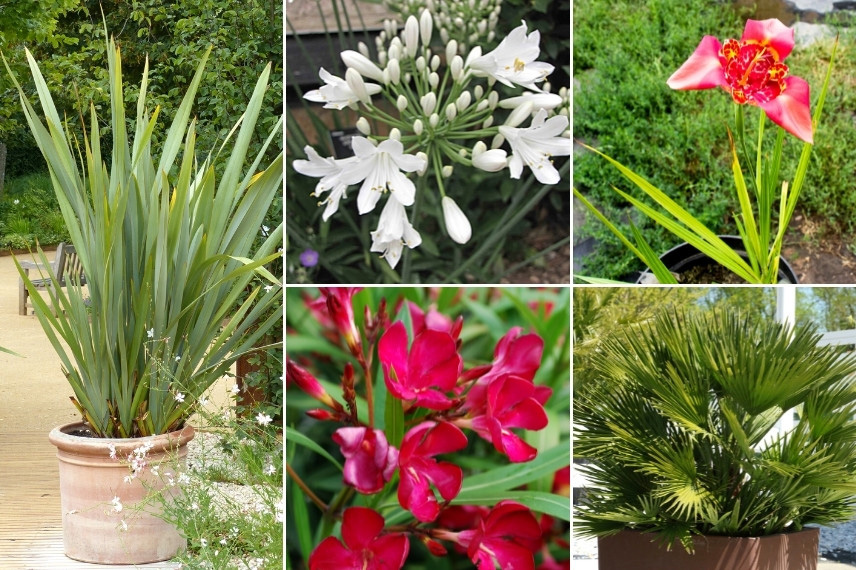
Phormium tenax, Agapanthus africanus ‘Albus’, Tigridia pavonia, Nerium oleander, and Chamaerops humilis ‘Vulcano’
Read also
7 rare and unique bulbsIn a sunny rockery
Tigridia requires well-drained soil and thrives in stony or sandy terrains. To showcase it, feel free to incorporate it into a raised rockery, where moisture won’t stagnate, in full sun, alongside small perennial rockery plants. Consider sedums and houseleeks, as well as helianthemums, Lychnis coronaria, and eryngiums. Also enjoy the lovely pompom flowers in white, pink, or red from carnations, for example with Dianthus ‘Whatfield Gem’. You can also include wall campanula, Campanula portenschlagiana, along with lavenders, red valerian, and Erigeron karvinskianus.
Feel free to check our guide “Creating a Rockery: Our Tips for Success” and our selection of 15 Plants for a Sunny Rockery.
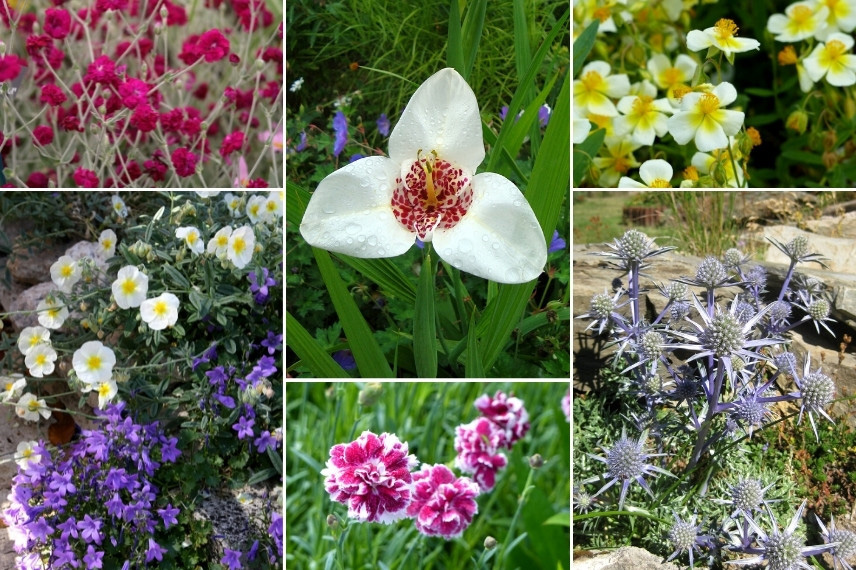
Lychnis coronaria ‘Gardener’s World’, Tigridia pavonia ‘Alba Grandiflora’ (photo Uleli), Helianthemum ‘Elfenbeinglanz’, Campanula portenschlagiana and Helianthemum ‘The Bride’ (photo Virginie Douce), Dianthus gratianopolitanus ‘Whatfield Gem’ and Eryngium bourgatii (photo Carmona Rodriguez)
With summer-flowering bulbs
Rare and original perennial, Tigridia deserves to be planted in the garden alongside other exceptional flowers. Pair it with lesser-known bulbous plants that offer impressive blooms, such as the Cardiocrinum giganteum, also known as the Giant Himalayan Lily. This plant produces floral spikes in summer that can reach up to 2 m tall, adorned with 10 to 20 large trumpet-shaped white flowers, maculate with purple. A spectacular flowering! You can plant alongside it Crinum powellii, with white or pink flowers, and the stunning Galtonia ‘Moonbeam’. Also enjoy the surprising flowering, in large bright red pom-poms, of the Scadoxus multiflorus subsp multiflorus. You can also opt for the large flowers of Giant Lily ‘Honeymoon’, Zantedeschia aethiopica ‘Himalaya’, and Amaryllis sonatini ‘Balentino’, which has the advantage of being relatively hardy.
Discover our entire range of summer bulbs and exceptional flowering bulbs.
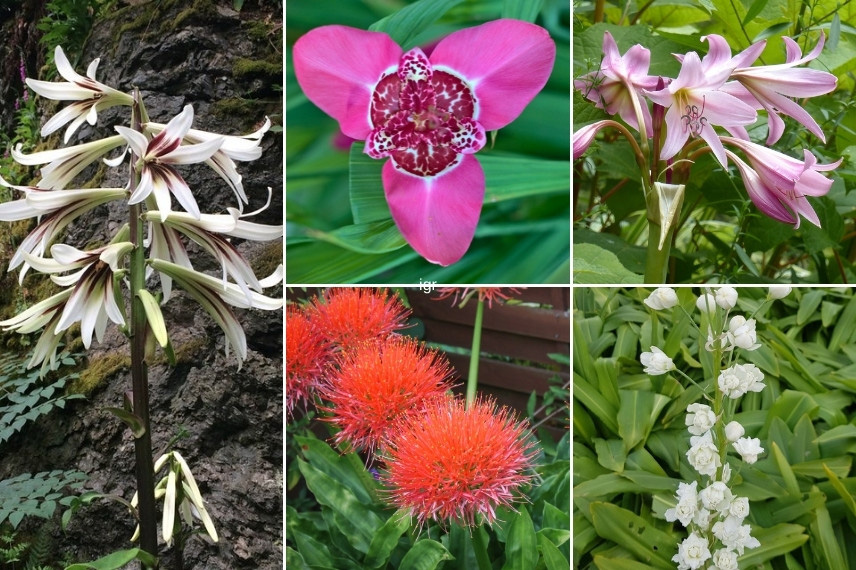
Cardiocrinum giganteum (photo Richard Hoare), Tigridia pavonia ‘Lilacea’ (photo M0tty), Crinum powellii, Scadoxus multiflorus (photo Maja Dumat) and Galtonia ‘Moonbeam’
In a dry garden with warm tones
With its warm hues and preference for full sun, heat, and perfectly drained soils, Tigridia can be included in the display of a dry exotic garden, in shades of yellow, orange, red, and purple… To complement its flowering, consider the stunning flowers of Sparaxis tricolor, as well as Osteospermums (for example, ‘Cape Daisy Terracotta’), crocosmias, kniphofias, Watsonia meriana, and Anigozanthos flavidus. Also favour plants with fine, pointed leaves (plants from arid environments have very reduced foliar laminae), such as Yucca rostrata, Dasylirion, agaves, and opuntias.
Discover our inspiration page “Australian Exoticism”
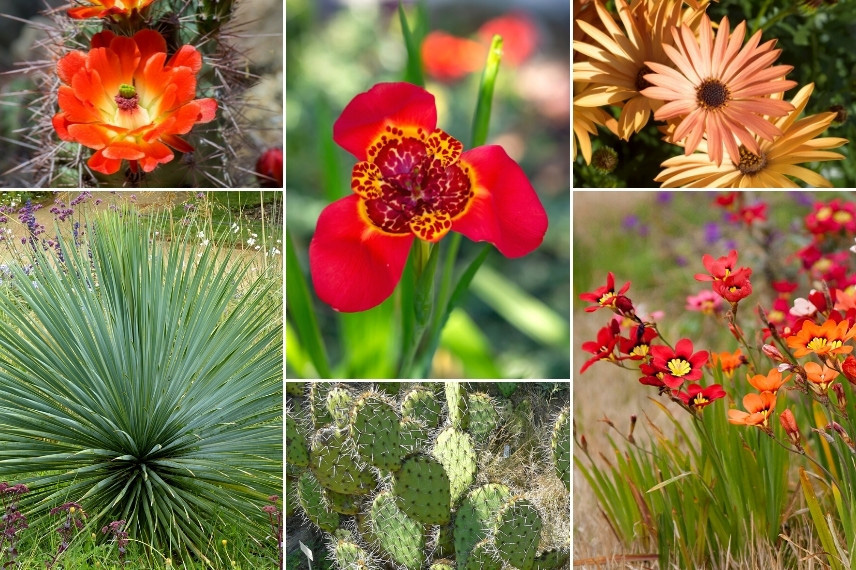
Opuntia engelmannii var. Lindheimeri, Tigridia pavonia, Osteospermum ‘Cape Daisy Terracotta’, Yucca rostrata, Opuntia phaeacantha (photo Stan Shebs) and Sparaxis tricolor (photo Richard Shiell – GWI – Biosphoto)
- Subscribe!
- Contents
 Garden Mix](https://en.promessedefleurs.eu/blogwp/wp-content/uploads/2022/06/Associer-le-Tigridia-ou-oeil-de-paon.jpg "Associate the Tigridia or peacock's eye.")
Comments