





























Bi-coloured Agapanthus: 5 must-have varieties
Agapanthus are often blue or white, and can also come in two colours at once
Contents
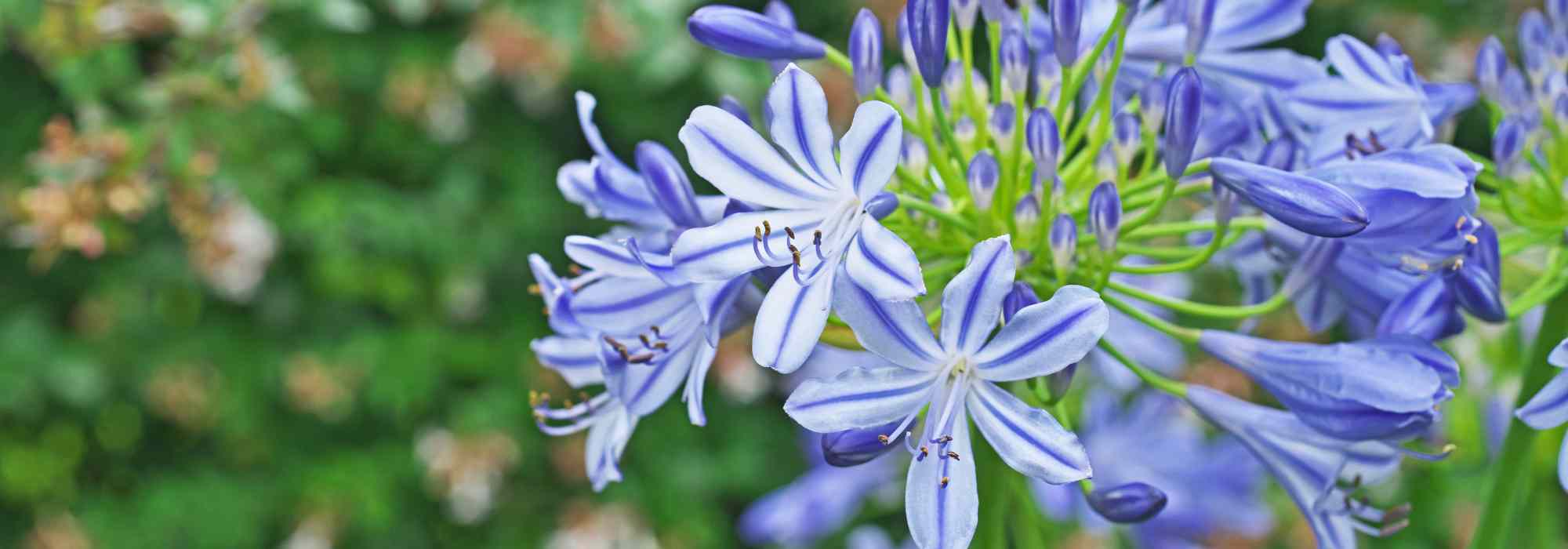
Once neglected, then favourites of landscape designers, agapanthus have earned their place in the borders and flower beds of amateur gardeners. It has to be said that they are not short of charm, with their broad, fleshy strap-like leaves from which tall stems bearing rounded umbels rise at their tips. These inflorescences come in a wide range of blues, purples and whites. Once confined to Brittany by their relative hardiness, agapanthus now grow everywhere thanks to the development of certain hybrids considerably hardier, such as ‘Headbourne Blue’, ‘Navy Blue’ or ‘Graphite White’. Wherever you live and garden, you can therefore treat yourself to a wide range of agapanthus with blue or white flowers.
For those who seek a little more originality and character, some agapanthus go as far as offering bi-colour flowering. Agapanthus for those who can’t decide between white or blue! Discover our selection of seven varieties of agapanthus that play on two fronts by combining two different shades.
For more information: Agapanthus: planting, growing and care.

Agapanthus ‘Twister’
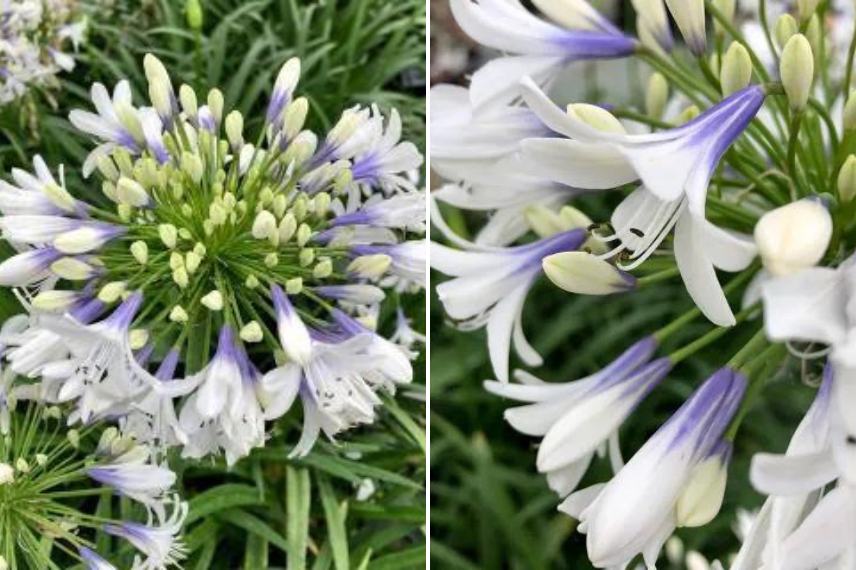
The Agapanthus variety Agapanthus ‘Twister’ alone embodies all the qualities one expects from an agapanthus! To begin with, the grace and refinement of its two-tone flowering, among the most aesthetically pleasing. The umbels of this variety, generously sized (15–18 cm in diameter) and borne on sturdy stems in a dark green-grey, 50–60 cm tall, display a certain originality. Indeed, the inflorescences consist of a profusion of small white flowers whose bases shade into dark blue, between navy blue and ultramarine, sometimes leaning toward violet.
The Agapanthus ‘Twister’
In addition to this two-tone flowering, with such aesthetic appeal, the Agapanthus ‘Twister’ displays hardiness well above average, around -10 to -12°C. Of course, to withstand such temperatures, it should be planted in well-drained soil and sheltered from cold winds and inclement weather.
With its dark green-grey foliage and its relatively modest size (it does not exceed 50 cm in spread at maturity), this agapanthus will thrive in large pots on a terrace or balcony, for example in a pretty pot made of white wooden slats, paired with annuals such as Petunia Surfinia ‘Heavenly Blue’ or perennials such as Buenos Aires Verbena (Verbena bonariensis) with airy blue-to-purple panicles. This agapanthus can also be integrated into a border alongside a dwarf Buddleja such as the variety ‘Lila Sweetheart’ from the Butterfly Candy collection. At its base, you can plant low-growing perennials such as Cerastium (mouse-ear chickweed) or Aubrieta.
Agapanthus 'Strawberry Ice'
Rare treasure alert! The agapanthus ‘Strawberry Ice’ (literally ‘strawberry ice’!) has all the hallmarks of a marvel. Indeed, this agapanthus with a long flowering period that runs from July to September is truly unique. It produces pink flower buds that, as they open, turn white, with a pink-tinged tip. This rosy touch is delicately brushed along the petal margins. The pink intensifies as temperatures cool and the flowers fade. The 8–10 cm flowers are borne on sturdy stems about 60 cm long.

The agapanthus ‘Strawberry Ice’
This New Zealand-origin cultivar, regarded as a collection agapanthus, is also distinguished by the upright presentation of its florets, which face upwards rather than horizontally like those of other agapanthuses. As for the foliage, dense and linear, it also presents an erect, upright habit. It has a hardiness of around -10 °C.
Grown in pots or in the ground, this agapanthus adds a touch of exotic refinement to borders, beds or rock gardens. Of course it can be paired with white agapanthus varieties, as well as with Phlomis tuberosa ‘Amazone’ with mauve-pink whorled flowers, with Hemerocallis ‘Neyron Rose’, or with the double oriental lily (Lilium) ‘Magic Star’, whose flowers are shaded in red, pink and white.
To go further, discover our selection of the 7 best agapanthuses to grow in pots.
Agapanthus 'Full Moon'
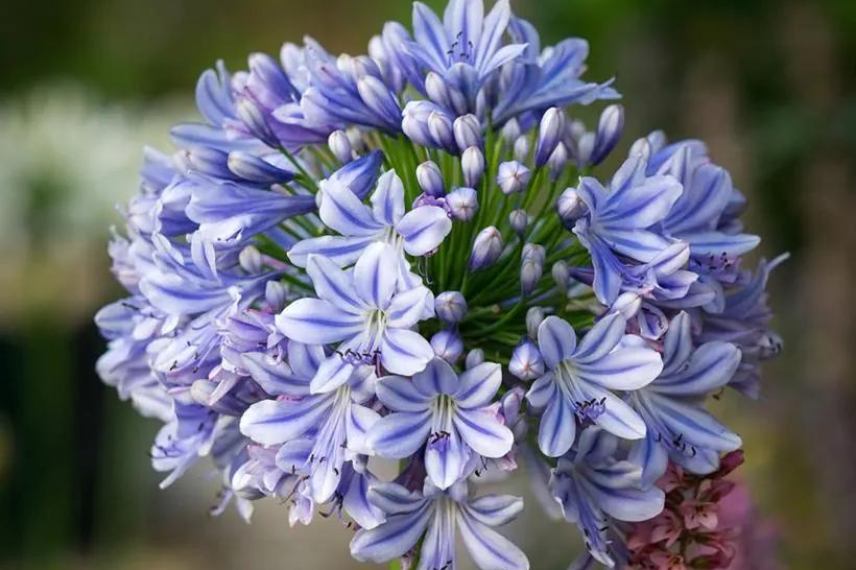
Admittedly, ‘Full Moon‘ isn’t strictly a bi-colour agapanthus variety, but it deserves to be included in this category. Indeed, this prettily named agapanthus, ‘Full Moon’, offers a flowering in which two colours in a tonal range sit side by side. The florets that make up the large umbels, particularly dense and compact for this variety, are of a pale lavender-blue and crossed by a dark blue midline. Needless to say, these umbels, perched on cylindrical flowering stems 90 cm tall, command attention with distinction. All the more so as they are highlighted by a tuft of linear foliage in a bright green.
Hardy only to around -5°C, this variety is best suited to gardens on the Mediterranean and Atlantic coasts. But pot culture is possible elsewhere, which will allow you to overwinter it in a conservatory to help it through the winter.
 The agapanthus ‘Full Moon’
With its decorative value, this agapanthus will easily find a place in a border, a rock garden or in pots on a terrace or balcony. Its colours, very delicate, could admirably pair with the delicacy of the flowers of the Dianella revoluta ‘Coolvista’.
For further reading, I invite you also to discover 7 blue agapanthus which could pair with ‘Full Moon’.
To learn all about protecting not very hardy agapanthus, read Virginie T’s article: How to protect agapanthus for the winter?
Read also
Agapanthus: how to plant themAgapanthus 'Fireworks'
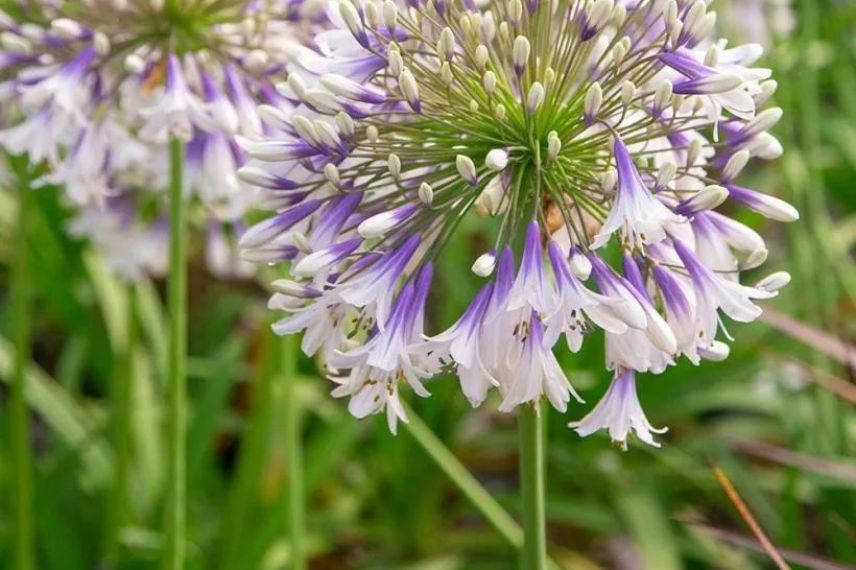
How can you resist the charm of this agapanthus, bearing the bright name ‘Fireworks‘? And its flowers are living proof! Indeed, this agapanthus, holder of a bronze medal at the Royal Horticultural Society Chelsea Flower Show in 2019, offers a profusion of hemispherical umbels of 10 to 12 cm in diameter, composed of small white flowers at the base largely tinged with blue-violet. The campanulate flowers take on the look of flared trumpets, with the six tubular petals that flare out. Each petal is also traversed by a fine blue line.
The agapanthus ‘Fireworks’
The bi-colour effect is all the more pronounced as the flowers open in profusion for three months, from June to August, on dark green foliage. With a hardiness of -10°C, this foliage dies back in winter. But each new summer flowering bursts into another fireworks display, year after year more spectacular.
As with all agapanthus, this variety, 60 cm tall and 40 cm wide, thrives in a border, in a border or in a rock garden, or in a pot on a balcony or terrace. It will find its place, among other things, in a modern-inspired garden alongside boxwood (Buxus sempervirens) and a grass such as Stipa tenuissima. You can even pair it with a botanical rose such as Rosa rugosa ‘Alba’ with crinkled white flowers and fragrance.
Agapanthus ‘Phantom’
Nothing to fear from the two-tone agapanthus ‘Phantom’. Quite the opposite, as it is imbued with real majesty. This agapanthus exudes delicacy, understated elegance and finesse. Its very large hemispherical umbels, almost 20 cm across, contain only about twenty flowers, giving them a light, airy appearance. As for the florets that compose them, they are tinted with a pure white, irregularly washed with a pale blue. These two discreet colours are heightened by a small bouquet of golden stamens. These inflorescences primarily showcase their opulence with sturdy stems nearing 1 metre in height and ribbon-like, linear and narrow foliage, a very glossy dark green.
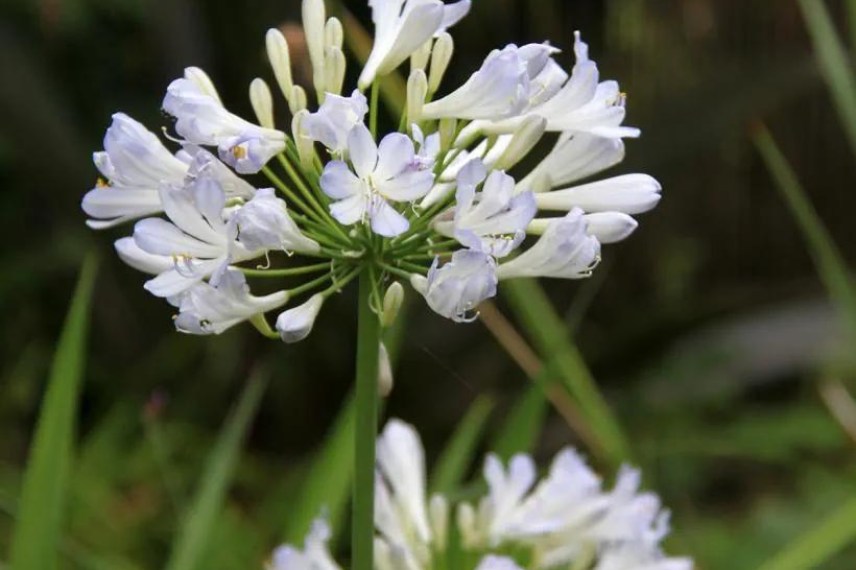 Agapanthus ‘Phantom'</caption]
With a fairly average hardiness of around -10°C, this agapanthus will thrive in the beds and borders of northern coastal gardens, around the Mediterranean rim or the Atlantic coast. Nevertheless, pot culture will allow all gardeners to enjoy this absolutely splendid bi-colour flowering. With its tall stature, this agapanthus can sit in front of a Ceanothus with blue-tinged summer blooms. The pairing with Delphinium will also highlight its beauty, as will that of a blue-flowered Clematis such as Clematis ‘Saphyra Estrella’.
For further reading, do not hesitate to consult our selection of 7 white agapanthus varieties.
- Subscribe!
- Contents
Comments