





























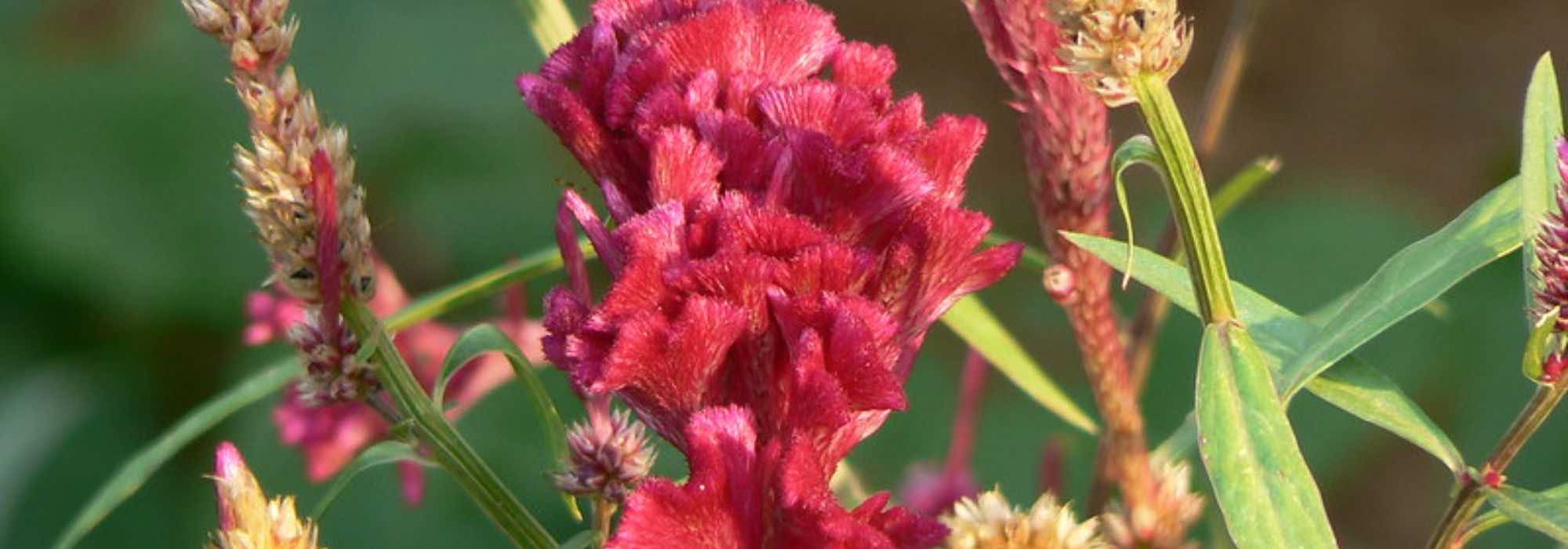
Celosia: ideal for borders and beds
A velvet plant with cheerful colours
Contents
With its plume-shaped, flame-shaped or coral-shaped flowers, Celosia brightens gardens from summer to autumn. Original and compact, this velvety plant adds an unusual, exotic touch to beds and borders. Native to the Americas and Africa, this perennial is frost-tender and used in our regions as an annual. Discover the advantages, the different species and the cultivation of Celosia, as well as the displays you can create with this amazing plant in beds and borders of your garden.

Celosia, a perennial plant grown as an annual
What are the main characteristics of Celosia?
Celosia is a frost-tender perennial that is grown as an annual in our climate. Its height ranges from 15 cm to 1.2 m. It forms a clump of lanceolate leaves of 10 to 15 cm long, veined and deciduous. This foliage displays different green tones, from lime green to purplish-green. It provides a backdrop for fluffy flowers in the form of feathery plumes, fine spikes or cock’s combs, depending on the variety. Flowering lasts from July to September, sometimes October or November. The flowers take on saturated and vibrant tones, warm and intense, ranging from yellow to red and purple, including orange and pink.
Benefits for beds and borders
Thanks to its size and ease of cultivation, Celosia is an ideal plant for brightening a bed or border. The taller plants can be placed in the middle or back of a bed, while the smaller ones are used to brighten the front of a bed or to fill a border. Thanks to their colour palette and their distinctiveness, Celosia’s fluffy flowers bring vitality, warmth and contrast to your beds or borders. They can serve as a focal point and ensure colour continuity in a garden. Another advantage is that they can self-seed.
[img class=”wp-image-216828 size-full” src=”https://www.promessedefleurs.com/blogwp/wp-content/uploads/2023/08/celosia.jpg” alt=”annual” width=”856″ height=”570″ /> Celosia argentea cristata in the border
Read also
Celosia: sowing, growing and careThe different Celosia species
The Celosia is part of the Amaranthaceae family and comprises nearly 60 species, of which three are cultivated in our gardens. Key characteristics to know when choosing which Celosia to plant in your garden!
- The Celosia argentea var. plumosa or feather Celosia offers colourful flowers in the form of plumes or plume heads.
- Celosia argentea var. spicata produces slender, lance-shaped flower spikes that are equally colourful.
- The Celosia argentea var. cristata produces striking flowers reminiscent of a cock’s comb or coral.
Celosia plumosa and spicata are bushy plants, while Celosia cristata forms a single stem.
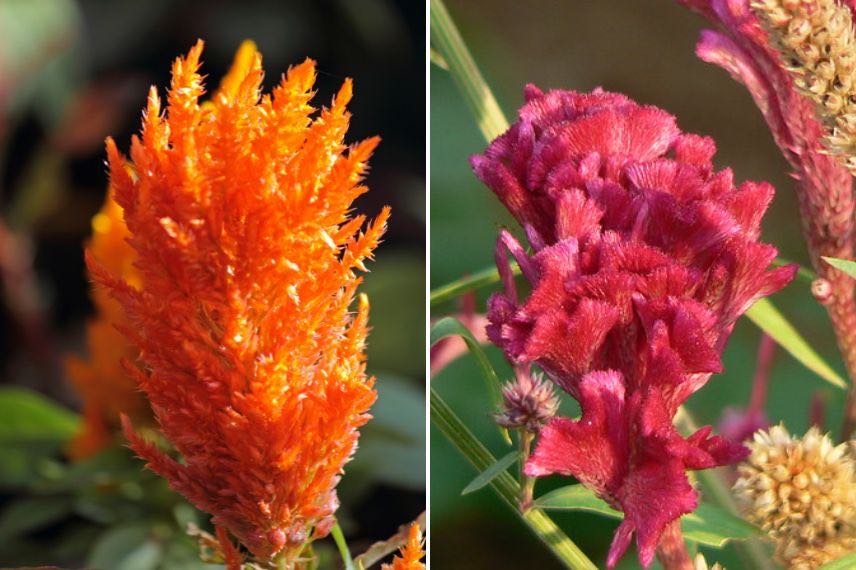
Celosia var.argentea plumosa in plume heads and Celosia var.argentea cristata in cock’s comb
Growing conditions for Celosia
Originating from tropical regions of the Americas and Africa, Celosia is a frost-tender plant that thrives in full sun and heat.
Its growing conditions are as follows:
- Exposure: Celosia grows in full sun and sheltered from the wind.
- Soil: It prefers fertile, cool and well-drained soil.
- Watering: The soil should stay moist but well-drained; water often but in small amounts. The soil must not dry out between waterings. Avoid wetting the leaves.
- Fertilisation: Celosia appreciates an application of fertiliser every fortnight during the flowering period.
Read also
How to harvest and dry Celosia?Celosia planting
- Planting Celosia takes place in April or May, once the risk of frost has passed.
- For attractive beds or borders, allow 7 to 9 young plants per square metre, spaced 20 to 50 cm apart depending on the variety chosen.
The planting steps:
- Dig planting holes, clearing the soil of any old roots.
- Position the young plants in place and plant them in a mixture of compost and garden soil.
- Firmly press the soil around each young plant to remove air pockets.
- Water well at the base of each young plant.
- You can also add mulch to help keep the soil cool.
Celosia care
Pruning and winter protection
- Remove faded flowers as they appear to encourage new flower buds.
- If you wish Celosia to reseed, leave the plants to go to seed after flowering. Then, when they are dry, cut the stems and collect the seeds.
- In autumn, lift the plants and overwinter them, if you wish, in a bright place at 10°C such as a conservatory or an unheated greenhouse.
- In winter, water the plants occasionally to keep the growing medium slightly moist.
- In spring, once frosts are past, you can replant the plants outdoors and resume more frequent watering.
Pests and diseases
Celosia can be susceptible to attacks by aphids, but also to whiteflies or red spider mites. Various treatments are possible, in particular the spraying of water mixed with black soap to which a few drops of vegetable oil or essential oil can be added depending on the insects to be eliminated.
Some Celosia display ideas
In a border, Celosia pairs well with itself. To create a dynamic and joyful effect, you can lean on the vibrancy and intensity of Celosia colours. Make for example a mix of Kelos Celosia ‘Fire Orange’, ‘Fire Yellow’, ‘Fire Red’ and ‘Fire Purple’. At a height of 35–38 cm and a width of 45 cm, these Celosia are fast-growing and offer flame-shaped plumes of 12 cm on bright green or purple foliage depending on the varieties. If the overall effect seems too lively, you can soften with plants in gentler colours such as the ivy or the ivy {ivy} or the alchemilla. If, on the contrary, you’d like other colours, draw inspiration from the foliage of Coleus.
In a border, use compact Celosia, such as Kelos, in the front, and add taller plants at the back whose flowers echo this pretty spike-like form. For example, choose green foxtail amaranths green foxtail amaranths, whose more subdued colouring will temper the bright colours of Celosia. You can also pair Celosia with Echinacea and Cosmos to vary shapes and create a lovely floral display. If you wish to temper colours and add lightness to your border, you can turn to Pennisetum, Carex or bushy Salvias.
For an exotic and escapist border, you can pair the feathery plumes of Celosia Kelos ‘Fire Yellow’ and ‘Fire Red’ with the striking Celosia cristata in coral-like shapes and add flamboyant cannas, euphorbias or Colocasia to provide contrast and originality. Bush salvias such as the Salvia ‘Delice Feline’ as well as scabious can help lighten the overall effect. In the back of the border, you can plant a dwarf banana plant as well as purple Cordylines to enhance the tropical look.
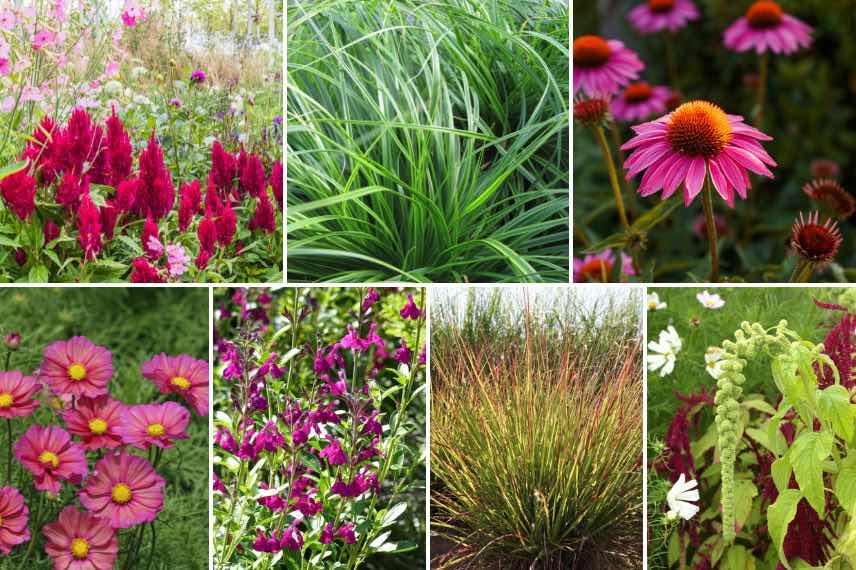
Clockwise from the top left: Celosia, Carex oshimensis ‘Everlime’, Echinacea, Amaranthus caudatus ‘Viridis’ (Green Foxtail Amaranth), Pennisetum ‘Windy Simonette’, Salvia jamensis ‘Raspberry Royal’, Cosmos ‘Xsenia’
Further reading
To learn more about growing this plant,
- see our complete guide to sowing and maintenance of Celosia
- and choose from our collection of Celosia plug plants or Celosia seeds, whether they are feathered or in cockscomb.
- Subscribe!
- Contents

Comments