





























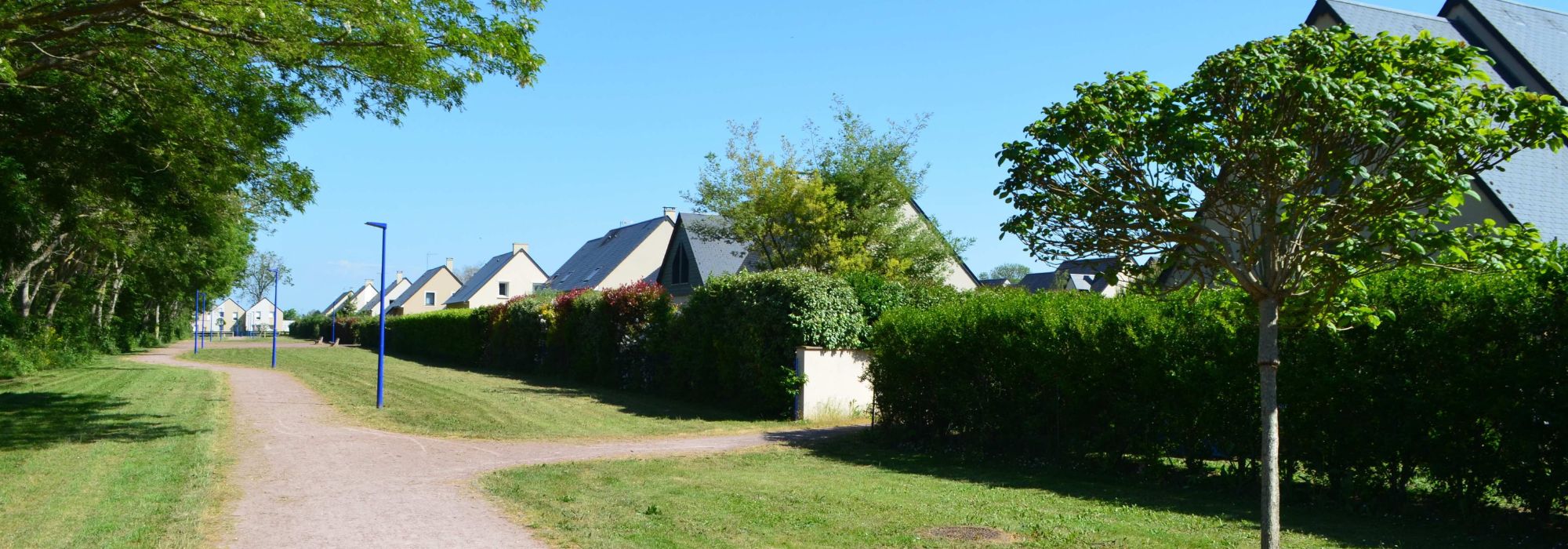
Choosing hedge shrubs for housing estate gardens
Our tips for choosing wisely
Contents
Garden hedges help delineate your property, create privacy and enhance the aesthetics of your garden. The choice of hedge shrubs is an important decision that affects appearance, function and maintenance of your outdoor space. Taking into account several important criteria: aesthetics, height, width, leaf type, growing conditions and maintenance, you can create a hedge that meets your needs. With a little planning and regular maintenance, your garden hedge becomes a valuable asset to your housing estate. In this article, we will explore the characteristics to consider when choosing your hedge shrubs for a housing estate garden, and we will offer you some ideas for possible plant pairings.

Characteristics of a hedge for a housing estate garden
Shrubs forming a hedge in a housing estate garden should be chosen according to a few important criteria.
1. Privacy
One of the main reasons residents in housing estates opt for garden hedges is the pursuit of privacy. A well-chosen and well-maintained hedge can shield you from the prying eyes of your neighbours and the street. To achieve this, it’s important to choose shrubs with dense foliage, which will provide effective visual coverage throughout the year. Evergreen shrubs are particularly suited to this use, as they retain their leaves even in winter.
2. Defining your property boundary
Hedges play an essential role in defining the boundary of your property. They clearly delineate the edges of your outdoor space while adding an aesthetic touch. Ensure that the hedge you choose is suitable for this purpose, with sufficient height to visibly mark the boundary of your land.
3. Aesthetics
In addition to their practical function, hedges should ideally bring an aesthetic dimension to your housing estate garden. By selecting shrubs with varied colours and shapes, you can create a hedge that attracts attention and helps improve the overall appearance of your outdoor space. Choosing deciduous foliage plants can also add seasonal appeal by displaying magnificent autumn colours and welcome variation.
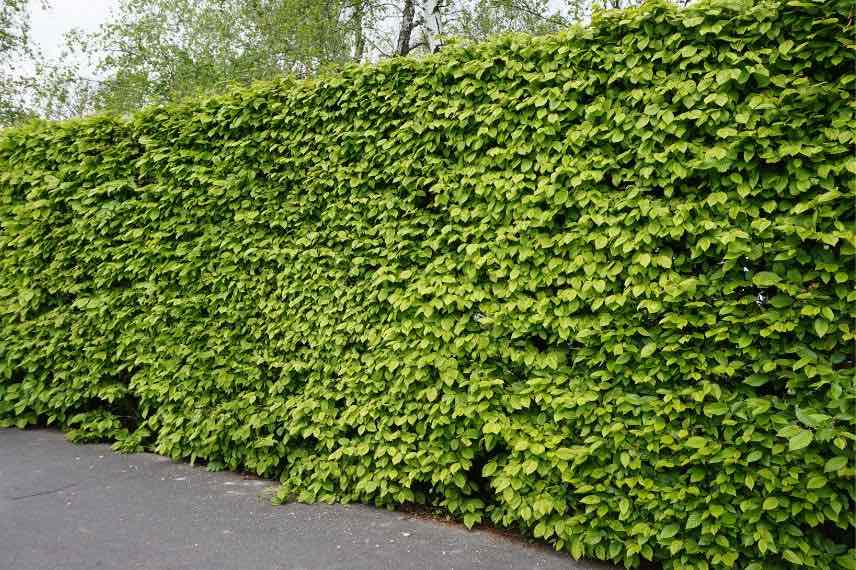
Monospecific evergreen hedges are the most effective at protecting privacy, but they have the drawback of creating a monotone wall.
Read also
8 shrubs to create a privacy hedgeHedge height and width
The height and width of your hedge will depend on the space available in your housing development’s garden. It is essential to take precise measurements to avoid costly mistakes. Generally, here are some guidelines to follow:
- Height of the hedge: The height of the hedge should be chosen according to the privacy you want. For maximum privacy, opt for a hedge of at least 1.8 to 2.5 metres in height. For a property boundary where privacy is not required, a height of 1 to 1.5 metres may suffice.
- Width of the hedge: The width of the hedge should be matched to the space available. Make sure to leave enough room for movement in your garden. Hedges that are too wide can reduce the usable area and make the garden feel crowded. On the other hand, spacing of around 80 cm to 1.20 m (depending on species) between shrubs is often recommended.
The general rule is that a shrub of up to 2 m in height must be planted at least 50 cm from the property boundary. In practice, it is better to plant it at a minimum of 80 cm to give it room to grow and ease maintenance. Shrubs taller than 2 m must be planted at a minimum distance of 2 m from the property boundary.
Note that more restrictive, specific rules may apply depending on your housing estate regulations. It is up to you to check.
Thus, if your garden is small, opt for a hedge around 1.80 m high, so you can plant it 50 cm from the property boundary and avoid encroaching too much on the garden space, with shrubs of a limited spread.
Types of foliage
The type of hedge foliage on your hedging shrubs has a significant impact on the appearance and function of the hedge. Here are the options:
1. Evergreen foliage shrubs
Evergreen foliage shrubs are an excellent option for those seeking year-round visual protection. These plants keep their leaves even in winter, providing year-round cover. Consider Cherry laurel, Privet and yew. If they are essential for forming a hedge, they can be somewhat monotonous. In that case, avoid a mono-species hedge, made up of a single species.
2. Deciduous foliage shrubs
Deciduous foliage shrubs, although they shed their leaves in autumn, offer seasonal beauty by displaying vibrant colours during that period. They also provide welcome variation year-round. Some bloom on bare shoots in winter or in spring before the restart of growth, a notable attraction. They can add an extra touch of aesthetic appeal to your housing-estate garden. They are paired with evergreens to form a diversified hedge. Examples of deciduous foliage shrubs include Lilac, Forsythia and Dogwood.
3. Semi-evergreen foliage shrubs
Semi-evergreen foliage shrubs lose some of their leaves in winter, but retain enough to offer a degree of privacy.
4. Marcescent foliage shrubs
Let’s not forget marcescent foliage shrubs such as Hornbeam, whose leaves persist through winter, but wither and die back, turning a brownish colour, before being replaced by new green foliage in spring.
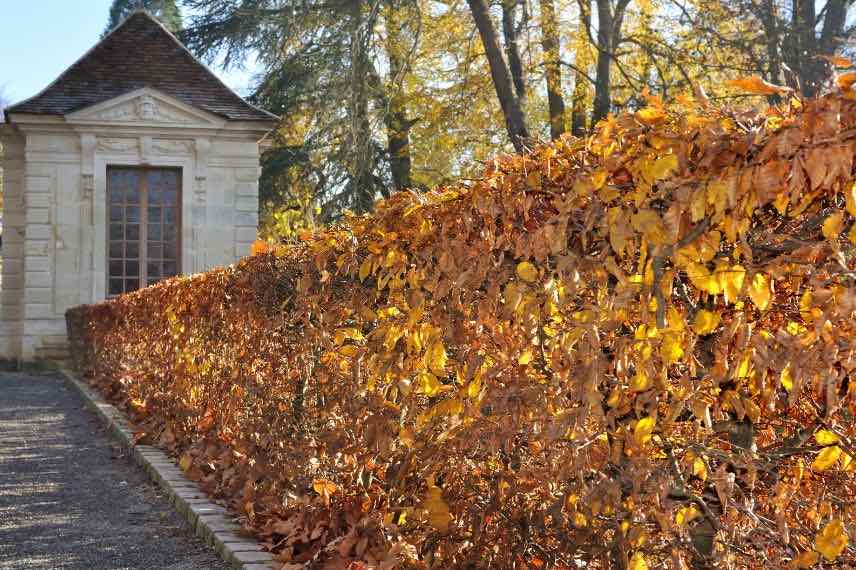
Marcescent foliage of Hornbeam in autumn and winter
Read also
How to plant a hedge?Some cultivation considerations to bear in mind.
- Choose hedging shrubs suited to your region’s climate
When selecting hedging shrubs for your housing estate garden, it’s essential to consider your region’s climate. Some plants thrive in hot, dry climates, while others prefer cooler, moister climates. Do your research. This will ensure that your hedging shrubs adapt well and stay healthy.
- Choose species suited to the time you can devote and the level of care you can provide
An essential aspect of hedge planning in a housing development garden is maintenance. Hedging shrubs vary in maintenance needs, and it’s essential to choose plants that match your availability and level of expertise. Here are a few tips to simplify hedge maintenance:
- Watering: Choose shrubs suited to the amount of natural rainfall in your region to minimise additional watering.
- Soil: Ensure your garden soil meets the needs of your hedging shrubs in terms of pH, drainage, and nutrients.
- Exposure: Check the sun’s orientation and the amount of light to choose your species carefully. However, many hedge-adapted species tolerate any type of exposure.
- Pruning: Opt for shrubs that do not require pruning too frequently, unless you are prepared to invest time in regular maintenance.
- Disease resistance: Choose plants resistant to common diseases in your region to reduce the risk of plant health issues.
Selection
More than in other types of housing, people living in a housing estate seek to protect their privacy; the selection below features a large number of evergreen shrubs and deciduous shrubs that will reach at least 1.80 m in height. If you wish to compose a varied hedge, keep one third of evergreens in your selection.
Here are some suggestions for creating a hedge:
Privacy-creating, monospecific hedge
- Evergreen shrubs: Cherry laurel (Prunus laurocerasus), Yew (Taxus baccata) or Leyland Cypress (Cupressocyparis leylandii).
- Height: 2.5 metres or more for total privacy.
- Maintenance: Regular pruning to maintain height and density.
Mixed hedge with coloured foliage, a little less dense and taller, but varied
- Combination of evergreen and deciduous : Photinia for its colourful red evergreen foliage, Laurustinus (Viburnum tinus), for its colourful foliage and white flowering, Flowering dogwood (Cornus florida) for its flowering and autumn colours, Black elder (Sambucus nigra) for its handsome leaves with lobes, Choisya, Osmanthus, Physocarpus, Winged euonymus, Aucuba variegata.
- Height : 1.80 m to 2.5 metres for moderate privacy and property delineation.
- Maintenance : Light pruning to maintain the shape and encourage flowering. These shrubs do not naturally grow very tall, to avoid having to prune too often.
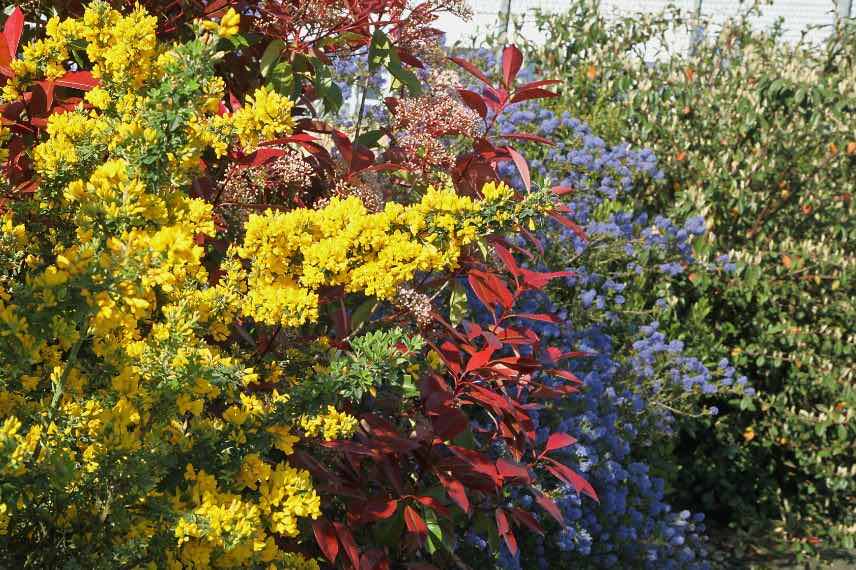
In this varied hedge, you can see Photinia’s red foliage, Forsythia’s yellow flowering and Ceanothus’ blue flowers
Free-flowering hedge, biodiversity-friendly
- Evergreen, marcescent and deciduous shrubs : Hornbeam, Strawberry tree, Buddleja, Weigela, Mock orange, Elaeagnus, Abelia, Ceanothus, Viburnum pragense…
- Height : 1.80 m to 2.5 metres for moderate privacy and property delineation.
- Maintenance : Pruning after flowering to encourage growth.
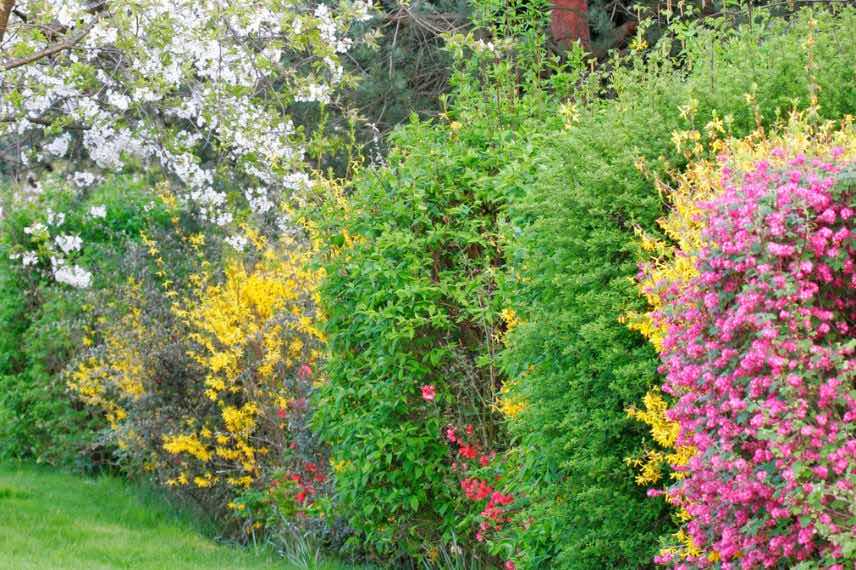
And in this one, in the foreground, a flowering currant. Even with a hedge composed of deciduous and evergreen plants, you obtain enough density to protect privacy
Further reading
In a housing estate, you may be tempted by species that grow quickly (but often require more regular pruning), read our article: fast-growing hedge.
Read our numerous articles on hedges, for example those on choosing according to climate or soil:
- Drought-resistant hedge shrubs
- Which shrubs for which types of hedge?
- 7 hedge shrubs for a south-facing garden
- 6 shrubs for a north-facing hedge
- How to create a privacy hedge?
We offer a wide range of hedge kits for sale to simplify the choice, which you can select by soil type, by preference for flowers or foliage, by garden size…
- Subscribe!
- Contents
Comments