





























Choosing periwinkles
Our buying guide
Contents
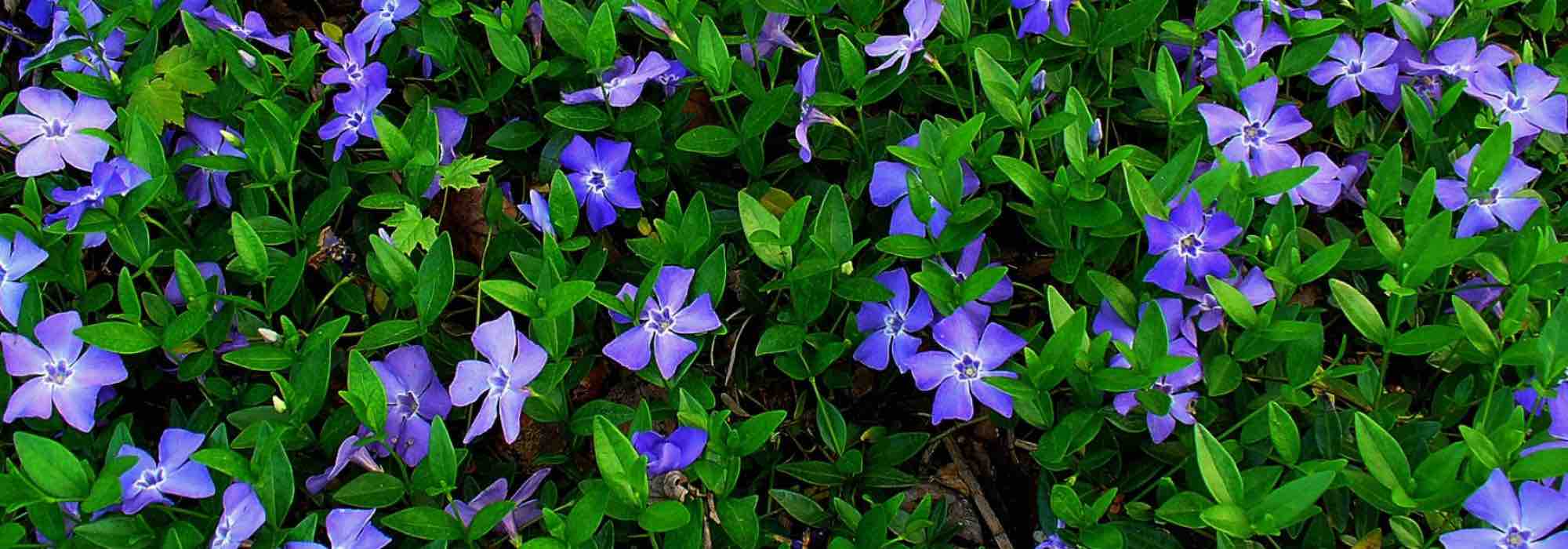
Periwinkles or Vinca form robust and vigorous carpets of evergreen leaves all year round, then brighten up in spring with countless flat star-shaped flowers, often blue, sometimes white or purple. Unfussy, they bloom in shade, partial shade, and full sun, in cool soil. They are appreciated for their enthusiasm in colonising woodland slopes, more challenging areas to cultivate, blooming in the shade, and providing year-round foliage cover. We thank them for their rapid spread, and from time to time, they overflow with enthusiasm, leading us to uproot them when they venture further than we would like. They are not afraid of frost or drought; they are truly tough plants, very useful in certain spots in the garden. Their temperament should not overshadow the fact that their foliage is fine and lovely, just like their flowers, which are clearly visible, as if placed on a carpet of leaves.
Discover the many variations of periwinkle, with green or variegated foliage, in different colour variations and their possible uses in the garden.

According to the size and colour of flowers
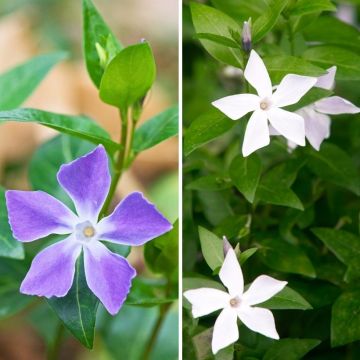
Periwinkles, known by their Latin name Vinca, produce flowers composed of five petals fused into a corolla, square-shaped, flattened, and open. The two most well-known species are: Vinca minor and Vinca major. The former reaches heights of 15 to 20 cm with flowers measuring 2 to 3 cm in diameter, while the latter grows to 30 to 50 cm tall, with slightly larger flowers, measuring 4 to 5 cm in diameter. Less commonly cultivated, the species Vinca difformis originates from the Mediterranean region; it is similar in size to Vinca minor but is distinguished by its periwinkle flower with elongated petals, finer than those of the other two species. Periwinkles bloom in white, blue, mauve, or purple and plum.
The Vinca minor
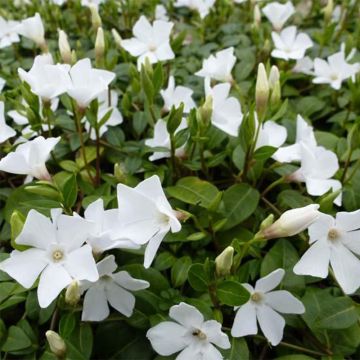
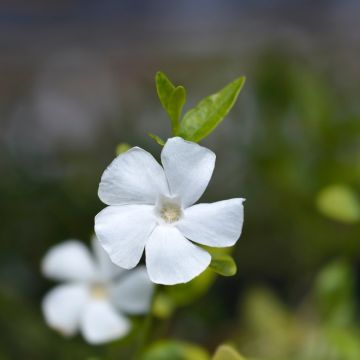
The Vinca minor ‘Elisa’ is a white-flowering periwinkle, dense, neat in appearance, very floriferous, and very bright, just like ‘Gertrude Gekyll’, which is particularly low and has a translucent white flower.
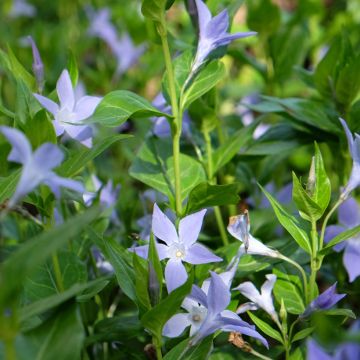
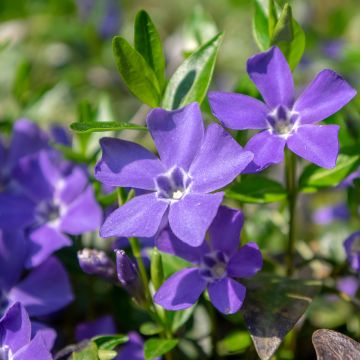
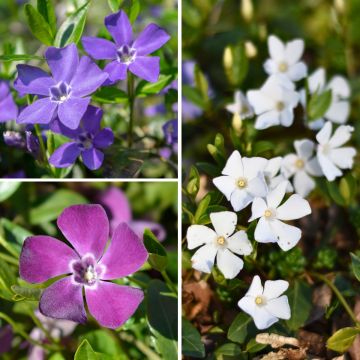
The typical species, Vinca minor, blooms in blue, the periwinkle blue. The improvements of the typical species are all more floriferous and express themselves in lavender-blue or mauve-blue, such as ‘Joséfine’ or ‘Marie’.
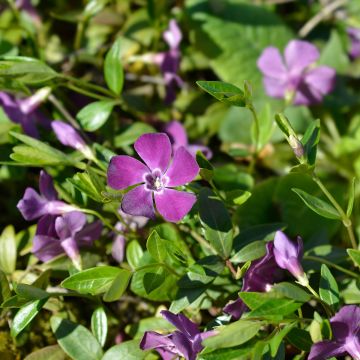
The Vinca minor ‘Atropurpurea’ offers deep purple flowers, and ‘Multiplex’ features a rare semi-double flower, also in purple.
The Vinca major
The typical species, Vinca major, offers blue flowers and forms a carpet 30 cm high. At the same height, ‘Alba’ is a lovely cultivar with white flowers.
The Vinca difformis
The Vinca difformis features a charming flower of very pale lilac blue. Its thin petals give it a more geometric appearance, like a windmill.
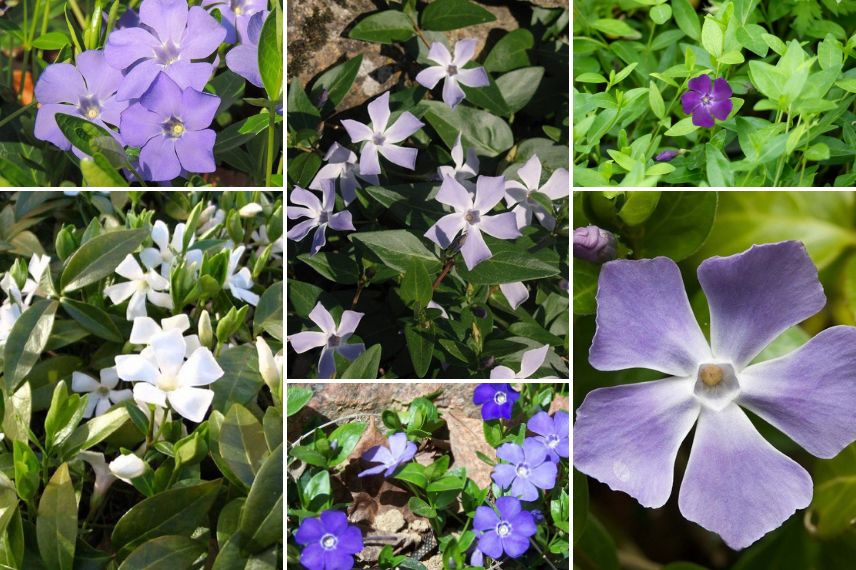
Clockwise: Vinca minor ‘Anna’, Vinca difformis, Vinca minor ‘Atropurpurea’, Vinca major, Vinca minor, Vinca minor ‘Gertrude Jekyll’
Read also
Periwinkle: planting, growing and careAccording to the colour of the foliage
The green foliage of periwinkles varies from a bright, tender green in the shade to a dark green, which looks lovely in contrast with the flowers. Others are adorned with variegated foliage. All variegated varieties bloom in blue.
Variegated Periwinkles
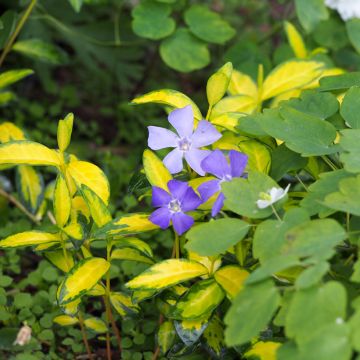
In Vinca minor, the foliage of ‘Ralph Shugert’ is decorated with a fine white margin that is very striking. ‘Argenteovariegata’, holder of an Award of Garden Merit from the Royal Horticultural Society, has more broadly variegated leaves of cream yellow and silver-white margins. ‘Illumination’, more unusual, develops light yellow variegated foliage with green margins.
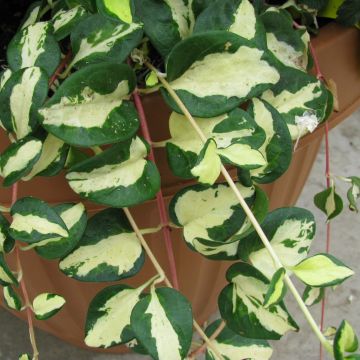
The Vinca major ‘Variegata’ offers lovely glossy foliage, light green with cream-white margins. The Vinca major ‘Wojo’s Gem’ (nice pronunciation), develops very ornamental and unusual light yellow to cream-white foliage with dark green margins.
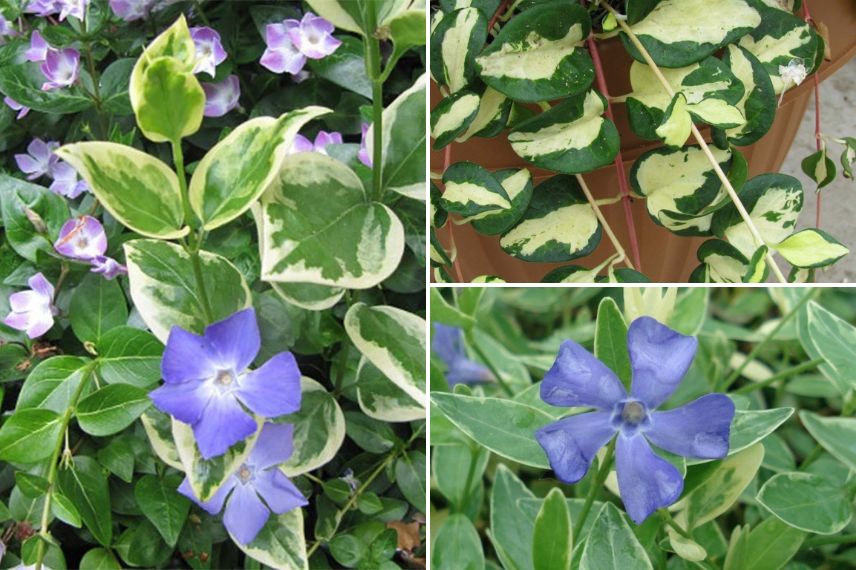
Vinca major ‘Variegata’, Vinca major ‘Wojo’s Gem’, Vinca minor ‘Ralph Shugert’
Discover other Vinca - Periwinkle
View all →
Available in 2 sizes
Available in 1 sizes
Available in 2 sizes
Available in 1 sizes
Available in 2 sizes
Available in 1 sizes
Available in 2 sizes
Available in 0 sizes
Available in 0 sizes
Available in 2 sizes
According to the flowering period
Periwinkles love to flower in spring, sometimes as early as February with Vinca minor, particularly the blue-flowered varieties ‘Flower Power’, ‘Marie’, ‘Anna’, and the white variety ‘White Power’. Between March and May, their evergreen foliage is adorned with small, single, flat flowers, occasionally lasting until June.
Some highly floriferous varieties of Vinca minor often bloom again in autumn, in September-October. This includes the early varieties mentioned above ‘Flower Power’, ‘Marie’, ‘Anna’, and ‘White Power’. It also includes ‘Josefine’, which blooms in blue, and ‘Elisa’ and Vinca minor ‘Alba’ with white flowers.
According to hardiness
The Vinca difformis retains a greater sensitivity from its Mediterranean origins: it is only hardy down to -7° C at most, classified in USDA zone 9a, while Vinca minor and major withstand negative temperatures of around -30° C!
According to the uses
The great adaptability of periwinkles and their tendency to blanket the soil with a persistent carpet of flowers, sometimes twice a year, make them useful allies in the garden in various situations.
Alone, in flowering carpets
This is how they are found in their natural state, during walks in the woods or along paths, on slopes. It is a beautiful expression of their talent to see them cover the ground at the base of a tree, in wide areas of shade or partial shade where our lawn does not thrive, but they do. Let them take over a somewhat neglected or ungrateful area; they will not let you down.
In shrub and perennial beds
More abundant in cool undergrowth, periwinkles form a groundcover alongside perennials that thrive in similar conditions. Choose a Vinca minor, which is lower, and accompany it with ferns, Brunnera, upright geraniums like Geranium phaeum, and Polygonatum (Solomon’s seal).
In pots or hanging
Periwinkle quickly covers a pot, either alone or accompanied by small upright perennials. In hanging arrangements, it cascades beautifully.
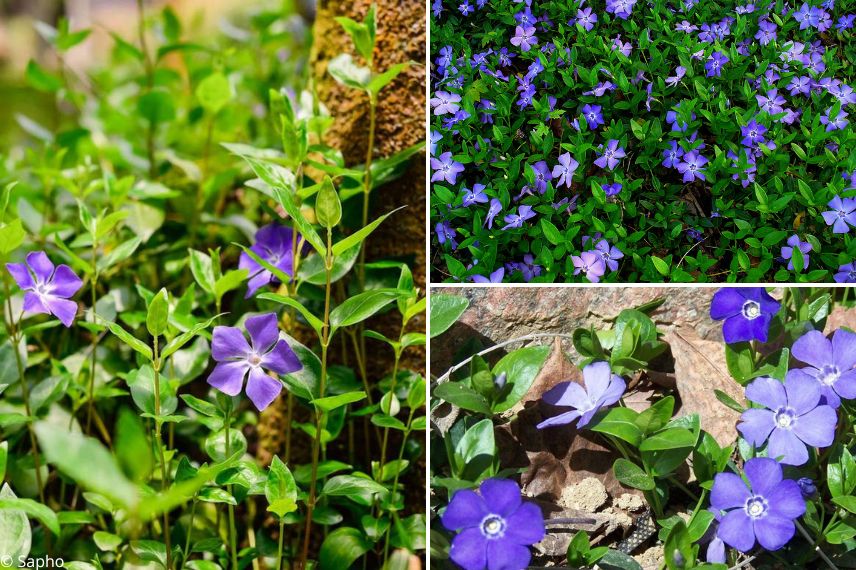
At the base of a tree, in a carpet of shade or in a sunny rockery
- Subscribe!
- Contents
![[plant_selector plant="Vinca major" color="blue"]](https://en.promessedefleurs.eu/blogwp/wp-content/uploads/2022/11/choisir-des-pervenches.jpg "[plant_selector plant=\"Vinca major\" color=\"blue\"]")
Comments