





























Choosing the right Ceratostigma for your garden
Our buying guide to choosing a suitable creeping plumbago
Contents
The genus Ceratostigma, formerly known as Plumbago and also referred to as Dentelaire, comprises shrubs and undershrubs particularly prized for their flowering in a vibrant gentian blue and autumn-coloured foliage. Originating from Asia, Ceratostigma adapts to a range of climates and even thrives in challenging conditions. Depending on the species, these plants can reach different sizes at maturity and display a variety of growth habits, from groundcovers to small upright shrubs. In addition to their beautiful blue flowering, Ceratostigmas are notable for their foliage, which takes on autumnal red or golden tones, bringing a splash of colour to late-season gardens. Hardy and low-maintenance, they are ideal for gardeners seeking ornamental and easy-to-care-for plants. This article guides you through the essential criteria to consider when choosing Ceratostigma that will best suit your wishes, taking into account its mature size, leaf colour and habit or its hardiness.
If you love blue flowering, be sure to discover this delightful plant!

According to the colour of the flowers
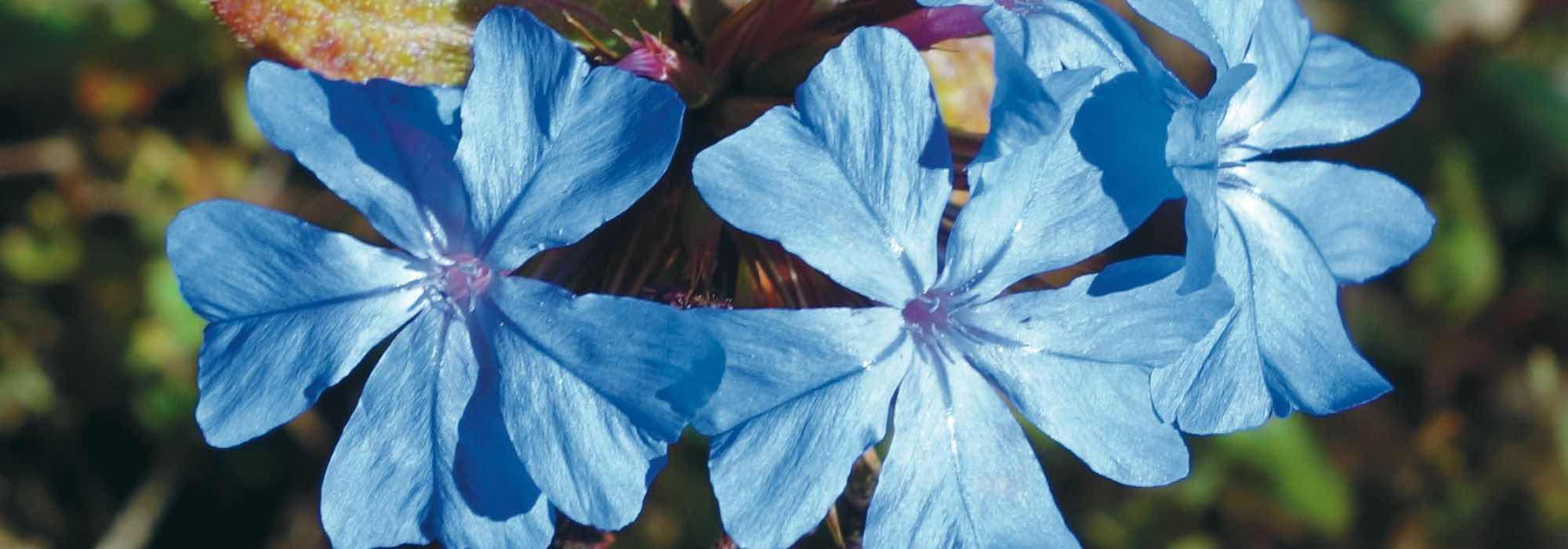
That’s obviously a joke! The ceratostigmas are appreciated, known and widely acclaimed for the fabulous electric blue colour, of exceptional intensity, for their round corolla flowers with well-cut petals, present on all specimens.
This superb flowering lasts for many months, extending from July (the earliest is Ceratostigma plumbaginoides) to October–November.
Note that the cultivar Ceratostigma willmottianum ‘Forest Blue’ is considered the most floriferous of them all, it has, moreover, been awarded an Award of Garden Merit by the Royal Horticultural Society.
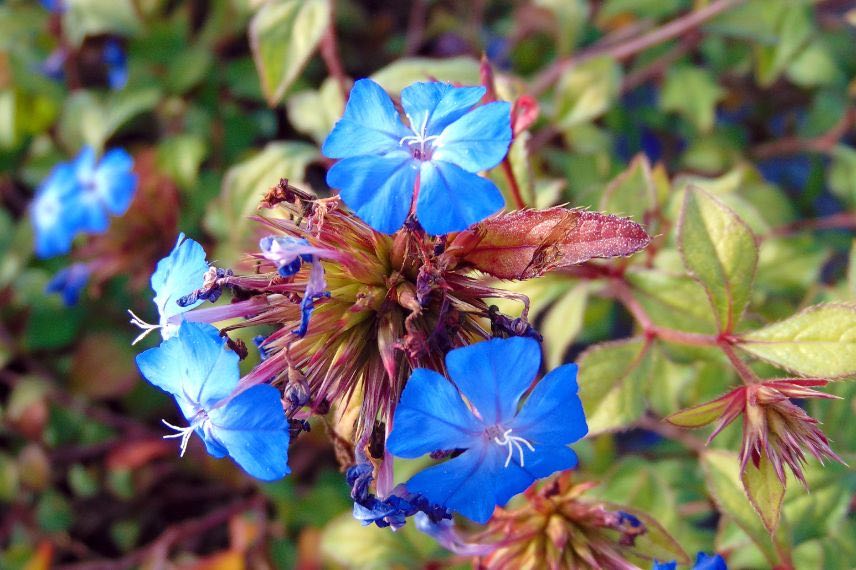
The intense blue of Ceratostigma flowers
Based on the plant's habit
That is the key distinction among Ceratostigmas. The Ceratostigma plumbaginoides, often regarded as a perennial, is an undershrub with creeping rootstocks. It indeed resembles a herbaceous perennial with deciduous foliage and can be classified as such.
The Ceratostigma plumbaginoides has a creeping habit, it is, moreover, sometimes called creeping Plumbago, because of its creeping rootstocks that colonise the soil.
The other Ceratostigmas, such as the Ceratostigma griffithii and Ceratostigma willmottianum, are shrub species, which form medium-sized shrubs, with a bushy and spreading habit. The Willmott Ceratostigma shows a loose habit, more vigorous than Ceratostigma griffithii.
From these varied behaviours arise differences in height and use, which we will discuss in the following paragraphs.
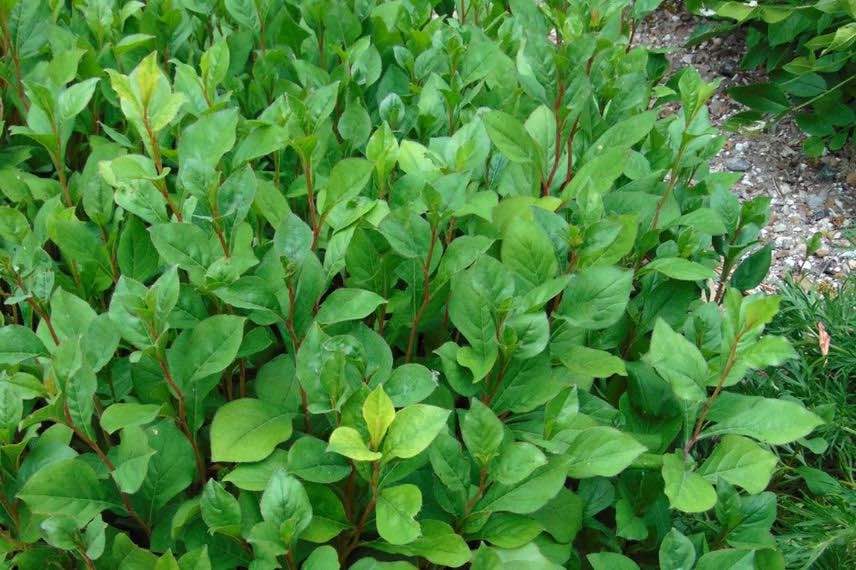
Ceratostigma plumbaginoides forms a low tuft of creeping foliage
Depending on foliage colour
The leaves of Ceratostigma are typically a bright green, with a lamina edged by dark, brownish to purplish cilia.
As the nights cool again in September, the foliage quickly takes on a bronze hue, then shifts to bright red and raspberry, before dropping late in autumn. The intensity of these colours is heightened when the plant has good sun exposure.
In Ceratostigma willmottianum ‘Sapphire Ring’, the foliage in spring and summer is a bright golden yellow, very bright. In autumn, it takes the same superb coppery and red colours as the others.
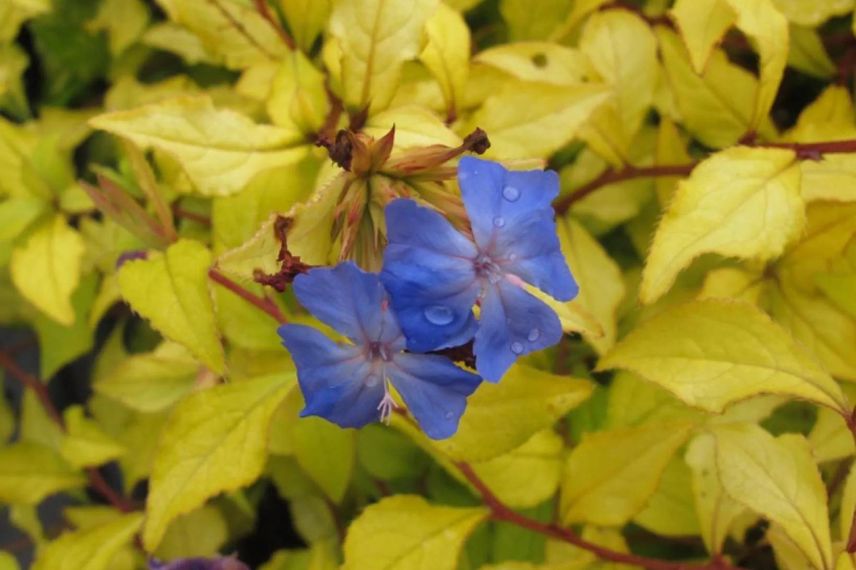
The golden yellow foliage of Ceratostigma willmottianum ‘Sapphire Ring’
Read also
Pairing ideas with CeratostigmaBased on foliage persistence
The Ceratostigma plumbaginoides is endowed with deciduous foliage, which remains on the stems for a long time in autumn and re-emerges late in spring, around May.
The Ceratostigma willmottianum also develops deciduous foliage, with the same characteristics.
Only Ceratostigma griffithii is evergreen, but only in mild coastal regions.
According to the its dimensions
The running and creeping habit of Ceratostigma plumbaginoides means it does not exceed 30 cm in height. It spreads over large areas, at least about 50 cm wide, and with no theoretical limit over time, especially in moist soil, where one should consider restraining it.
The other Ceratostigma form shrubs somewhat wider than tall, ranging from 60 cm to 80 cm in height depending on species and variety, with a width of 50 cm to 1 m in maturity.
The tallest and widest is the type species Ceratostigma willmottianum which reaches 1 m in height and still spreads to 1.5 m.
The most compact among the shrubs is undoubtedly the Ceratostigma willmottianum ‘Forest Blue’, which reaches 60 cm in height and 80 cm wide.
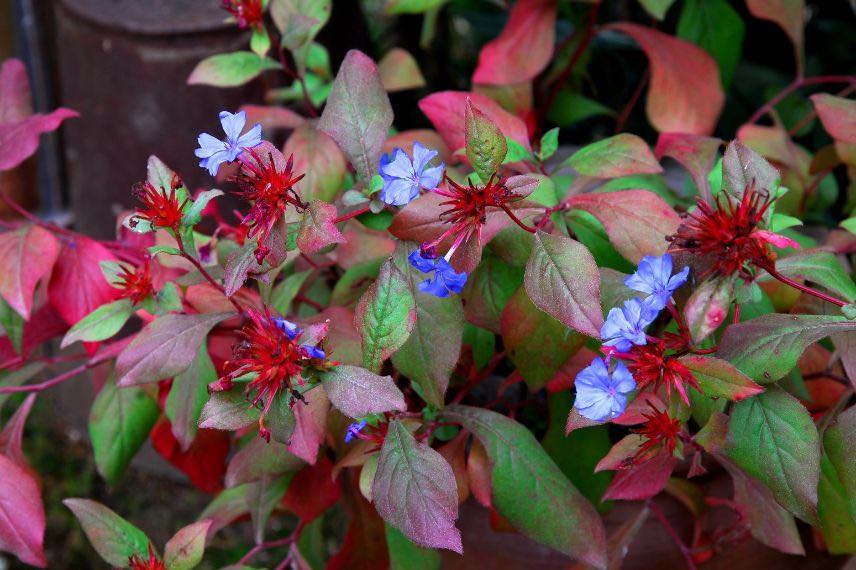
The colourful foliage of Ceratostigma willmottianum in autumn
According to usage
From these differences in behaviour, growth habit and height, there are also differences in how they can be used.
The creeping Plumbago can be used in many ways thanks to its groundcover qualities and its adaptation to difficult growing conditions.
- On a low wall, where it prettily covers the wall with its coloured foliage and blue flowering.
- On a slope, even when poor and hard to access, where it colonises steadily.
- As groundcover for borders or the front of a bed.
- At the base of shrubs or climbing plants in open ground, as it tolerates root competition well.
All Ceratostigma can establish themselves:
- In a dry rock garden
- On a border or in a bed
- In a large pot
Those that form shrubs can also form small mixed hedges in dry, sunny conditions.
Based on frost resistance
The Ceratostigma plumbaginoides is the frost-hardy, since it tolerates frosts of around -20°C.
The others are hardy down to about -12 to -15°C. But in case of an intense cold spell, they are nonetheless capable of regrowing from the stump if the aerial parts are destroyed.
All this should be considered under good cultivation conditions, i.e., well-drained soil that stays dry in winter.
But in all cases, ceratostigmas appreciate warm situations. They are not advised in climates that are too cool or in areas exposed to cold winds.
- Subscribe!
- Contents

Comments