





























5 lovely pairing ideas with Erythronium
Our ideas for elegantly pairing Erythronium in the garden or on a balcony
Contents
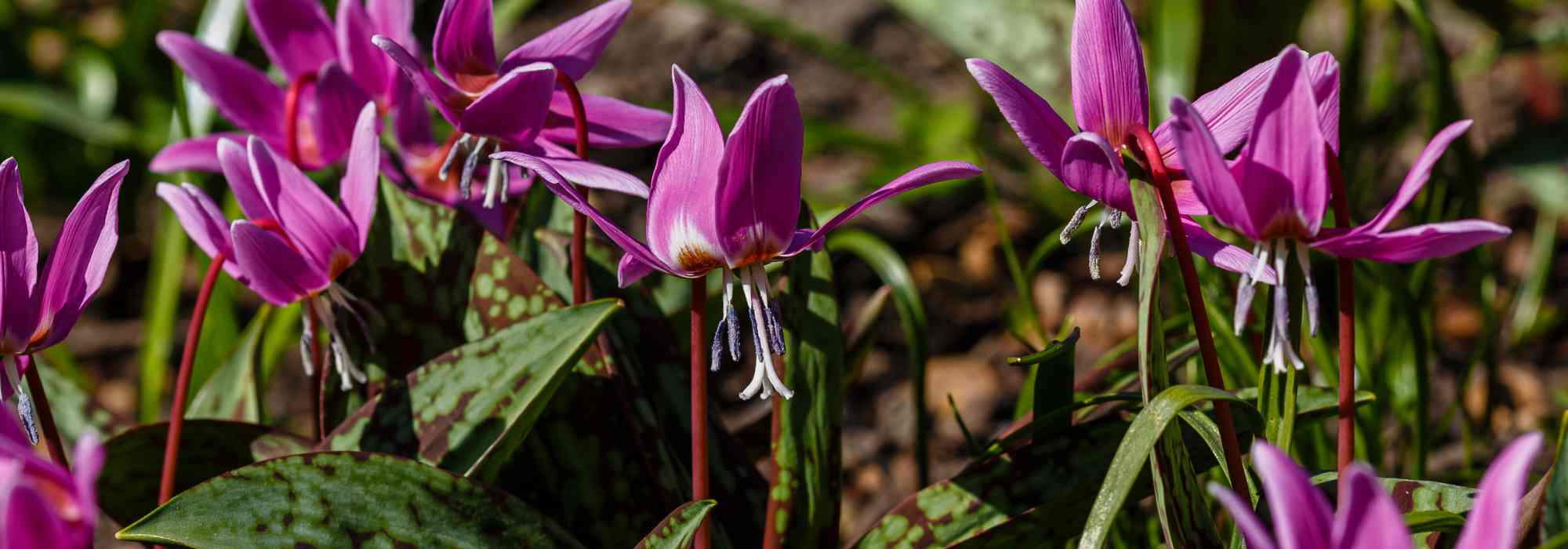
Erythroniums are not yet among the garden’s most popular bulbs. But that shouldn’t be long before they bring forth radiant colours from the end of winter! In shades of yellow, white, sometimes pink, the Erythroniums, with the curious nickname of the dog’s-tooth lily, indeed present charming lily-like flowers, but in a much smaller form. Their colours, sometimes warm, sometimes soft, can be paired with many plants, which will enhance them or provide a backdrop for them. Discover our garden planting ideas quickly, or container planting ideas for the terrace!
Read also: Erythronium: plant and grow.

In a yellow and white scene
Yellow Erythronium varieties, such as the popular ‘Pagoda’, do wonders in semi-shaded borders, with soil that stays moist, accompanied by equally sun-loving blooms and tempered with touches of white which are plentiful in early spring flowering. Its sulphur-yellow colour pairs beautifully with the fading bloom of a paperbush (or Edgeworthia chrysantha), but also with the whiteness of birch bark. There is a whole host of plants that can slip into this colour palette, such as garden primroses, narcissi (here, we choose a nuanced salmon variety with ‘Sagitta’), Epimediums with flowers so delicate, whose foliage will also provide a nice relief, Leucojum snowflakes to carry on the flowering, and a few hellebores with green or white flowers, still in bloom.
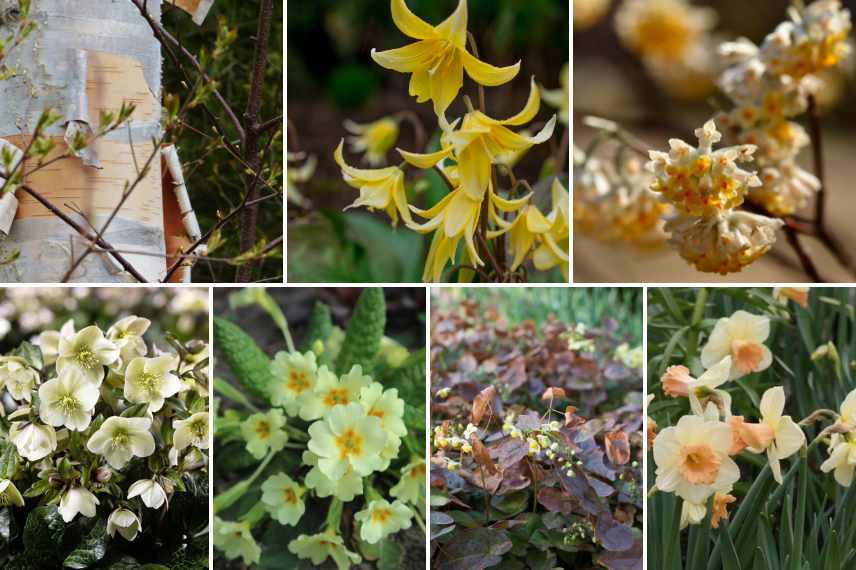
Birch, Erythronium ‘Pagoda’, Edgeworthia chrysantha, Helleborus HGC Ice’N Roses ‘Milla Marbled’, Garden primroses, Epimediums and Narcissus ‘Sagitta’.
Read also
Growing Erythronium in potsIn a blue, white and pink flower bed
To achieve a beautiful harmony of soft tones, try grouping a few pink Erythroniums, such as the botanical species Erythronium dens-canis or the charming ‘Purple King’ and other bulbous or spring perennials that thrive in cool soil. These Erythroniums are compact in habit, so plant them in a mass planting, and preferably along the edge of the border. Mix them with white, pink or blue wood anemones, a few pink and purple Pulmonarias with speckled foliage, and blue Chionodoxa to form a small, very elegant carpet. Here again, two or three hellebores will have a striking effect and add a little height, and a small groundcover such as the Cornus canadensis will extend the scene with its white flowers, later replacing the erythronium as they go into dormancy. The charm of a Bleeding Heart with white bells will accompany this bed between sun and shade, from April to May.
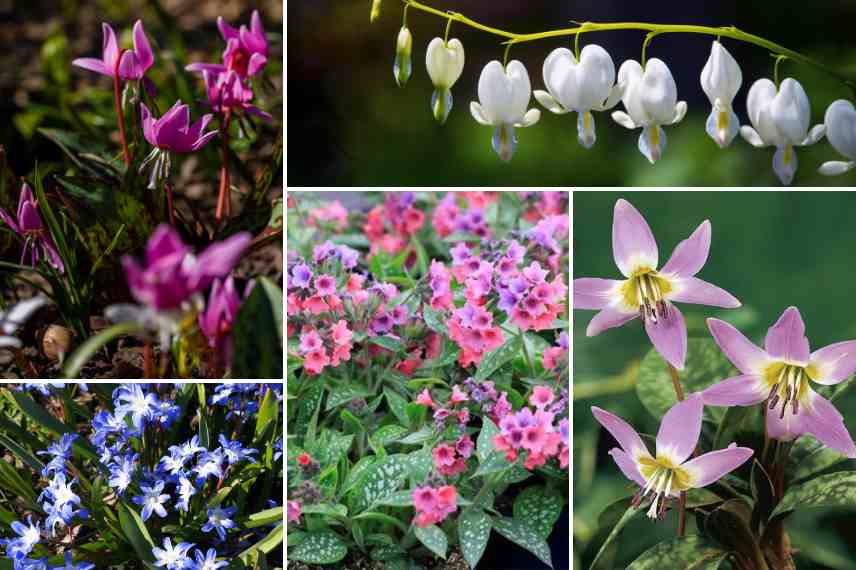
Erythronium dens-canis, Dicentra spectabilis ‘Alba’, Chionodoxa luciliae, Pulmonaria ‘Shrimps on the Barbie’ and Erythronium dens-canis ‘Lilac Wonder’.
To illuminate a woodland area
In a bright woodland or at the base of trees and shrubs, plant a few Erythronium: they naturalise here very readily, and will receive enough light before the tree canopy closes in. For this configuration, opt for low-growing botanical species, such as the Erythronium dens-canis, the Erythronium albidum, with white flowers and handsome maculated foliage, or the Erythronium japonicum. The Erythronium californicum, very slender, as well as the Erythronium oregonum, both with white flowering, are also perfect if you can manage to find them. These species will gradually colonise the area.
If the space is sufficiently sunny, a Cornus mas flowering in midwinter will bring plenty of gaiety. In this often wooded space, the aim is mainly to colour the lower stratum to illuminate the bare soil with white, yellow or pink tones. Choose wild plants such as the snake’s-head fritillaries, the Primula veris, the famous cowslip for early spring bouquets, but also the delicate Anemone flaccida, the Trilliums with white or crimson flowers. A few small Narcissi or botanical Scillas will also be charming. Finally, hostas will gradually establish from April.
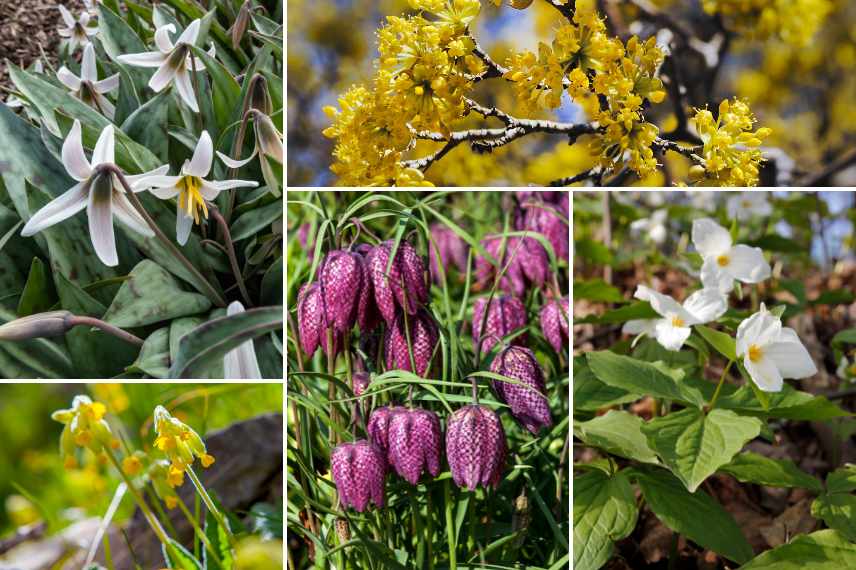
Erythronium albidum, Cornus mas, Primula veris, Fritillaria melleagris et Trollium.
Read also
5 early winter flowering bulbsIn a bed of lush foliage
What we also love about Erythronium is its foliage, typical of the Liliaceae family, but rather ample, almost exotic, as it is often punctuated with marbling or maculate white or bronze spots. It blends easily into a border where attractive foliage can have its say! With Erythronium foliage disappearing completely in summer, one might pair it with some evergreen foliage, such as Carex and Black Ophiopogon to highlight the dark stems of some Erythroniums, but also with ferns. Here, we have chosen a white-flowered Erythronium, the Erythronium californicum, but it could be replaced by the handsome cultivar ‘White Beauty’, both offering fairly large flowers and reaching at least 25 cm tall. The rounded, variegated foliage of Brunnera starting to emerge contrasts with the finesse of a Dryopteris wallichiana, and the freshness of wood anemones (Anemone nemorosa), such as the striking variety ‘Green Fingers’. All of this, of course, in a cool, partially shaded ambience like that of a woodland floor or a border in the shade of deciduous trees.
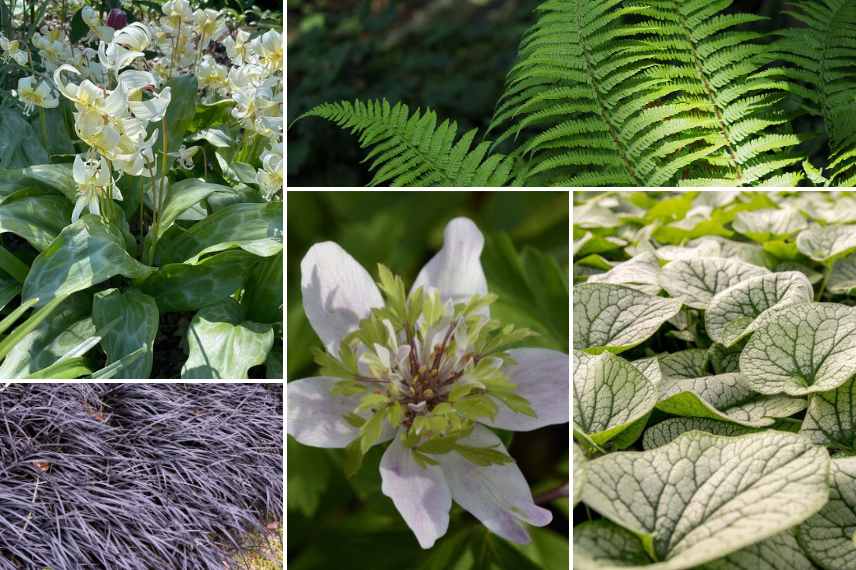
Erythronium californicum, Dryopteris wallichiana, Ophiopogon planiscapus ‘Nigrescens’, Anemone nemorosa ‘Green Fingers’ and Brunnera macrophylla ‘Alexander Great’
In a luminous pot
Finally, Erythronium can also brighten a balcony or terrace, planted in a pretty pot display or deep planter (Erythronium bulbs are long!). Why not create a lovely contrast between the complementary colours yellow and purple? We therefore choose the Erythronium ‘Pagoda’, planted with at least 6 bulbs, and surround it with a few early tulips such as the single early ‘Purple Prince’. If you have space left or your pot is small, simply add three pots of Viola tricolor. Another, more rustic option would include guinea-hen fritillaries. And here your pot display becomes a miniature garden, in full bloom as the first warm spells arrive in March and April!
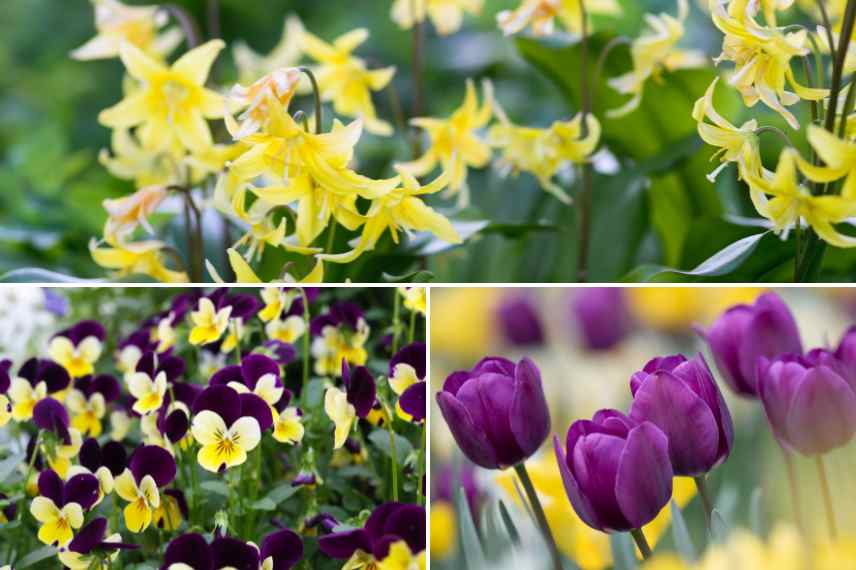
Erythronium ‘Pagoda’, Viola tricolor and tulips
- Subscribe!
- Contents
Comments