


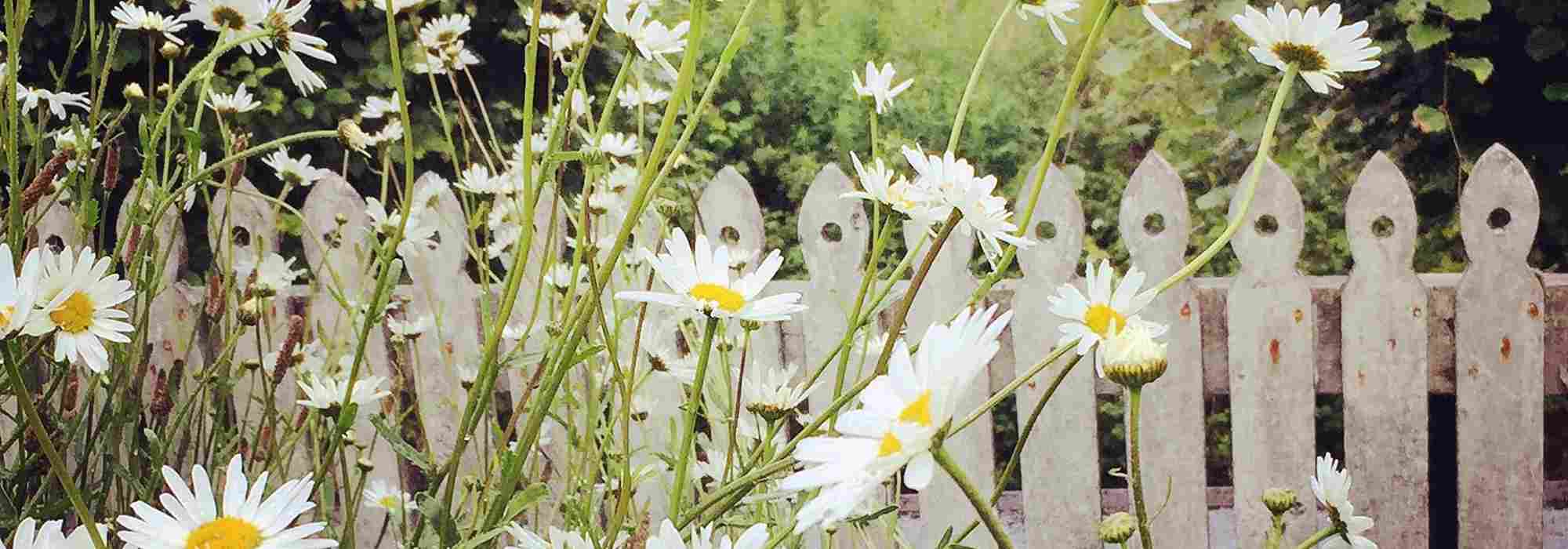
Cottagecore: the trend combining country garden and loose living
The retro charm of a countryside garden
Contents
From the English cottage (country house) and core (meaning soul or spirit in this context), the “cottagecore” trend is becoming increasingly popular: it highlights the simple values of a dream life in the countryside, a sort of new Eden, a reimagined “Little House on the Prairie“, embraced by the new generation.
Inspired by 19th-century English aesthetics, widely followed and discussed on social media since the onset of the Covid pandemic, this lifestyle advocates an art of living, as well as artisanal values, a need for comfort, as much as a desire to step away from the tumult of the world. Cottagecore translates into the gardening world as a longing for simplicity in plants, with a more relaxed attitude towards gardening, a return to a rewarding and nourishing nature, and a way of living and thinking that is “sustainable”.
The cottagecore garden is intended to be abundant, a bit retro, and charmingly nostalgic, blurring contours and lines, and embracing a certain laissez-faire. Let’s discover it!
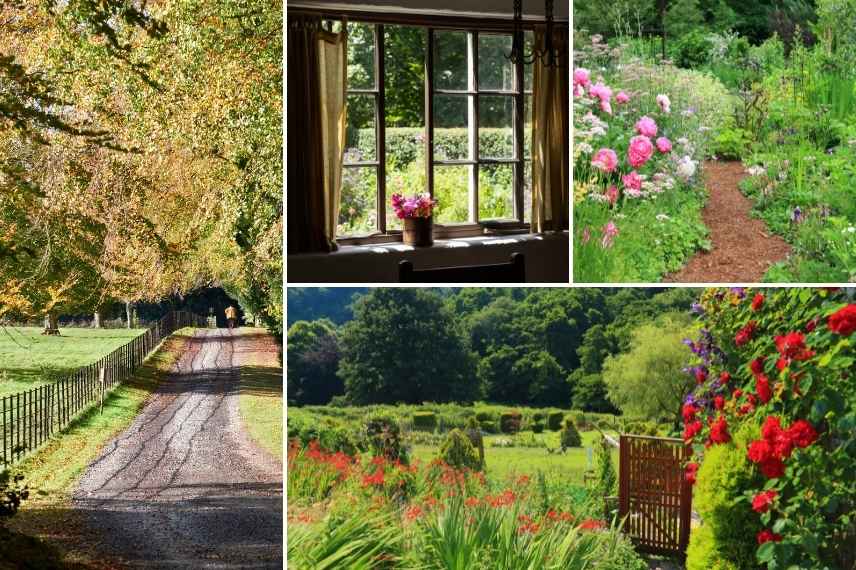
A charming vision of the garden, with countryside accents, this is the trend of the moment!

An abundance of flowers
Happiness is in the meadow… or almost! Advocating for a cottagecore garden means embracing a space that disregards certain principles like precise associations or a defined style.
The cottagecore trend is asserting itself with a bucolic garden, pastoral, as a return to roots, in ultimate communion with nature. It fills with flowers, bursting with colour from spring to autumn, overflowing with a vegetal abundance that transports you to a soothing place, where only birds disturb the surrounding calm.
The aim is to create a romantic jumble in a cocooning spirit, a profusion of informal colours without worrying about conventions. Among the little treasures to invite into this garden: climbing English roses and rambling roses, generous Oriental poppies, phlox, alliums, campanulas, daisies that are fresh and simple, and lychnis radiant, beautiful bushes dripping with flowers like Kolkwitzia amabilis in spring, hawthorns and cherry trees in bloom, or fragrant lilacs. Bulbs reminiscent of the natural meadows, such as botanical daffodils or snake’s head fritillaries, also contribute to creating a charming atmosphere, reminiscent of a garden from yesteryear. We also turn to annual plants without worry, coming back to life each summer, like California poppies, or cosmos and erigerons, all these plants that will be laden with a profusion of flowers, almost uninterrupted in summer. In terms of colours, it’s a mix of pastel or vibrant tones, it doesn’t matter, as long as the whole exudes softness and cheerfulness. The most beautiful flowers will be picked to compose bouquets, to be placed in the house… or on a lovely table in the garden!
This return to the countryside, whether experienced daily by city dwellers craving nature and calm, or a place to quickly retreat to every weekend, is shared in a timeless microcosm imbued with charm.
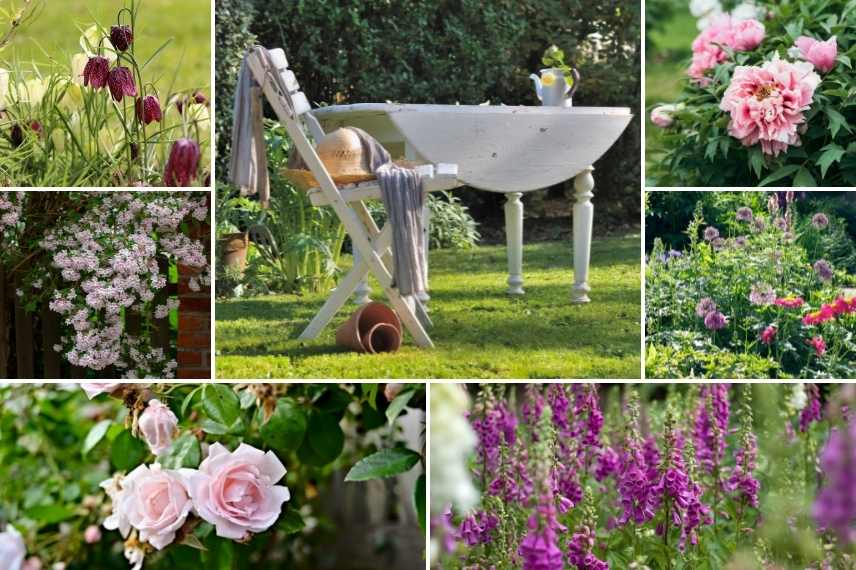
Fritillaria meleagris, Kolkwitzia amabilis, climbing rose, peonies, Allium, Veronicastrum and Digitalis… A little abundant and colourful universe around vintage furniture straight from the home
→ Also see our range of cottage perennials, self-seeding plants, and our article on vintage plants from grandmother’s garden.
Read also
Designing a country gardenA welcoming pantry
The desire to eat healthier and closer to home is more relevant than ever. In an ideal vision of a natural lifestyle that we wish to recreate, a small vegetable garden is essential…
However, it is not necessarily separate from the rest of the garden. Integrating it harmoniously is possible with many soft fruits (raspberries, blackcurrants…) that can be interspersed among cheerful perennials or annuals. Standard fruit trees like apple, pear, or quince trees will join spring-flowering bushes such as Prunus or hawthorns, while chards, rhubarb, and artichokes will proudly stand among cosmos or sages, with aromatic plants—particularly culinary sages with their soft grey leaves—finding a lovely spot.
Some vintage glass or wicker cloches will enhance this nourishing garden, making it even more charming among the flowers!
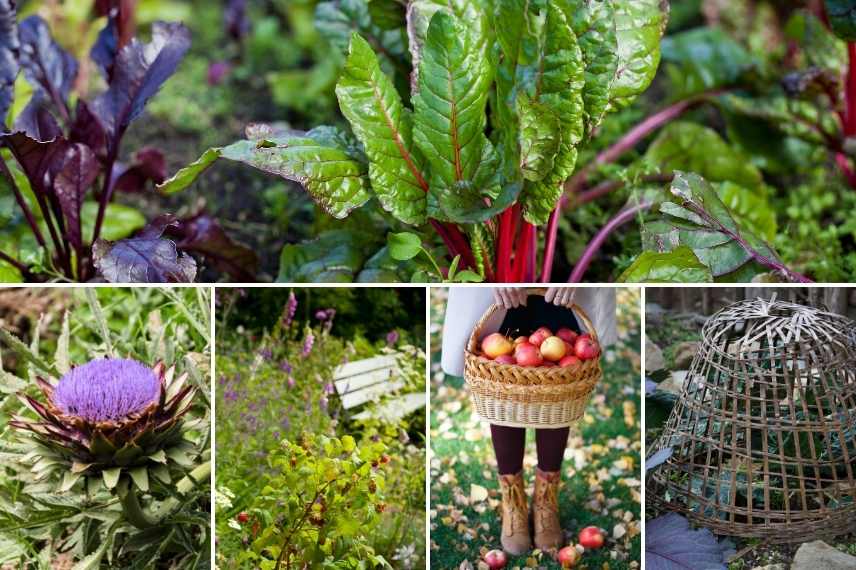
Chard with red stems, some artichokes left to flower, wild raspberries near foxgloves, apples ready to be picked, and a few vintage finds to further decorate this rustic garden…
Blur in the structure
The cottagecore garden trend is an undeniably rustic garden, without any particular artifice, focusing on showcasing a lush and free nature in its structure. There’s no need for excessive regularity or aestheticism… quite the opposite! Moreover, this garden is often associated with an old or characterful country house, even a farmhouse. It is essential to respect the spirit of the place.
However, achieving this natural, even wild effect is not as simple as it seems. Initially, the focus is on blurred lines, without any particular perspective. Pathways will be curved or random, following the terrain’s contours. The lawn often fades away in favour of opulent flowerbeds that fill the view and space.
It is the plants that will contribute to creating a “blurring” effect: the silhouettes of the bushes are soft, the foliage displays itself with flair, and tabular forms like dogwoods or arched bushes soften the outlines and curves. Thick thickets allow access to a green nook where a table and chairs, found or reclaimed, can be placed in a vintage spirit.
Perspectives remain blurred, as one hesitates between a bohemian garden and a secret garden, maintaining small hidden spots, even wilder, just waiting to be discovered… One also creates some views and gaps at the periphery of the garden to gracefully open it up to the surrounding landscape (using wooden barriers or smooth-type fences, gabions, etc.)
→ also see our tips on designing a secret garden, the bohemian garden, and creating a thicket in the garden
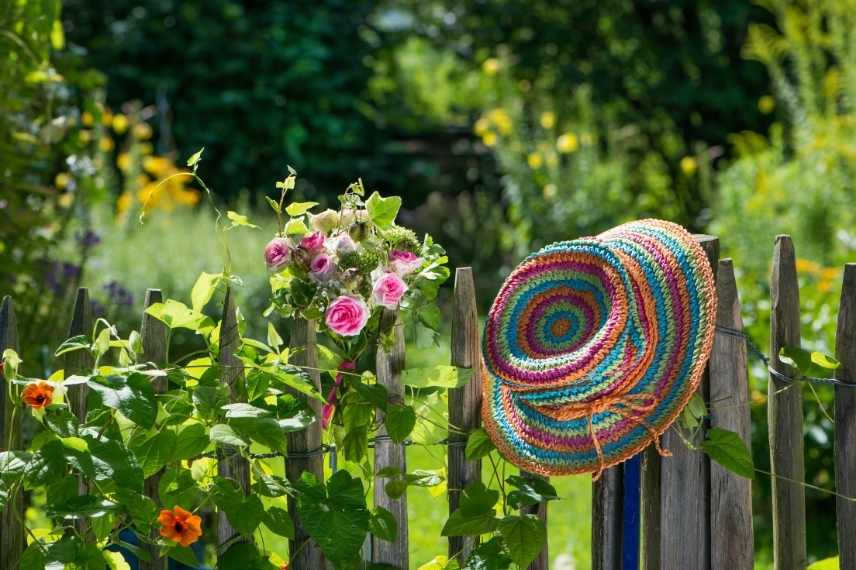
Fences like these lovely gabions draw the eye, subtly blurring the spaces with a few summer climbers
A certain laxity
In this new garden where we love to take our time, laziness sometimes creeps in a little, or a lot, without detracting from this space designed to be easy-going and spontaneous. For new gardeners, it’s really another way to experience gardening, between slow gardening (yet another anglicism… we should rather speak of a relaxed approach to gardening), and living in harmony with nature.
Life at a slower pace is embodied by the addition of layers for resting, easy-to-move sun loungers according to one’s mood, benches for dreaming under pergolas dripping with climbing and fragrant plants, the creation of a jetty by a water feature for meditation and escape, simple details that blend into nature…
In terms of planting, in the vegetable garden for example, there’s no strict arrangement, and we let squashes spread across the beds or climb on trellises.
A sense of letting go is essential when it comes to maintenance: it’s not about heading towards a chaotic garden, but rather accepting slightly less tidy flowerbeds, allowing voluble climbers to flourish more than necessary without resorting to pruning shears, using self-seeding flowers that make life easier, and favouring perennial plants and grandmother’s garden flowers, those easy plants that make life simpler by returning more beautiful, season after season…
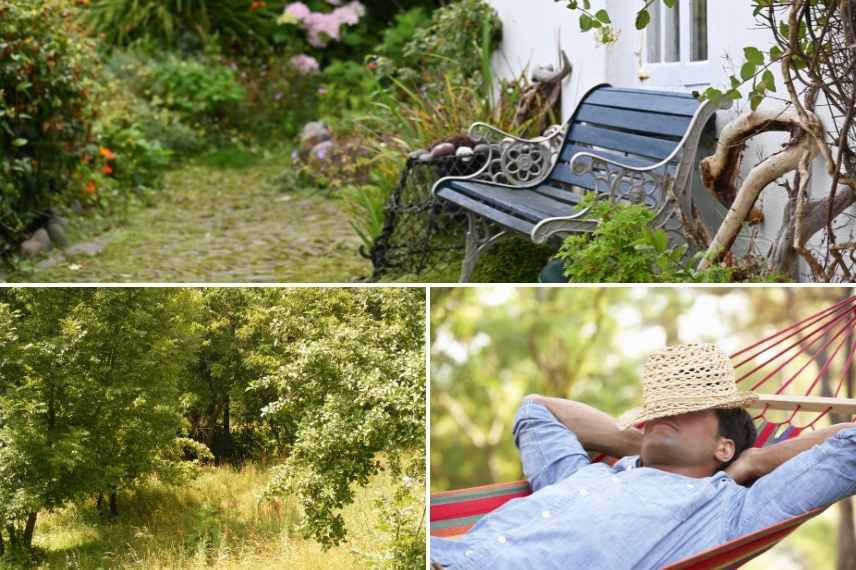
It doesn’t matter if the garden isn’t “spotless”, on the contrary… We also reserve time for ourselves!
On the library side...
One can rely on the web and social media, which are keen on the cottagecore theme, to escape and start dreaming… However, many books have emerged in recent years about country living and nature-inspired gardens. Among these, I recommend (these come in French, but two of them are of British authors, can be found in their original versions):
- Living Autonomously in the Countryside by Bella and Nick Ivins, published by Eyrolles (2016). A lovely introductory guide by a couple of English people who moved to a farm in Sussex, covering practical aspects of the home, ornamental garden, vegetable patch, and orchard, as well as wood management and beekeeping…
- A Little Piece of Paradise: The Art of the Small Garden by Isabelle Olikier-Luyten, published by Ulmer (2022). A small book filled with beautiful ideas for a lush garden that is both romantic and natural;
- The perfect country garden by Sunniva Harte, published by Gründ (1999). A beautiful book that may be a bit dated but remains very relevant in style and practice for country gardening.
- Subscribe!
- Contents
Comments