





























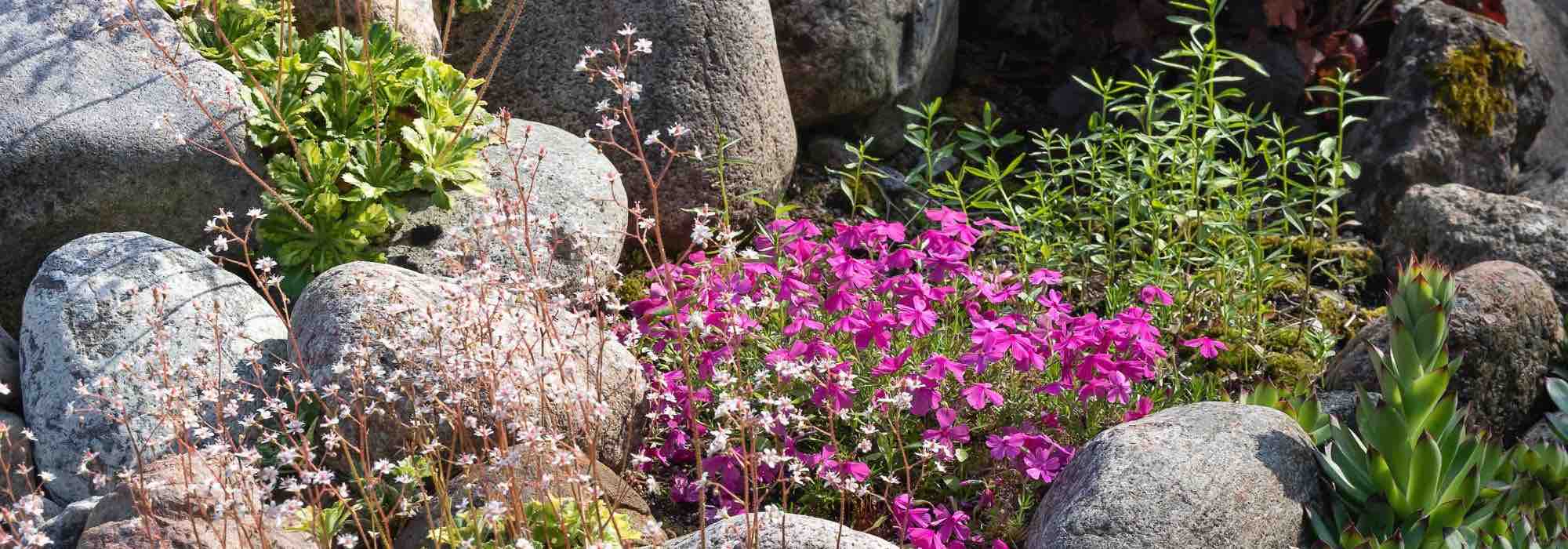
Create an alpine rockery.
Tips and tricks for a successful rock garden
Contents
The alpine rock garden (also known as an alpine garden) is widely loved by many gardeners. If its installation requires a little preparation, the result obtained takes the imagination on a journey, in effect bringing the mountains within sight. The cultivation conditions it offers allow, in fact, to acclimatise certain plants that could refuse to grow in a traditional bed. A blend of mineral and plant life, it becomes a miniature landscape to admire all year round.
In this article, I invite you to discover what characterises an alpine rock garden, how and where to lay it out, which plants to select for a natural look and how to maintain it.
What is an alpine rockery?
An alpine rock garden aims to artificially recreate certain landscapes that one may encounter in the mountains, where different plants grow on steep, rocky terrains. In such an environment, plants are generally well exposed to the sun, and the water they receive from precipitation does not stagnate at the level of the roots or the collar (the junction between the above-ground and underground parts). Moreover, the rocks present store the day’s heat to release it at night, thus creating a favourable microclimate. They also provide a certain coolness (water evaporates less quickly beneath the stones) from which plants can benefit without risk of overwatering.
Create a rock garden in one’s garden allows one to reproduce some of these conditions and to grow plants that might not thrive without this little boost. Indeed, high humidity or heavy soil, particularly when associated with cold, prolonged temperatures, risk suffocating the roots of alpine plants and this can be fatal.
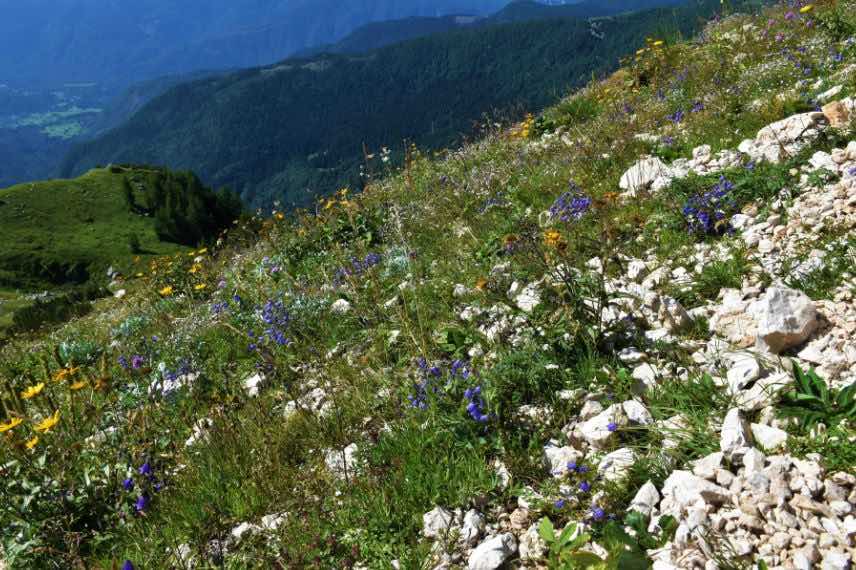
A natural mountain landscape: a slope, rocky soil, and high-altitude plants typical of this environment
Read also
Alpine perennial plantsHow do you create a rock garden?
- To copy nature as closely as possible, it is essential to work on ground that offers a minimum gradient. Thus, water drains down the slope of your ‘bank’ and the plants never become waterlogged. If your site is already sloping, make the most of it! If not, create an artificial slope by forming a mound. This can be achieved by reserving for this purpose part of the soil excavated during the construction of a house. On existing ground, you can always have topsoil delivered. Rest assured, you do not need to create an Everest in your garden! A total rise of around 60 cm every 2 metres is more than sufficient. If the slope is steeper, that isn’t a problem, provided you stabilise the whole with rocks. Rather than shaping a regular slope, try instead to create terraces and ledges, with some parts that rise a little from time to time, as occurs in a natural environment.
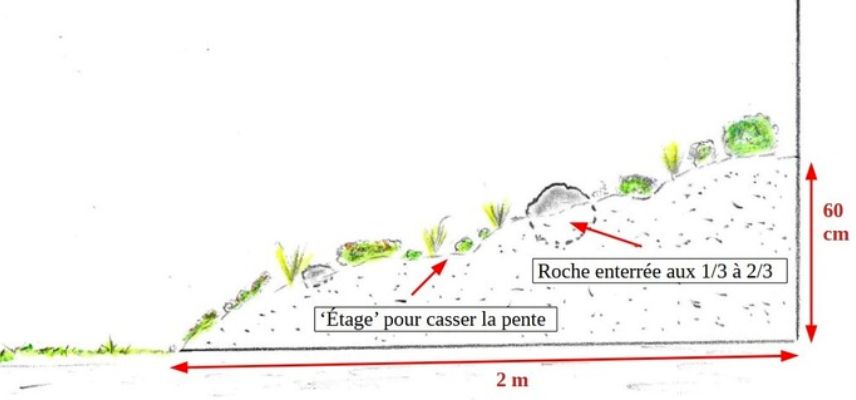
Slope diagram, sketch © Jean-Christophe Aumont
- Une fois votre talus matérialisé, il vous faut maintenant apporter les éléments minéraux à votre rocaille. Choisissez des roches de dimensions différentes, dont certaines sont suffisamment grandes pour à la fois créer le décor et retenir la terre. Les pierres locales sont à prioritiser pour des raisons d’intégration au paysage et aux constructions environnantes mais aussi afin de limiter leur empreinte écologique. Disposez vos roches de façon faussement aléatoire et la plus naturelle possible. Pour les roches les plus imposantes, faites des tranchées de façon à enterrer leur base d’au minimum 1/3, voire 2/3 si elles sont vraiment imposantes, afin de garantir leur stabilité. Ces pierres ont aussi pour fonction de retenir la terre de votre massif et d’empêcher le substrat de finir en bas de votre réalisation sous l’effet des précipitations. Dans un souci esthétique, alternez roches plus grosses et plus modestes. Des pierres plus petites et des cailloux servent aussi à mimer les éboulis rocheux qui se produisent sur les flancs des montagnes.
- Lors de la conception, anticipez l’entretien futur. Il faut que vous puissiez avoir accès à votre massif. Selon la taille, l’inclinaison et la forme de votre rocaille, pensez éventuellement à aménager des sentiers, pas japonais ou marches pour vous faciliter la tâche.
- La pente crée un drainage naturel, mais augmentez ce dernier en rajoutant à la terre une bonne part de matériau drainant, tel que des graviers de différents calibres et du sable grossier. Les plantes alpines poussant en sol pauvre, l’ajout de matières organiques est rarement nécessaire.
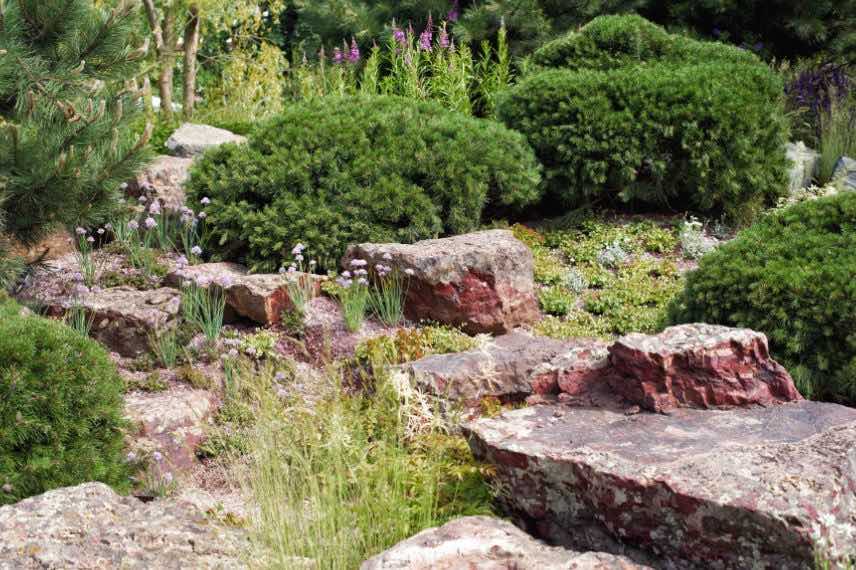
The aim is to create a substantial yet irregular slope, and to install rocks of different sizes
Which sun exposure should I choose?
Alpine plants prefer open, well-exposed positions. In regions with very hot and very dry summers, a west-facing exposure may be preferable. Elsewhere, a south-westerly, or even a southerly, exposure is feasible.
Read also
15 plants for a sunny rockeryHow to plant a rock garden?
Rock garden planting generally follows the same principles as those for a traditional herbaceous border.
1. Ensure that the soil has been well weeded.
2. For shrubs, which require larger planting pits, use a spade and dig a hole roughly twice the size of the pot. A small transplanting trowel is sufficient to create the planting holes for perennials and bulbs (Note: there are special narrow rockery trowels available for rockeries). Proceed in the same way as for shrubs, keeping proportions in mind.
3. If required, add a little drainage material to the soil.
4. After soaking your shrub in a bucket of water to saturate the substrate, unpot it and place it in the centre of your hole.
5. Fill with the remaining substrate and lightly firm with your fist.
6. Water generously, but in several small applications.
7. Once planting is finished, spread a layer of gravel over the soil surface around the plants and rocks. This layer acts both as insulation against the cold and, moreover, helps prevent the plant collars from direct contact with moisture, not to mention the aesthetic it provides.
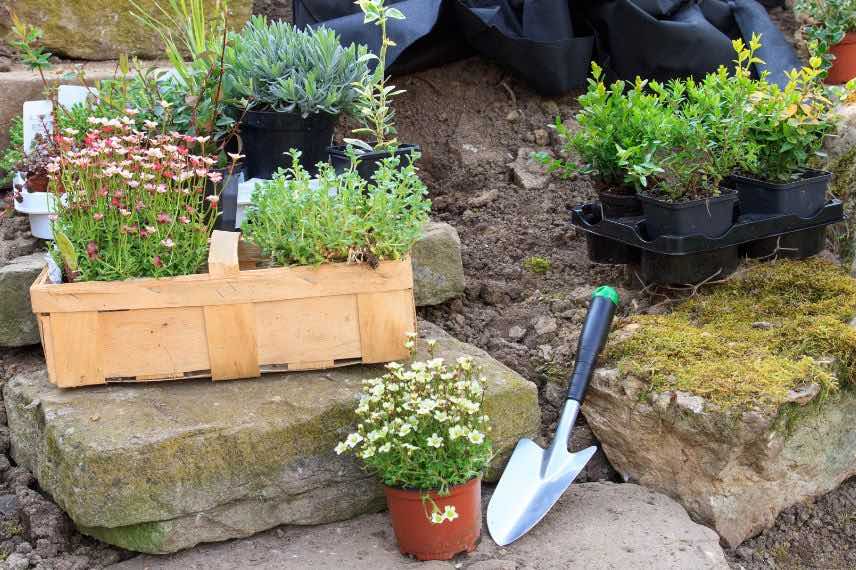
The planting of an alpine rock garden is similar to that of a border once the layout has been created
Which plants for an alpine rock garden?
Different plants can be used to plant up such a scheme, ranging from the tallest with an upright habit to those adopting a trailing, ground-covering habit. However, be careful to adjust the size of your plants to match that of your composition in order to maintain a good balance. The larger your rockery, the more you can accommodate vigorous-growing specimens.
- Generally, alpine shrubs are often evergreen and mainly represented by conifers, which helps them cope better with climatic vagaries (cold, wind, snow…).
- With perennials, vary the flowering but also consider the foliage which provides colour over a longer period, especially with evergreens whose presence brightens the rockery all year round.
- Finally, don’t forget early-blooming bulbs that kick off the season, very early for some, and a few grasses for their lightness.
Evergreen shrubs
Among evergreen shrubs and undershrubs you can use in a rockery alpine think, for example, of Heather (Erica), Cotoneasters or the Black Crowberry (Empetrum nigrum). Difficult, or even impossible, to envisage such an arrangement without rockery conifers, which combine slow growth, modest dimensions and sometimes striking, season-to-season changing colours. Rockery conifers, Cryptomeria, Cypress, Spruces, Junipers, Pines or Thuja are just a few examples of shrubs with upright or more globose or prostrate habit, allowing to create pleasing contrasts of shapes and silhouettes. Their foliage also comes in a range of greens but also in vibrant yellows, blues and surprising oranges that never leave you indifferent.
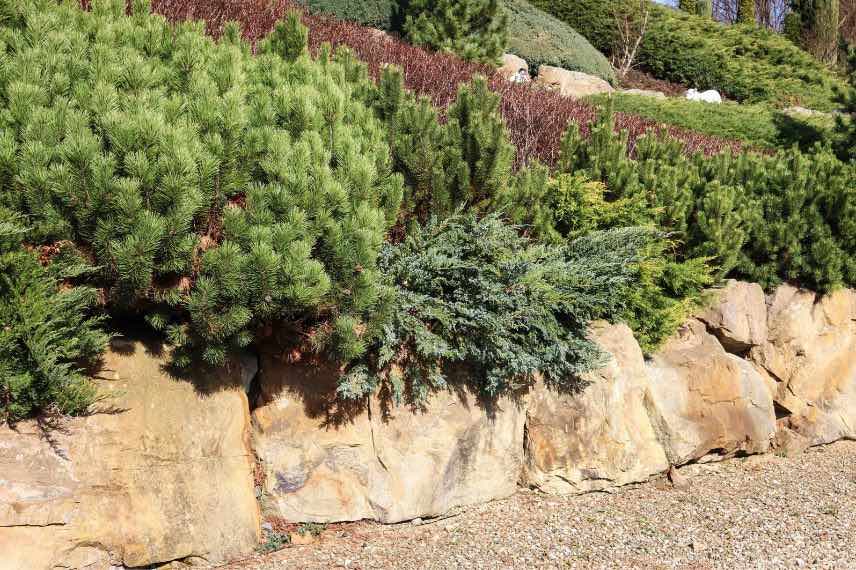
Dwarf conifers are essential in a rockery
Deciduous shrubs
Deciduous shrubs allow you to variety the palette and to complete scenes with flowering or fruiting displays, with enchanting fragrances or with interesting foliage. Among those that can be incorporated into your rockery, turn to, among others, Barberries, Caryopteris, Coronillas, Genêts or Potentillas.
High-growing perennials
Alpine perennials whose growth exceeds a metre are not numerous, but some can create interesting verticals, such as willowherbs (Epilobums) with summer flowering, ornamental thistles with distinctive form, or Yellow Gentian (Gentiana lutea) whose bright blooms require patience.
Low-growing perennials, cushion- or mat-forming
Many rockery perennials adopt a low habit, forming dense cushions or carpets that follow the shape of the terrain. Ideal in the foreground, they also act as a frame for their taller neighbours. For example, the very popular Basket of Gold, Aubrieta, Iberis and certain Erigerons not forgetting the Alpine Gentian, Moss Phlox, the Alpine Aster, Sagina and, of course, the iconic Edelweiss.
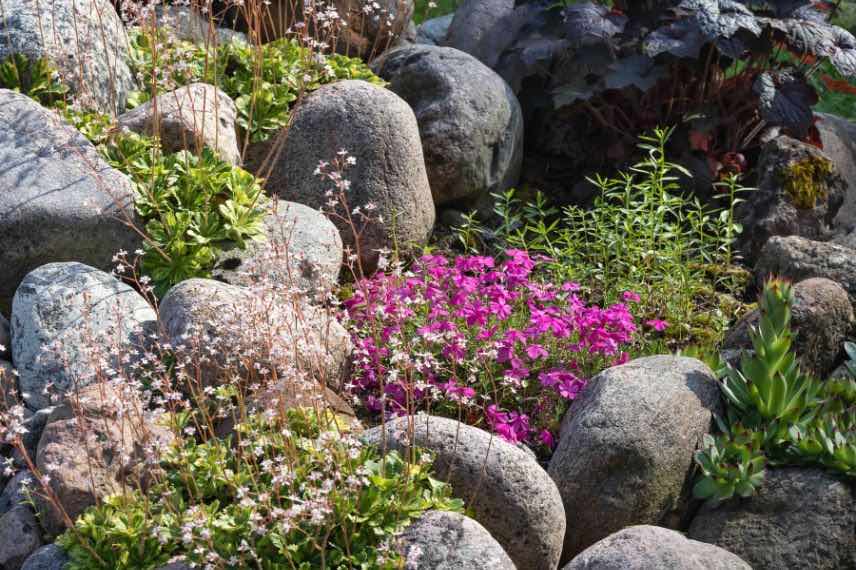
Moss Phlox and some Saxifrages make good rockery plants
Mediterranean and desert perennials
Nothing prevents you from straying from the beaten (mountain) paths and integrating plants that are not alpine plants but which, like them, prefer well-drained soil and sun. Sempervivum, cacti, Aloe, Aloe, Crassula, Delosperma, Echeveria, Mangave and their kin provide a touch of originality and exotica, the limit depending on the hardiness of your region.
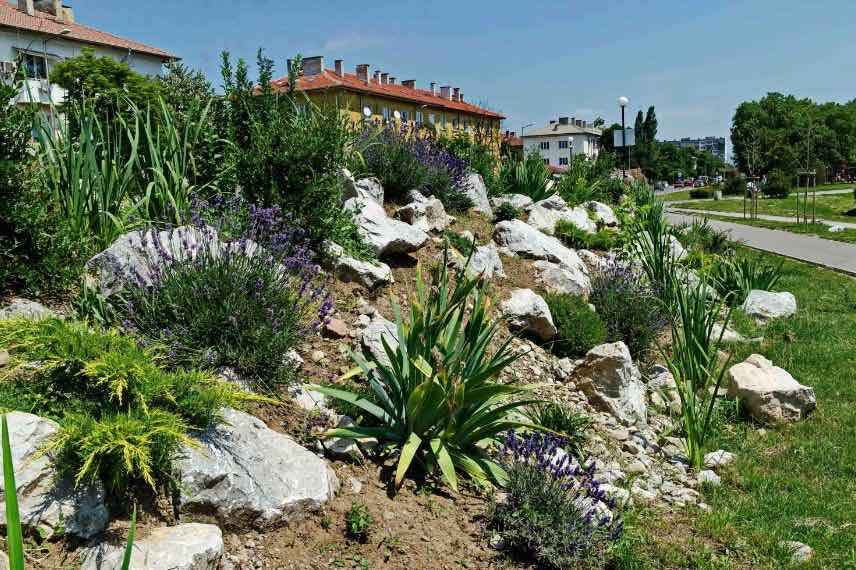
A rockery integrating desert and Mediterranean plants
Bulbs
It is easy to insert here and there groups of bulbs that wake up the end of winter and spring with their sparkling colours. Easy to grow, reliable year after year, sometimes naturalising, they are the guarantee of a rockery that flowers early in the season. Crocus, Iris pumila and Iris reticulata, Ipheion, botanical Narcissus, Snowdrops, Scilla ‘Tubergeniana’ or botanical Tulips… all have something to tempt us!
Grasses
Grasses bring flexibility and movement to a rockery. Since alpine plants are often low, stay with this spirit by choosing, for example, Blue Oat Grass, Fescues or Cheerful Feather Grasses.
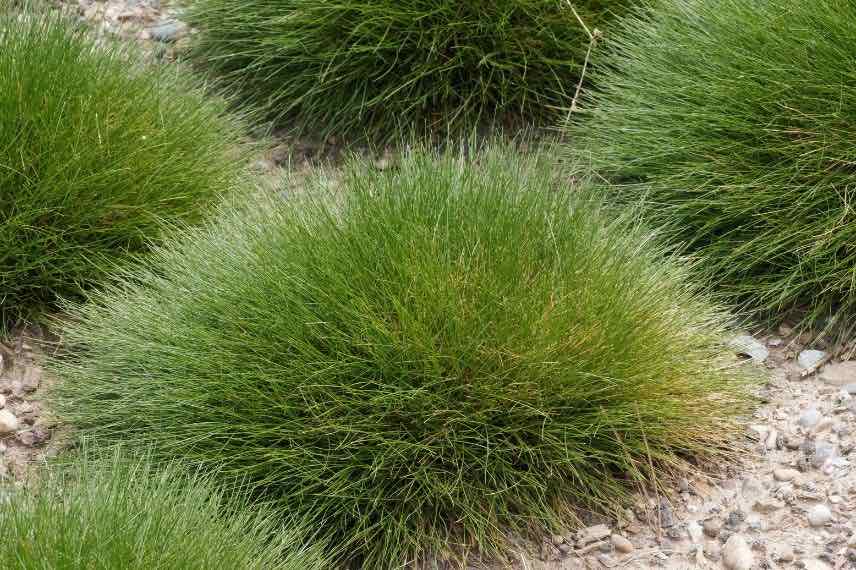
Finally, tiny grasses like cushion-forming fescues are excellent rockery subjects
Rock garden maintenance
Maintaining a rock garden is not difficult at all, especially as the plants grow and cover the soil.
- Initial weeding before planting is, of course, the foundation but should be continued over time, when necessary, in order not to let unwanted competitors compete with your prized plants and to maintain a neat display.
- It is advisable to water your plants just after planting but you also need to monitor that the soil does not dry out too much in the early months, as your plants establish themselves. The plants shown here tolerate dry conditions, but the climate changes we are experiencing each year may force the gardener to water from time to time during prolonged drought. Be sure to water with a fine spray to avoid risking displacing surface gravel or dislodging your plants.
- Remove spent blooms when necessary and trim the dry, unsightly parts.
- After a few years (about 3 to 4 on average), some plants benefit from being dug up to be divided and thus rejuvenated.
- Some delicate plants may require winter protection in the form of a transparent polycarbonate sheet. This sheet, secured by stakes driven around the plant, lets light through but prevents rain from reaching its heart, thereby protecting it from rotting.
Further reading...
- Discover our wide range of alpine perennials!
- Find more inspiration with our rockery perennials.
- Take advantage of the wide diversity of rockery conifers!
- Subscribe!
- Contents
Comments