





























Creating garden steps: our tips to elevate your outdoor space
Considerations, materials, planting and execution
Contents
Installing a staircase undoubtedly helps to structure space. It is a decorative element, but above all a functional one, which will facilitate circulation and access to different levels of the garden. To this end, it must meet certain criteria to ensure it is safe and practical. But the aim is also for it to blend well with the landscape. In this article, discover our tips for creating a garden staircase.

Key questions to ask in advance
First, to plan the most appropriate layout, it’s worth considering your objectives. Installing a garden staircase is primarily for practicality and accessibility: to reach the top of a bank, to ascend a slope, to guide visitors to a specific area (terrace, entrance, pool…), etc. But aesthetics should not be neglected either: the staircase can be used to highlight an area.
Materials
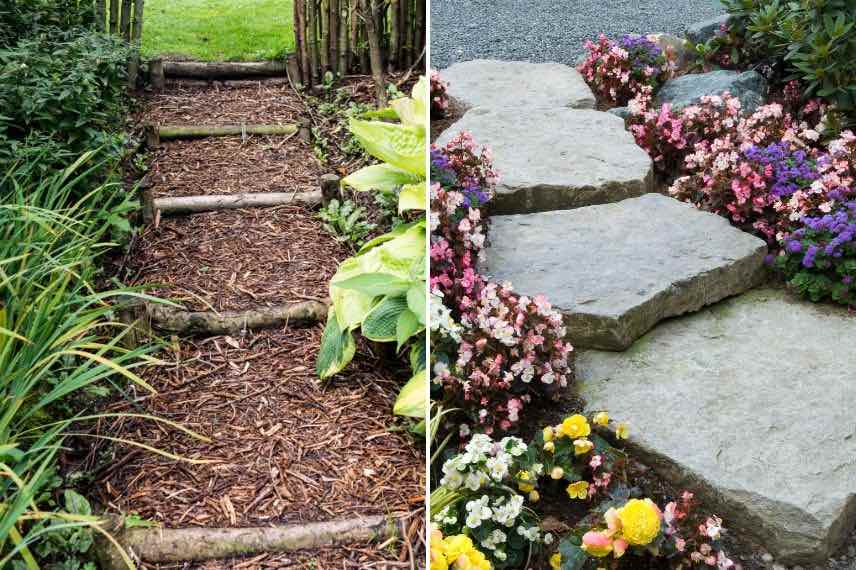
You should choose materials, each with its own advantages and disadvantages. For your staircase to integrate seamlessly into the garden, it should be made from materials that harmonise with the space, whether in texture or colour. A garden staircase in raw concrete will be fairly coherent in a space with a modern style, whereas wood or stone will be harmonious in a rustic and natural garden. Your budget can also help you decide.
- Concrete. It is an economical and solid material, but not the most eco-friendly. It does not necessarily have a very warm appearance, but it can be dressed with tiles, paving stones or bricks, render, wood, etc. It can become less aesthetically pleasing over time if it darkens and requires heavier masonry work.
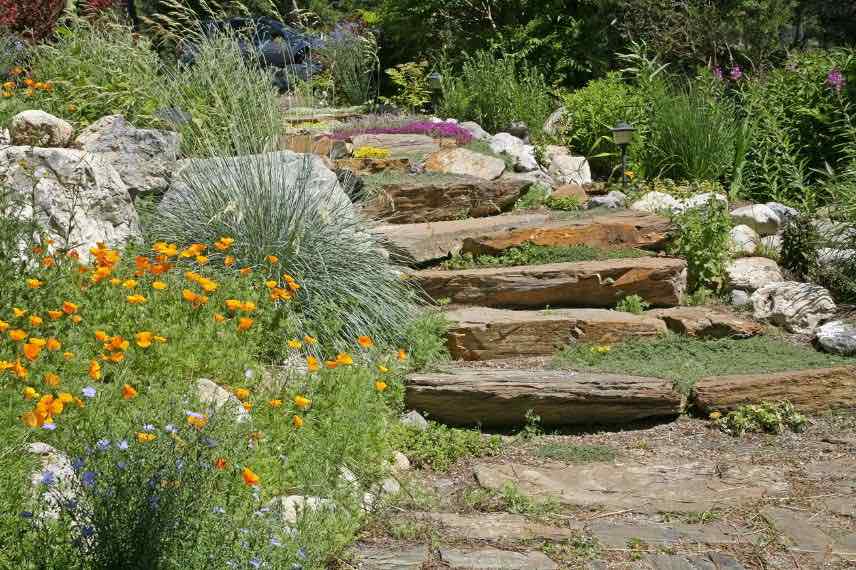
- Natural stone. It has a lot of charm and is appreciated for its rustic character. However, it is more expensive to buy and can be slippery or frost-prone, depending on the type chosen.
- Reconstituted stone. It can be seen as an intermediate between natural stone and concrete.
- Wood (logs, boards, beams…). It integrates easily into a garden and feels warm, but will require maintenance to stay protected against weather, fungi and insects. Opt for durable timber and prefer grooved woods to limit slip risks. For a more eco-friendly staircase, opt for locally sourced timber.
- Metal. Strong and durable, it is more commonly used for external or cantilevered staircases.
You can also use reclaimed materials, such as old kerbstones.
The length and shape of the staircase
Take into account the slope on which you plan to implement your staircase. If it is fairly gentle, you could indeed create a steep staircase with only a few steps.
If the slope is steeper, it is preferable to create a winding staircase, so that the ascent is easier.
If the slope is long, you can plan intermediate landings. Generally, this is recommended when there are more than eight to ten steps in a row.
You can also opt for a gradine or a donkey step, which are lower risers but much deeper treads.
To facilitate movement, you can also add a handrail. To improve safety further, plan for stringers (vertical sides that prevent the foot from stepping off the tread and help contain soil from runoff).
Calculate the dimensions and the number of steps
The number of steps, their rise and configuration must be adapted to the site. Start by measuring the space where you plan to build your staircase, to determine its future dimensions. Also measure the slope of the ground. To calculate the number of steps, divide the total height to be climbed by the rise of a step.
To ensure the staircase is comfortable to use, it is generally recommended to allow a riser height of about 12 to 17 cm (the vertical part). Then allow a tread depth of 30 to 40 cm (where the foot rests). Depth is proportional to height. The higher a step, the less deep its going. Don’t forget to check your local planning regulations: there are standards for staircase construction.
The most general calculation is twice the riser height plus the going equals 65 centimetres, roughly the length of a stride (the length of a step). For a rise of 15 cm, the tread depth would therefore be 35 cm.
When it comes to the width of the staircase, decide whether you want two people to be able to pass each other or walk side by side on the stairs. If so, allow at least 1.5 metres in width. Otherwise, in tighter spaces, 1 metre will suffice.
Staircase design
Equipment
- a shovel
- a spade
- a rake
- a spirit level
- a tape measure
- a mallet
- a trowel
- protective equipment (gloves, goggles…)
This list may vary depending on the type of staircase to be built. You may therefore add sand, cement, mortar, wood, stone, stakes, etc.
How to proceed to build your staircase?
Whatever type of staircase, start by marking out the planned location with taut string, attached to stakes or reinforcing bars.
Next, remove any vegetation from the work area with the spade.
Continue the layout by shaping the landings with the shovel to excavate the soil to a depth of around fifteen centimetres, from bottom to top. Compact the remaining soil until it is stable and perfectly level.
Lay the steps one by one with a slight forward tilt (1 to 2%) to allow rainwater to drain naturally. If you opt for a traditional staircase, let them overlap by at least 2 cm.
For fairly heavy materials (stones), a bed of sand laid on levelled ballast or soil may be enough to stabilise the whole, provided the ground is well compacted. Otherwise, a layer of concrete will be necessary. You can use straps to handle the heaviest steps. Consider installing a geotextile fabric to prevent the growth of unwanted plants between the steps. Fill the joints with mortar.
A concrete staircase will be formed by constructing formwork for each step. Optionally add a metal reinforcement to limit cracking over time.
Stairs made from wooden logs should be fixed with stakes driven into the ground. To prevent the steps from becoming slippery over time, you can fix a mesh to them.
Integrate the staircase into the garden to achieve a harmonious look.
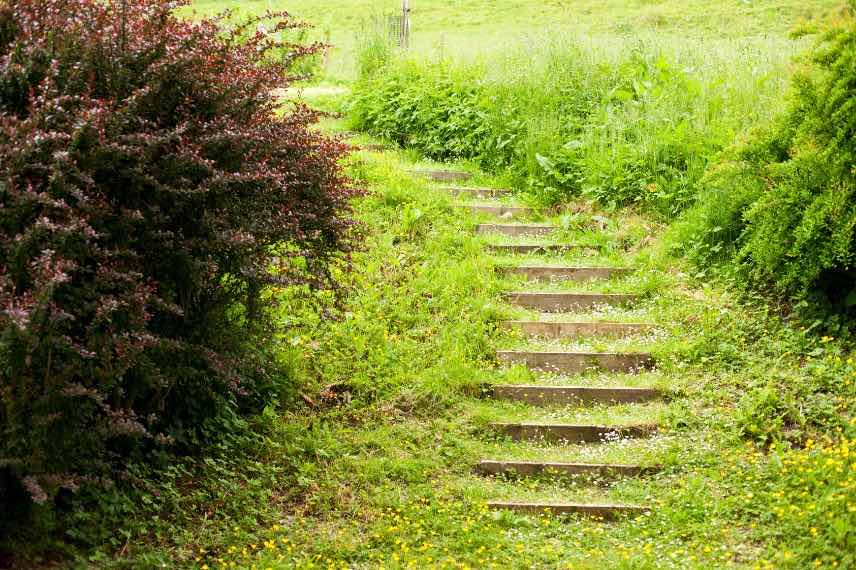
To ensure the staircase sits in harmony with the rest of the landscape and doesn’t look as though it’s been dropped in, nothing beats plants. They will soften the rather strict, geometric layout and let you play with volumes.
If you choose to install landings in your staircase, it’s ideal for adding pots of flowers or for creating a small border, a small planting bed, or even a hedge.
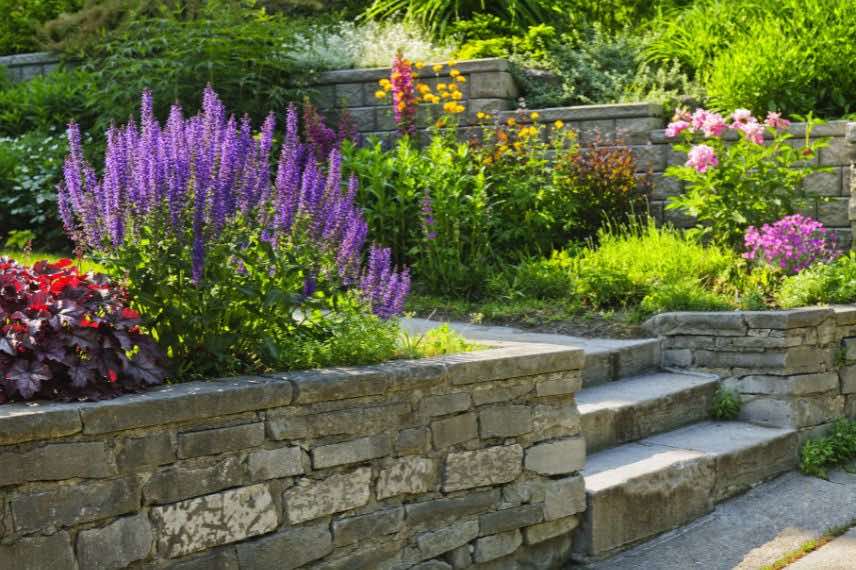
Around the staircase, you can also add plantable borders, or a stone retaining wall.
To choose the plants to grow around a staircase, consider:
- Your growing conditions (soil, exposure, climate…);
- their habit (avoid plants that are too imposing);
- their tolerance to pruning (regular pruning may be necessary if they spill over onto the steps, especially for shrubs);
- their root system, which should not be too invasive, suckering or vigorous, to avoid risking damage to the staircase and lifting the steps;
- their fruiting, which can make the steps slippery and dirty when fruits fall to the ground.
Ground-cover perennials or creeping will be perfect for this use: Aubrietas (rock cress), hardy geraniums, short ornamental grasses, bergenias, hostas, creeping bugle, etc. In fairly poor and dry soil, also think of rock garden plants, such as the sedums, the alyssums and the sempervivums. Don’t forget small shrubs : dwarf roses, heathers, rosemary, lavender, dwarf photinias, etc. If you are potting up containers, turn to the container perennials, paired with a few annuals.
A l’inverse, évitez donc de planter des running bamboos, des mimosas, des wisterias ou encore des Sorbaria sorbifolia. Bannissez également les fig trees, les black mulberry trees ou les Prunus domestica.
The first two years of growth, remember to water your plants, even the most undemanding ones, while they establish and develop their root system. You may also install a soaker hose or a hidden drip-irrigation line to help.
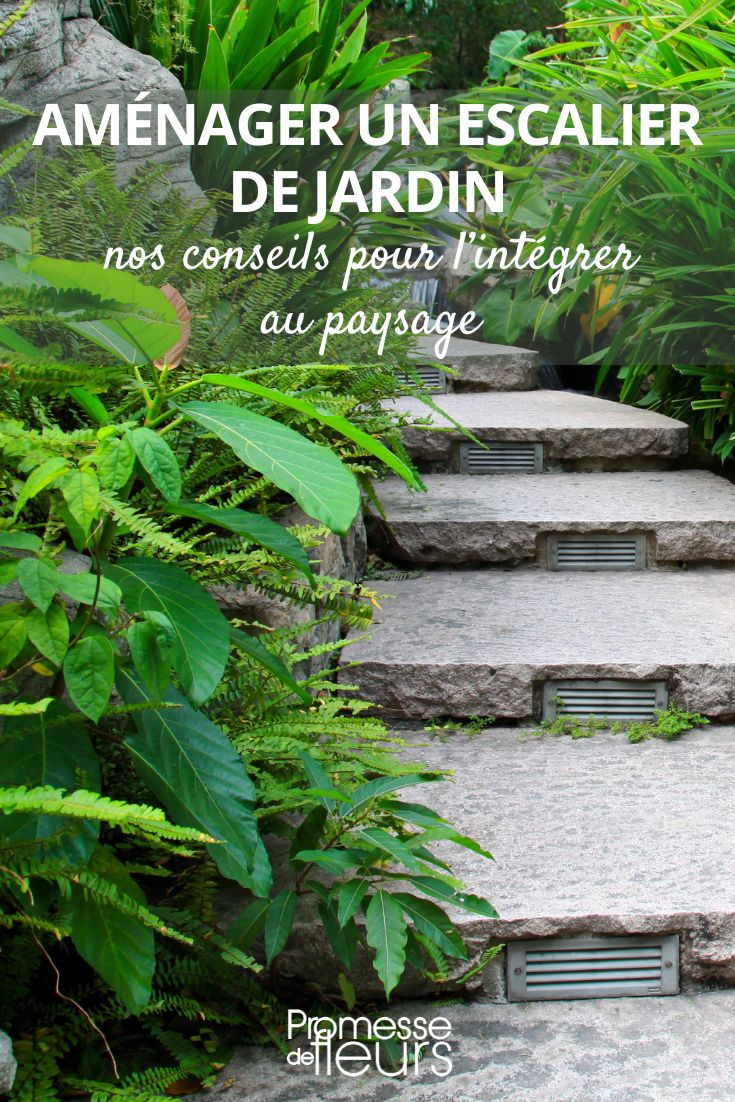
If the staircase is intended to be used after sunset, you can add lighting. Solar lights are effective, but their lifespans are sometimes limited. Moreover, this solution may not be suitable if your staircase is placed in a shaded or dim location. If you wish to install a lighting system, plan for it before constructing the staircase to make routing any electrical cables easier.
Finally, you can complete the design with decorative objects: large pots, sculptures, etc.
- Subscribe!
- Contents
Comments