





























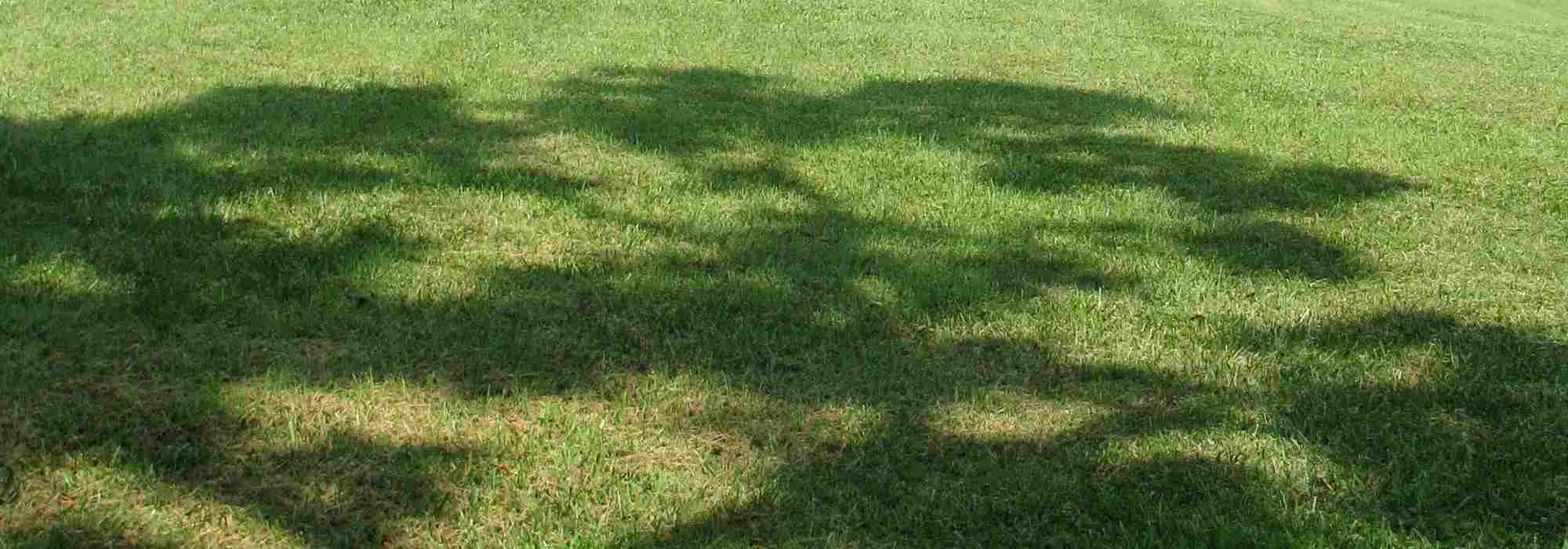
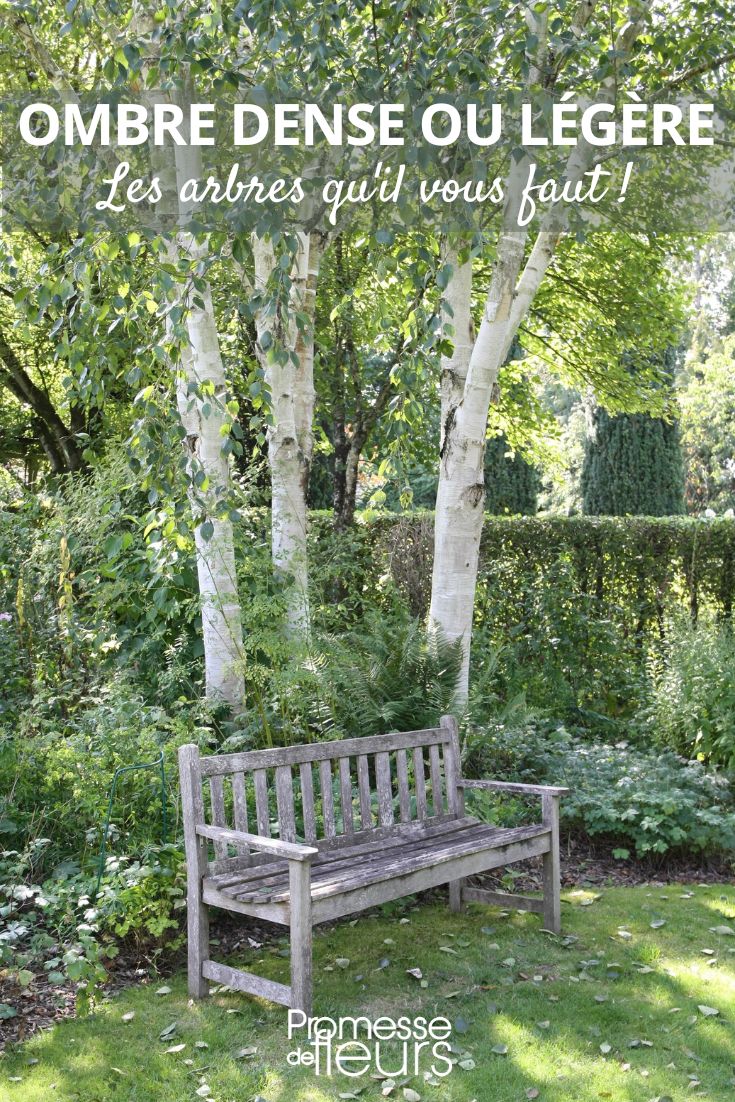
Dense or light shade: the trees you need!
For a welcome shade at the height of summer
Contents
Shading our gardens has become essential with increasingly hot summers. When it’s time to choose the tree that will meet our need for coolness, it’s not always easy to know what type of shade it will provide. Trees, depending on their foliage, habit and branches, provide shade that is more or less dense, giving a coolness that varies accordingly. Sometimes very light, they are suitable for simply filtering sunlight.
This guide reviews a selection of trees according to the type of shade they provide to help you make the right choice!
→ Discover our range of shrubs and shade trees online.
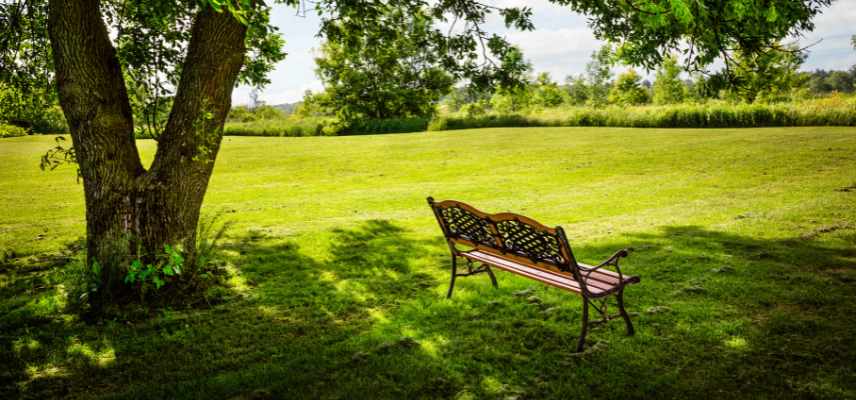
Shade from trees: one of the essential elements of the garden

Tree shading basics
Beyond the chosen species, a few basic principles should be borne in mind regarding how they shade our lawns:
- The younger the tree, the more modest its crown and foliage are; it is the older specimens established for at least 15 years that provide the most developed shade.
- The shorter the trunk, the shorter the shade cast.
- The height of the tree also obviously influences the area of shade on the ground.
- The variety or species of the tree can greatly modify the type of shade, as the foliage is often very different, influencing the shade on the ground.
- The tree’s vigour matters: a weakened or aging tree, with less dense foliage, will be less shady than a tree in full vigour.
- The shape of the foliage: it can be entire or divided into leaflets, producing shade that is generally lighter. With a very broad lamina, the shade is more pronounced.
- The growth habit of the tree influences the shade cast it projects: a tree with a columnar habit casts a narrow shade, while a loose and supple silhouette (spreading or weeping habits) creates a broad and diffuse shade. Coppiced trees will be lower, with crown spread producing lower density.
- A grove or trio of trees will provide more shade than a single tree (often seen with birches, for example). Most conifers provide dense shade due to their compact foliage.
- Finally, evergreen trees and large shrubs with broad and leathery leaves such as Magnolia grandiflora, the loquat, and all conifers provide shade year-round.
→ Read: Half-standard tree, high-stem tree, coppice: what is it?, The most beautiful coppiced bushes,
Read also
Trees and bushes: different habitsLight-shade trees
Their foliage provides a very pleasant dappled shade, a wrapping semi-shade rather than dense shadow, thanks to their more open, lanceolate or airy foliage, but also often by their spreading silhouette:
Gleditsia or American locusts
They are large trees (between 10 and 30 m in height), with foliage cut into pennate leaflets, pale in colour, providing relatively light shade. Their crown is loose and spreading, and the species are numerous, all very hardy, allowing them to be grown anywhere in the country. Their golden foliage is superb in autumn, and their nectariferous flowering adds to their qualities. The variety ‘Rubylace’ dresses in bronze and red tones in autumn, magnificent.
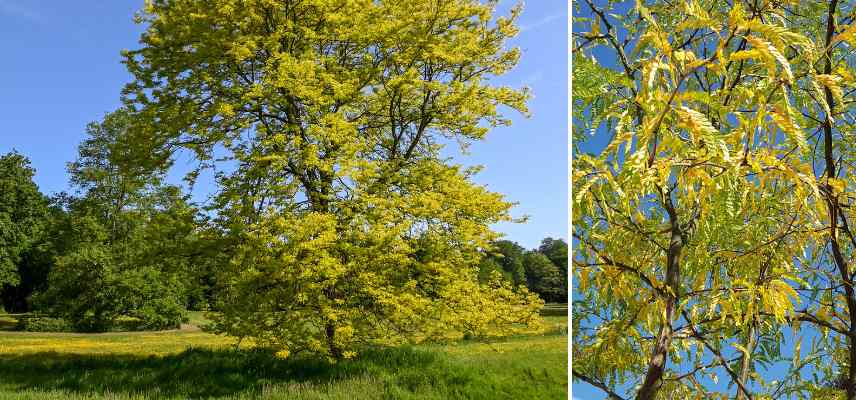
Gleditsia triacanthos
Eucalyptus
They may be the shade trees of tomorrow, given their excellent drought tolerance. Sculptural thanks to their bark, Eucalyptus are evergreen trees whose shade is among the lightest and most pleasant. Their bluish-tinged foliage takes a variety of forms (rounded, lanceolate), more or less leathery. They are also suitable for coastal planting, as they do not fear salt spray. A slight Achilles’ heel, however: their hardiness varies by species (tolerating roughly -3°C to -15°C for the hardier among them).
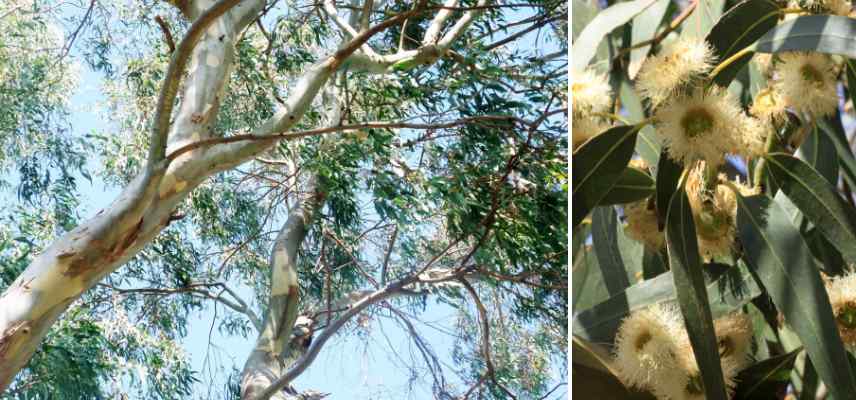
Eucalyptus : bark, branches and foliage
Birches
Contrary to Eucalyptus, birches are becoming increasingly drought-sensitive and will now be planted in less exposed regions. Nevertheless, on fresh ground and in propitious areas, they form one of the finest shade trees possible: light, dancing foliage in the breeze, providing discreet and very pleasant shade. Their bark is part of their great ornamental value, allowing them to display an elegant and distinctive silhouette twelve months a year!
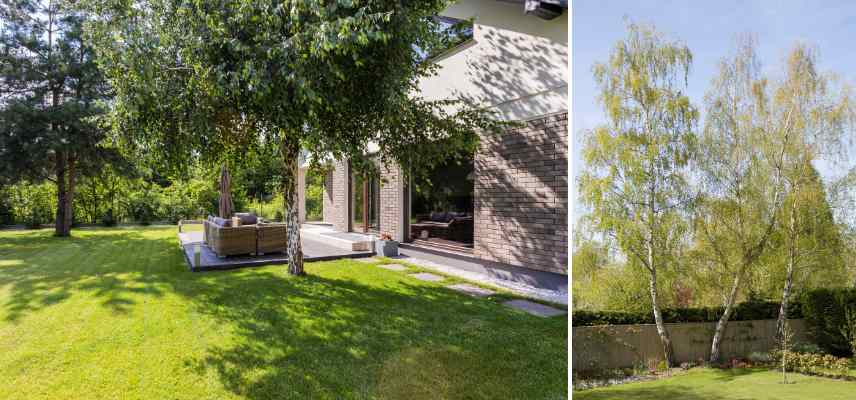
The birch, softly shaded, can even feature in small gardens depending on the variety chosen.
Ashes
The ashes, emblematic trees of our forests, also give a fairly light shade with a open crown, and are often used in towns in single-file planting for this reason. Their compound and cut foliage is very elegant, their habit interesting in weeping varieties like the Fraxinus excelsior ‘Pendula’, which are a little shorter (up to 15 m), form a parasol of shade under which it is pleasant to rest in the hot hours of summer. If their flowering is generally of little interest, this is not the case with Fraxinus ornus (the flowering ash) which is cloaked in white, nectariferous flowers in spring. Ashes have the advantage of not being fussy about soil type and tolerate sea spray.
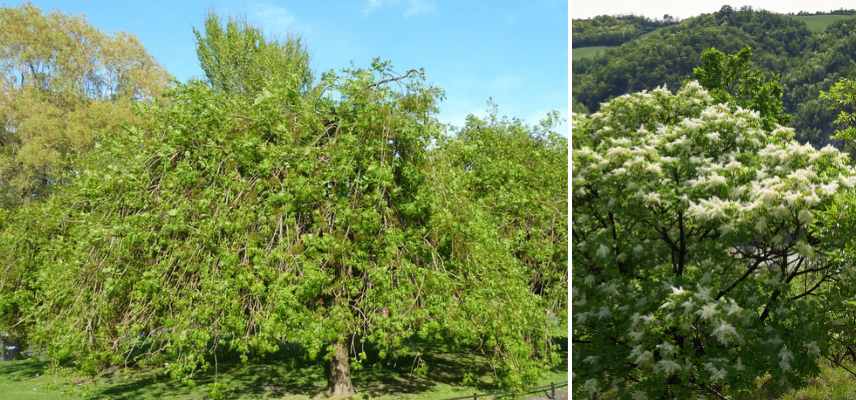
Fraxinus excelsior ‘Pendula’ (©Wendy Cutler) et Fraxinus ornus
Willows
They are also trees that bear small, typical leaves, elongated, like the weeping willow, iconic of romantic gardens and moist ground. If their branches are expansive, they stay light and very flexible in the case of the weeping willow, allowing shade that is both protective and beneficial.
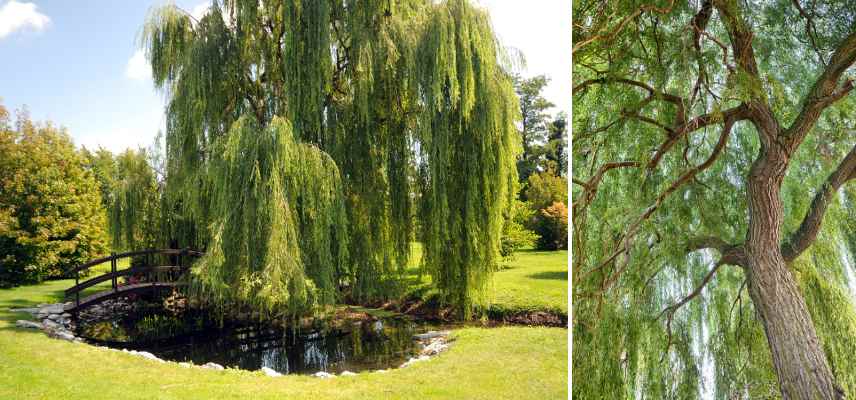
The weeping willow, romantically inclined, is perfect by a water feature.
Sophora
Also known as the Japanese pagoda, here is one of the most elegant trees there is, adding an orientalist touch to the garden. Its flowering is superb, but occurs when the tree is around fifteen years old, and during hot summers. Its ample habit and its large, imparipinnate (compound) leaves produce shade almost ideal for the summer season, combining light and dense shade. It turns yellow in autumn. It is a large tree, best planted in full sun to provide shade in a large garden or park (ultimately about 10 m spread, with a height of 10–25 m).
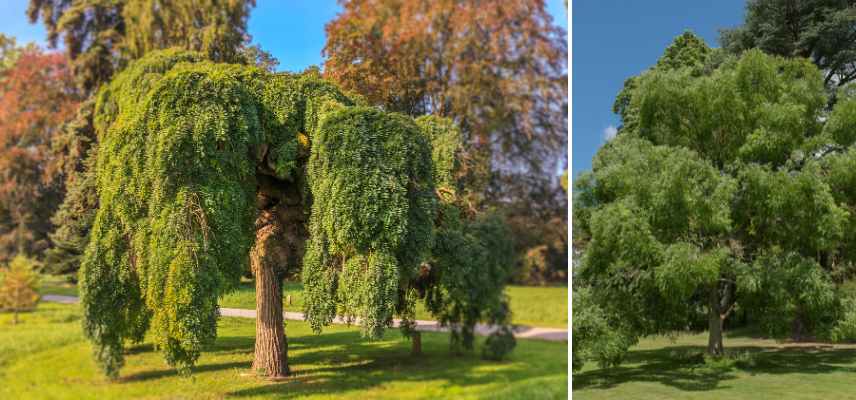
Sophora japonica ‘Pendula’ et à droite l’espèce type.
Albizia or silk tree
Now popular in gardens, the Constantinople Acacia is one of the favourites for providing a soft shade. Its foliage is very light and ornamental, doubly divided. It grows up to 10 m tall and takes a semi-rounded shape, becoming a parasol with age, perfect for a siesta or a meal. It bears a lovely bloom in small pink pom-poms in summer. Flowering and foliage give it a feathery appearance, delightful! The Albizia julibrissin prefers sun and tolerates drought once established. Its deciduous foliage can turn purple in the variety ‘Summer Chocolate’. Only drawback: its very numerous pods falling to the ground in autumn, and slightly lower hardiness than other shade trees.
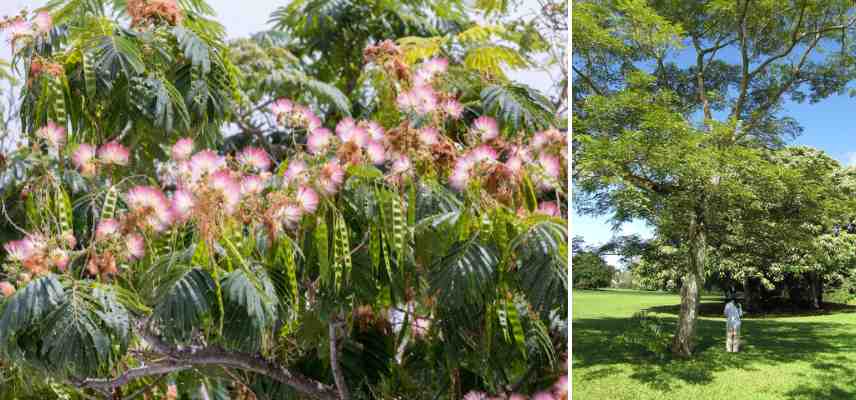
Albizia julibrissin, flowering, pods and habit to the right (® Forest and Kim Starr)
Melia
This fine deciduous tree is not yet very common in gardens, more often found in the south of the Loire. But the Persian lilac is promised a bright future further north. Its compound foliage is of a beautiful pale colour and very light. Its rounded, spreading habit makes it a graceful shade tree, and its late-spring flowering adds to its charms. A later comes yellowish berries that linger on the tree. It tolerates dry soils and partial shade well. It grows to 8–10 m at maturity.
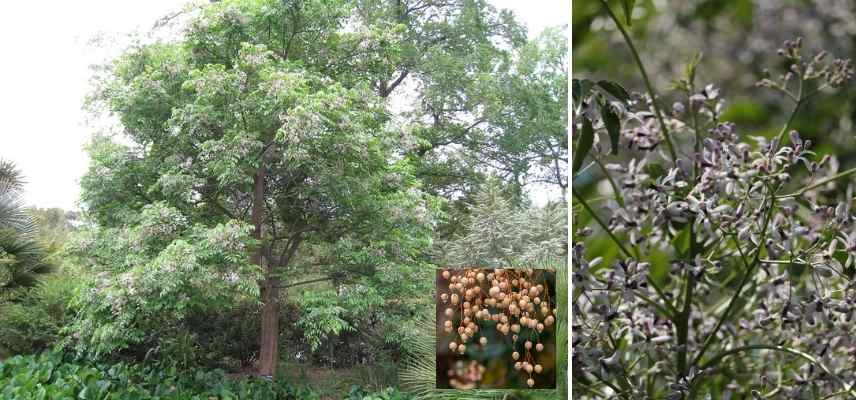
Melia azedarach : habit, fruit and spring flowering.
Micocoulier
The Celtis australis, by its Latin name, is very common in the southern part of the country due to good drought tolerance. It nevertheless has good hardiness and can be planted in many regions to enjoy a rounded crown that gradually spreads, forming the light vegetative parasol we dream of in summer! The lanceolate leaves turn yellow before falling. Plant in full sun, in well-drained soil (it tolerates calcareous soil).
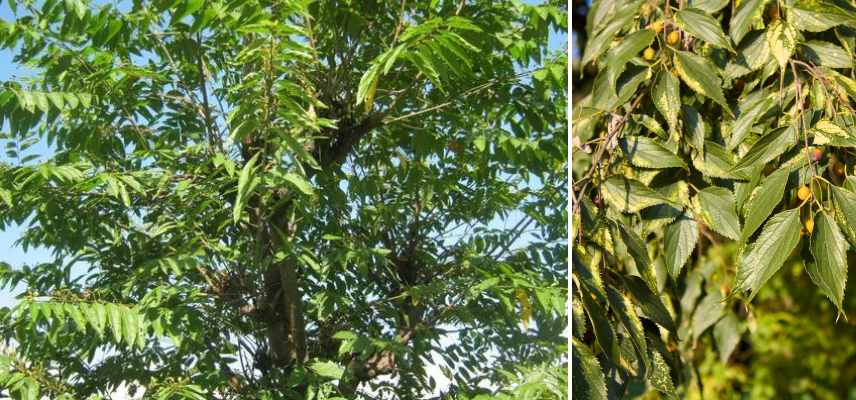
Celtis australis : branches and foliage
The small trees
Amelanchiers
Rather than large shrubs, amelanchiers are plants with multiple merits: delicate white spring flowers, edible fruits, autumn colour and attractive bark. We mention them here because they can also provide interesting shade when mature: their small, pubescent leaves at bud burst are graceful, and their rounded, spreading canopy casts a pleasant, subdued shade in summer. You will have a choice of many cultivars, and two main commercially available species (Amelanchier lamarckii and Amelanchier canadensis, the latter being shorter).
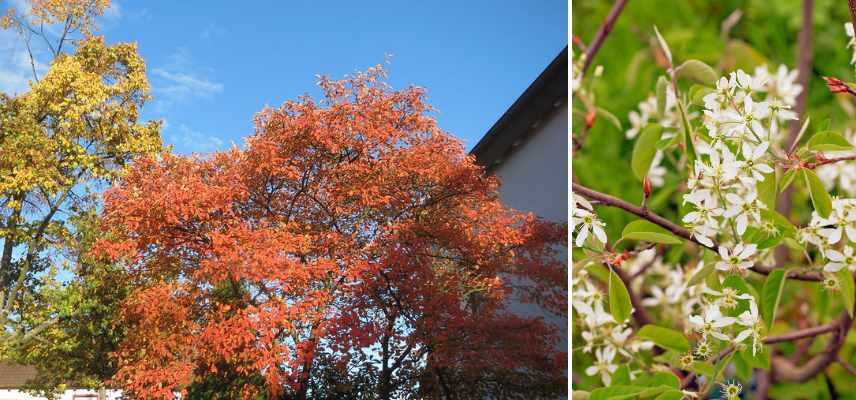
Amelanchier lamarckii in autumn (© Andreas Rockstein). On the right, flowering of Amelanchier canadensis.
Chitalpa tashkentensis
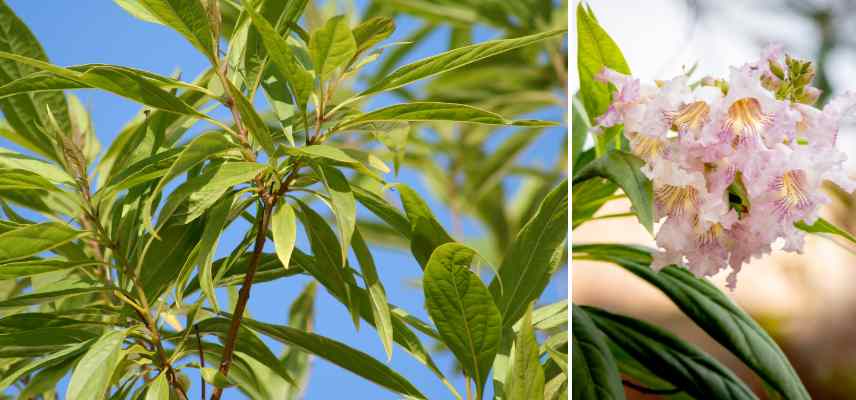
In the small-tree or large-shrub category, Chitalpa tashkentensis, a hybrid between a Chilopsis and a Catalpa, provides a very light, beneficial shade. Suitable for small gardens due to intermediate size, its flowering tubular rose-pink in terminal clusters, lightly scented, resembles a pink bougainvillea at the very start of summer. But its deciduous, narrow, light-green foliage becomes tinged with purple in autumn, another of its assets, enabling perfect shade to be dispensed! This handsome shrub, still too little used, grows to 5–7 m tall in maturity.
Dense shade trees
The species and varieties cited here are known for their cool shade and dense foliage, with broad-leaved trees that guarantee a refreshing coolness in midsummer. They provide more effective protection in regions with strong sunshine.
Catalpa
Often confused with Paulownia (see below), the Catalpa also features very large leaves of around twenty centimetres, also heart-shaped, and arranged in whorls of three. The density of its foliage is truly effective and casts a substantial shade on the ground. It flowers in summer, with splendid white flowers with yellow throats and purple centres, and fruits quite differently, in the form of long pendulous pods. Its crown is rounded and provides shade very welcome in midsummer. One can use the type species (Catalpa bignonioides), a large tree (10-20 m) or prefer the Catalpa boule (Catalpa bignonioides ‘Nana’) whose foliage is very compact on a highly branched framework, and a silhouette in a thick parasol dispenses the shade sought (though its leaves are slightly smaller).
Also read : Shade tree: opt for Catalpa for a cool and elegant garden.
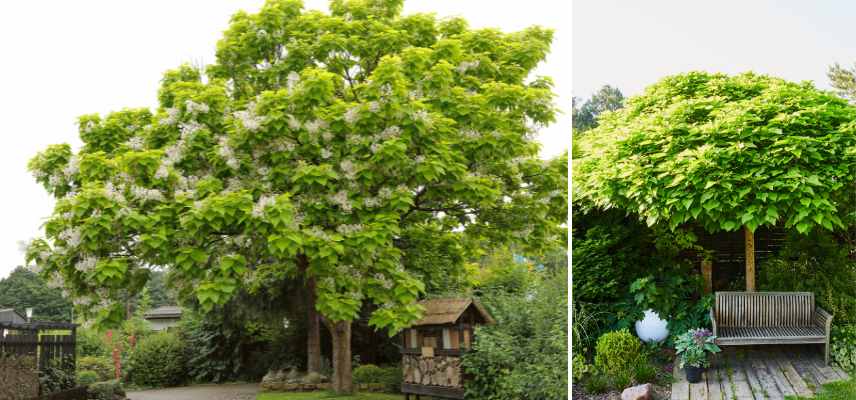
Catalpa bignonioides, and to the right the ball form, smaller
Mulberries
Mulberries are rather large shrubs, they are often chosen as shade trees. They grow on a single trunk, forming a rounded, very regular crown. Not particular about soil type, they are ideal for small gardens. Their dark foliage is irregular and highly ornamental. It is often the Morus Kagayamae mulberry chosen for the beauty of its glossy, deeply lobed and dense foliage. It measures between 6 and 8 m, but you can train it into a true umbrella tree with iron supports. The white mulberry Morus alba is another attractive small tree whose crown forms a neat compact ball. Be mindful of the hardiness limits of these trees in certain regions, and opt for fruitless varieties to avoid staining.
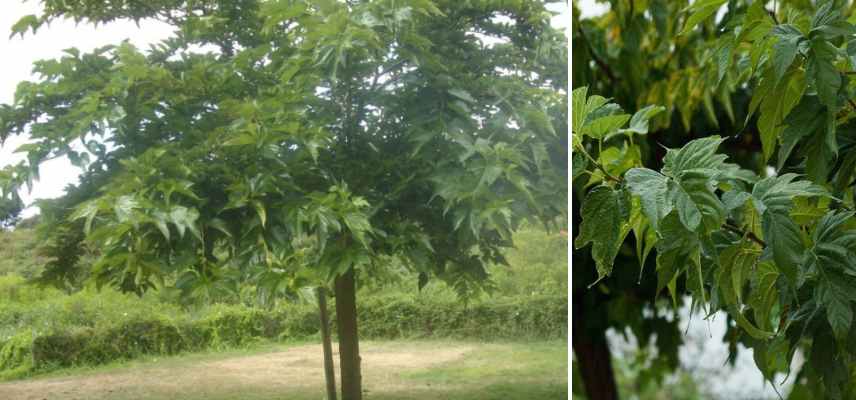
White mulberry, habit and foliage
Lindens
These are majestic trees (between 10 and 25 m tall), whose heart-shaped leaves (in the shape of a heart), though modest, manage to create dense shade. Their habit becomes rounded with age. Their flowers in late June are the sign of summer’s departure, and we enjoy strolling by them just for their sweet scents, and to harvest them for home infusions. Lindens, if you have space to accommodate them, are among the best trees for cool shade, where it is pleasant to rest on hot summer days. Look closely at the different species (there are about twenty), which do not all require the same soil conditions.
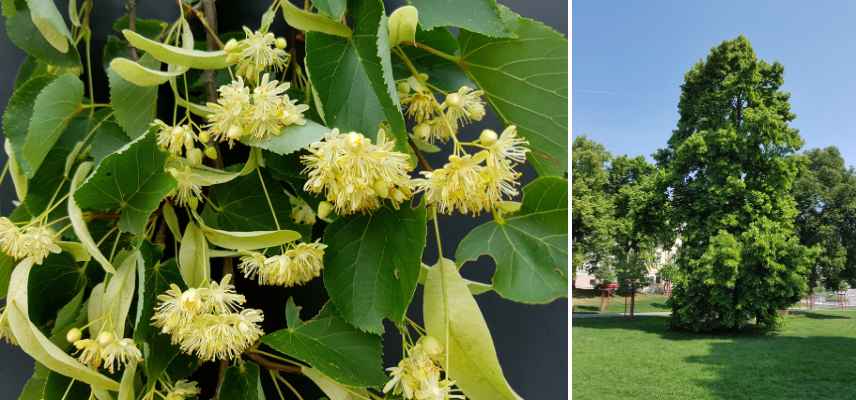
Tilia platyphyllos
Horse-chestnuts
Imposing trees, with delightful springtime white or pinkish, melliferous flowers, they impress with their silhouette and their dense, majestic crown, which provides very refreshing shade. Perfect in large gardens, the horse-chestnuts (genus Aesculus) include about 25 species. Their leaves, always palmately compound, are decorative, and turn yellow to brown in autumn. These trees are drought-sensitive, to be reserved for the northern regions, climate warming notwithstanding. Fully hardy, some species are more compact such as Aesculus x carnea or Aesculus parviflora.
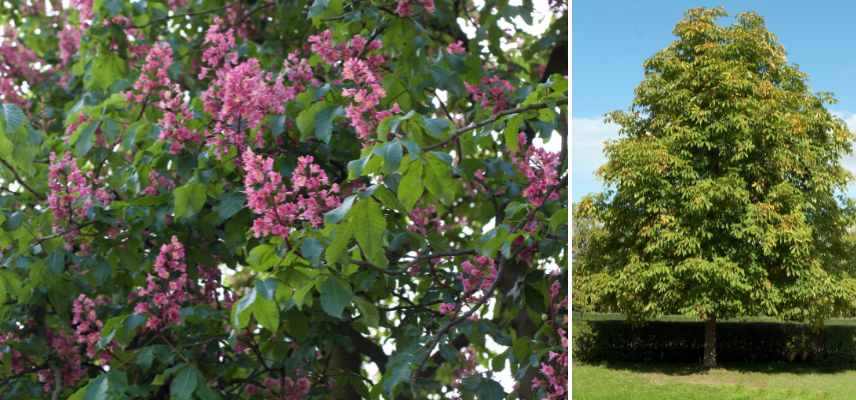
On the left, bloom of an Aesculus x carnea and growth habit of the Aesculus hippocastanum on the right
Paulownia or imperial tree
With its largest leaves for a tree (they can reach up to 50 cm!), the Paulownia is undoubtedly one of the densest shade trees. Its rounded form and vigor make it a prized species, as it grows quickly (reaching 10 m in a few years) and adapts very well to heat. We also adore its sublime flowering in mauve panicles, in April or May, on bare wood. To plant ideally as a solitary specimen in a large garden where it adds an exotic touch thanks to its unique foliage!
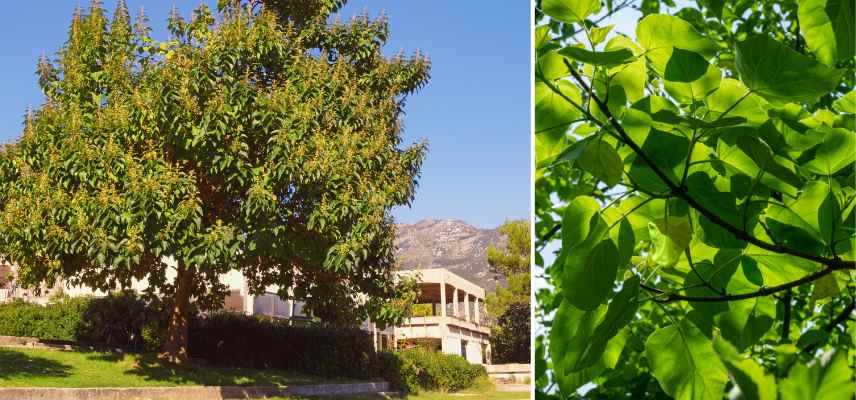
Paulownia tomentosa, habit and foliage
Walnut tree
The walnut is reputed for such dense shade that nothing can grow beneath its canopy. This powerful tree with a broad crown features large, long compound leaves (between 30 and 60 cm) that hardly let light through, producing a cool shade. It has many advantages, beyond the production of nuts: excellent resistance to urban pollution for large city gardens, rapid growth, and tolerance to high heat (but although hardy, it is sensitive to late frosts).
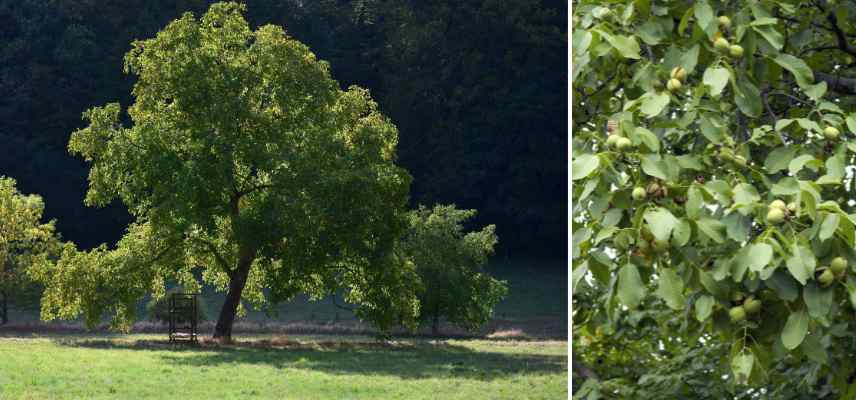
Even when young, a walnut already provides a dense shade.
- Subscribe!
- Contents
Comments