






























Diseases and pests of Mahonia
Identify, treat, prevent
Contents
The Mahonia or false holly, a beautiful evergreen bush with an exotic appearance, native to North America or Asia, is susceptible to two fungal diseases: powdery mildew and rust. It can also be affected by downy mildew. However, it is rarely visited by pests, except occasionally by aphids and the holly leaf miner, without major damage.
Discover how to identify these potential attacks, treat them naturally, and prevent them for a healthy bush.

powdery mildew
Powdery mildew frequently affects Mahonia; it is also a common fungal disease in the garden on certain plants. It is characterised by a white fluff on the surface of leaves, young shoots, and flower buds, which can become deformed if the bush is heavily infested. It can appear as early as spring on ornamental plants, but this damage does not compromise the plant’s life.
It is important to know that the best prevention against powdery mildew is to plant with sufficient spacing so that your Mahonia can benefit from an airy and non-congested environment. Pruning the bush is also a gesture that helps to aerate the branches. It is also useful for plants sensitive to powdery mildew, like Mahonia, to spray it with a decoction of horsetail as a preventive measure. When watering, avoid wetting the leaves.
As for treatments, there are recognised natural remedies such as baking soda, skimmed cow’s milk, or macerated garlic oil.
In any case, remove affected branches if possible and burn them to prevent the fungus from remaining in the garden for the winter and the following spring.

Powdery mildew
Read also
Mahonia : planting, pruning and careRust
Rust is the second most common nuisance for Mahonias, with the following issues being much less frequent. Also often found in gardens, rust is another cryptogamic disease caused by microscopic fungi, which is characterised by the appearance of orange spots.
Like powdery mildew, it can appear in spring and thrives in confined environments. It develops with a combination of heat and humidity. It is recognised by the appearance of discoloured patches on the upper side of the leaves and orange pustules on the underside and stems. The colours can vary depending on the plants. The spots darken by the end of summer, and the leaves usually end up falling. Aside from the unsightly appearance and leaf drop, the plants are mostly little affected.
Preventing this disease once again involves spacing your plantings to promote good air circulation. Avoid wetting the foliage when watering. Natural treatments using horsetail decoction and nettle manure are effective for both prevention and treatment. For treatment, fungicides such as Bordeaux mixture and sulphur are effective when sprayed to neutralise rust. It is also useful to remove affected leaves from the tree and those that have fallen to the ground and dispose of them.
→ See Pascal’s article on rust

rust on Mahonia leaves
Discover other Mahonia
View all →
Available in 3 sizes
Available in 1 sizes
Available in 3 sizes
Available in 1 sizes
Available in 1 sizes
Available in 2 sizes
Available in 1 sizes
Available in 1 sizes
Available in 1 sizes
Available in 1 sizes
Downy mildew
We are now addressing a very common fungal disease in the garden, but less likely to be found on Mahonias. Favoured by humidity and temperature fluctuations, it is the well-known downy mildew. It is recognised by its brown spots bordered with yellow on the surface of the leaves.
Once again, good air circulation and careful watering without wetting the leaves are two very important aspects to prevent its occurrence. Horsetail decoction, which strengthens plants, is also a good preventive treatment.
In case of infection, remove the affected parts and burn them. Bordeaux mixture is often recommended as it is more effective for prevention.
→ Read Ingrid’s article on tomatoes with a long paragraph dedicated to downy mildew
Read also
Mahonia: 7 companion planting ideasAphids
As for parasitic insects, even though Mahonias are generally spared, you may find aphids on your bush. Black, green, grey, or white, aphids tend to cluster in impressive colonies on shoots and young leaves, although their damage is limited.
The natural treatment for aphids is to spray a soapy solution made from black soap regularly every week.
Prevention against aphids involves encouraging beneficial insects by creating wild areas in the garden, with plants that host them such as nettles, building insect hotels, creating wood piles, varied mowing, and maintaining free hedges.
Read Virginie’s article to learn more about controlling and preventing aphids.

Aphids
Holly leaf miner
The holly miner, as its name suggests, is a parasitic pest of holly, known as Phytomyza ilicis. It can occasionally be found on Mahonias. Its presence is indicated by yellow to brown-red spots. The larva of this miner, resembling a maggot, burrows galleries within the thickness of the lamina between the upper and lower epidermis of the leaf. The damage is primarily aesthetic.
There is no effective treatment because miners are temporarily present on the bush, and the larvae are resistant to chemical treatment.
If your Mahonia shows these characteristic spots, you can spray a solution of black soap in spring, or even in summer, once a month. You can also plant two aromatic species at the base of the Mahonia that strongly deter the miner: lemon balm (Melissa officinalis) and lemongrass (Cymbopogon citratus, here as seeds and here as plant). This should be sufficient to keep it away. You can also cut and burn the affected leaves.
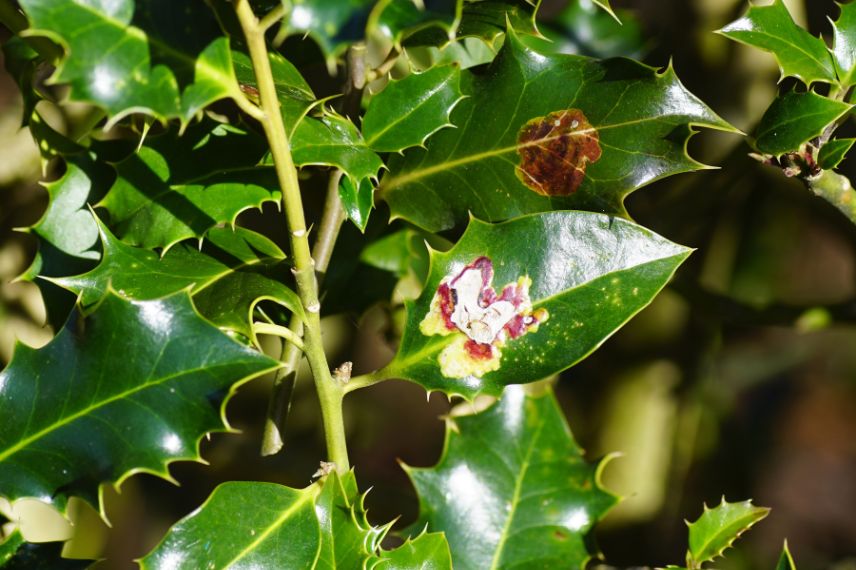
Holly miner on holly
- Subscribe!
- Contents
Comments