





























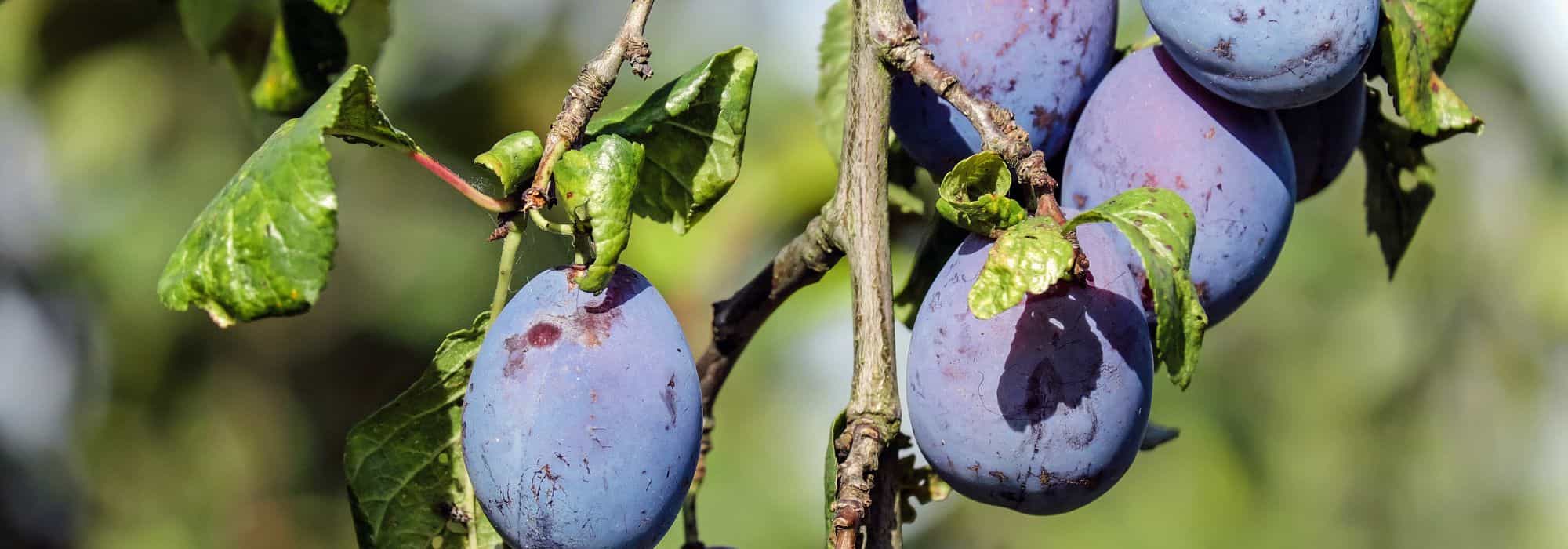
Diseases and Pests of the Plum Tree
Identification, prevention and natural treatments
Contents
The plum tree is one of the easiest fruit trees to grow. Hardy, it thrives throughout France and adapts to all types of soil. Moreover, the multitude of varieties offered by this fruit tree allows for a range of flavours as well as different harvest periods.
However, the plum tree can be susceptible to numerous diseases and various pests, especially if the proper growing conditions are not met.
Let’s take stock of the diseases, viruses, and pests that can affect the plum tree, along with prevention guidelines and natural treatments to implement.
Feel free to consult our comprehensive guide on this fruit tree with many advantages: Plum tree, mirabelle plum tree: planting, pruning, harvest

Plum rust
The rust of the plum tree is a relatively common fungal disease affecting plum trees. It is caused by the fungi Tranzschelia pruni spinosae and Tranzschelia discolor, and can have significant consequences on fruit production.
The fungus overwinters on the roots of various plant species before infesting the leaves in spring. Several generations then develop, especially in July and August, leading to defoliation of the trees. This disease is favoured by a rainy spring and abundant rainfall in April and May.
Identification
Small yellow spots appear on the upper side of the leaves. On the underside, the disease is noticeable by the presence of brown pustules.
The leaves die and fall prematurely. The fruits struggle to develop, compromising the harvest.
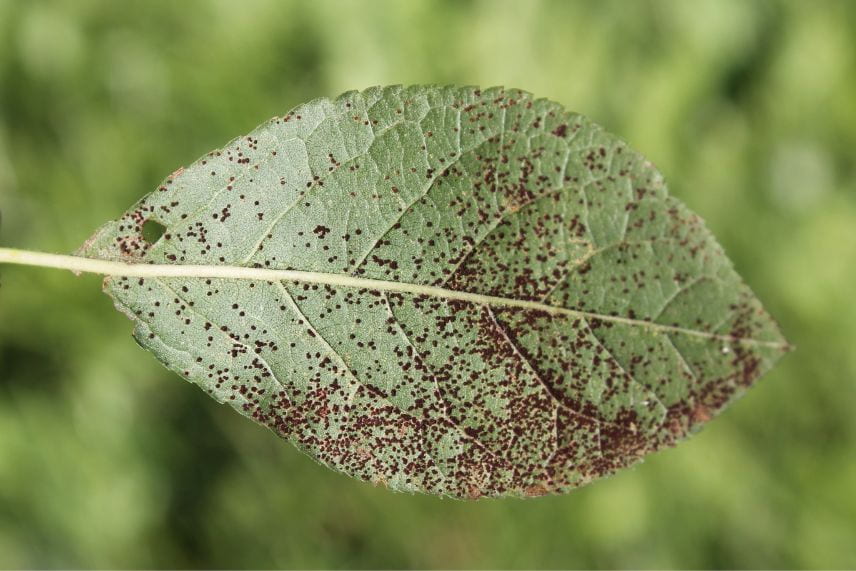
Rust on a plum tree leaf
Prevention
- Disinfect pruning tools between uses
- Carefully collect fallen leaves to prevent the mycelium from overwintering.
- Burn or dispose of the leaves at your local waste facility. Do not put them in compost
- Also carefully remove pruning residues
- Spray with horsetail manure or nettle liquid fertiliser in spring and until mid-July.
Natural Treatments
- Spray with a decoction of horsetail, repeating once after two weeks. You can also do the same with a decoction of wormwood garlic
- Treat with Bordeaux mixture, repeating the operation after 3 weeks if necessary
Read also
Nettle manure: how to make it?Moniliosis
Moniliosis, caused by the fungus Monilia fructigena, is also a very common disease in plum trees. This fungus overwinters in mummified, rotten, or dried fruits that remain on the trees. It can also be present at the sites of leaves or on branches.
It is spread by wind, rain, and insects, on the scars of flowers, and then on rotten fruits. Moniliosis is favoured by a rainy spring, and the disease develops at the very beginning of flowering, making it difficult to detect. Later, it is more easily noticed on the fruits.
Identification
The tissues interrupt the flow of sap, causing the flowers and fruits to wilt and die. However, they remain attached to the tree for months.
Brown spots, surrounded by yellow-brown circles, dot the affected fruits. Often the skin turns blackish.
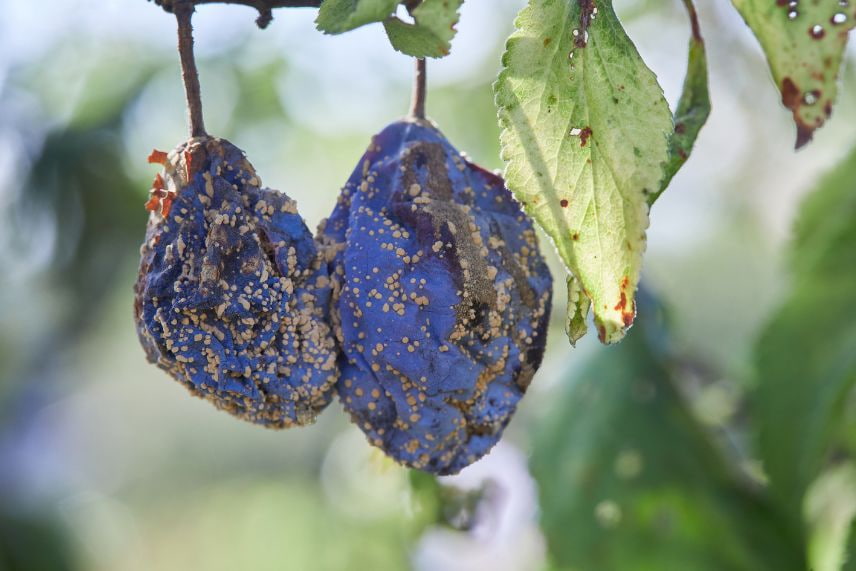
Moniliosis on a plum tree
Prevention
- Thin the fruits if they are too numerous in spring
- Carefully prune the plum trees by removing some branches to avoid excessive fruiting. Treat pruning wounds with wound dressing
- In autumn, collect fallen leaves and fruits from the ground and burn them. Do not put them in the compost.
- Spray Bordeaux mixture in autumn when the leaves have fallen. This spraying can be repeated twice at two-week intervals and continued at the time of bud burst.
- Carefully remove mummified fruits from the ground and branches
Natural Treatments
- At the time of flowering, spray a diluted horsetail decoction at 10%. This operation can be repeated when the fruits appear.
Discover other Plum Trees
View all →
Available in 1 sizes
Available in 0 sizes
Available in 0 sizes
Available in 0 sizes
Available in 1 sizes
Available in 2 sizes
Available in 5 sizes
Available in 2 sizes
Available in 1 sizes
Available in 1 sizes
Bacterial canker
Bacterial canker is a bacteriosis caused by Pseudomonas (Pseudomonas syringae and Pseudomonas morsprunorum), which has become a significant problem in recent years. Their development is favoured by humid conditions. These bacteria often develop in autumn or winter on leaves, but also in spring on buds and cut flower arrangements. The bacteria also enter the tree through leaf scars and bark wounds.
Identification
Light green spots that turn brown appear on the leaves. Fruits may be marked with black spots. The bark of the trunk and branches is also affected by necrosis that cracks and exudes gum. Eventually, branches, or even the entire tree, die, especially in early summer.
Prevention
- Avoid excessive fertilisation, particularly those rich in nitrogen
- Do not thin too heavily
- Prune plums in summer and at the end of winter, and seal wounds with healing paste
- Water moderately
- Carefully disinfect pruning tools
- Remove all affected shoots and burn them
Natural Treatments
- Spray Bordeaux mixture in autumn during leaf fall and in spring before the bud burst period
- Also treat with a 10% horsetail decoction at the time of leaf fall.
Read also
How to make horsetail manure?The Sharka virus
The Sharka virus is a disease caused by Plum pox virus (PPV) that affects fruit trees of the genus Prunus. It is primarily transmitted through infected and unsuitable grafting material, scions, or by various species of aphids.
This disease does not kill the trees, but it has significant consequences for fruit production. The symptoms of the disease, visible in spring and early summer, are reduced by high temperatures.
Identification
Fruits become deformed and show internal scarring, with visible spots on the skin. Leaves discolour, as does the wood. Pink streaks can also be observed on the petals of the flowers.
Prevention
- Use healthy and disinfected grafting material
- Use perfectly healthy rootstocks or grafted plants
- Carefully manage aphid infestations
- Identify and uproot infested trees before aphids arrive
Natural Treatments
There is no treatment to combat the Sharka virus.
Lead disease or parasitic lead
Itis a disease caused by a fungus, Chondrosterum purpureum. Without intervention, it is fatal and leads to the death of the tree within a few years.
This fungus enters the tree through pruning wounds or via animals. It is favoured by a warm and humid climate, particularly in early autumn.
Identification
The leaves become dull and take on a leaden colour. The tips of the branches dry out. The leaves die, followed by the branches. The bark undergoes necrosis and turns brown. Eventually, the tree dies. After 3 or 4 years of infestation, the fruiting body of the fungus becomes visible as rigid brown plates with a pink edge. In autumn, during warm and humid weather, the spores are dispersed by the wind.
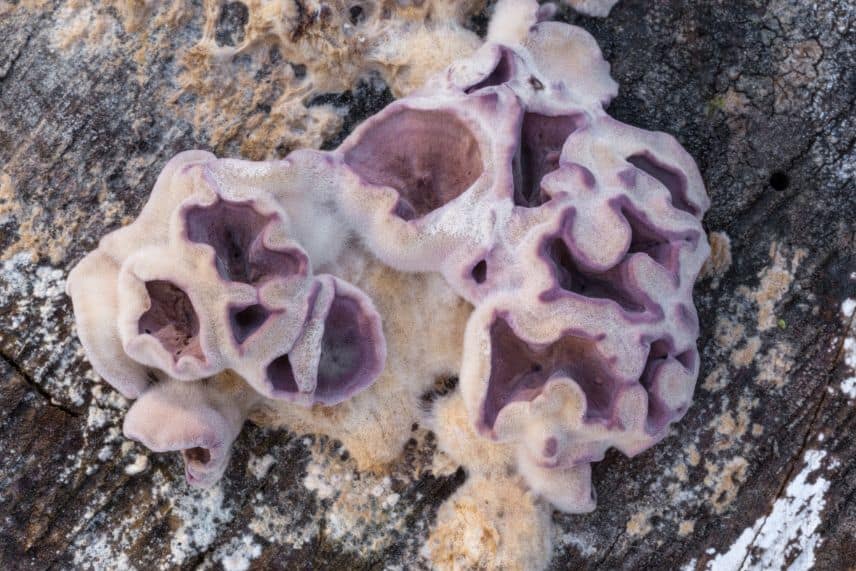
The fruiting body of the fungus responsible for lead disease
Prevention
- Avoid excessive nitrogen fertilisation
- Disinfect pruning tools after each use and coat wounds with healing paste
- Remove dead or severely affected trees by burning them
- Clear away all dead wood near plum trees
Natural Treatments
- Burn affected branches that bear leaden leaves 15 cm below the diseased areas
Coryneum or sieve plate disease
This is a fungus: Coryneum beyerinckii, which attacks plum trees, but also peaches, cherries, almonds, and apricots. It primarily develops in spring and autumn and becomes visible in summer. It is favoured by cold rains followed by a rise in temperature.
Identification
Round reddish-purple spots appear on the upper side of the leaves, along the main vein. Then, the centre of the spots turns grey and perforates. The leaves yellow and fall. Branches can also be affected, with the same brown spots appearing, accompanied by a slight gum exudation.
Prevention
- Collect fallen affected leaves and fruit and burn them
- Water the trees after harvest, but at the base and without spraying
- Prune early
- Cut affected branches before and after winter
- Disinfect pruning wounds and apply a healing paste
- Limit nitrogen fertiliser applications
Natural Treatments
- Treat with copper 2 to 3 times during the season, just before flowering and after petal fall, before bud swelling
- Treat at the start of vegetation with horsetail decoction.
The main pests of the plum tree
“`html
The Hyponomeute
The hyponomeute is a grey-white butterfly about 20 mm long that gives rise to a yellowish-grey caterpillar with black spots. The eggs and cocoons are arranged against each other, somewhat like tiles. Adults fly from June to August.
Identification
The caterpillars nibble on buds and leaves from April. From May to June, they create their silky nests on the leaves. In the case of a massive infestation (which is quite rare), the foliage is completely eaten.
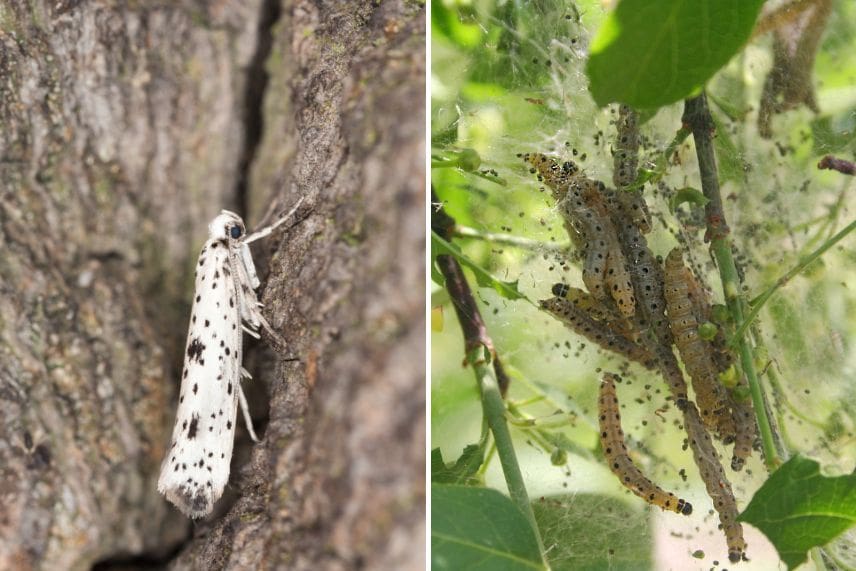
Hyponomeute butterfly and caterpillars
Prevention
- Encourage birds, the hyponomeute’s main predators, by installing feeders and nesting boxes
- Protect parasitic wasps
- Plant hawthorns that attract the hyponomeute
- Coat the trunk and branches of plum trees with a clay wash in winter
Natural Treatments
- Remove and burn the cocoons. You can also destroy them with a water jet
- Treat with a mixture of black soap, methylated spirits, and salt in hot water
- Spray Bacillus thuringiensis before the nests form
The Hoplocampe
The hoplocampe is a brown hymenopteran with veined wings. The caterpillars are whitish and emit a bug-like odour. Adults fly in April and May and lay their eggs in the epidermis of the calyx of white flowers. The larva hatches when the petals fall and penetrates the newly formed fruit, before colonising other fruits on the branch. It devours the almond of the fruit. It then falls to the ground where it hibernates in a cocoon.
Identification
The larvae enter the fruit laterally and eat the inside. The entry hole is visible. The inside of the fruits is filled with droppings and emits a bug-like odour.
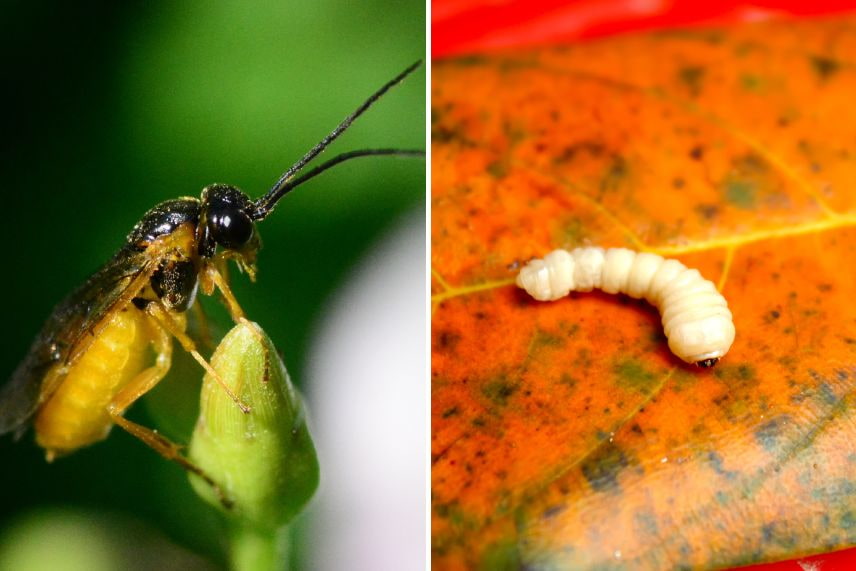
The hoplocampe at different stages of development
Prevention
- Encourage birds by installing feeders and nesting boxes
- Monitor plum trees at the end of May, as soon as the fruits are visible. Remove any fruits with holes.
Natural Treatments
- Set up white chromatic traps coated with glue to detect the first flights and capture males
- Spray infusions of tansy or wormwood after the petals have fallen
Green and Woolly Aphids
Green aphids are easily recognised by their colour, while woolly aphids are covered in a wax that gives them a floury appearance. Plum trees can be invaded by large colonies that grow very quickly.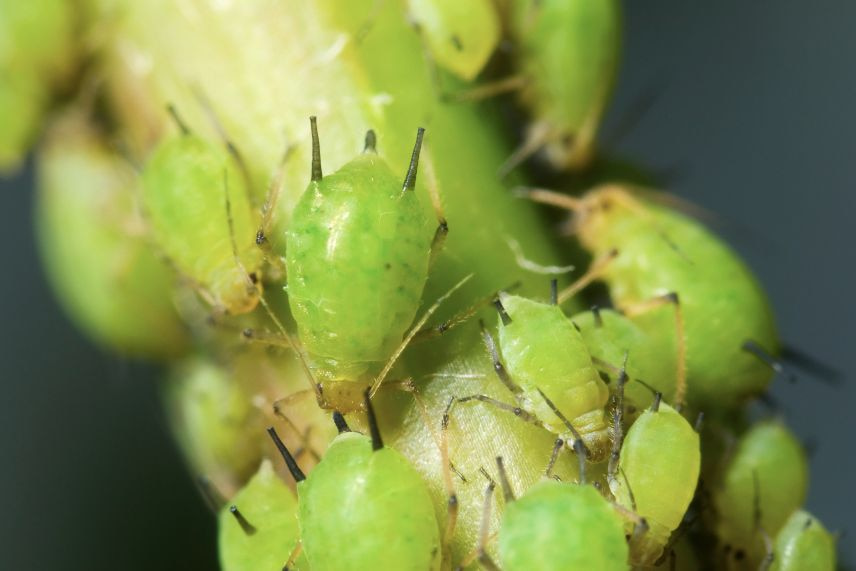
Identification
The leaves are punctured, become crinkled, and dry out, growth is halted due to the excretion of toxic substances that poison the sap. The honeydew secreted by the aphids can lead to the appearance of sooty mould. The tree is inevitably weakened.
Woolly aphids tend to concentrate on the underside of the leaves.
Prevention
- Avoid overly rich nitrogen fertilisation in spring
- Treat the bark with paraffin oil in winter
- Spray decoctions of tansy, fern manure, or nettle
- Encourage the introduction of beneficial insects like ladybirds, hoverflies, or lacewings
- Regularly prune plum trees to thin them out
Natural Treatments
- Remove heavily infested parts
- Water with a powerful jet of water
- In case of severe infestation, spray a natural insecticidal product based on pyrethrum in the evening
Red Mites
It is primarily a red mite (Panonychus ulmi), mistakenly called red spider, that is responsible for the main infestations on fruit trees. Action is needed, as they multiply very quickly. They hibernate in the egg stage and remain on the trees. The eggs are also red.
Identification
Mites live on the underside of the leaves, sucking the external cells for nourishment. The leaves quickly take on a leaden hue and fall prematurely.
Prevention
- Limit nitrogen inputs
- Strengthen the plant with sprays of nettle manure or horsetail decoction
- Maintain constant soil moisture by watering
Natural Treatments
- Burn or compost the affected parts
- Treat with a cold water jet directed at the underside of the leaves
- Spray nettle manure 2 to 3 times over 10 days
- In case of severe attack, treat with a pyrethrum-based insecticide
- Paint the trunks in winter with a mineral oil
The Eastern Tortrix
The damage caused by this caterpillar (Cydia molesta) on young plum trees can be significant. It is a fruit-boring caterpillar. Adult butterflies (easily confused with those of the plum codling moth) fly from late March to late May, with egg-laying occurring from April-May to September-October. The larva is initially white before turning pink.
Identification
Damage is mainly observed in the fruits where the tortrix burrows galleries. Young shoots can also be attacked and wilt.
Prevention
- Cut off the attacked young shoots
- Encourage predators like great tits or earwigs by installing feeders, nesting boxes, and insect shelters
- Encourage green pruning
- Limit nitrogen inputs
Natural Treatments
- Install pheromone traps
- Spray the bacterium Bacillus thuringiensis
Plum Codling Moths
Once again, it is a butterfly, Grapholita funebrana, with grey-black forewings marked with vague patterns. The caterpillar is crimson red. Adults fly from May to June and from July to August, when it is warm. Females lay their eggs on the fruits.
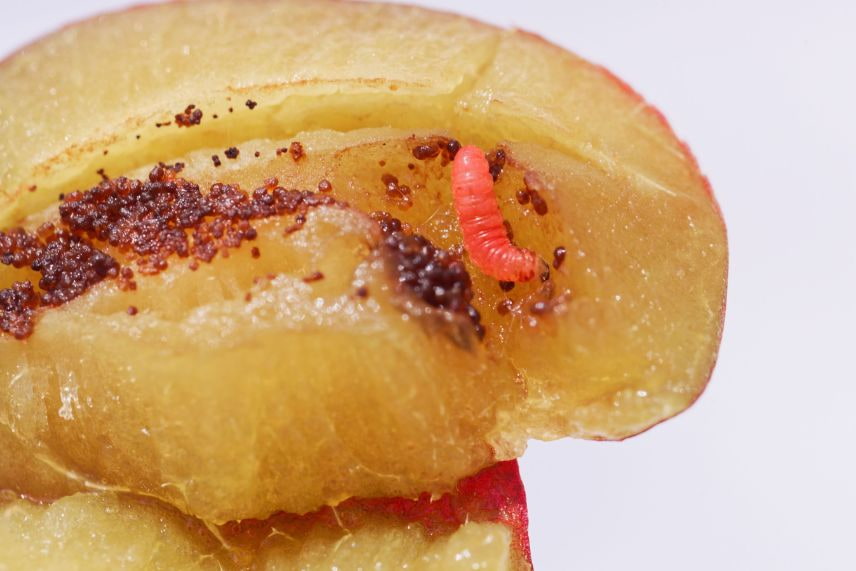 Plum codling moth[/caption>
Identification
The larvae burrow galleries inside the fruits. Affected fruits change colour and fall. The area around the stone is filled with droppings. Gum oozes from the entry hole.
Prevention
- Encourage beneficials like earwigs and birds
- Let chickens roam under the plum trees
Natural Treatments
- Place trap bands on the trunk in spring and from July to September and destroy them in autumn
- Collect fallen affected fruits
- Set up special pheromone traps to combat plum codling moths
“`
- Subscribe!
- Contents
Comments