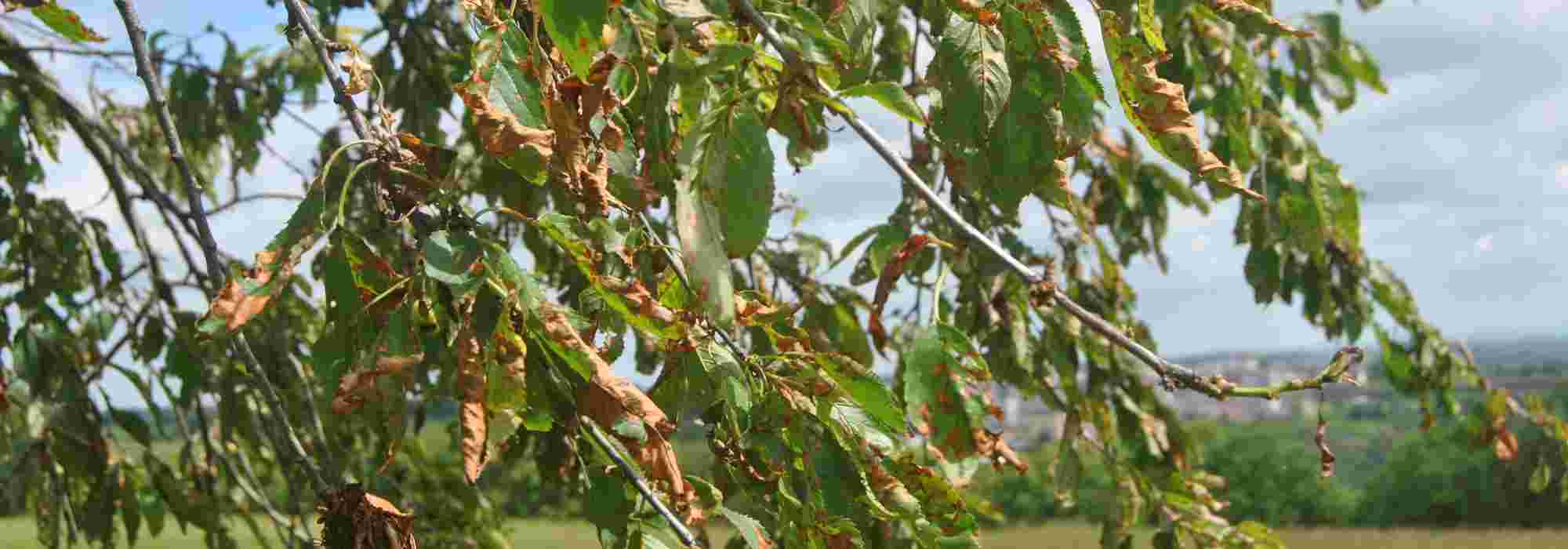
Coryneum blight or shot hole disease of stone fruit trees
Control and treatment of Coryneum
Contents
Shot hole disease, also known as “coryneum blight” or “shothole disease”, is well known to fruit growers for its effects on stone fruit trees and is caused by a virulent fungus, Coryneum beijerinckii. This disease can lead to a significant drop in yield, spoil the fruit and considerably weaken the tree in the event of severe attacks. It also affects ornamental Prunus such as Cherry Laurel and Prunus pissardii.
Which species are susceptible to Coryneum?
Coryneum beijerinckii, also known as Stigmina carpophila, is responsible for shot hole disease in cherry trees, peach trees, almond trees, apricot trees and sometimes even plum trees (especially Ente plums), walnut trees, blackcurrants, redcurrants and raspberries. Plum trees are more often affected by Coryneum microstichum, which also affects Kerria, these popular shrubs producing small yellow pom-poms in spring.
Read also
Apricot tree: planting, pruning, careHow to identify Coryneum?
This fungal disease usually appears in summer, but as early as spring on cherry laurel.
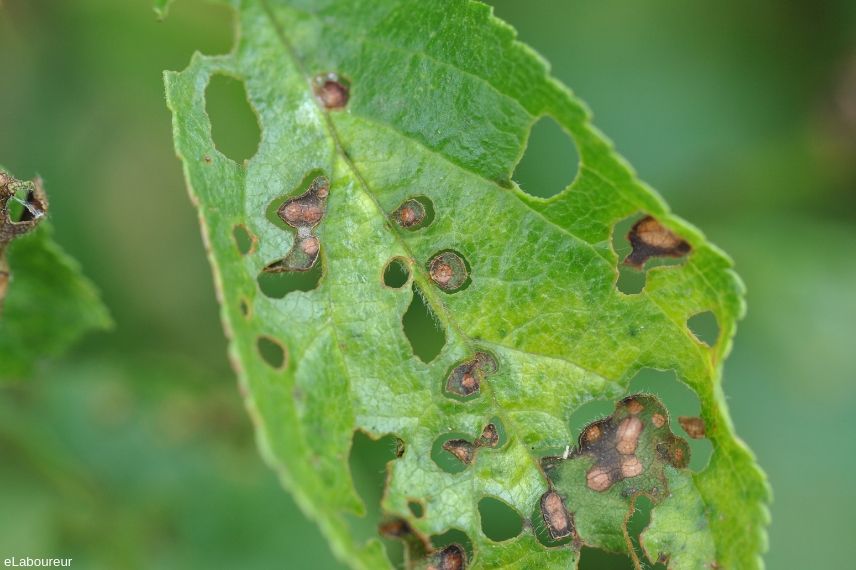
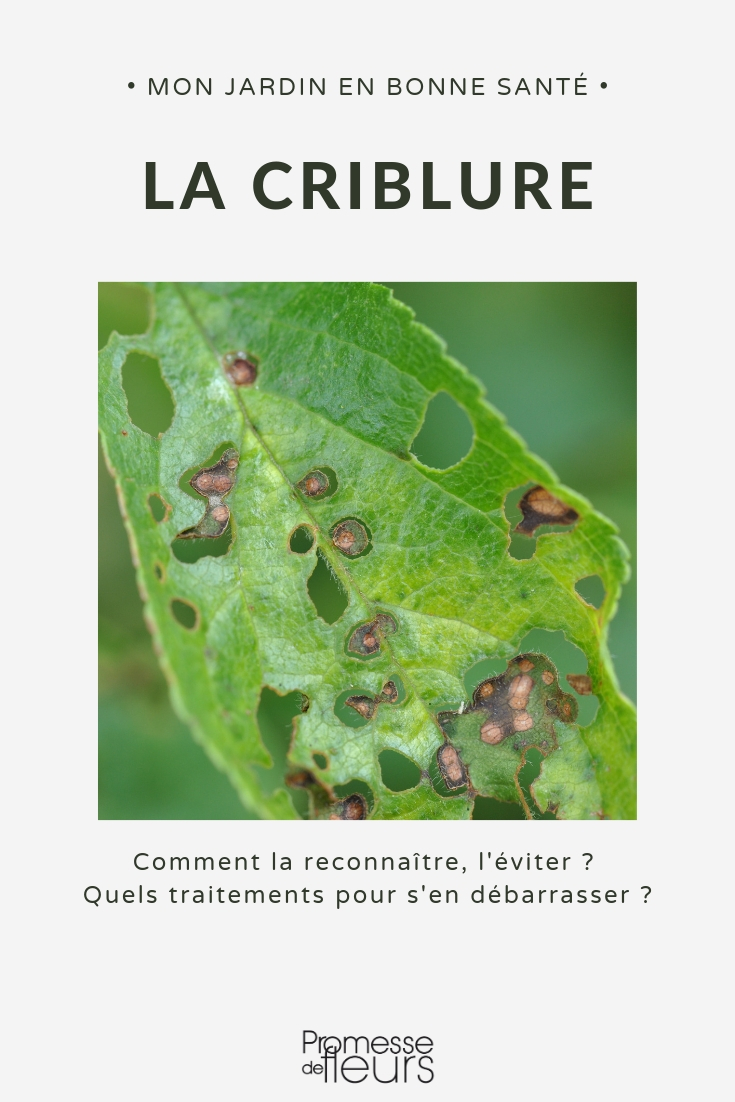
Generally speaking, Coryneum fungi initially cause brightly coloured, round spots of around 3 mm on the foliage:
- reddish with a dark margin on Cherry, Peach and Cherry Laurel,
- purplish brown on Apricot,
- orange, red or purple on Plum (3 to 5 mm in diameter),
then the centre turns grey and becomes perforated, hence the term ‘shot hole disease’.
- Peach, like Almond, reacts by sheading its foliage, even when only lightly affected.
- When young shoots are infected, characteristic round spots can be seen on the branch, from which gum sometimes oozes abundantly, occasionally causing the branch to die back.
- The attacked buds no longer burst.
- Fruits are often affected on Almond and Apricot, which then develop a more or less lumpy surface marked with small greyish-brown spots, and sometimes also on Cherry (small brown spots that become sunken), causing the fruit to stop growing and subsequently drop.
Coryneum microstichum, more common on Plums, causes, in addition to perforations in the foliage, small cankers on the branches around the buds, causing the branches to die back. On Kerria, elongated purplish-brown spots with a dried centre appear on young branches, on which blackish pits (the spores) develop. This leads to the drying out of the terminal part of the branches.
The symptoms can be confused with those of an attack by bacteria (bacteriosis caused by Pseudomonas or Xanthomonas), or by a virus, or with damage caused by a treatment that is too concentrated, particularly one containing copper, or by a scorch caused by water droplets on the foliage during the hottest hours of the day.
Discover other Peach and Nectarine trees
View all →
Available in 4 sizes
Available in 2 sizes
Available in 1 sizes
Available in 2 sizes
Available in 1 sizes
Available in 2 sizes
Available in 4 sizes
Available in 1 sizes
Available in 1 sizes
Available in 2 sizes
Factors Favouring Coryneum
The fungus is mainly preserved in cankers and buds, and sometimes in the fruit, which spread the spores.
The fungus responsible for shot hole disease in stone-fruit trees causes significant economic damage, especially during wet winters and springs. With rain and temperatures above 2 °C, the fungus can continue to spread through the plant during winter. In spring, rain and wind help disperse the spores onto the flowers and young leaves.
In years with a relatively dry winter, the fungus often remains inconspicuous.
Managing and Treating Coryneum
- Prune the infested wood as soon as possible and burn it. Remember that healthy stone fruit trees should not be pruned too heavily, except for peach trees, which flower only on one-year-old shoots!
- Remove and burn the dead leaves beneath the infested trees.
- Collect the infested fruit carrying spores.
- Treat with copper (copper oxychloride) the cherry and plum trees, just after leaf fall in autumn, then again at bud burst. For peach trees, choose products such as Cuivrol or Ferticuivre, which contain lower levels of metallic copper and are less toxic to the tree (formed of copper sulphate or copper oxychloride, trace elements and plant macerations). These can be applied two or three times during the season at low doses (3 to 5 g/l). Treatments for peach leaf curl generally prevent shot hole disease in peach trees. You can treat just before flowering and immediately after the first petals have fallen.
- Disinfect pruning wounds with a copper-based solution and coat the larger ones with healing tree wound paste.
- Limit applications of nitrogen fertiliser and avoid watering your orchard with a sprinkler.
- Subscribe!
- Contents
This form is protected by reCAPTCHA - the Google Privacy Policy and Terms of Service apply.





























Comments